
1. Background
Breast cancer remains a major global health concern and is the most common cancer among Iranian women. Studies have shown that Iranian patients are diagnosed approximately a decade earlier than Western populations and often at a more advanced stage, resulting in poorer survival outcomes (1). The proportion of patients with breast cancer younger than 50 years is higher in southeastern Iran than in Western countries (2). Traditional survival analyses based on overall survival or cause-specific survival are limited by imprecision in cause-of-death data and by failure to account for underlying mortality risks. Accordingly, excess mortality models have been developed to estimate cancer mortality by comparing observed survival among patients with expected survival in the general population (3).
Some long-term effects, which may begin during treatment and persist thereafter, may result from interactions among several risk factors, including cancer treatment, lifestyle, genetic predisposition, and environmental exposures. Some of these factors and their effects on cancer survivors are country-specific (4). This approach is particularly useful in population-based settings in which mortality data are incomplete, as in many low- and middle-income countries, including Iran. Relative survival also enables comparisons across time, regions, and demographic groups without precise cause-of-death information (5). International applications of excess mortality models have suggested survival disparities by age, socioeconomic status, tumor subtype, and access to care. However, few studies have focused on Iranian women, among whom younger age at diagnosis, limited screening, and regional inequalities may uniquely affect outcomes.
Recent developments have refined excess mortality methodology. Rubio emphasized that life tables lacking stratification by deprivation or comorbidity could bias estimates and suggested using single-parameter or random-effects adjustments (6). In 2025, penalized flexible models showed a higher excess mortality rate among unscreened women than among organized screening groups (7). A 2022 model indicated that hormone receptor-positive patients who continued endocrine therapy beyond specific age thresholds showed no 10-year excess mortality rate (8). Other studies have linked pandemic-related excess mortality rates to data limitations in low- and lower-middle-income countries (9), reported excess cancer mortality in Peru (10), analyzed socioeconomic correlates in Europe using quasi-Poisson modeling (11), and examined trajectories across 34 countries using Human Mortality Database data (12).
In Iran, most survival studies have used Kaplan-Meier or Cox models, which ignore expected background mortality and can therefore misestimate cancer-specific survival. Integrating excess mortality modeling into Iranian cancer research would provide population-adjusted, more accurate survival estimates and help identify high-risk groups.
2. Objectives
This study aimed to estimate breast cancer-associated excess mortality among women in southeastern Iran by comparing patients’ observed survival with expected survival derived from general population life tables.
3. Methods
3.1. Study Population and Data Sources
The source population comprised all female breast cancer cases registered in the Kerman Cancer Registry between 2014 and 2020, providing a maximum follow-up of 6 years. Eligible participants were women with a registered diagnosis of breast cancer and a valid registration date. We excluded male cases, death-certificate-only (DCO) cases, and records with incorrect registration dates. The final analytic cohort included 3,431 women.
Vital status was ascertained through deterministic linkage of cancer registry records with mortality data provided by the Deputy of Health at the Ministry of Health and Medical Education. Unique national identification numbers were used to ensure accurate linkage and follow-up of mortality events. Patients were followed until death or December 31, 2020, whichever came first; individuals without a linked death record were considered alive at the end of follow-up.
After ethical approval (IR.KMU.REC.1402.464), patient-level demographic, clinical, and mortality data were obtained. In addition, population-level mortality data for 2014 to 2020 and age- and sex-specific census data for Kerman Province were obtained from official Ministry of Health and national census sources. Kerman Province in southeastern Iran had a female population of 1,456,259 according to the 2011 census. To enable annual survival comparisons, life tables for 2014 to 2020 were constructed using interpolated intercensal population estimates based on age- and sex-specific growth rates and annual death counts, following the Human Mortality Database protocol.
3.2. Statistical Analysis
Survival probabilities and mean survival time were estimated using the Kaplan-Meier method, and between-group differences were assessed using the log-rank test. To estimate breast cancer-associated excess mortality, we applied an excess hazard framework, in which the observed hazard in the patient cohort is decomposed into the expected hazard from the general population and the excess hazard attributable to breast cancer. Expected mortality was obtained by matching each patient to the general-population life tables by age and calendar year. To account for aging during follow-up and temporal changes in background mortality, follow-up time was split into yearly intervals, and attained age and calendar year were updated over time. Accordingly, the observed hazard was modeled as:
where ho(t;x) is the observed hazard, hp (A+t;y+t;z) is the expected hazard derived from the general population, and hE (t;x) is the excess hazard attributable to breast cancer.
In this study, the excess mortality rate (EMR) refers to the instantaneous excess hazard, whereas cumulative excess mortality reflects the accumulated risk of death attributable to the disease over time. Confidence intervals were calculated using a Wald-type method based on the inverse Hessian matrix and the corresponding Fisher information matrix, with standard errors obtained as the square root of the diagonal elements of the estimated variance-covariance matrix. Analyses were performed in R using the packages dplyr, numDeriv, knitr, and compiler. Statistical significance was defined as two-sided P < 0.05.
4. Results
Of the 3,617 patients with breast cancer registered from 2014 to 2020, 73 male cases, 99 DCO cases, and 14 records with incorrect registration dates were excluded, leaving 3,431 women for analysis. Figure 1 shows the study flowchart for the recruitment of all breast cancer cases.
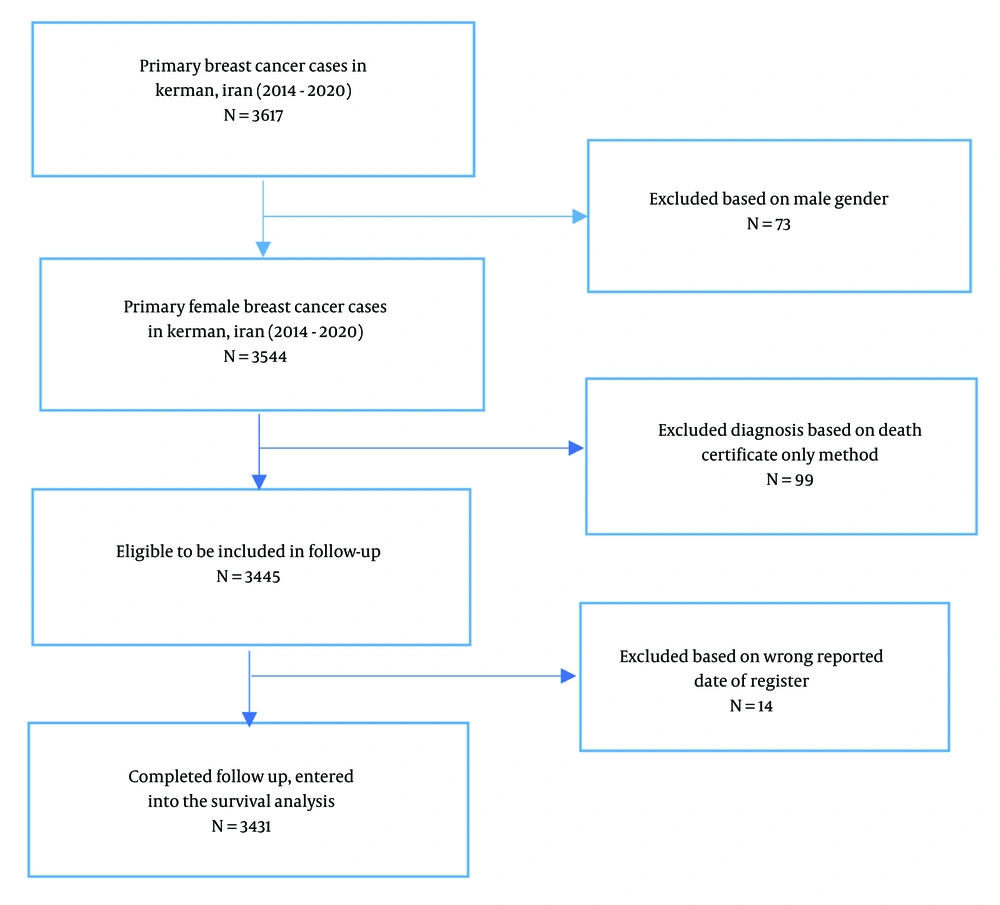
Figure 1.
Flowchart of case selection for the Kerman breast cancer registry, 2014 - 2020.
Of the 3,431 patients, 284 (8.3%) died during the study period. A total of 1457 (42.4%) were residents of Kerman city, the provincial capital, whereas 1974 (57.5%) were residents of other cities in Kerman Province. The mean age was 50.4 years, and the mean and median survival times were 3.56 and 3 years, respectively. Differences in survival distributions were further examined using the log-rank test to compare outcomes among breast cancer patients by 1) registration location (provincial center vs other cities), 2) tumor grade, and 3) age group. The results showed a significant difference in survival between the provincial-center and other-city groups (χ2 = 8.4, P = 0.0037), and there was also a significant difference in survival among groups with different final disease scores (χ2 = 29.1, P < 0.001). The log-rank test also revealed a statistically significant difference in survival distributions among the age groups. Specifically, survival among patients older than 65 years was significantly worse, with a shorter survival time than that in younger cohorts (χ2 = 41.8, P < 0.001) (Table 1).
Table 1.
Clinical and Demographic Characteristics of Patients with Breast Cancer Stratified by Status (N=3431)
| Parameters | No. (%) | Number of Deaths | Mean Survival Time | 5-Year Survival | P-Value |
|---|---|---|---|---|---|
| Overall breast cancer | 3431 (100) | 284 | 3.56 | 0.89 | |
| Grade | <0.001 | ||||
| 4 | 953 (27.77) | 96 | 3.65 | 0.87 | |
| 3 | 882 (26.70) | 96 | 3.42 | 0.86 | |
| 2 | 1384 (40.33) | 82 | 3.47 | 0.91 | |
| 1 | 212 (6.17) | 10 | 4.25 | 0.94 | |
| Place of residence | 0.0037 | ||||
| Kerman city as the provincial capital | 1457 (42.46) | 144 | 4.02 | 0.87 | |
| Another city in Kerman Province | 1974 (57.53) | 140 | 4.06 | 0.90 | |
| Age at diagnosis | <0.001 | ||||
| 21 - 45 | 1305 (38.03) | 77 | 3.18 | 0.90 | |
| 45 - 65 | 1692 (49.31) | 98 | 3.17 | 0.89 | |
| 65 - 75 | 290 (8.45) | 22 | 2.92 | 0.88 | |
| 75 - 91 | 147 (4.28) | 27 | 2.84 | 0.75 |
Baseline characteristics were limited to the variables available in the registry. Several clinically relevant factors, including stage at diagnosis, receptor status, treatment modality, comorbidities, and socioeconomic indicators, were unavailable and therefore could not be reported in Table 1. Table 2 presents the number at risk, number of events, survival probabilities, and 95% confidence intervals for each year of the 6-year follow-up period. By the end of follow-up, 743 individuals remained in the risk set for survival analysis (Table 2).
Table 2.
Summary of Survival Parameters and Number of People at Risk at the End of Each Year Until the End of the 6-Year Follow-Up Period
| Follow-up Time (y) | Number at Risk | Number of Events | Observed Survival | Lower 95% CI for Observed Survival | Upper 95% CI for Observed Survival |
|---|---|---|---|---|---|
| 0 a | 3431 | 62 | 0.982 | 0.977 | 0.986 |
| 1 | 3369 | 69 | 0.962 | 0.955 | 0.968 |
| 2 | 2748 | 48 | 0.945 | 0.937 | 0.953 |
| 3 | 2180 | 49 | 0.924 | 0.914 | 0.934 |
| 4 | 1674 | 29 | 0.908 | 0.897 | 0.919 |
| 5 | 1162 | 17 | 0.895 | 0.882 | 0.907 |
| 6 | 743 | 8 | 0.885 | 0.871 | 0.899 |
a Time zero was defined as the date of diagnosis, marking the beginning of the follow-up period for survival analysis. Abbreviation: CI, confidence interval.
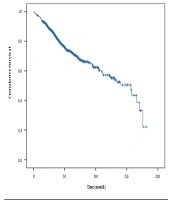
Figure 2 shows the trend in overall excess mortality among women with breast cancer in Kerman compared with the general female population over the 6-year follow-up period. The horizontal axis shows follow-up time in years, and the vertical axis shows the excess mortality rate, defined as the difference between observed and expected deaths. Expected values were determined based on standard mortality rates in the general population, adjusted for age and sex. Increasing values over time indicate the accumulation of excess mortality risk among patients with breast cancer compared with the general population. A higher curve indicates a higher risk of death in the cancer population than in the general population. A steeper slope indicates faster accumulation of excess mortality.
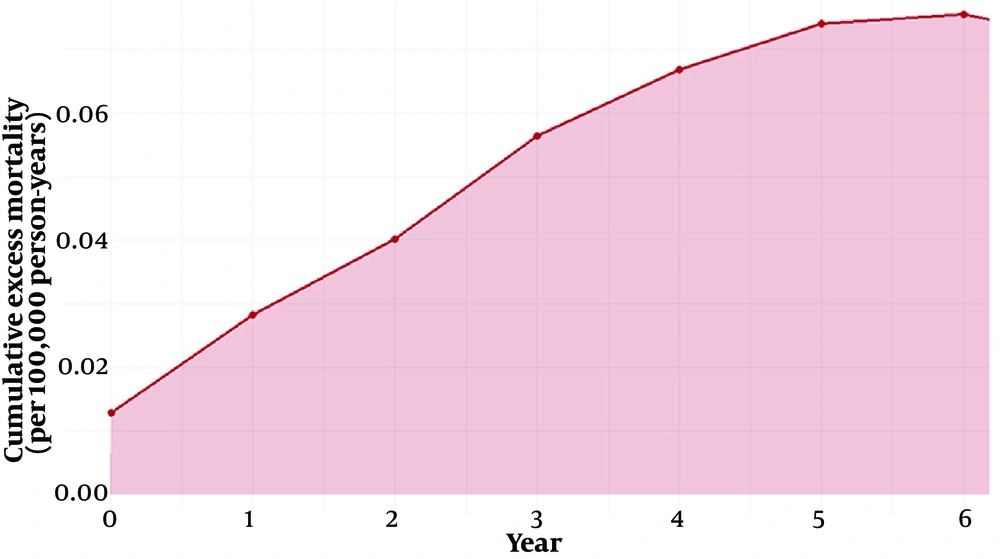
Figure 2.
Trend of cumulative excess mortality among women with breast cancer from 2014 to 2020 (with follow-up through December 31, 2020) registered in the Cancer Registry Center of Kerman University of Medical Sciences. The x-axis represents calendar years, and the y-axis indicates cumulative excess mortality.
The age-standardized rate (ASR) showed a nonlinear temporal pattern, increasing until 2016, declining until 2018, and rising again thereafter, as shown in Figure 3. This nonlinear trend may reflect a combination of changes in age structure, detection patterns, treatment access, reporting completeness, or other underlying population-level factors. Although the ASR exhibited temporal fluctuations, cumulative excess mortality continued to increase, reflecting the accumulated burden of death over the follow-up period rather than the annual standardized rate alone.
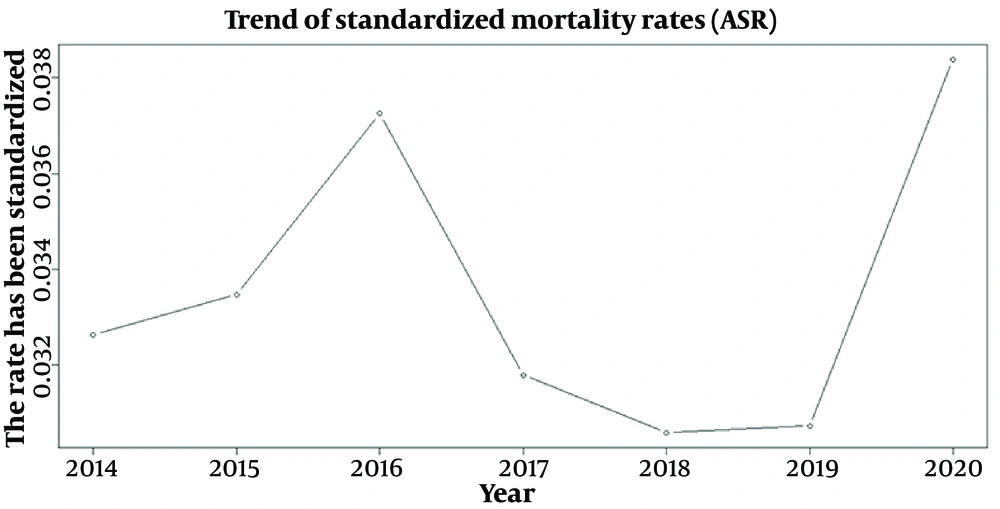
Figure 3.
Trend in age-standardized mortality rate (ASR) over time.
Table 3 presents excess mortality among women with breast cancer in Kerman compared with the general population, calculated as the difference between observed mortality in the cohort and expected age- and sex-adjusted mortality from population life tables. Cumulatively, the 5-, 4-, and 3-year excess mortality rates were 0.07, 0.06, and 0.05, respectively. Cumulative excess mortality rates were estimated for the study groups. The 95% confidence intervals were wide and included the null value; therefore, the differences were not statistically significant (P > 0.05). Thus, statistical imprecision precludes definitive conclusions regarding the magnitude of excess mortality in this population.
Table 3.
Observed Cumulative Hazard, Expected Cumulative Hazard, and Cumulative Excess Mortality With 95% Confidence Intervals Among Women with Breast Cancer
| Follow-up Time (y) | Observed Cumulative Hazard | Expected Cumulative Hazard | Cumulative Excess Mortality Rate | Lower 95% CI for Excess Mortality Rate | Upper 95% CI for Excess Mortality Rate | P-Value |
|---|---|---|---|---|---|---|
| 0 | 0.018 | 0.005 | 0.012 | -0.209 | 0.234 | 0.909 |
| 1 | 0.038 | 0.010 | 0.028 | -0.300 | 0.357 | 0.866 |
| 2 | 0.056 | 0.015 | 0.040 | -0.352 | 0.432 | 0.841 |
| 3 | 0.078 | 0.022 | 0.056 | -0.409 | 0.522 | 0.812 |
| 4 | 0.095 | 0.028 | 0.066 | -0.440 | 0.573 | 0.795 |
| 5 | 0.110 | 0.036 | 0.074 | -0.459 | 0.607 | 0.785 |
| 6 | 0.121 | 0.045 | 0.075 | -0.463 | 0.614 | 0.783 |
5. Discussion
In this 6-year cohort study, women with breast cancer experienced reduced survival and excess mortality compared with that expected in the general population, indicating a substantial burden of premature mortality. Observed survival decreased from 0.982 in the first year to 0.908 in the fourth year and 0.880 by the sixth year of follow-up. The log-rank test demonstrated significant differences in survival according to registry location and tumor grade. Patients registered in urban registries had better survival than those registered in the provincial capital, which may reflect differences in referral patterns and disease severity at presentation. Survival was higher among patients with grade 1 tumors and lower among those older than 65 years, suggesting that tumor grade and age are associated with survival outcomes.
The excess mortality analysis showed a persistently higher mortality risk than that expected in the general population throughout follow-up, with cumulative excess mortality increasing during the final 2 years of the study. Breast cancer mortality can be substantially reduced through early detection strategies and health education, particularly in underserved communities. Findings presented at the 2023 Royal Society of Medicine Conference on Tackling Inequalities in Uganda showed that, even when population-based screening programs are not feasible because of their high cost, health education delivered through existing social and cultural networks can significantly reduce breast cancer mortality (13). In Iran, spatial analyses have also identified significant geographic variations in breast cancer incidence (14).
In the present study, patients residing in rural areas demonstrated better survival than those living in the provincial capital. This finding is somewhat unexpected given the greater availability of specialized health care services in the provincial capital. One possible explanation is referral bias, whereby patients with more advanced or complex disease may be referred to tertiary care centers in the provincial capital. Because information on stage at diagnosis was not available in our registry data, this hypothesis could not be formally evaluated.
A Dutch study of 205,827 women aged 15 to 89 years with breast cancer estimated conditional 5-year relative survival for each year after diagnosis over a 15-year follow-up period. Patients with stage I or II breast cancer had favorable long-term outcomes, although a small but significant excess mortality persisted for at least 15 years after diagnosis. More modest improvements were observed among patients with stage III disease (15). Similarly, women with breast cancer in our study demonstrated favorable survival outcomes during the 6-year follow-up period, although excess mortality remained evident, reaching approximately 7% at 5 years of follow-up. A study conducted in northeastern Peninsular Malaysia evaluated excess mortality among women with breast cancer over a 5-year follow-up period ending in 2016 using Poisson regression modeling. Excess mortality varied according to age group, ethnicity, and stage at diagnosis (16). Similarly, in our study, survival differed according to place of residence and tumor grade.
One strength of the present study was the use of updated general population mortality rates with careful age- and sex-specific adjustment to improve the accuracy of excess mortality estimates. However, the retrospective design and the lack of detailed clinical information, including stage at diagnosis and treatment-related variables, limited the interpretation of the findings. In addition, potential inaccuracies in death registration and the inclusion of some cancer-related deaths in the general population mortality data may have resulted in slight overestimation of excess mortality. Therefore, the observed differences in survival by place of residence should be interpreted with caution, as the absence of important covariates, such as stage at diagnosis, receptor status, treatment modality, comorbidities, screening history, and socioeconomic status, precluded adjustment for potential confounders and may have introduced residual confounding.
A major strength of the present study was the use of an excess mortality framework rather than a crude comparison of mortality between women with breast cancer and the general population. By deriving expected mortality from life tables matched on age and calendar year and by updating attained age throughout follow-up, the analysis partially accounted for the strong effects of age and temporal changes in background mortality. This approach is particularly important in population-based cancer survival studies, in which differences in age structure can substantially bias unadjusted comparisons. However, some limitations should be acknowledged. The validity of excess mortality estimates depends on the appropriateness of the life tables used to represent background mortality in the source population. If the general-population life tables are insufficiently stratified with respect to factors such as socioeconomic status, comorbidity, or regional variation, some residual bias may remain. Therefore, the findings should be interpreted in light of these methodological considerations.
5.1. Limitations
This study has several limitations. First, the exclusion of 99 DCO cases and 14 records with invalid dates, which was necessary for survival analysis, may have resulted in more favorable survival estimates, as DCO cases are often associated with advanced disease. Second, registry incompleteness and regional referral patterns may limit the generalizability of the findings. Finally, the analysis was constrained by limited clinical covariates and wide confidence intervals in the excess mortality estimates (Table 3), reflecting limited precision in detecting modest long-term mortality differences. Therefore, the results should be interpreted with caution.
5.2. Conclusions
Over 6 years of follow-up, women with breast cancer experienced reduced survival and excess mortality compared with that expected in the general population. Using an excess mortality framework that incorporated age- and calendar year-specific population mortality rates, this study provides population-based estimates of the mortality burden associated with breast cancer in southeastern Iran. Although excess mortality was observed, associations between patient characteristics and excess mortality could not be established with confidence because of limited clinical covariate data and imprecise estimates reflected by wide confidence intervals. These findings should therefore be interpreted cautiously. Future studies with larger cohorts, longer follow-up, and more comprehensive clinical information are needed to better characterize the determinants of excess mortality among women with breast cancer.