
1. Background
Thyroid nodules are a common clinical finding encountered by physicians (1). Epidemiological data suggest a modest but real increase in the occurrence of thyroid nodules and thyroid malignancies; much of this increase appears to result from the broader use of imaging modalities and routine medical screening, leading to more frequent identification of small, clinically silent thyroid nodules (2-4).
Accurate diagnosis of malignancy remains challenging, and the decision to perform a biopsy is based on sonographic findings and nodule size. Although larger nodules have been associated with complications and a poorer prognosis, small nodules may also be highly malignant and invasive (1, 5, 6). Thyroid nodules are approximately 4 times more common in women than in men, and their prevalence increases with age (1, 7-9).
Thyroid carcinomas are rare but represent the most common malignant disease of the endocrine system. Fine-needle aspiration is an important method for the initial evaluation of thyroid nodules because it is safe, accurate, and easy to perform (2, 9, 10). Nevertheless, many patients with benign lesions undergo unnecessary surgery.
FNA is advised for thyroid nodules ≥ 1 cm with high- or medium-risk sonographic patterns, nodules ≥ 1.5 cm with low-risk sonographic patterns, and nodules ≥ 2 cm with very-low-risk sonographic patterns (8, 9, 11-13). Diagnostic and therapeutic evaluation aims to minimize undiagnosed disease and false-positive or false-negative results because these errors may have substantial clinical and financial consequences. When FNA does not provide an accurate diagnosis, repeat sampling may be recommended, which can increase stress, adversely affect mental health, and reduce trust in physicians (8, 13-17).
Although thyroid surgery is performed to relieve symptoms and treat disease, it may cause adverse effects, including hypothyroidism and the need for lifelong replacement therapy. Therefore, accurate and definitive diagnosis of thyroid nodules is important, given their increasing detection and the widespread use of FNA (18-20).
2. Objectives
The present study aimed to assess the sensitivity, specificity, diagnostic performance, false-positive rate, and false-negative rate of FNA cytology using thyroid surgical histopathology as the reference standard.
3. Methods
3.1. Study Design and Setting
This retrospective cross-sectional study was conducted among patients who underwent thyroid surgery at Imam Khomeini Hospital from March 2019 to March 2021. The diagnostic accuracy of FNA cytology was evaluated by comparing cytological findings with final histopathological outcomes after surgery.
3.2. Inclusion and Exclusion Criteria
Patients who underwent preoperative FNA and subsequent thyroid surgery because of Bethesda III-VI cytology, suspicious findings, 2 - 4 cm nodules, or compressive symptoms were included to enable comparison of FNA results with final histopathology.
The inclusion criteria were thyroid nodules confirmed by ultrasonography and/or FNA, thyroidectomy or lobectomy, and a surgical indication of Bethesda III-VI cytology, large suspicious nodules (2 - 4 cm), or compressive symptoms. The exclusion criteria were significant comorbidities, failure to return for follow-up or surgery, incomplete medical records, or insufficient cytological or histopathological data.
3.3. Patient Selection
Participants were aged 18 to 75 years, had thyroid nodules, and underwent thyroid surgery during the defined study period. Thyroid nodules were initially evaluated by clinical examination and confirmed by ultrasonography.
3.4. Data Collection
Demographic and clinical data were collected retrospectively from patients' medical records. Variables included age, sex, thyroid function test results, ultrasonographic characteristics of thyroid nodules, FNA cytology results, type of surgical procedure, and final histopathological diagnosis.
3.5. Fine-Needle Aspiration Cytology
FNA was performed for thyroid nodules according to standard clinical indications. Cytological findings were extracted from cytopathology reports in the medical records. For indeterminate cytological findings, such as atypia of undetermined significance, clinical decision-making was based on the treating physician's assessment and the available diagnostic information.
3.6. Surgical Procedures and Histopathological Evaluation
All patients underwent thyroid surgery according to clinical indications. Surgical procedures included total thyroidectomy, lobectomy, or lobectomy with isthmectomy. Surgical specimens were examined by experienced pathologists, and the histopathological diagnosis was considered the reference standard for comparison with FNA cytology.
3.7. Statistical Analysis
Data were analyzed using STATA version 12. Descriptive statistics were used to summarize demographic and clinical characteristics. Agreement between the two diagnostic approaches was assessed using Cohen's kappa coefficient, with a significance level of 0.05.
4. Results
A total of 102 patients with thyroid lesions were included in the analysis (Figure 1).
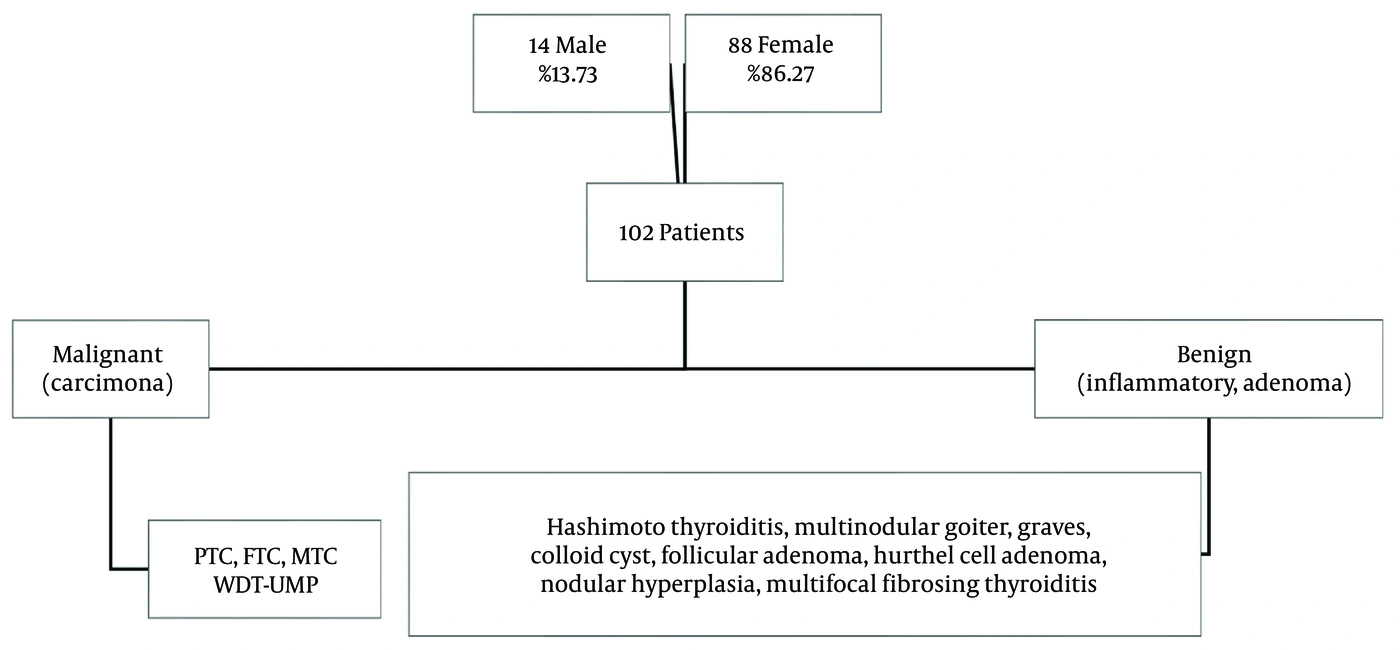
Figure 1.
Classification of thyroid lesions
The mean age of the patients was 43.372 ± 11.345 years (men: 49.00 ± 12.00 years; women: 43.00 ± 11.05755 years). The overall mean thyroid-stimulating hormone (TSH), T3, and T4 levels were 1.797 ± 2.649 µIU/mL, 39.890 ± 14.516 µIU/mL, and 25.123 ± 38.360 µIU/mL, respectively.
According to FNA cytology, 67.65% (n = 69) of the patients had benign lesions and 32.35% (n = 33) had malignant lesions. Based on surgical histopathology, 66% (n = 68) had benign lesions, 31% (n = 32) had malignant lesions, and 1% (n = 2) had suspected malignant lesions.
The most common thyroid lesions based on FNA cytology and surgical histopathology were MNG, PTC, and Hashimoto thyroiditis (Table 1).
Table 1.
Thyroid Lesions by FNA Cytology and Surgical Histopathology, and Type of Surgery by Final Histopathology a
| Lesion | FNA | Histopathology | Total thyroidectomy | Lobectomy | Lobectomy with isthmectomy | Total |
|---|---|---|---|---|---|---|
| MNG | 50 (49.02) | 26 (25.49) | 16 | 5 | 5 | 26 |
| Hashimoto thyroiditis | 8 (7.84) | 13 (12.75) | 9 | 2 | 2 | 13 |
| Colloid cyst | 2 (1.96) | 2 (1.96) | 0 | 0 | 2 | 2 |
| Follicular adenoma | 2 (1.96) | 10 (9.80) | 6 | 2 | 2 | 10 |
| Hurthle cell adenoma | 2 (1.96) | 2 (1.96) | 2 | 0 | 0 | 2 |
| Nodular hyperplasia | 1 (0.98) | 15 (14.71) | 11 | 4 | 0 | 15 |
| Multifocal fibrosing thyroiditis | 0 (0.00) | 1 (0.98) | 0 | 1 | 0 | 1 |
| PTC | 27 (26.47) | 25 (24.51) | 17 | 4 | 4 | 25 |
| FTC | 5 (4.90) | 6 (5.88) | 5 | 0 | 1 | 6 |
| MTC | 1 (0.98) | 1 (0.98) | 1 | 0 | 0 | 1 |
| WDT-UMP | 0 (0.00) | 1 (0.98) | 1 | 0 | 0 | 1 |
| Graves | 4 (3.92) | 0 (0.00) | 0 | 0 | 0 | 0 |
| Total | 102 (100.00) | 102 (100.00) | 68 | 18 | 16 | 102 |
a Values are expressed as No. (%) or number. Abbreviations: MNG, multinodular goiter; PTC, papillary thyroid carcinoma; FTC, follicular thyroid carcinoma; MTC, medullary thyroid carcinoma; WDT-UMP, well-differentiated neoplasm of uncertain malignant potential.
The sensitivity of FNA cytology for diagnosing lesion type, using surgical histopathology as the reference, was 51.52% (95% CI, 49.8% - 53.2%), and the specificity was 76.81% (95% CI, 75.8% - 77.8%). The false-negative rate was 48.48%, and the false-positive rate was 23.19% (Table 2). The accuracy of FNA cytology for detecting lesion type was 68.63% (Figure 2). Agreement between the two approaches for identifying malignant or benign thyroid nodules was substantial and statistically significant (Cohen's kappa, 68.6%; 95% CI, 59.5% - 77.8%; P < 0.001) (Figure 3).
Table 2.
Diagnostic Performance of FNA Cytology Compared with Surgical Histopathology a
| Item | Malignant | Benign | Value |
|---|---|---|---|
| FNA malignant | 17 | 16 | 33 b |
| FNA benign | 16 | 53 | 69 b |
| Total | 33 | 69 | 102 b |
| Sensitivity | — | — | 51.52 |
| Specificity | — | — | 76.81 |
| Positive predictive value (PPV) | — | — | 51.52 |
| Negative predictive value (NPV) | — | — | 76.81 |
| False-positive rate (FPR) | — | — | 23.19 |
| False-negative rate (FNR) | — | — | 48.48 |
| Accuracy | — | — | 68.63 |
a Values are expressed as percentage unless otherwise indicated.
b Values are expressed as numbers.
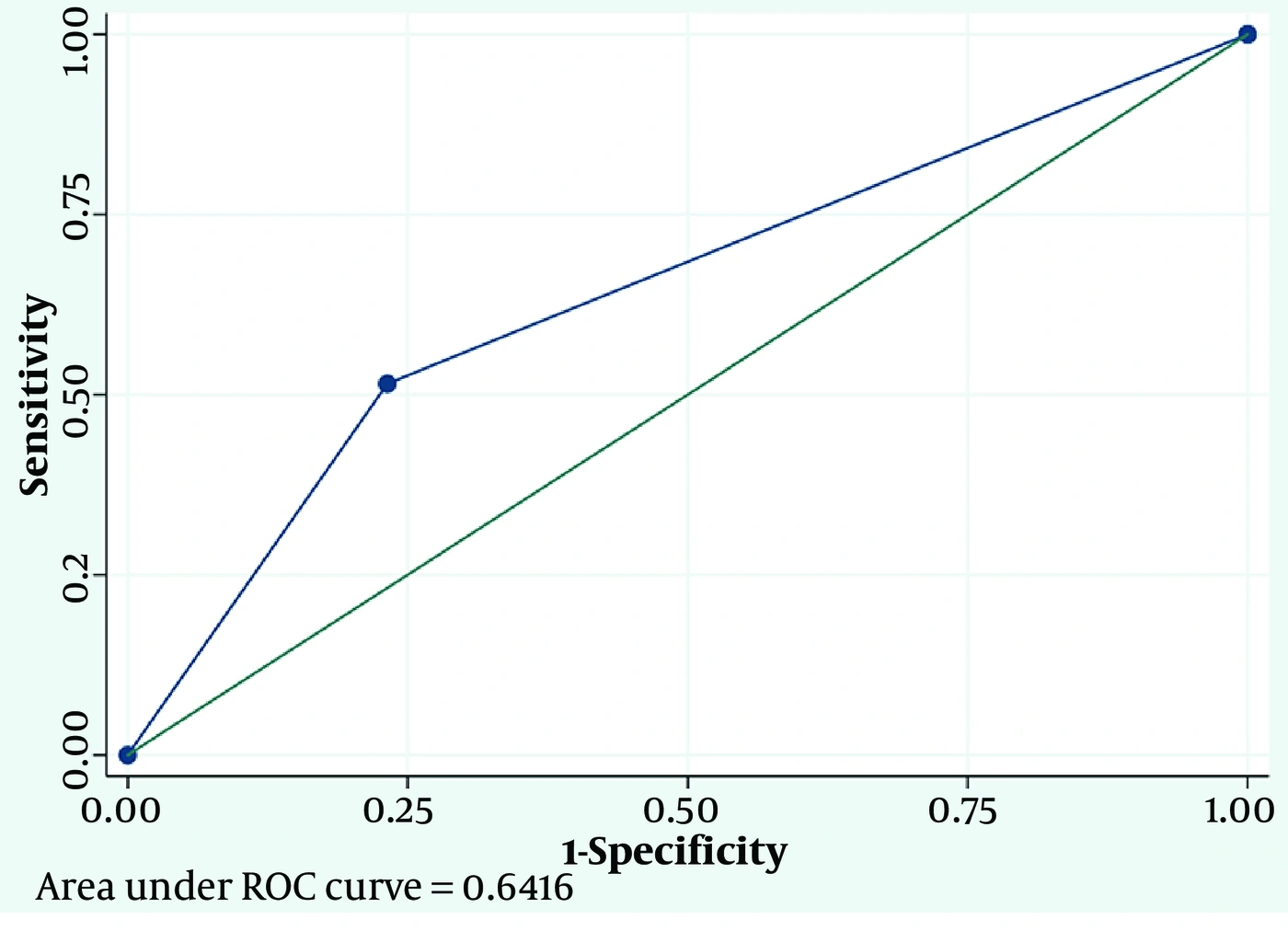
Figure 2.
Discrimination power of lesions in the participating patients. The area under the curve was 64%, indicating nearly acceptable discriminatory power of the model.
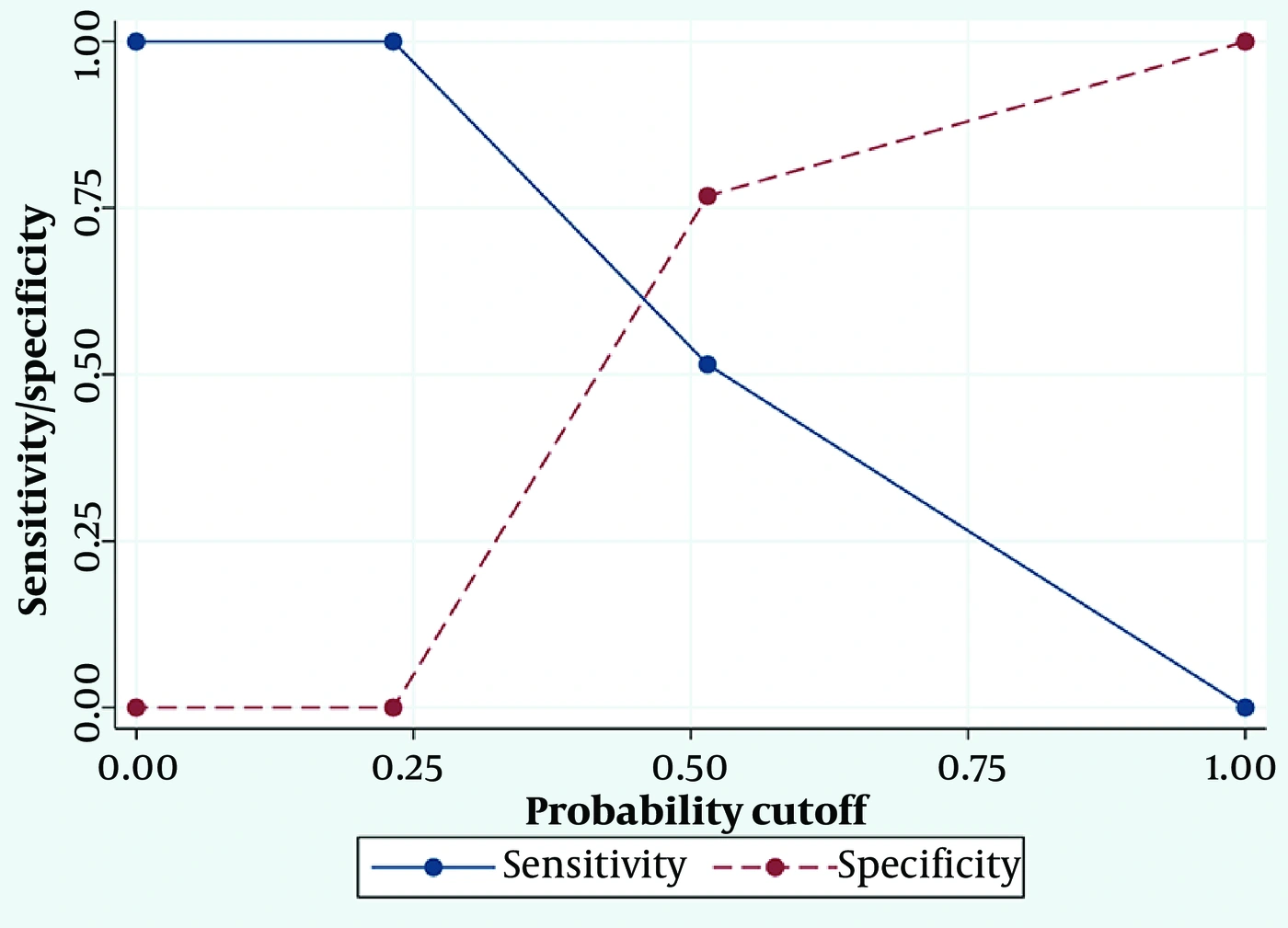
Figure 3.
Cutoff point for differentiating lesion types in the study patients. Cases above this point were considered malignant lesions, whereas cases below this point were considered benign lesions.
5. Discussion
Thyroid nodules can arise from a broad spectrum of benign and malignant conditions. Initial clinical evaluation includes a detailed medical history and a careful physical examination (3, 21, 22). Thyroid ultrasonography is routinely used to confirm the presence of nodules, identify additional lesions, assess cervical lymph nodes, and characterize the sonographic features of individual nodules. FNA biopsy is subsequently performed when clinically indicated and is considered a key method for lesion stratification (23).
Microcarcinomas, defined as malignant thyroid tumors smaller than 1 cm, are frequently identified incidentally during post-thyroidectomy histopathological examination (24, 25). Most patients with benign FNA cytology and no other clinical indication do not undergo surgical resection. Consequently, occult microcarcinomas in these patients may remain undetected because of false-negative cytological findings, potentially affecting clinical management and patient outcomes. Therefore, careful clinical assessment for possible malignancy in patients with benign FNA findings remains important (25, 26).
Papillary thyroid carcinoma, predominantly the micro-PTC subtype, is reported as the most common type of thyroid malignancy and accounts for nearly 30% of thyroid malignancies (11, 27). In the present study, PTC was identified in 25 patients. Twelve of these cases were classified as micro-PTC, with 2 patients undergoing lobectomy and 3 undergoing lobectomy with isthmectomy.
Among the 69 patients with benign FNA cytology, 16 were diagnosed with malignant lesions on final surgical histopathology (23.19%). In contrast, Alshahrani et al. reported a malignancy rate of 46%, which was lower than the false-negative rate of 48.48% observed in our study (28). Several factors may influence false-negative and false-positive FNA cytology results, including the experience and skill of the physician performing the procedure, the use of ultrasound guidance, and the expertise of cytotechnicians and pathologists interpreting the specimens (29, 30).
Because of the challenges associated with the preoperative diagnosis of microcarcinomas and the high prevalence of incidental thyroid cancer, consensus regarding the optimal extent of surgery remains limited, particularly for patients with benign FNA cytology. Many physicians and surgeons therefore advocate total thyroidectomy to minimize the risk of leaving multifocal or diffuse malignancy untreated and to avoid repeat surgery (25, 31). In some cases, total thyroidectomy may also be performed because of patient-specific symptoms or a family history of thyroid neoplasms, even when this approach differs from standard clinical guidelines. In our study, 68 patients underwent total thyroidectomy (PTC: 17; FTC: 5; MTC: 1), 18 underwent lobectomy (PTC: 4; FTC: 0; MTC: 0), and 16 underwent lobectomy with isthmectomy (PTC: 4; FTC: 1; MTC: 0).
The risk of malignancy should be balanced against treatment-related risks when determining patient management. Patients should be fully counseled regarding these risks because the choice of intervention directly affects morbidity and survival. When conservative, nonsurgical management is selected, the potential risk of occult malignancy despite benign FNA cytology should be clearly discussed to support adherence to lifelong clinical surveillance. Although FNA is an established diagnostic modality for thyroid nodules, the elevated false-negative rate observed in this study underscores the importance of standardized sampling techniques and rigorous cytological interpretation. Clinical protocols should focus on improving the diagnostic proficiency of clinicians and pathologists while implementing cost-effective, regular, and minimally invasive monitoring, such as ultrasonographic surveillance, to detect malignant progression according to established risk-stratification criteria. Patients should also be counseled to seek prompt medical reassessment if new or worsening clinical symptoms develop.
5.1. Conclusions
Although FNA remains a valuable diagnostic tool for evaluating thyroid nodules, our findings demonstrate only moderate agreement between cytological and final histopathological diagnoses. The observed risk of malignancy despite benign cytological findings highlights the need for careful clinical and radiological correlation and appropriate follow-up. Given the retrospective cross-sectional, single-center design, these findings should be interpreted with caution and may not be fully generalizable to other populations or clinical settings.