
1. Background
Thyroidectomy is widely performed for benign and malignant thyroid diseases. Although the procedure is generally safe, postoperative hypocalcemia remains one of the most common complications (1). It occurs mainly because the parathyroid glands are very small and closely adherent to the thyroid (1). During surgery, these glands may be injured, devascularized, or unintentionally removed (2). Even when preserved in situ, they may become temporarily inactive because of surgical stress or mild ischemia (2, 3). Low vitamin D levels, low postoperative parathyroid hormone (PTH), and extensive neck dissection can also contribute to decreased calcium levels (4). Consequently, many patients develop symptoms such as numbness, tingling, or muscle cramps in the early postoperative period (5, 6). In a smaller proportion of patients, hypocalcemia can become permanent and require lifelong treatment (5).
Understanding this complication is important because it affects patient safety, length of hospital stay, and long-term quality of life (7). Early hypocalcemia is one of the main reasons for readmission after thyroid surgery (8). Permanent hypocalcemia can lead to repeated emergency visits, chronic symptoms, renal problems, and the need for continuous calcium and vitamin D supplementation (9). Therefore, identifying the true risk factors for both transient and permanent hypocalcemia is essential for improving surgical planning, postoperative management, and prevention strategies (10).
Many studies have investigated this topic, but their findings are inconsistent (11). A large meta-analysis by Qin et al. showed that female sex, younger age, Graves disease, central lymph node dissection, and accidental removal of the parathyroid gland increase the risk of postoperative hypocalcemia (12). Some randomized trials reported that preoperative calcium and vitamin D administration may reduce early hypocalcemia, but these studies were small and had short follow-up periods (13). Other research has examined the role of magnesium, postoperative changes in PTH, and new imaging tools such as indocyanine green angiography to protect the parathyroid glands (14-16). Results from these studies vary, and differences in definitions, sample sizes, and surgical techniques limit comparability.
Because of these limitations, current evidence does not provide a clear picture of which factors truly predict transient and permanent hypocalcemia. Most published data are derived from single-center studies, lack standardized laboratory measurements, or do not include large patient cohorts. Therefore, multicenter studies with consistent definitions and adequate follow-up are needed.
2. Objectives
The present study aimed to address these gaps by evaluating the incidence and predictors of transient and permanent hypocalcemia after thyroid surgery in a large cohort across three major hospitals.
3. Methods
3.1. Study Design and Setting
This retrospective cohort study was conducted in four tertiary referral hospitals in a single city, where thyroid surgery is routinely performed using similar surgical protocols and a unified electronic medical record (EMR) system. All thyroid surgery procedures performed between January 2020 and December 2025 were reviewed. One hospital had a low case volume (n = 203) and was excluded a priori because thyroid surgery had only recently been introduced at that center and the maximum available postoperative follow-up period was less than 6 months. Because permanent hypocalcemia requires a minimum of 6 months of follow-up for valid ascertainment, reliable outcome evaluation was not feasible for patients at this hospital. Therefore, the final study cohort was derived from the remaining three hospitals, which together contributed 7,227 thyroid surgery cases as the source population.
3.2. Participants and Sampling
A total of 7,227 patients who underwent thyroid surgery during the study period were initially screened for eligibility. Exclusion criteria were applied systematically. First, patients operated on at the fourth hospital (n = 203) were excluded because of insufficient follow-up duration. Foreign nationals (n = 462) were excluded because their postoperative follow-up information was not accessible in the local EMR system, and long-term outcome verification could not be ensured. In addition, 438 patients with incomplete medical records were excluded because missing operative or postoperative documentation, mainly due to unsuccessful postoperative contact or failure to attend reassessment visits, precluded accurate determination of calcium-related outcomes. After these exclusions, 6,124 patients remained and constituted the final analytic cohort. Patients of all ages and both sexes were eligible. The extent of thyroid surgery was recorded for each patient and categorized as total thyroidectomy, near-total thyroidectomy, subtotal thyroidectomy, or hemithyroidectomy. Based on the available baseline data, patients excluded because of incomplete follow-up or missing data were broadly comparable to the included cohort with respect to age, sex, and primary thyroid diagnosis, suggesting a low likelihood of substantial selection bias (Figure 1).
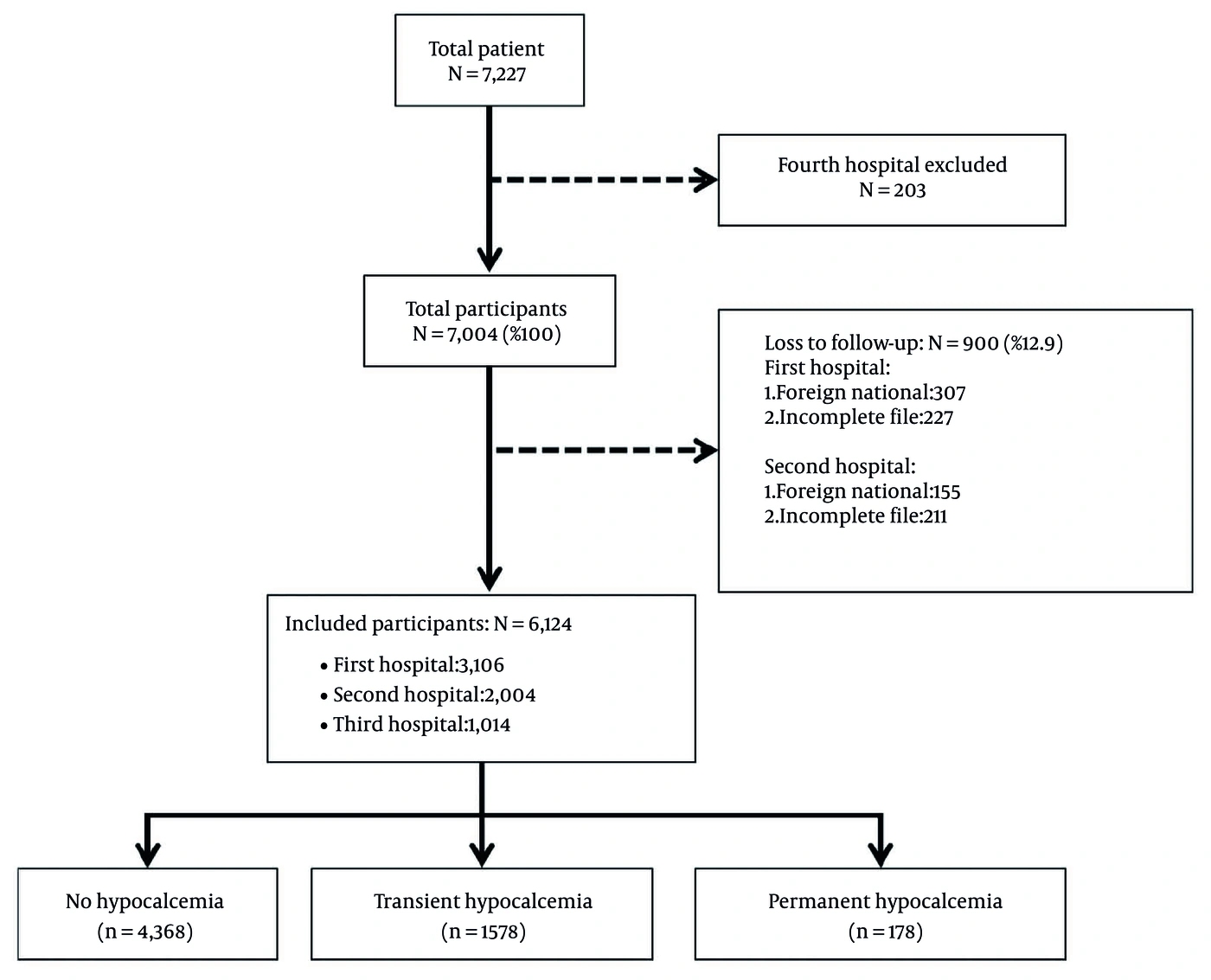
Figure 1.
Participant flow diagram
3.3. Data Collection and Instruments
Data were extracted from the EMR systems of the three participating hospitals using a standardized extraction form developed specifically for this study. Demographic information included age, sex, and nationality. Preoperative clinical data included the underlying diagnosis, thyroid function tests, serum calcium, magnesium, and 25-hydroxyvitamin D levels, and documentation of preoperative calcium or vitamin D supplementation. Intraoperative variables included the type of thyroidectomy performed; whether central or lateral neck dissection was performed; the number of parathyroid glands identified; whether parathyroid autotransplantation was performed; operative time; intraoperative complications; and identification of parathyroid tissue in the final pathology report. Surgeon experience was categorized by annual thyroidectomy volume, with fewer than 50 cases per year defined as low-volume practice. Postoperative variables included serum calcium and PTH values at predefined time points, symptoms of hypocalcemia, requirement for intravenous calcium administration, endocrinology consultation, length of hospital stay, readmission, and final calcium status classification as no hypocalcemia, transient hypocalcemia, or permanent hypocalcemia. Patients with missing key laboratory values or unavailable postoperative follow-up were excluded before analysis to ensure accurate outcome classification. As a result, all variables included in the final analytic dataset were complete, and no missing biochemical data remained.
3.4. Laboratory Measurements and Variable Definitions
Biochemical measurements were performed in the certified clinical laboratories of each participating hospital using standardized assays. Serum calcium was measured using colorimetric methods, and corrected serum calcium was calculated using the standard albumin-corrected formula: corrected calcium (mg/dL) = measured calcium + 0.8 × [4.0 - serum albumin (g/dL)]. The same equation was applied across all participating centers whenever serum albumin was available. Hypocalcemia was defined as corrected serum calcium < 8.5 mg/dL and/or compatible clinical symptoms requiring calcium supplementation, as determined by the treating physician. Severe hypocalcemia was defined as corrected serum calcium < 7.5 mg/dL or the requirement for intravenous calcium administration. Postoperative serum calcium was routinely measured immediately after surgery, on postoperative day 1, and thereafter as clinically indicated during the first 48 hours. When multiple postoperative calcium measurements were available, the lowest corrected calcium value recorded within the first 48 hours was used for analysis. Serum PTH was measured using a second-generation immunoassay, with values between 15 and 65 pg/mL considered normal. PTH was routinely assessed within 1 - 3 hours after surgery and again on postoperative day 1. Vitamin D status was evaluated using serum 25-hydroxyvitamin D levels, and deficiency was defined as concentrations < 20 ng/mL. Serum magnesium was measured using standard assays, and hypomagnesemia was defined as levels < 1.8 mg/dL.
Transient hypocalcemia was defined as biochemical and/or symptomatic hypocalcemia that resolved within 6 months after surgery, without the need for ongoing calcium or active vitamin D supplementation thereafter. Permanent hypocalcemia was defined as persistent biochemical and/or symptomatic hypocalcemia requiring continued oral calcium and/or active vitamin D supplementation beyond 6 months after surgery. Accidental parathyroid removal was defined as the presence of parathyroid tissue identified in the pathology report. Parathyroid autotransplantation was defined as implantation of devascularized or suspected compromised parathyroid tissue into the sternocleidomastoid muscle or forearm.
3.5. Statistical Analysis
Statistical analyses were performed using SPSS version 26.0 (IBM Corp., Armonk, NY, USA). Continuous variables are presented as mean ± standard deviation (SD), and categorical variables as frequencies and percentages. Data normality was assessed using histograms and the Kolmogorov-Smirnov test. Group comparisons were performed using one-way analysis of variance (ANOVA) for continuous variables and the chi-square test for categorical variables, with Bonferroni-adjusted post hoc comparisons when appropriate. Because patients with incomplete laboratory data or follow-up were excluded before analysis, the final dataset contained no missing values, and complete-case analysis was performed. Separate multivariable logistic regression models were constructed to identify independent predictors of transient and permanent postoperative hypocalcemia, each using patients without postoperative hypocalcemia as the reference group. Variables with P < 0.10 in univariable analyses or considered clinically relevant based on prior evidence were entered into the multivariable models. Multicollinearity among candidate predictors was assessed using variance inflation factors (VIFs). VIF values ranged from 2.33 to 3.71, indicating no evidence of problematic multicollinearity according to the prespecified threshold of VIF < 5. Because the participating hospitals were tertiary referral centers located within the same city and operated under highly standardized clinical pathways, including shared endocrine surgeons, identical surgical protocols, a unified EMR system, and comparable laboratory methods using the same assay kits, substantial intercenter variability was considered unlikely. Therefore, the hospital center was not included as a separate covariate in the multivariable analyses. Results are presented as adjusted odds ratios (aORs) with 95% confidence intervals (CIs). Model discrimination and calibration were evaluated using the area under the receiver operating characteristic curve (AUC) and the Hosmer-Lemeshow goodness-of-fit test, respectively. All statistical tests were 2-sided, and P < 0.05 was considered statistically significant.
3.6. Ethical Considerations
The study protocol was approved by the Ethics Committee of Shahid Sadoughi University of Medical Sciences, Yazd (ethics code: IR.SSU.MEDICINE.REC.1404.190). Given the retrospective nature of the study and the absence of any therapeutic intervention, informed consent was not required. All patient data were anonymized and treated as strictly confidential, and the information was used exclusively for research purposes.
4. Results
4.1. Patient Characteristics
A total of 6,124 patients who underwent thyroid surgery were included in the analysis. Of these, 4,368 (71.3%) had no postoperative hypocalcemia, 1,578 (25.8%) developed transient hypocalcemia, and 178 (2.9%) developed permanent hypocalcemia. Patients with transient or permanent hypocalcemia were slightly older than those without hypocalcemia (mean age 43.1 ± 10.5 and 44.4 ± 12.0 years vs 42.0 ± 11.2 years, respectively). Pairwise comparisons showed significant differences between the no-hypocalcemia group and both the transient (P = 0.002) and permanent hypocalcemia groups (P = 0.012), whereas the difference between the transient and permanent hypocalcemia groups was not significant (P = 0.30). Female patients predominated in all groups (87.6%, 88.9%, and 90.4%, respectively), with a small but statistically significant difference in sex distribution (P = 0.041). Preoperative diagnoses differed significantly among groups (P < 0.001). Benign disease was more common in patients with transient hypocalcemia (62.2%), whereas malignant and suspicious lesions were proportionally more frequent in the permanent hypocalcemia group. Among patients with thyroid malignancy, the distribution of histological cancer types was similar across all groups (P = 0.92) (Table 1).
Table 1.
Demographic, Clinical, and Perioperative Characteristics of Patients According to Calcium Status After Thyroid Surgery (N = 6124) a
| Variables | No Hypocalcemia (n = 4368) | Transient Hypocalcemia (n = 1578) | Permanent Hypocalcemia (n = 178) | P-Value |
|---|---|---|---|---|
| Age (y) b | 42.0 ± 11.2 | 43.1 ± 10.5 | 44.4 ± 12.0 | 0.002 b; 0.012 c; 0.3 |
| Female sex, % | 87.6 | 88.9 | 90.4 | 0.041 |
| Preoperative diagnosis | < 0.001 | |||
| Benign | 2350 (53.8) | 982 (62.2) | 89 (50.0) | |
| Malignant | 1372 (31.4) | 456 (28.9) | 59 (33.1) | |
| Suspicious | 646 (14.8) | 140 (8.9) | 30 (16.9) | |
| Type of thyroid cancer | 0.92 | |||
| Papillary | 1029 (75.0) | 346 (75.9) | 44 (74.6) | |
| Follicular | 206 (15.0) | 64 (14.0) | 9 (15.3) | |
| Medullary | 69 (5.0) | 23 (5.0) | 3 (5.1) | |
| Anaplastic/others | 68 (5.0) | 23 (5.1) | 3 (5.0) | |
| Total thyroidectomy | 3462 (79.3) | 1418 (89.9) | 173 (97.2) | < 0.001 |
| Neck dissection | 1180 (27.0) | 698 (44.2) | 112 (62.9) | < 0.001 |
| Intraoperative parathyroid identified | 3112 (71.3) | 1119 (70.9) | 131 (73.6) | 0.61 |
| Parathyroid tissue on pathology report | 523 (12.0) | 190 (12.0) | 49 (27.5) | < 0.001 |
| Calcium replacement (IV) | 115 (2.6) | 332 (21.0) | 86 (48.3) | < 0.001 |
| Lowest postoperative calcium (mg/dL) b | 8.4 ± 1.1 | 7.6 ± 0.6 | 7.0 ± 0.7 | < 0.001 |
| Degree of hypocalcemia during admission | < 0.001 | |||
| Mild | — | 1096 (69.5) | 78 (43.8) | |
| Severe | — | 482 (30.5) | 100 (56.2) | |
| Length of hospital stay (days) b | 2.1 ± 0.9 | 3.4 ± 1.2 | 4.6 ± 1.5 | < 0.001 b; < 0.001 c; < 0.001 d |
a Values are expressed as mean ± SD or No. (%) unless indicated. Groups were compared using one-way ANOVA for continuous variables and chi-square tests for categorical variables. Abbreviations: ANOVA, analysis of variance; IV, intravenous; SD, standard deviation.
b Comparison between no hypocalcemia and transient hypocalcemia.
c Comparison between no hypocalcemia and permanent hypocalcemia.
d Comparison between transient hypocalcemia and permanent hypocalcemia.
4.2. Perioperative Findings
The extent of surgery differed significantly according to postoperative calcium status. Total thyroidectomy was performed in 79.3% of patients without hypocalcemia, compared with 89.9% of those with transient hypocalcemia and 97.2% of those with permanent hypocalcemia (P < 0.001). Similarly, central neck dissection was performed with increasing frequency among patients without hypocalcemia and those with transient and permanent hypocalcemia (27.0%, 44.2%, and 62.9%, respectively; P < 0.001). The proportion of patients in whom parathyroid glands were identified intraoperatively was similar across groups (71.3%, 70.9%, and 73.6%; P = 0.61). However, parathyroid tissue identified on final pathology was significantly more common in patients with permanent hypocalcemia (27.5%) than in those without hypocalcemia or with transient hypocalcemia (both 12.0%; P < 0.001). Intravenous calcium replacement was required in 2.6% of patients without hypocalcemia, 21.0% of those with transient hypocalcemia, and 48.3% of those with permanent hypocalcemia (P < 0.001). The lowest postoperative serum calcium level progressively decreased across the three groups (8.4 ± 1.1, 7.6 ± 0.6, and 7.0 ± 0.7 mg/dL, respectively; P < 0.001). Severe hypocalcemia during hospitalization occurred in 30.5% of patients with transient hypocalcemia and 56.2% of those with permanent hypocalcemia (P < 0.001). The mean length of hospital stay also increased significantly with worsening hypocalcemia severity (2.1 ± 0.9, 3.4 ± 1.2, and 4.6 ± 1.5 days, respectively; all pairwise comparisons P < 0.001) (Table 1).
4.3. Preoperative and Intraoperative Predictors
Several preoperative biochemical variables were significantly associated with postoperative hypocalcemia. Mean preoperative calcium levels decreased progressively from patients without hypocalcemia to those with transient and permanent hypocalcemia (9.3 ± 0.4, 9.1 ± 0.5, and 8.9 ± 0.5 mg/dL, respectively; all pairwise comparisons P < 0.001). Similarly, vitamin D deficiency became increasingly prevalent across the three groups (18.9%, 29.4%, and 41.6%, respectively; P < 0.001). Mean preoperative magnesium levels also declined significantly with increasing hypocalcemia severity (2.03 ± 0.22, 1.96 ± 0.24, and 1.88 ± 0.25 mg/dL; all pairwise comparisons P < 0.001). Among intraoperative variables, total thyroidectomy, central neck dissection, parathyroid autotransplantation, accidental parathyroid removal, and parathyroid tissue identified on pathology were all significantly more frequent in patients with transient and permanent hypocalcemia (all P < 0.001). Lower surgeon experience (< 50 thyroidectomies annually), longer operative duration, and a higher incidence of intraoperative complications were also significantly associated with increasing severity of postoperative hypocalcemia (all P < 0.001). In contrast, the rate of intraoperative visualization of the parathyroid glands did not differ significantly among groups (P = 0.61) (Table 2).
Table 2.
Preoperative and Intraoperative Predictors of Transient and Permanent Hypocalcemia After Thyroid Surgery (N = 6124) a
| Variables | No Hypocalcemia (n = 4368) | Transient Hypocalcemia (n = 1578) | Permanent Hypocalcemia (n = 178) | P-Value |
|---|---|---|---|---|
| Preoperative factors | ||||
| Preoperative calcium (mg/dL) b | 9.3 ± 0.4 | 9.1 ± 0.5 | 8.9 ± 0.5 | < 0.001 b; < 0.001 c; < 0.001 d |
| Vitamin D deficiency, unit (%) | 18.9 | 29.4 | 41.6 | < 0.001 |
| Magnesium (mg/dL) b | 2.03 ± 0.22 | 1.96 ± 0.24 | 1.88 ± 0.25 | < 0.001 b; < 0.001 c; < 0.001 d |
| Intraoperative factors | ||||
| Total thyroidectomy | 79.3 | 89.9 | 97.2 | < 0.001 |
| Central neck dissection | 27.0 | 44.2 | 62.9 | < 0.001 |
| Parathyroid glands visualized | 71.3 | 70.9 | 73.6 | 0.61 |
| Parathyroid autotransplantation | 4.2 | 7.9 | 18.5 | < 0.001 |
| Accidental parathyroid removal | 6.5 | 12.8 | 29.2 | < 0.001 |
| Parathyroid tissue on pathology report | 12.0 | 12.0 | 27.5 | < 0.001 |
| Surgeon experience < 50 thyroid cases/year | 22.3 | 33.8 | 48.9 | < 0.001 |
| Surgery duration (minutes) b | 87 ± 22 | 102 ± 28 | 118 ± 35 | < 0.001 b; < 0.001 c; < 0.001 d |
| Intraoperative complications | 2.1 | 4.8 | 9.0 | < 0.001 |
a Values are expressed as mean ± SD or No. (%) unless indicated. Abbreviation: SD, standard deviation.
b Comparison between no hypocalcemia and transient hypocalcemia.
c Comparison between no hypocalcemia and permanent hypocalcemia.
d Comparison between transient hypocalcemia and permanent hypocalcemia.
4.4. Multivariable Analysis
Separate multivariable logistic regression analyses were performed to identify independent predictors of transient and permanent postoperative hypocalcemia, using patients without postoperative hypocalcemia as the reference group (Table 3).
Table 3.
Multivariable Logistic Regression Analyses for Predictors of Transient and Permanent Postoperative Hypocalcemia a
| Variables | Transient Hypocalcemia | Permanent Hypocalcemia | ||||
|---|---|---|---|---|---|---|
| Adjusted OR | 95% CI | P-Value | Adjusted OR | 95% CI | P-Value | |
| Preoperative calcium (per 1 mg/dL decrease) | 1.58 | 1.38 - 1.89 | < 0.001 | 1.46 | 1.18 - 2.05 | < 0.005 |
| Vitamin D deficiency | 1.25 | 1.11 - 1.51 | 0.008 | 1.45 | 1.30 - 1.98 | 0.001 |
| Central neck dissection | 2.03 | 1.51 - 2.71 | < 0.001 | 2.27 | 1.68 - 2.72 | < 0.001 |
| Accidental parathyroid removal | 2.79 | 2.26 - 3.86 | < 0.001 | 3.08 | 2.35 - 4.11 | < 0.001 |
| Parathyroid tissue on pathology | 3.11 | 2.12 - 4.21 | < 0.001 | 3.67 | 2.52 - 4.91 | < 0.001 |
| Parathyroid autotransplantation | 1.91 | 1.39 - 2.63 | < 0.001 | 2.12 | 1.54 - 2.88 | < 0.001 |
| Immediate postoperative PTH (per 10 pg/mL decrease) | 2.44 | 2.09 - 2.76 | < 0.001 | 2.79 | 2.22 - 2.98 | < 0.001 |
a Separate multivariable logistic regression analyses were performed to identify independent predictors of transient and permanent hypocalcemia, each compared with patients without postoperative hypocalcemia. Results are presented as adjusted odds ratios (aORs) with 95% confidence intervals (CIs). Abbreviations: OR, odds ratio; PTH, parathyroid hormone.
For transient hypocalcemia, lower preoperative serum calcium levels (aOR 1.58 per 1 mg/dL decrease, 95% CI 1.38 - 1.89; P < 0.001), vitamin D deficiency (aOR 1.25, 95% CI 1.11 - 1.51; P = 0.008), central neck dissection (aOR 2.03, 95% CI 1.51 - 2.71; P < 0.001), accidental parathyroid removal (aOR 2.79, 95% CI 2.26 - 3.86; P < 0.001), parathyroid tissue identified on final pathology (aOR 3.11, 95% CI 2.12 - 4.21; P < 0.001), parathyroid autotransplantation (aOR 1.91, 95% CI 1.39 - 2.63; P < 0.001), and lower immediate postoperative PTH levels (aOR 2.44 per 10 pg/mL decrease, 95% CI 2.09 - 2.76; P < 0.001) were independently associated with increased odds of transient postoperative hypocalcemia. The model demonstrated acceptable discrimination, with an AUC of 0.77 (95% CI 0.72 - 0.82), and good calibration according to the Hosmer-Lemeshow goodness-of-fit test (χ2 = 6.11, P = 0.57).
For permanent hypocalcemia, lower preoperative serum calcium levels (aOR 1.46 per 1 mg/dL decrease, 95% CI 1.18 - 2.05; P = 0.005), vitamin D deficiency (aOR 1.45, 95% CI 1.30 - 1.98; P = 0.001), central neck dissection (aOR 2.27, 95% CI 1.68 - 2.72; P < 0.001), accidental parathyroid removal (aOR 3.08, 95% CI 2.35 - 4.11; P < 0.001), parathyroid tissue identified on final pathology (aOR 3.67, 95% CI 2.52 - 4.91; P < 0.001), parathyroid autotransplantation (aOR 2.12, 95% CI 1.54 - 2.88; P < 0.001), and lower immediate postoperative PTH levels (aOR 2.79 per 10 pg/mL decrease, 95% CI 2.22 - 2.98; P < 0.001) were independently associated with increased odds of permanent postoperative hypocalcemia. Multicollinearity diagnostics demonstrated acceptable collinearity among the variables included in the multivariable models, with VIF values ranging from 2.33 to 3.71. The model demonstrated modest discrimination, with an AUC of 0.63 (95% CI 0.55 - 0.71), and satisfactory calibration according to the Hosmer-Lemeshow goodness-of-fit test (χ2 = 3.14, P = 0.24).
5. Discussion
In this large multicenter cohort of 6,124 patients, postoperative hypocalcemia occurred in 25.8% of patients as transient hypocalcemia and in 2.9% as permanent hypocalcemia. By analyzing these outcomes separately, this study provided a comprehensive evaluation of factors associated with postoperative calcium disturbances after thyroid surgery. The observed incidences are consistent with previous reports, despite differences in patient populations, surgical indications, follow-up, and outcome definitions (8, 11, 17, 18).
Lower preoperative serum calcium levels and vitamin D deficiency were independently associated with both transient and permanent hypocalcemia. These findings are consistent with prior evidence suggesting that impaired calcium homeostasis may reduce the physiological reserve required to maintain normocalcemia following transient postoperative parathyroid dysfunction (12, 19). Similarly, Qin et al. and Qi et al. reported that vitamin D deficiency significantly increases the risk of postoperative hypocalcemia after thyroid surgery (12, 19). Collectively, these findings suggest that assessment and optimization of preoperative calcium and vitamin D status may support perioperative risk stratification and postoperative management, particularly in patients undergoing extensive thyroid surgery.
Although older patients more frequently developed hypocalcemia in univariable analyses, age was not independently associated with either transient or permanent hypocalcemia after adjustment. This finding differs from that of Qin et al., who reported a higher risk among younger patients (12), suggesting that age alone is unlikely to be a reliable predictor and that differences in study populations may explain these discrepancies.
Operative factors also contributed substantially to postoperative hypocalcemia. Central neck dissection remained an independent predictor of both transient (aOR 2.03) and permanent hypocalcemia (aOR 2.27), consistent with previous studies demonstrating an increased risk of parathyroid devascularization or inadvertent injury during central compartment dissection (12, 17, 20).
Parathyroid-related operative variables were among the strongest predictors. Accidental parathyroid removal, parathyroid autotransplantation, and identification of parathyroid tissue in the pathology specimen were independently associated with both transient and permanent hypocalcemia. The presence of parathyroid tissue on pathology showed one of the strongest associations with both outcomes, emphasizing that preservation of parathyroid gland integrity and vascular supply remains critical for maintaining postoperative calcium homeostasis (12, 20). Although parathyroid autotransplantation remained an independent predictor of postoperative hypocalcemia, the observed association likely reflects the severity of intraoperative parathyroid compromise rather than a direct causal effect of the procedure itself.
Longer operative duration and lower surgeon volume were associated with hypocalcemia in univariable analyses but not after adjustment, suggesting that their effects were largely explained by operative complexity and parathyroid-related injury.
Immediate postoperative PTH was one of the strongest independent predictors of both transient and permanent hypocalcemia. Lower postoperative PTH levels were associated with significantly increased odds of both outcomes, consistent with previous studies demonstrating that early postoperative PTH may serve as a marker of residual parathyroid function (2, 12). Because PTH can be measured within hours after surgery, it may serve as a practical biomarker for identifying patients who may benefit from closer biochemical monitoring and early calcium and vitamin D supplementation.
Although preoperative magnesium levels were lower among patients who developed hypocalcemia, magnesium was not independently associated with either outcome after adjustment. This finding is biologically plausible given magnesium's role in parathyroid hormone secretion and calcium regulation, although its independent predictive value remains uncertain (2, 14).
The prediction models demonstrated acceptable discrimination for transient hypocalcemia (AUC 0.77) but only modest performance for permanent hypocalcemia (AUC 0.63). This likely reflects the multifactorial nature of permanent hypoparathyroidism and the relatively small number of affected patients. Additional intraoperative assessments and serial postoperative biochemical measurements may improve future prediction models.
From a clinical perspective, these findings suggest that these routinely available variables may facilitate early postoperative risk stratification, enabling more individualized monitoring, timely calcium and vitamin D supplementation, and optimized discharge planning. Patients who developed hypocalcemia also experienced longer hospital stays and more frequent intravenous calcium administration, underscoring the clinical burden of this complication and supporting risk-stratified postoperative management (21).
The strengths of this study include its large multicenter design, a comprehensive perioperative dataset, standardized outcome definitions, and separate multivariable analyses for transient and permanent hypocalcemia, providing clinically relevant insight into the distinct predictors of each condition.
5.1. Study Limitations
Limitations include the retrospective observational design, the potential for residual confounding, possible selection bias resulting from the exclusion of patients with incomplete data, and only modest predictive performance for permanent hypocalcemia. Future prospective multicenter studies incorporating standardized intraoperative assessment and serial postoperative biochemical measurements are warranted to further refine prediction models.
Overall, postoperative hypocalcemia after thyroid surgery is a multifactorial complication influenced by both preoperative calcium homeostasis and intraoperative preservation of parathyroid function. Lower preoperative calcium, vitamin D deficiency, central neck dissection, parathyroid-related injury, and reduced immediate postoperative PTH were independently associated with both transient and permanent hypocalcemia. These routinely available clinical and biochemical parameters, particularly early postoperative PTH, may facilitate early risk stratification and support individualized postoperative management.
5.2. Conclusions
In this large multicenter cohort, transient and permanent hypocalcemia were common complications following thyroid surgery and were associated with several shared preoperative biochemical and operative risk factors. Separate multivariable analyses demonstrated that lower preoperative calcium, vitamin D deficiency, central neck dissection, parathyroid-related operative factors, and lower immediate postoperative PTH levels were independent predictors of both transient and permanent hypocalcemia. Immediate postoperative PTH remains a valuable tool for early postoperative risk stratification, while meticulous parathyroid preservation and optimization of preoperative biochemical status may help reduce the burden of postoperative hypocalcemia.