1. Background
Multiple myeloma (MM) and monoclonal gammopathy of undetermined significance (MGUS) are clonal plasma cell disorders (PCDs), characterized by abnormal clonal expansion of plasma cells (PCs) that produce monoclonal protein (M protein). The technological development of multi-parametric flow cytometry (MFC), in addition to the availability of anti-bodies to detect specific antigens, has provided insights into pathophysiology comprehension (1-3) and advanced the uses of MFC in clinical practice (4-12). Its main applications in relation to monoclonal gammopathies are diagnosis and differential diagnosis (7, 13, 14), evaluation of risk progression in MGUS and asymptomatic MM (aMM) (9), detection of minimal residual disease (MRD) in MM-treated patients (15, 16), and identification of patients with poor prognosis (10, 17).
In this study, we reported the results of a study performed on newly diagnosed MM and MGUS patients in 2 hematology centers in Algeria with a focus on differential diagnosis and predictive value of neoplastic PC (NeoPC) markers. In particular, we sought to determine the cutoff point values of aberrant antigen expression on plasma cell myeloma (PCM) that could be important in determining a patient’s potential prognosis.
2. Methods
2.1. Patients and Samples
Diagnostic bone marrow (BM) samples were analyzed at the department of immunology (army central hospital, Algiers, Algeria) from 112 newly diagnosed MM and 17 MGUS patients. Diagnosis was based on the international myeloma working group criteria (18). All patients with MM were treated uniformly with high-dose therapy (HDT) protocol; patients who received no treatment / palliative care or corticosteroids only were excluded. MM group included 65 men and 47 women (median age: 62 years). Patients with MGUS included 11 men and 6 women (median age: 65 years). MM patient characteristics are summarized in Table 1. At the time of final analysis, 18 patients (16%) had died. The median overall survival (OS) was 18.55 months, with a median follow-up period of 22.4 months for survivors. Patients and their families gave written consent, and the protocol was approved by the hospital ethics committee.
Table 1.
Patients’ Characteristicsa
| Variables | MM, N = 112 |
|---|---|
| Age, y | 62 [24-88] |
| Male/Female | 65/47 |
| M protein subtypes | |
| IgG/IgA/IgD/К/λ/ | 71/10/03/12/12 |
| biclonal/non-secretory | 02/02 |
| ISS stage I/II/III | 49/13/50 |
| DS stage I/II/III | 22/25/65 |
| WHO score 1/2/3/4 | 46/25/21/20 |
| Diagnosis age: > 65 / <65, y | 73/39 |
| Infections | 21 (0.21) |
| Lytic bone lesions | 61 (0.54) |
| Calcium, mg/dL | 11 [7.2-13.2] |
| Creatinine, mg/dL | 1.1 [0.4-8.1] |
| Hemoglobin, g/dL | 10.3 [3.9-15.6] |
| Albumin, g/dL | 2.3 [1.4-4.0] |
| CRP, mg/L | 16 [3-172] |
| β2M, mg/L | 8.3 [1.3-19.3] |
| LD, UI/L | 230 [107-2731] |
| sFLC К/λ abnormal ratio | 103 (0.91) |
| Platelets, × 109/L | 230 [102-321] |
| BMPC, % | 25 [12-65] |
| BJP positive | 40 (0.36) |
Abbreviations: BJP, Bence-Jonce Protein; BMPC, Bone Marrow Plasma Cells; CRP, C-Reactive Protein; DS, Durie-Salmon; ISS, International Staging System; LD, Lactate Dehydrogenase; sFLC, Serum Free Light Chain; WHO, World Health Organization Performance Status; β2M, Beta-2 Microglobulin.
aValues are expressed as No. (%) or Median [Range].
2.2. MFC Analysis
Evaluations of NeoPC phenotypes were performed on BM aspirates, using a 4 laser flow cytometer (LSR Fortessa; BD Biosciences, Palo Alto, CA, USA). Three combinations of 9 colors staining of whole erythrocyte-lysed BM samples were performed, as shown in Table 2.
Table 2.
Anti-Body and Dye Combinations Used in MFC Labeling
| Tube | APC-H7 | BV421 | V500 | PE-Cy7 | BV605 | FITC | APC | PE | PerCP-Cy5.5. |
|---|---|---|---|---|---|---|---|---|---|
| 1 | CD38 | CD138 | - | - | - | - | - | - | - |
| 2 | CD38 | CD138 | CD45 | CD56 | CD19 | CD27 | CD117 | CD20 | CD33 |
| 3 | CD38 | CD138 | CD45 | - | CD19 | Cyto Lambda | - | Cyto Kappa | - |
In accordance with the manufacturer’s recommendations (BD Biosciences, Palo Alto, CA, USA), approximately 106 cells were labeled with pretitrated volumes of conjugated monoclonal anti-bodies (BD Biosciences). After lysis step, cells were, then, washed with phosphate-buffered saline and suspended in FACS flow (BD Bioscience). Using FACS Diva 8.0 software (BD Biosciences), acquisition was performed with at least 5 × 10⁵ events per tube. The CD138 and CD38 tubes were used to determine PC counts and the PC autofluorescence background. Using the 9 and 6 color tubes, NeoPCs were defined as being CD56 positive, CD45 weak or negative, CD19 positive, and having an abnormal cytoК/λ ratio (Figure 1). At the same time, the expression levels of aberrantly expressed antigens (CD20, CD56, CD28 and CD117) and a lack of normal expression of CD19 and CD27 were assessed. For differential diagnosis, the expression of an antigen was considered positive when ≥ 20% of PCs expressed the antigen at the time of diagnosis. To assess the prognostic impact of our results, we tested various threshold values of antigen expression to identify the most prognostically significant cutoff points.
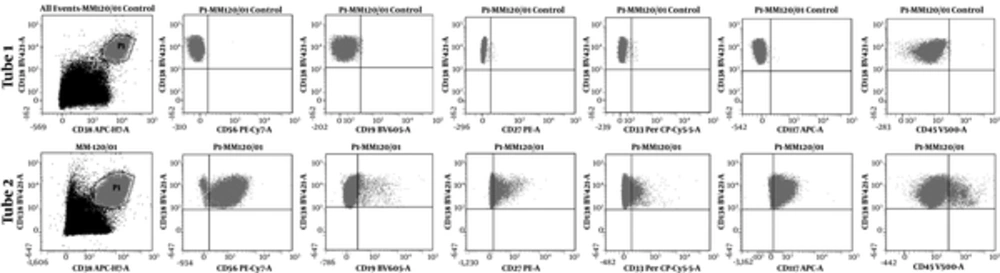
Figure 1.
Bone marrow plasma cells gating strategy by flow cytometry. Tube 1, CD38 and CD138 labeled cells for counting PC and setting the PC autofluorescence background. Tube 2, Abnormal plasma cells immunophenotype pattern from MM patient (This expression pattern represented the most frequent immunophenotype in our cohort).
2.3. Clinical Significance and Risk Stratification
MM patient characteristics at the time of diagnosis were determined according to the percentage of antigens expressed to estimate the impact on clinical features and prognosis. These characteristics include demographic data (age at diagnosis, sex and paraprotein isotype), clinical stage (Durie-Salmon system, DS), international staging system (ISS) designation, world health organization status, survival data (progression free survival, PFS), clinical features (infections, renal failure, neurologic symptoms, and lytic bone lesions) and laboratory parameters (calcium, creatinine, hemoglobin, M protein, β2-microglobulin (B2M), albumin, lactate dehydrogenase (LD), platelet count, bone marrow PC (BMPC) count determined by light microscopy, Bence-Jones proteinuria (BJP), and serum free light chains (sFLC) ratio).
2.4. Statistical Analysis
Statistical analysis was performed, using SPSS software (IBM SPSS Statistics for Windows, Version 22.0. Armonk, NY: IBM Corp.). Nominal variable differences were evaluated, using the Chi-square test, and differences between continuous variables were evaluated, using the Mann-Whitney U test. PFS was measured from the start of treatment until disease progression or death. Survival curves were plotted according to the Kaplan-Meier method and compared, using the log-rank test. When necessary, a multivariate analysis was performed, using Cox modeling. A two-sided P value of < 0.05 was considered statistically significant.
3. Results
3.1. Differential Diagnosis
Using MFC analysis, we identified a mean plasma cell of 10.8% (range: 5.1% - 65%) in the MM patient group compared to 1.67% (range: 0.1% - 6.42%) in the MGUS patient group (P < 0.01). Median differences in antigen expression between 2 groups were statistically significant. In the MM and MGUS groups, respectively, the differences were as follows: CD45- (67.2 vs. 82.9, P = 0.03), CD19- (54.7 vs. 76.1, P < 0.01), CD56+ (17.5 vs. 61.7, P < 0.01), CD27- (24.5 vs. 57.8, P < 0.01), and CD20+ (8.6 vs. 18.6, P < 0.01). No significant differences were detected for CD33 and CD117 between 2 groups. For MM patients, 65% had PCs with monotypic kappa light chains (73/112) and 35% had PCs with lambda light chains (39/112), whereas an even PC cytoplasmic light chain К/λ ratio was observed in MGUS patients.
3.2. Aberrant Immunophenotype Frequencies in MM Patients
In MM patients, a lack of CD45 and CD19 expression was predominant in 98.2% (110 out of 112) and 88.4% (98 out of 112) of patients, respectively. At diagnosis, the overexpression of CD56, a plasma cell anchoring antigen to the stromal environment, was found in 75% of the patients (85 out of 112) and low level expression of CD27, a plasma cell differentiation antigen, was found in 85.7% (96 of 112) of the patients. However, CD33, a myeloid-associated marker, was present in only 21.4% of patients (24 of 112). CD117, a tyrosine kinase receptor, and CD20, a B-cell maturation antigen, were detected in 28.6% (32 out of 112), and 15.4% (14 of 91) of the patients, respectively.
3.3. Prognosis Factors
Based on standard risk stratification variables (DS, ISS and WHO status), the results of the Kaplan-Meier analysis indicated that patients in a high-risk stage (DS stage III, ISS stage III, WHO score of 3 or 4) demonstrated significantly shorter OS times than other patients (P < 0.01). Similarly, patients who were older at the time of diagnosis (> 65 years) or those presented with infections or lytic bone lesions demonstrated shorter PFS times than did other patients (P = 0.0001, P = 0.006 and P = 0.02, respectively).
Kaplan-Meier analysis revealed that decreased platelet (< 150.109/L), Hb (< 10 g/dL), or albumin (< 3.5 g/dL) levels or increased levels of calcium (> 11 mg/dL), creatinine (> 2 mg/dL), B2M (> 4 mg/dL), CRP (> 6 mg/L), or BMPCs (> 30%) significantly influenced OS and PFS times. Moreover, patients with an abnormal FLC ratio (< 0.03 or > 32) had shorter OS and PFS times (P = 0.001). Other clinical or biological parameters had no statistically significant impact on OS and PFS times (Table 3).
Table 3.
Median Survival (Months) and Log-Rank Significance Among Prognosis Factors
| Prognostic Factors | Median Survival, Mo | Log-Rank (Mantel-Cox) | ||
|---|---|---|---|---|
| With Factor | Without Factor | Chi-Square | Pc | |
| ISS stage III | 29 | NR | 10.1 | 0.001 |
| DS stage III | 32 | NR | 7.2 | 0.007 |
| WHO status of 3 or 4 | 28 | NR | 20.1 | 0.0001 |
| Age > 65, y | 28 | NR | 22.8 | 0.0001 |
| Infections | 29 | NR | 7.5 | 0.006 |
| Lytic bone lesion | 32 | 35 | 5.4 | 0.02 |
| Platelets < 150 × 109/L | 27 | NR | 13.4 | 0.0001 |
| sFLC Ratio < 0.03 or > 32 | 29 | NR | 10.3 | 0.001 |
| Calcium > 11 mg/dL | 29 | NR | 9.7 | 0.002 |
| BMPC > 30% | 29 | NR | 8.7 | 0.003 |
| Hb < 10 g/dL | 32 | NR | 7.5 | 0.006 |
| B2M > 4 mg/L | 30 | NR | 7.3 | 0.007 |
| Albumin < 3.5 g/dL | 29 | NR | 6.6 | 0.01 |
| Creatinine > 2 mg/dL | 34 | NR | 4.9 | 0.02 |
| CRP > 6 mg/L | 32 | NR | 4.3 | 0.03 |
| LD > 250 UI/L | 32 | 32 | 0.1 | NS |
| IgA isotype | 29 | 35 | 0.9 | NS |
| BJP positive | 34 | 34 | 0.2 | NS |
Abbreviations: B2M, Beta-2 Microglobulin; BJP, Bence-Jonce Protein; BMPC, Bone Marrow Plasma Cells; CRP, C-Reactive Protein; DS, Durie-Salmon; ISS, International Staging System; LD, Lactate Dehydrogenase; NR, Not Reached; sFLC, Serum Free Light Chain; WHO, World Health Organization Performance Status.
3.4. Impact of MFC Results on Prognosis and Risk Stratification
For MFC results, using a 20% positivity cutoff, Kaplan-Meier analysis indicated that there was no difference in OS or PFS times between MM patients. Subsequently, we tested and evaluated different cutoff points for marker expression until a significant difference in OS and PFS times was observed. The results are summarized in Table 4.
Table 4.
Impact of Antigen Expression Levels on Median Survival (Months) and Log-Rank Significance
| Immunophenotyping | Median Survival, Mo | Log-Rank (Mantel-Cox) | |||
|---|---|---|---|---|---|
| Markers | Cutoff point, % | > Cutoff | < Cutoff | Chi-Square | Pc |
| CD38+CD138+ | 10 | 30 | NR | 4.2 | 0.04 |
| CD19- | 90 | 28 | NR | 15.5 | 0.001 |
| CD56+ | 60 | 29 | NR | 5.1 | 0.02 |
| CD27- | 90 | 29 | NR | 5.3 | 0.02 |
| CD45- | 60 | 32 | 34 | 2.9 | 0.06 |
| CD20+ | 20 | 32 | 33 | 1.1 | 0.12 |
| CD117+ | 20 | 34 | 32 | 2.9 | 0.08 |
| CD33+ | 20 | 32 | 34 | 2.9 | 0.08 |
Abbreviation: NR, Not Reached.
Based on the CD38+/CD138+ ratio and CD19-, CD56+, CD27- and CD45- levels, we combined all of them to obtain an MFC score that ranged from 0 to 5. Score 0 means the absence of expression abnormality of these antigens. A score of 1 means that at least 1 antigen is expressed abnormally and score 5 means that all these antigens are abnormally expressed. The Kaplan-Meier analysis indicated shorter OS and PFS times (P = 0.03) in MM patients with MFC scores of 4 or 5 compared to other subsets (Figure 2A).
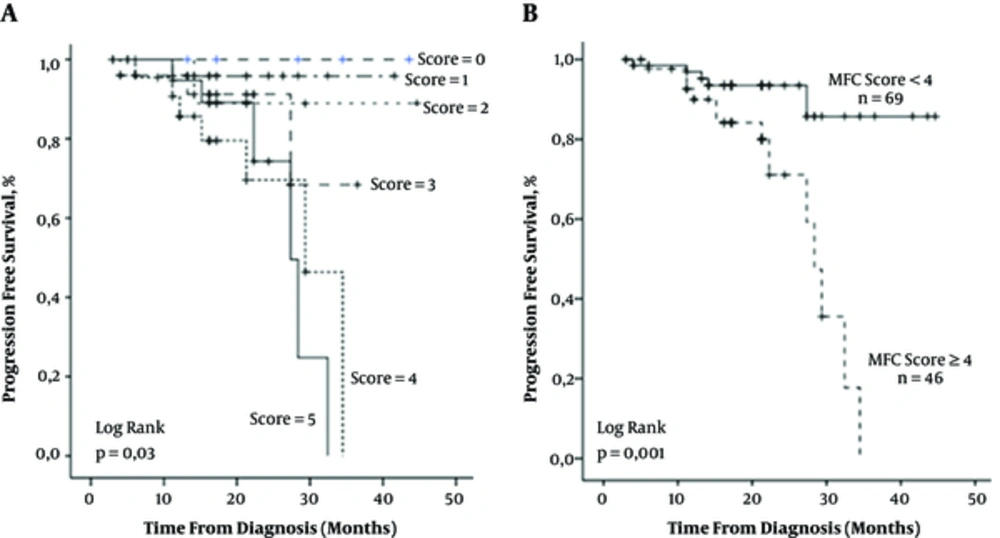
Figure 2.
A, Kaplan-Meier analysis of progression-free survival (PFS) curves in MM patients displaying aberrant antigen expression. Patients with MFC scores ≥ 4 had a significantly shorter survival time (P = 0.03, log-rank test). B, Kaplan-Meier analysis of PFS curves in combined MM patients with MFC scores of 4 or 5 (n = 46) versus other patients (n = 69). Group combination demonstrated better discrimination between longer and shorter survival times (P < 0.001, log-rank test) (MFC Multi-parametric Flow Cytometry).
For subsequent analysis, patients with MFC scores of 4 or 5 were designated as group A (n = 46) and other patients as group B (n = 69). The Kaplan-Meier test demonstrated better discrimination between longer and shorter survival times with an overall statistical significance of P = 0.001 (Figure 2B). To better understand the relationship between these 2 groups and their disease characteristics, we used multivariate analysis to compare prognostic factors. Kaplan-Meier analysis indicated shorter OS and PFS times in group A patients, as well as diagnoses of ISS stage III (P = 0.01), DS stage III (P = 0.006), increased serum B2M (P = 0.01), and lower hemoglobin levels (P = 0.008) (Figure 3A - D). All of these results point to a poor prognosis.
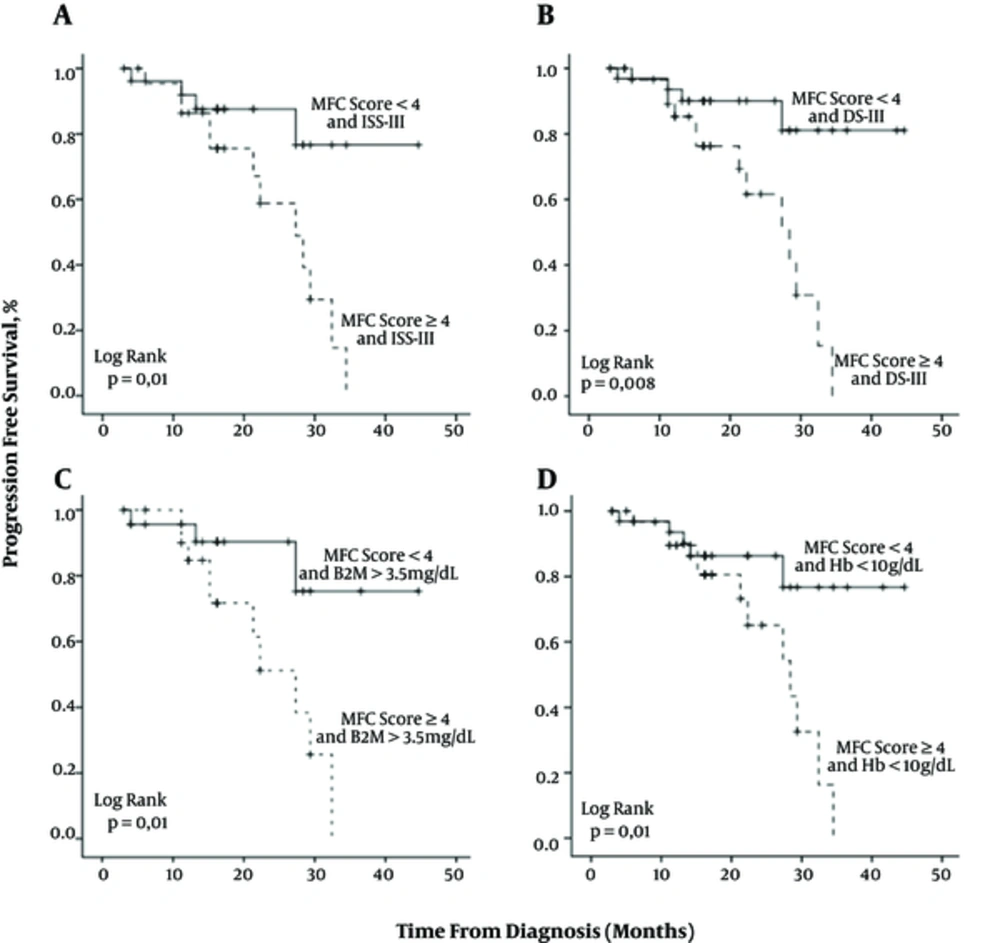
Figure 3.
Kaplan-Meier analysis of progression-free survival curves in MM patients, using MFC scores for A, ISS stage III; B, DS stage III; C, B2M high level (> 3.5 mg/L), and D, low hemoglobin levels (< 10 g/dL). MFC scores ≥ 4 discriminated between high-risk patients with shorter survival times in poor prognosis categories (ISS stage III, P = 0.01; DS stage III, P = 0.008; β, P = 0.01; hemoglobin, P = 0.01). (ISS, International Staging System; Hb, Hemoglobin; MFC, Multi-parametric Flow Cytometry)
4. Discussion
In the last decade, MFC immunophenotyping has been used routinely in clinical settings for the differential diagnosis and risk stratification of patients with monoclonal gammopathy (MG). The present study demonstrated the clinical utility of MFC in the characterization of NeoPCs and the evaluation of patients with PCD.
Immunophenotyping of NeoPCs by MFC allowed us to discriminate between MM and MGUS, with a high statistical significance. Typical antigen levels were more commonly associated with symptomatic MM than MGUS with an overexpression of aberrant markers (CD56, CD20, CD117, CD33) and low expression or absence of normally expressed PC antigens (CD19, CD27). However, it is normal for BM aspirates from patients with MGUS to exhibit a neoplastic phenotype with decreased CD19 and/or CD27 expression and reduced levels of CD45 or overexpression of CD117, as observed with MM patients. Nevertheless, the number of PCs with these marker levels was still less than 1%. This particular expression pattern has been correlated with disease progression in patients with MGUS (9).
From a clinical perspective, the distinction between normal and aberrant PCs has been of great utility in the differential diagnosis of MGUS and MM (19, 20), the evaluation of the risk of transformation of MGUS, and the progression of smoldering MM into symptomatic MM (9). For example, patients with > 5% normal PCs within their BM samples can be assessed for the risk of transformation of MGUS and smoldering MM into symptomatic disease, with 5-year progression rates predicted by PC levels of 25% versus 5% (P < 0.001) and 64% versus 8%, respectively (P < 0.001) (9).
Taken together, these results should encourage the use of MFC in routine practice for MM diagnosis. However, immunohistochemical patterns and plasmablastic morphology assessed by light microscopy are still standard procedures for diagnosis. In Algeria, the routine use of these standard procedures is likely due to the low number of centers conducting MFC analysis; these few centers are focused more on the diagnosis of hematologic malignancies such as leukemia and lymphoma. Another difficulty may be the variable data reports between international groups involved in this field. Even if immunophenotyping were beneficial in differential diagnosis in PCD, clinical correlations and risk stratification have not been consistent.
In agreement with previous studies (18, 21), most of the classical prognosis factors, such as ISS stage, DS stage, WHO status, clinical features, and biological parameters (e.g., FLC ratio, albumin, hemoglobin, creatinine, and platelets levels) discriminated between longer and shorter survival times with overall statistical significance.
On the other hand, multiple studies have clearly demonstrated the prognostic value of specific patterns of antigen expression on NeoPCs. A > 5% proportion of normal plasma cells in patients with MM is associated with favorable clinical outcomes and a lower frequency of high-risk cytogenetic abnormalities (10). Furthermore, the expression of specific antigens has been shown to correlate with prognosis, including CD45, CD56, CD27, CD28, CD19, CD33, CD44, CD52, and CD117 (22-24). In light of this finding, we analyzed the predictive value of NeoPC phenotypes and demonstrated that expression patterns may be a risk stratification factor when analyzing at a different cutoff point than normal (20%). Thus, weak or negative CD19 and CD27 (< 10%), positive CD56 (> 60%), weak or negative CD45 (< 60%), and a flow cytometry PC count (CD38+ CD138+) > 10% demonstrated potential prognosis values. We have also shown that patients having combinations of 4 or 5 of these aberrant antigen expression levels had a negative prognosis and presented with high-risk ISS stage III, DS stage III, lower hemoglobin values, and increased β2-microglobulines levels.
Other groups have reported similar data. CD56 (NCAM-neural cell adhesion molecule), a commonly used marker for identifying abnormal plasma cells, has been correlated with a bad prognosis in myeloma patients treated with conventional therapies compared to patients, who have received autologous stem cell transplants (25, 26). One study demonstrated that a lack of CD56 expression is correlated with the presence of circulating plasma cells (27). Even if heterogeneity of CD56 expression among MM patients implies a prognostic value, it could be difficult to use for data interpretation (28). A study by Moreau et al. demonstrated that a lack of CD27 on myeloma patient PCs had an effect on disease progression. At diagnosis, low CD27 expression correlates with a shorter overall survival rate (29). In addition, transcriptome analysis data show that the lowest CD27 levels are observed in patient groups with poor prognoses (30, 31). In MM patients, CD19 expression levels at the time of diagnosis correlate with an adverse outcome (11), although its clinical value is somewhat hampered by the low frequency (4%) of CD19 expression in MM cases (11).
CD45 is an early stage marker of PC development that progressively decreases during PC maturation. In PCD, the CD45+/CD45- ratio appears to be abnormal in relation to the disease stage. In a study carried out on 95 MM patients undergoing high-dose therapy, patients lacking CD45 expression on PCs had shorter survival times (32). However, these results can be explained by some important biological differences between these 2 cell populations, including their proliferative rates, IL-6 responsiveness and dependence, chromosomal abnormalities, and angiogenic capability (32). A small portion of NeoPCs also expresses the CD20 antigen, as reported by several studies (33, 34).
CD20 antigen expression has been associated with small mature plasma cell morphology and the occurrence of t(11;14) in lymphomas (35). Given the success of anti-CD20 directed monoclonal anti-body therapy in lymphoma, trials have been carried out with Rituximab in myeloma, but without any clear efficacy, suggesting little hope for a positive prognosis (1). Unfortunately, our study did not confirm the prognostic value of the CD117 antigen (36).
Nevertheless, based on Kaplan-Meier analysis, the expression patterns of this antigen within our cohort showed a trend toward longer survival times in patients with positive CD117 expression. In addition to its capacity to distinguish between neoplastic and normal plasma cells (16), CD117 may be a valuable marker for prognosis, as demonstrated in different cohorts (11, 37). Interestingly, patients with a CD45-/CD19-/CD56+/CD27- antigen combination and high PC count (> 10% CD38+ CD138+) demonstrated lower survival times. Furthermore, high-risk ISS stage III, DS stage III, low hemoglobin, and high B2M levels at the time of diagnosis represented the best combination of independent variables for predicting both PFS and OS. These results reinforce the clinical relevance of these antigens and may suggest the possibility of these combinations in assessing the prognosis of MM.
Even though our cohort is relatively homogeneous in terms of therapeutic modalities and clinical outcomes, one possible bias within this study is the lack of patients, who have received autologous stem cell transplants. Regardless of these limitations, this is the first study to describe the clinical usefulness of MFC for assessing PCD patients in Algeria. These data might offer vital baseline information for future clinical trials, using MFC in Algeria.
In conclusion, our results provided a comprehensive approach for the use of MFC in the management of PCD patients by measuring the percentage of NeoPCs and characterizing their specific immunophenotypes. MFC analysis, in conjunction with well-described prognosis factors, can identify subsets of patients with aggressive outcomes and poor prognosis for early treatment regimens.