
1. Background
Multiple myeloma (MM), the second most frequently diagnosed hematological malignancy in high-income countries, arises from the accumulation of myeloma cells in the bone marrow (BM). The global incidence of MM is increasing, accounting for approximately 10% of all blood cancers. Despite the advent of new therapies, MM remains incurable in all but a few patients, who show significant responses to immunotherapy (1, 2).
For more than 3 decades since its introduction, autologous stem cell transplantation (ASCT) has remained the gold standard for treating transplant-eligible patients with MM. High-dose melphalan-based therapy followed by ASCT after primary therapy with a 4-drug regimen comprising immunomodulatory drugs (IMiDs), proteasome inhibitors (PIs), steroids, and, most recently, monoclonal antibodies significantly prolongs progression-free survival (PFS) (3-5). Despite substantial therapeutic advances, disease progression remains common, and clinical outcomes vary considerably among patients (6-9). Tumor burden, host factors, the BM microenvironment, and cytogenetic abnormalities influence the risk of progression in MM (10-12). Therefore, accurate identification of high-risk patients is crucial to guide treatment decisions and optimize outcomes.
Over the years, several disease staging and risk stratification systems have been developed for patients with active MM, including the International Staging System (ISS), Revised-ISS (R-ISS), R2-ISS, and the International Myeloma Society (IMS)/International Myeloma Working Group (IMWG) risk classification systems (10, 13). The International Staging System integrates key laboratory parameters, including serum albumin, β2-microglobulin, and lactate dehydrogenase (LDH), together with cytogenetic data obtained by fluorescence in situ hybridization (FISH) (14-16).
Notably, albumin, a major component of serum total protein, has been consistently associated with the risk of disease progression, with hypoalbuminemia (less than 3.5 g/dL) associated with inferior overall survival (OS) (17, 18). Previous studies have reported that an abnormal albumin-to-globulin ratio (AGR) and albumin-to-M-protein ratio (AMR) are independently associated with worse survival outcomes (19-22). These findings suggest that evaluation of baseline total protein as an integrated biomarker may provide additional prognostic value. However, it remains unclear whether baseline total protein, a simple and readily measurable laboratory parameter, can serve as an independent prognostic biomarker in MM.
2. Objectives
The present study investigated the prognostic significance of baseline total protein for PFS in patients with MM undergoing ASCT.
3. Methods
3.1. Patients
Twenty-one consecutive patients with MM (11 men and 10 women; age range, 36 - 69 years) who underwent ASCT between 2023 and 2025 at the Stem Cell Transplant Research Center of Taleghani Hospital were included in this study. All diagnoses were established according to the IMWG criteria. This study was approved by the Ethics Committee of Shahid Beheshti University of Medical Sciences (Approval ID: IR.SBMU.RETECH.REC.1401.837). Written informed consent was obtained from all patients and/or their guardians. The study was conducted in accordance with the Declaration of Helsinki.
3.2. Data Collection
Laboratory and clinical data at diagnosis and at the time of ASCT were collected from patients' clinical records. Cytogenetic data assessed by FISH, as well as the ISS, R-ISS, R2-ISS, and other established risk stratification parameters, were available for only a limited number of patients (6 - 8 cases); therefore, comprehensive cytogenetic or risk-based staging could not be performed for the entire cohort. Patient age refers to age at the time of ASCT. Patients were followed to assess treatment response at 3 months post-ASCT and to evaluate PFS and OS, with a median follow-up of 19 months (range, 10.5 - 32 months).
3.3. Survival Analysis
PFS and OS were calculated from the date of transplantation to disease progression and death from any cause, respectively. The 12-month PFS was defined as the time from transplantation to disease progression occurring within 12 months post-ASCT. Disease progression and treatment response were defined according to the IMWG criteria. Survival curves were estimated using the Kaplan-Meier method with 95% confidence intervals (CIs), and survival rates between groups were compared using the log-rank test. Kaplan-Meier survival curves were illustrated based on prognostic factors found to be significant in Cox regression analysis.
3.4. Statistical Analysis
Data analyses were conducted using IBM SPSS Statistics version 23.0. For comparisons between the 2 groups, the Mann-Whitney U test or independent-samples t-test and the chi-square (χ2) test or Fisher exact test were used, as appropriate. The Spearman or Pearson test was used to assess the relationship between baseline serum total protein and laboratory parameters, depending on the data distribution. The Cox proportional hazards model was applied to identify predictors of survival. Given the limited sample size and number of events, multivariable Cox regression was not performed. Statistical significance was defined as P < 0.05.
4. Results
4.1. Patients
The laboratory and clinical characteristics of the 21 patients with MM undergoing ASCT are presented in Table 1. The participants included 11 men and 10 women, with a median age of 55 years (range, 36 - 69 years). Patients were classified into 4 groups according to MM isotype: IgGκ, IgGλ, IgAκ, and λ light chain.
Table 1.
Demographic and Clinical Features of MM Patients Undergoing ASCT (21 Patients) a
| Clinical Factors | Values |
|---|---|
| Gender | |
| Male | 11 (52.4) |
| Female | 10 (47.6) |
| Age(y) | 55 (36 - 69) |
| Isotype | |
| IgGκ | 7 (33.3) |
| IgGλ | 7 (33.3) |
| IgAκ | 2 (9.5) |
| λ light chain | 3 (14.3) |
| Unknown | 2 (9.5) |
| Plasma cell | 50 (6 - 95) |
| ≥ 60 | 8 (38.1) |
| < 60 | 13 (61.9) |
| Presence of extramedullary disease | 3 (14.3) |
| CRAB | |
| Hypercalcemia | 0 |
| Renal insufficiency | 3 (14.3) |
| Anemia | 18 (85.7) |
| Bone lesions | 11 (52.4) |
| Initial induction regimen | |
| VRD | 11 (52.4) |
| VCD | 5 (23.8) |
| Others | 5 (23.8) |
| Depth of response before ASCT | |
| CR | 14 (66.7) |
| VGPR | 2 (9.5) |
| PR | 3 (14.3) |
| SD | 1 (4.8) |
| Unknown | 1 (4.8) |
| Time of achieved CR/VGPR/PR/SD (mo) | 7 (2 - 27) |
| Time interval between diagnosis and ASCT (mo) | 11 (7 - 28) |
| Melphalan dose (mg/m2) | |
| ≥ 180 | 6 (28.6) |
| 140 - 179 | 8 (38.1) |
| < 140 | 7 (33.3) |
| Injected stem cell dose (×106/kg) | 5.2 (2.1 - 19.7) |
| Duration of neutrophil engraftment (d) | 11 (9 - 16) |
| Length of hospital stay post-ASCT (d) | 14 (11 - 20) |
| Infection within 3 months post-ASCT | |
| Reactivation of CMV | 1 (4.8) |
| COVID-19 | 1 (4.8) |
| Depth of response at 3 months post-ASCT | |
| CR | 15 (71.4) |
| VGPR | 2 (9.5) |
| PR | 3 (14.3) |
| PD | 1 (4.8) |
| Maintenance regimen | |
| Lenalidomide | 14 (66.7) |
| Proteasome inhibitor-containing regimen | 7 (33.3) |
| Follow-up duration (mo) | 19 (10.5 - 32) |
| 12-month progression-free survival | 16 (76.2) |
| Progression-free survival | 13 (61.9) |
| Overall survival | 18 (85.7) |
a Values are expressed as No. (%) or median (range). Abbreviations: ASCT, autologous stem cell transplantation; CMV, cytomegalovirus; CR, complete response; CRAB, hypercalcemia, renal insufficiency, anemia, and bone lesions; N, number; PD, progressive disease; PR, partial response; SD, stable disease; VCD, bortezomib, cyclophosphamide, and dexamethasone; VGPR, very good partial response; VRD, bortezomib, lenalidomide, and dexamethasone.
At 3 months post-ASCT, 17 patients (81%) achieved very good partial response (VGPR) or better. Patients were monitored for disease progression and survival for a median of 19 months (range, 10.5 - 32 months). During follow-up, 8 patients (38.1%) experienced disease progression, including 5 patients (23.8%) who experienced progression within the first 12 months after ASCT. During the follow-up period, 3 patients (14.3%) died. Table 2 compares the laboratory and clinical characteristics of patients with and without disease progression during follow-up.
Table 2.
Laboratory and Clinical Features of MM Patients with and Without Disease Progression Post-ASCT (N = 21) a
| Clinical Factors | Disease Progression Yes | Disease Progression No | P-Value |
|---|---|---|---|
| Number | 8 | 13 | |
| Gender (n) | 0.387 | ||
| Male (11) | 3 (27.3) | 8 (72.7) | |
| Female (10) | 5 (50) | 5 (50) | |
| Age (y) | 55.3 ± 7 | 56.3 ± 9 | 0.780 |
| Isotype | 0.459 | ||
| IgGκ (7) | 2 (28.6) | 5 (71.4) | |
| IgGλ (7) | 3 (42.9) | 4 (57.1) | |
| IgAκ (2) | 2 (100) | 0 | |
| λ light chain (3) | 1 (33.3) | 2 (66.7) | |
| Unknown (2) | 0 | 2 (100) | |
| Plasma cell (%) | 54.6 ± 22.4 | 45.6 ± 31.8 | 0.493 |
| ≥ 60 (8) | 3 (37.5) | 5 (62.5) | 1.0 |
| < 60 (13) | 5 (38.5) | 8 (61.5) | |
| Presence of extramedullary disease (3) | 1 (33.3) | 2 (66.7) | 1.0 |
| CRAB | |||
| Hypercalcemia | 0 | 0 | |
| Renal insufficiency (3) | 2 (66.7) | 1 (33.3) | 0.531 |
| Anemia (18) | 6 (33.3) | 12 (66.7) | 0.531 |
| Bone lesions (11) | 4 (36.4) | 7 (63.6) | 1.0 |
| Initial induction regimen | 0.611 | ||
| VRD (11) | 3 (27.3) | 8 (72.7) | |
| VCD (5) | 3 (60) | 2 (40) | |
| Others (5) | 2 (40) | 3 (60) | |
| Depth of response before ASCT | 1.0 | ||
| ≥ VGPR (16) | 6 (37.5) | 10 (62.5) | |
| < VGPR (4) | 2 (50) | 2 (50) | |
| Unknown (1) | 0 | 1 (100) | |
| Time of achieved CR/VGPR/PR/SD (mo) | 7 (6 - 7) | 8 (5.5 - 12.7) | 0.278 |
| Time interval between diagnosis and ASCT (mo) | 8.5 (7.3 - 10.9) | 12.7 (9.5 - 20.8) | 0.088 |
| Melphalan dose (mg/m2) | 0.207 | ||
| ≥ 180 (6) | 2 (33.3) | 4 (66.7) | |
| 140 - 179 (8) | 5 (62.5) | 3 (37.5) | |
| < 140 (7) | 1 (14.3) | 6 (85.7) | |
| Injected stem cell dose, ×106/kg | 4.2 (2.4 - 7.4) | 5.9 (3.3 - 7.1) | 0.538 |
| Duration of neutrophil engraftment (d) | 11 (10 - 12) | 11 (11 - 12) | 0.638 |
| Length of hospital stay post-ASCT (d) | 13.5 (12 - 15) | 14 (14 - 16.5) | 0.128 |
| Infection within 3 months post-ASCT | 0.133 | ||
| Reactivation of CMV | 1 (100) | 0 | |
| COVID-19 | 1 (100) | 0 | |
| Depth of response at 3 months post-ASCT | 0.618 | ||
| ≥ VGPR (17) | 6 (35.3) | 11 (64.7) | |
| < VGPR (4) | 2 (50) | 2 (50) | |
| Laboratory data at MM diagnosis time | |||
| Total protein (g/dL) | 10.04 ± 1.81 | 8.24 ± 1.95 | 0.060 |
| Albumin (g/dL) | 4.05 ± 0.50 | 3.86 ± 0.43 | 0.444 |
| Globulin (g/dL) | 7 (4.4 - 7.5) | 5.7 (2.9 - 7.1) | 0.397 |
| AGR | 0.68 (0.46 - 0.83) | 0.57 (0.40 - 1.37) | 0.458 |
| M protein (g/dL) | 4.74 ± 1.32 | 3.97 ± 1.65 | 0.369 |
| WBC (/μL) | 5671 ± 1962 | 6040 ± 1193 | 0.625 |
| ANC (/μL) | 3264 ± 1475 | 2997 ± 793 | 0.649 |
| ALC (/μL) | 1934 ± 586 | 2223 ± 659 | 0.378 |
| AMC (/μL) | 326 ± 225 | 511 ± 154 | 0.071 |
| NLR | 1.7 (1.1 - 1.8) | 1.5 (1 - 2) | 0.750 |
| LMR | 6.4 (3.7 - 13.3) | 4.4 (3.5 - 6) | 0.185 |
| Platelet (×103/μL) | 205 ± 62 | 225 ± 70 | 0.535 |
| PLR | 111 ± 37 | 106 ± 45 | 0.842 |
| Hb (g/dL) | 10.7 ± 3.3 | 10.8 ± 1.9 | 0.880 |
| RDW (%) | 14.65 (12.9 - 15.8) | 14.15 (13.8 - 17.8) | 0.796 |
| ESR (%) | 90 ± 41 | 82 ± 51 | 0.698 |
a Values are expressed as mean ± SD, median (interquartile range) or No. (%). Abbreviations: AGR, albumin-to-globulin ratio; ALC, absolute lymphocyte count; AMC, absolute monocyte count; ANC, absolute neutrophil count; ASCT, autologous stem cell transplantation; CMV, cytomegalovirus; CR, complete response; CRAB, hypercalcemia, renal insufficiency, anemia, and bone lesions; ESR, erythrocyte sedimentation rate; Hb, hemoglobin; LMR, lymphocyte-to-monocyte ratio; M protein, monoclonal protein; N, number; NLR, neutrophil-to-lymphocyte ratio; PD, progressive disease; PLR, platelet-to-lymphocyte ratio; PR, partial response; RDW, red cell distribution width; SD, stable disease; VCD, bortezomib, cyclophosphamide, and dexamethasone; VGPR, very good partial response; VRD, bortezomib, lenalidomide, and dexamethasone; WBC, white blood cell.
4.2. Prognostic Factors for Disease Progression Post-ASCT
To identify prognostic factors associated with disease progression, a Cox proportional hazards model was used. In univariate analysis, higher baseline total protein was significantly associated with shorter PFS (hazard ratio [HR], 2.10; 95% CI, 1.08 - 4.08; P = 0.028), whereas higher absolute monocyte count (AMC) was significantly associated with longer PFS (HR, 0.995; 95% CI, 0.991 - 1.00; P = 0.049) (Table 3). Detailed results are presented in Table 3.
Table 3.
Risk Factors for Disease Progression in MM Patients Undergoing ASCT a
| Predictive Variables | HR (95% CI) b | P-Value |
|---|---|---|
| Gender | 0.47 (0.11 - 1.99) | 0.306 |
| Age (y) | ||
| < 60 | Reference | |
| ≥ 60 | 0.75 (0.18 - 3.16) | 0.698 |
| Plasma cell ≥ 60% | 1.02 (0.24 - 4.31) | 0.981 |
| Presence of extramedullary disease | 0.52 (0.06 - 4.4) | 0.548 |
| CRAB | ||
| Renal insufficiency | 1.68 (0.34 - 8.40) c | 0.527 |
| Anemia | 0.37 (0.07 - 1.93) | 0.240 |
| Bone lesions | 1.02 (0.25 - 4.21) | 0.978 |
| Initial induction regimen | ||
| VRD | Reference | |
| VCD | 0.53 (0.09 - 3.25) | 0.495 |
| Others | 1.49 (0.25 - 8.96) c | 0.661 |
| Depth of response before ASCT ≥ VGPR | 0.57 (0.11 - 2.89) | 0.496 |
| Time of achieved CR/VGPR/PR/SD | 0.91 (0.75 - 1.10) | 0.305 |
| Time interval between diagnosis and ASCT | 0.94 (0.82 - 1.07) | 0.362 |
| Melphalan dose (mg/m2) | ||
| ≥ 140 | Reference | |
| < 140 | 0.57 (0.13 - 2.40) | 0.440 |
| Injected stem cell dose (×106/kg) | 0.99 (0.82 - 1.20) | 0.938 |
| Duration of engraftment (d) | 1.0 (0.55 - 1.84) | 0.985 |
| Length of hospital stay post-ASCT (d) | 1.04 (0.93 - 1.18) | 0.488 |
| Depth of response at 3 months ≥ VGPR | 2.05 (0.40 - 10.43) c | 0.388 |
| Laboratory data at MM diagnosis | ||
| Total protein (g/dL) | 2.10 (1.08 - 4.08) | 0.028 |
| Albumin (g/dL) | 1.27 (0.18 - 8.82) c | 0.812 |
| Globulin (g/dL) | 1.59 (0.87 - 2.90) | 0.128 |
| AGR | 0.44 (0.05 - 3.75) | 0.456 |
| M protein (g/dL) | 1.69 (0.81 - 3.52) | 0.162 |
| WBC (/μL) | 1.0 (0.99 - 1.0) | 0.460 |
| ANC (/μL) | 1.0 (0.99 - 1.0) | 0.909 |
| ALC (/μL) | 1.0 (0.99 - 1.0) | 0.905 |
| AMC (/μL) | 0.995 (0.991 - 1.0) | 0.049 |
| NLR | 0.85 (0.36 - 2.02) | 0.714 |
| LMR | 1.28 (0.986 - 1.66) | 0.064 |
| Platelet (×103/μL) | 1.0 (1.0 - 1.0) | 0.742 |
| PLR | 1.0 (0.98 - 1.02) | 0.993 |
| Hb (g/dL) | 0.91 (0.66 - 1.26) | 0.564 |
| RDW (%) | 0.75 (0.42 - 1.34) | 0.332 |
| ESR (%) | 1.01 (0.99 - 1.03) | 0.347 |
a Values are expressed as hazard ratios (HRs) (95% confidence intervals). Abbreviations: AGR, albumin-to-globulin ratio; ALC, absolute lymphocyte count; AMC, absolute monocyte count; ANC, absolute neutrophil count; ASCT, autologous stem cell transplantation; CMV, cytomegalovirus; CR, complete response; CRAB, hypercalcemia, renal insufficiency, anemia, and bone lesions; ESR, erythrocyte sedimentation rate; Hb, hemoglobin; LMR, lymphocyte-to-monocyte ratio; M protein, monoclonal protein; N, number; NLR, neutrophil-to-lymphocyte ratio; PD, progressive disease; PLR, platelet-to-lymphocyte ratio; PR, partial response; RDW, red cell distribution width; SD, stable disease; VCD, bortezomib, cyclophosphamide, and dexamethasone; VGPR, very good partial response; VRD, bortezomib, lenalidomide, and dexamethasone; WBC, white blood cell.
b HR with 95% CI was obtained using the Cox proportional hazards model to evaluate the association between variables and PFS.
c HR and 95% CI for these variables are wide due to the limited sample size, reflecting low precision; these findings are not statistically significant and should be interpreted with caution. P values < 0.05 were considered statistically significant.
4.3. Impact of Baseline Total Protein on Survival Outcomes Post-ASCT
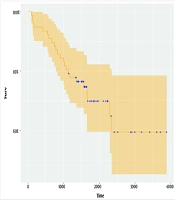
As noted above, higher baseline total protein levels were significantly associated with shorter PFS. For visualization of survival outcomes, patients were stratified by the median value (≤ 9 g/dL and > 9 g/dL). Kaplan-Meier analysis showed that baseline total protein levels > 9 g/dL were significantly associated with worse outcomes in MM patients post-ASCT. Patients with baseline total protein > 9 g/dL had shorter PFS and 12-month PFS than those with baseline total protein ≤ 9 g/dL (log-rank test; P = 0.008 and P = 0.029, respectively) (Figure 1). In addition, a trend toward shorter OS was observed in these patients, although the difference did not reach statistical significance (log-rank test; P = 0.052) (Figure 2).
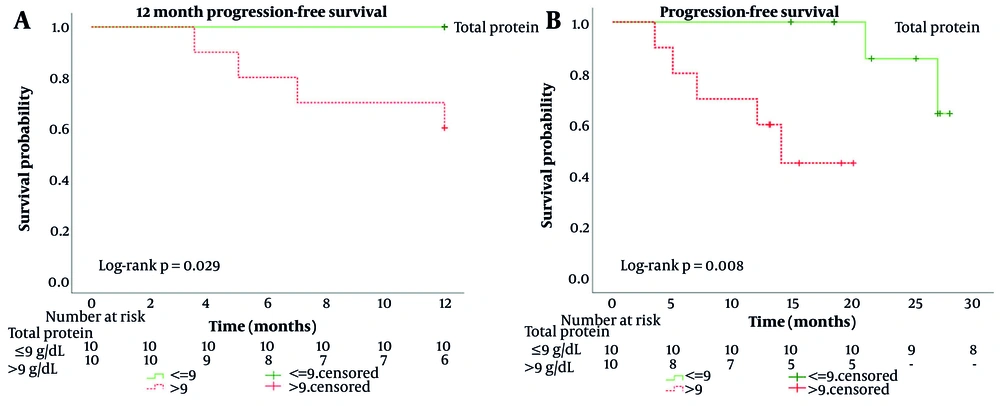
Figure 1.
Kaplan-Meier survival estimate of PFS in 20 MM patients undergoing ASCT according to baseline total protein level (≤ 9 g/dL vs > 9 g/dL). The figure shows (A) 12-month PFS and (B) overall PFS over 32 months of follow-up (log-rank test; P = 0.029 and P = 0.008, respectively).
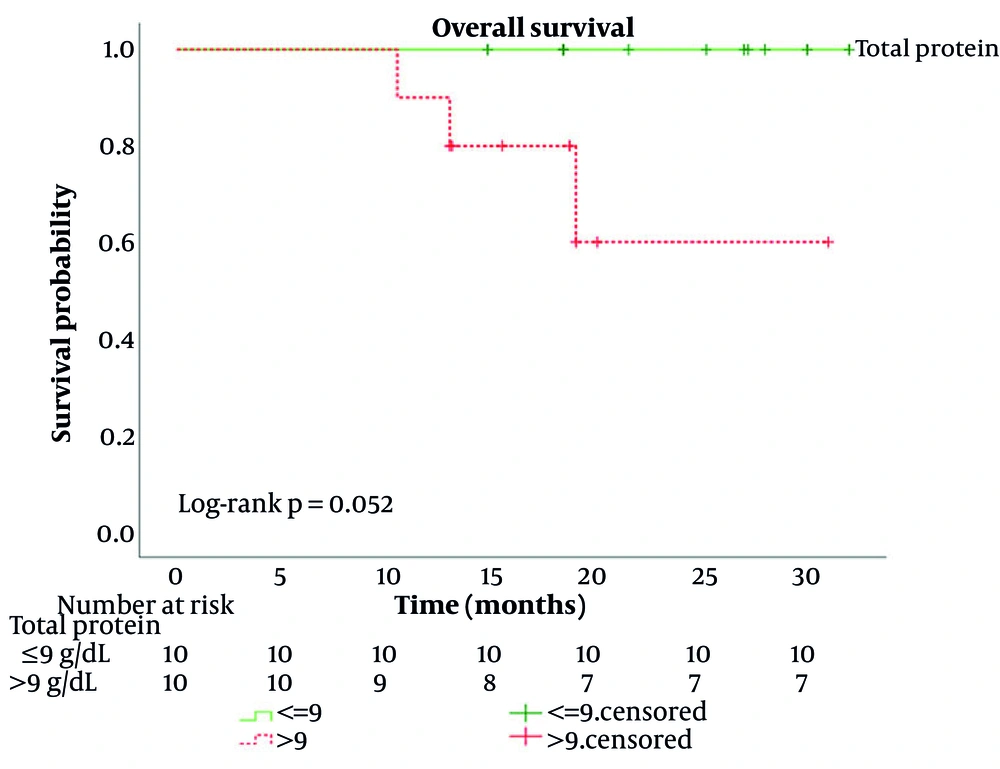
Figure 2.
Kaplan-Meier survival estimate of overall survival (OS) over 32 months of follow-up in 20 MM patients undergoing ASCT according to baseline total protein level (≤ 9 g/dL vs > 9 g/dL) (log-rank test; P = 0.052).
4.4. Association of Baseline Total Protein Levels with Laboratory and Clinical Parameters
To further characterize patients according to baseline total protein levels, laboratory and clinical parameters were compared between 2 groups (≤ 9 g/dL vs > 9 g/dL). Patients with baseline total protein > 9 g/dL had significantly lower hemoglobin levels and higher ESR values than those with total protein ≤ 9 g/dL (P = 0.034 and P = 0.033, respectively). Globulin and M-protein levels were significantly higher in this group (P < 0.001 and P = 0.002, respectively), whereas AGR was significantly lower (P = 0.030) (Figure 2). Detailed results are presented in Table 4.
Table 4.
Laboratory and Clinical Features of MM Patients Undergoing ASCT According to Baseline Total Protein (≤ 9 g/dL vs > 9 g/dL) a
| Clinical Factors | Baseline Total Protein ≤ 9 g/dL | Baseline Total Protein > 9 g/dL | P-Value |
|---|---|---|---|
| Number | 10 | 10 | |
| Gender (n) | 1.0 | ||
| Male (11) | 6 (54.5) | 5 (45.5) | |
| Female (9) | 4 (44.4) | 5 (55.6) | |
| Age (y) | 57.3 ± 9.6 | 54.6 ± 7 | 0.483 |
| Isotype | 0.244 | ||
| IgGκ (6) | 2 (33.3) | 4 (66.7) | |
| IgGλ (7) | 2 (28.6) | 5 (71.4) | |
| IgAκ (2) | 1 (50) | 1 (50) | |
| λ light chain (3) | 3 (100) | 0 | |
| Unknown (2) | 2 (100) | 0 | |
| Plasma cell (%) | 44.30 ± 30.6 | 53.7 ± 28.2 | 0.484 |
| ≥ 60 (12) | 7 (58.3) | 5 (41.7) | 0.650 |
| < 60 (8) | 3 (37.5) | 5 (62.5) | |
| Presence of extramedullary disease (3) | 3 (100) | 0 | 0.211 |
| CRAB | |||
| Renal insufficiency (3) | 1 (33.3) | 2 (66.7) | 1.0 |
| Anemia (17) | 8 (47.1) | 9 (52.9) | 1.0 |
| Bone lesions (10) | 5 (50) | 5 (50) | 1.0 |
| Initial induction regimen | 0.204 | ||
| VRD (10) | 7 (70) | 3 (30) | |
| VCD (5) | 1 (20) | 4 (80) | |
| Others (5) | 2 (40) | 3 (60) | |
| Depth of treatment response before ASCT | 0.582 | ||
| ≥ VGPR (15) | 8 (53.3) | 7 (46.7) | |
| < VGPR (4) | 1 (25) | 3 (75) | |
| Unknown (1) | 1 (100) | 0 | |
| Time of achieved CR/VGPR/PR/SD (mo) | 7 (4.5 - 12) | 7 (7 - 11) | 0.466 |
| Time interval between diagnosis and ASCT, mo | 10.8 (7.5 - 16.5) | 11.9 (8.8 - 20.6) | 0.495 |
| Melphalan dose (mg/m2) | 0.523 | ||
| ≥ 180 (5) | 2 (40) | 3 (60) | |
| 140 - 179 (8) | 3 (37.5) | 5 (62.5) | |
| < 140 (7) | 5 (71.4) | 2 (28.6) | |
| Injected stem cell dose (×106/kg) | 5.2 (3.3 - 8) | 4.8 (2.8 - 6.7) | 0.571 |
| Duration of neutrophil engraftment (d) | 11 (11 - 12) | 11 (11 - 12) | 0.740 |
| Length of hospital stay post-ASCT (d) | 14 (14 - 18) | 14 (13 - 15) | 0.560 |
| Infection within 3 months post-ASCT | 0.474 | ||
| Reactivation of CMV | 0 | 1 (100) | |
| COVID-19 | 0 | 1 (100) | |
| Depth of treatment response at 3 months post-ASCT | 1.0 | ||
| ≥ VGPR (17) | 9 (52.9) | 8 (47.1) | |
| < VGPR (3) | 1 (33.3) | 2 (66.7) | |
| Laboratory data at MM diagnosis time | |||
| Albumin (g/dL) | 4.2 ± 0.29 | 3.8 ± 0.50 | 0.114 |
| Globulin (g/dL) | 2.9 (2.5 - 3.4) | 7.1 (6.2 - 7.6) | < 0.001 |
| AGR | 1.38 (0.7 - 1.5) | 0.52 (0.44 - 0.67) | 0.030 |
| M protein (g/dL) | 2.5 ± 1.0 | 5.0 ± 1.0 | 0.002 |
| WBC (/μL) | 6325 ± 1146 | 5671 ± 1762 | 0.386 |
| ANC (/μL) | 3462 ± 903 | 2973 ± 1260 | 0.429 |
| ALC (/μL) | 2108 ± 902 | 2087 ± 473 | 0.954 |
| AMC (/μL) | 465 ± 183 | 450 ± 194 | 0.883 |
| NLR | 1.6 (1.2 - 2.7) | 1.5 (0.9 - 1.9) | 0.478 |
| LMR | 4.3 (3.2 - 7.5) | 5.4 (3.6 - 6.5) | 0.723 |
| Platelet (×103/μL) | 231 ± 62 | 203 ± 73 | 0.413 |
| PLR | 116.8 ± 34.8 | 102 ± 46 | 0.516 |
| Hb (g/dL) | 12.0 ± 2.2 | 9.7 ± 2.3 | 0.034 |
| RDW (%) | 14.3 (13.5 - 17.9) | 14.4 (13.6 - 15.8) | 0.770 |
| ESR (%) | 55 ± 51 | 105 ± 27 | 0.033 |
a Values are expressed as mean ± SD, median (interquartile range) or No. (%). Abbreviations: AGR, albumin-to-globulin ratio; ALC, absolute lymphocyte count; AMC, absolute monocyte count; ANC, absolute neutrophil count; ASCT, autologous stem cell transplantation; CMV, cytomegalovirus; CR, complete response; CRAB, hypercalcemia, renal insufficiency, anemia, and bone lesions; ESR, erythrocyte sedimentation rate; Hb, hemoglobin; LMR, lymphocyte-to-monocyte ratio; M protein, monoclonal protein; N, number; NLR, neutrophil-to-lymphocyte ratio; PD, progressive disease; PLR, platelet-to-lymphocyte ratio; PR, partial response; RDW, red cell distribution width; SD, stable disease; VCD, bortezomib, cyclophosphamide, and dexamethasone; VGPR, very good partial response; VRD, bortezomib, lenalidomide, and dexamethasone; WBC, white blood cell.
Correlation analyses were also performed to assess the relationship between baseline total protein and laboratory parameters. Total protein levels showed a significant negative correlation with hemoglobin (r = -0.583, P = 0.007) and a significant positive correlation with ESR (r = 0.686, P = 0.002). Strong positive correlations were observed between total protein and both M-protein (r = 0.834, P < 0.001) and globulin levels (r = 0.922, P < 0.001). Although AGR demonstrated a moderate negative correlation with total protein (r = -0.418), this relationship was not statistically significant (P = 0.107) (Figure 3).
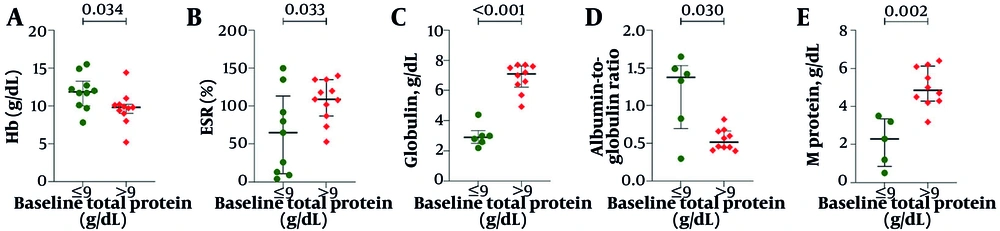
Figure 3.
Comparison of laboratory parameters according to baseline total protein level (≤ 9 g/dL vs > 9 g/dL). (A) Hb, (B) ESR, (C) globulin, (D) albumin-to-globulin ratio (AGR), and (E) M-protein. Scatter plots represent individual subjects along with the median and interquartile range. P values < 0.05 were considered statistically significant. Abbreviations: ESR, erythrocyte sedimentation rate; Hb, hemoglobin; M protein, monoclonal protein.
5. Discussion
The results of this study indicate that elevated baseline total protein was significantly associated with inferior PFS in MM patients undergoing ASCT. In univariable Cox regression analysis, baseline total protein and AMC were the only variables significantly associated with survival. Notably, patients with baseline total protein levels > 9 g/dL exhibited significantly worse PFS throughout follow-up period and at 12 months. A trend toward inferior OS was also observed, although it did not reach statistical significance, possibly due to the small number of deaths.
To our knowledge, baseline total protein has not previously been reported as an independent prognostic factor in MM. Although individual components of serum proteins, such as hypoalbuminemia, elevated globulin levels, increased M-protein concentration, and reduced AGR, have been associated with adverse outcomes (17-22) (Table 5), the prognostic value of baseline total protein as a composite and readily available laboratory parameter has not been systematically evaluated. Our findings suggest that baseline total protein may reflect tumor burden and could serve as a simple surrogate marker.
Table 5.
Recent Evidence on Albumin and Related Serum Protein Ratios as Prognostic Biomarkers in MM Patients
| Investigated Biomarker | Study Population | Main Findings | Ref |
|---|---|---|---|
| Albumin | Newly diagnosed MM patients (n = 373); 136 received conventional therapy, and 237 underwent ASCT | Hypoalbuminemia (< 3.5 g/dL) was significantly related to inferior OS during follow-up. | (17) |
| Newly diagnosed MM patients (n = 377); 229 received conventional therapy, and 148 underwent ASCT | Normal serum albumin levels were significantly correlated with favorable outcomes. | (18) | |
| AGR | Newly diagnosed MM patients (n = 65) | Low AGR is associated with worse 24- and 36-month OS, whereas a higher globulin-to-albumin ratio is associated with inferior OS during follow-up. | (20) |
| Newly diagnosed MM patients (n = 200); 190 receiving conventional therapy and 10 underwent ASCT | Higher AGR was associated with improved OS and PFS. | (21) | |
| MM patients with renal impairment (n = 79); 76 receiving conventional therapy and 3 underwent ASCT | Low AGR independently predicted inferior OS. | (22) | |
| AMR | Newly diagnosed MM patients (n = 103); 47 receiving conventional therapy and 56 receiving thalidomide, bortezomib alone or in combination with conventional agents | AMR < 1 at diagnosis was associated with worse 2- and 5-year OS. | (19) |
Abbreviations: AGR, albumin-to-globulin ratio; AMR, albumin-to-monoclonal protein ratio; OS, overall survival; PFS, progression-free survival.
Our comparative analysis supports the biological plausibility of this observation. Patients with baseline total protein levels > 9 g/dL had significantly higher globulin and M-protein levels, along with a reduced AGR. These findings suggest that elevated total protein may indicate a higher M-protein burden and greater disease activity at the time of diagnosis.
Moreover, patients with elevated total protein had lower hemoglobin levels and higher ESR at diagnosis. Anemia and elevated ESR are well-recognized markers of disease activity and systemic inflammation in patients with MM (23, 24). The concurrence of these abnormalities further supports the notion that elevated total protein is associated with increased disease activity and may serve as a readily measurable marker of disease burden.
Correlation analyses further supported these observations, showing that baseline total protein was inversely associated with hemoglobin, tended to be inversely associated with AGR, and was positively associated with ESR, M-protein, and globulin levels. These associations reinforce the findings from the group-based comparisons, highlighting total protein as a potential surrogate marker of disease burden.
AMC also emerged as significant in the univariable Cox analysis. Subgroup analyses suggested that monocytopenia might be associated with poorer outcomes (not shown). Previous studies have indicated that abnormal AMC predicts inferior overall survival in patients with MM at diagnosis and during follow-up (25, 26). These findings highlight the potential utility of AMC as a simple, readily available biomarker for risk stratification and warrant further investigation in prospective studies to clarify the functional role of monocytes in MM.
Our study has several limitations. Multivariable Cox regression modeling was not feasible due to the limited number of events and the small sample size. Additionally, the low number of death events may explain the lack of statistical significance in OS despite the observed trend toward inferior survival.
Despite these limitations, our study has notable strengths. Total protein is an inexpensive and widely available laboratory parameter routinely measured in clinical practice. If validated in larger cohorts, baseline total protein could potentially serve as a simple and accessible prognostic marker, particularly in resource-limited settings where advanced molecular risk stratification is not readily available.
5.1. Conclusions
Elevated baseline total protein appears to be associated with inferior PFS in MM patients undergoing ASCT. Given its simplicity and universal availability, it may represent a cost-effective and accessible prognostic marker at the time of diagnosis. Larger prospective studies are needed to validate its independent prognostic value.