Fulltext
Full text is available in PDF.
International Journal of Cancer Management
The Official Journal of Cancer Research Center (CRC), Shahid Beheshti University of Medical Sciences
Authors
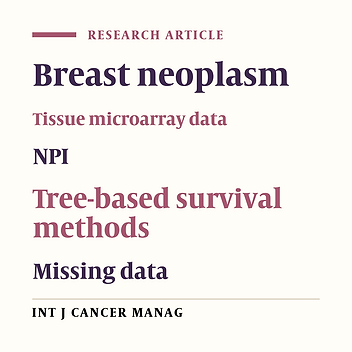
Background: The Nottingham Prognostic Index (NPI) is widely-used in the UK for risk stratification of breast cancer patients. This paper aims to evaluate the ability of this index to detect patients with sufficiently low risk of recurrence that they could be spared harsh treatments, and to construct an enhanced prognostic rule that integrates biomarkers with clinical variables to achieve better risk stratification.
Methods: We undertook review of published studies of outcomes in risk groups derived by applying NPI, and report estimated event-free rates extracted from Then we analysed biological and clinical variables for 401 ER+ patients, to develop a Tree-based Survival Model (TSM), for risk prediction, and estimated event-free rates by resulting risk-groups, Kaplan-Meier (K-M) curves corresponding to TSM and NPI were plotted.
Results: We concluded that NPI does not distinguish low risk patients with a sufficiently high event-free rate to make it likely clinicians would decide treatments with potential harmful side effects can be avoided in that group. On the other hand, in the decision tree constructed, utilising 3 biomarkers, nodal status and tumour size, the 4 risk groups were clearly diverged in terms of event-free rates.
Conclusion: There is considerable potential for improved prognostic modelling by incorporation of biological variables into risk prediction. Whilst low risk patients identified by our TSM model could potentially avoid systemic treatment, higher risk patients might require additional treatment, including chemotherapy or other adjuvant treatment options. However, the decision tree model needs to be validated in a larger clinical trial cohort.
© 2010, Author(s). This open-access article is available under the Creative Commons Attribution 4.0 (CC BY 4.0) International License (https://creativecommons.org/licenses/by/4.0/), which allows for unrestricted use, distribution, and reproduction in any medium, provided that the original work is properly cited.
Allaveisi F, Abdolmohammadi J, Parvaz H, Ghaznavi H. Unsupervised Machine Learning for Five-Year Survival Prediction in Non-metastatic Breast Cancer Patients Treated with Chemotherapy, Radiotherapy, and Surgery. Int J Cancer Manag. 2026;19(1):e169145. doi: https://doi.org/10.5812/ijcm-169145
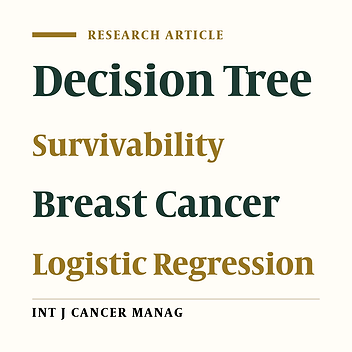
Momenyan S, Baghestani AR, Momenyan N, Naseri P, Akbari ME. Survival Prediction of Patients with Breast Cancer: Comparisons of Decision Tree and Logistic Regression Analysis. Int J Cancer Manag. 2018;11(7):e9176. doi: https://doi.org/10.5812/ijcm.9176
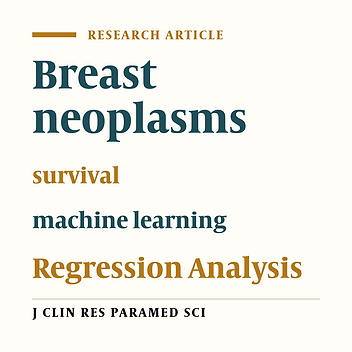
LotfnezhadAfshar H, Rahmatnejad L, Rahimi B, Khalkhali HR. Presentation of hidden knowledge from a localbreast cancer dataset by the classification and regression trees. J Clin Res Paramed Sci. 2017;6(2):e81268. doi:
Zamaninasab F, Fendereski A, Zamaninasab Z, Godazandeh G, Yazdani Charati J. Predicting Factors Affecting Lymph Node Involvement in Breast Cancer Using Random Forest Approaches. Int J Cancer Manag. 2024;17(1):e140283. doi: https://doi.org/10.5812/ijcm-140283

Nejati K, Fekri Aval S, Alivand M, Akbarzadeh A, Arabzadeh A. Prominent Prognostic Factors in Aggressive Breast Cancer: A Review. Int J Cancer Manag. 2021;14(9):e109015. doi: https://doi.org/10.5812/ijcm.109015
Last Update: 3 weeks ago
Last Update: 3 weeks ago
Last Update: 3 weeks ago
Last Update: 7 hours ago
Last Update: 1 day ago
Last Update: 4 days ago