Fulltext
This part is available in the PDF file.
International Journal of Endocrinology and Metabolism
Research Institute for Endocrine Sciences
Image Credit:Int J Endocrinol Metab
Authors
Atherosclerotic coronary vascular disease (CVD) is a major cause of mortality and morbidity among diabetic patients. The ankle-brachial pressure index (ABI) is a simple screening procedure used in primary care settings for high risk populations, such as in diabetic patients, in whom medial arterial calcification results in falsely elevated ABI, which complicates?? the value of ABI in predicting CVD. The aim of this study was to determine whether ABI or Toe-brachial index (TBI) abnormalities can be used to identify asymptomatic type 2 diabetic patients with CVD.
Materials &Methods: In this case control study, 91 patients with Type 2 DM were selected. All the patients, who had documented evidence for presence or absence of CVD, completed a questionnaire regarding medical history, following which TBI and ABI were measured using a handheld ultrasound Doppler. ABI values less than 0.9 and TBI less than 0.7 considered abnormal.
Results: Forty-four persons (patient group) had documented CVD and 47 had normal angiography (control group). ABI < 0.9 was present in 13.6% of the patient group and in 8.5% of control group; TBI < 0.7 was present in 34.1% of the patients group and 23.4% of controls. There was no significant difference between abnormal ABI and abnormal TBI in the patients or and controls. Sensitivity and specificity of abnormal results in prediction of CVD was 13.6% and 91.4% for ABI and 34% and 76.5% for TBI.
Conclusion: Our study shows lack of sensitivity of ABI and TBI in identifying diabetic patients with CVD due to accelerated atherosclerosis.
© 2009, Author(s). This open-access article is available under the Creative Commons Attribution 4.0 (CC BY 4.0) International License (https://creativecommons.org/licenses/by/4.0/), which allows for unrestricted use, distribution, and reproduction in any medium, provided that the original work is properly cited.
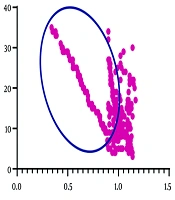
Pishgahi M, Niroomand M, Tahazadeh SP. Association of Ankle-Brachial Index with Coronary Artery Disease Burden in Patients with Type 2 Diabetes and Stable Angina. Int J Cardiovasc Pract. 2025;10(2):e168409. doi: https://doi.org/10.69107/intjcardiovascpract-168409
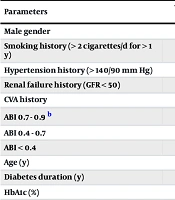
Pishgahi M, Niroomand M, Motahari SM. Ankle-Brachial Index Changes in Patients with Diabetes Presenting with Acute Coronary Syndrome During the Early and Late Phases. Int J Cardiovasc Pract. 2026;11(1):e173273. doi: https://doi.org/10.5812/ijcp-173273
Vakili H, Sadeghi R, Doustali K, Saadat H, Namazi MH, et al. Evaluation of Asymptomatic Peripheral Arterial Disease by Ankle- Brachial Index in Patients with Concomitant Coronary Arterial Disease. Int Cardiovasc Res J. 2017;6(4):e12790. doi:
Kamal Hedayat D, Karim H. Correlation between carotid stenosis and severity of coronary disease in diabetic candidates for angiography in cardiology clinic of Shariati Hospital in 2011. J Kermanshah Univ Med Sci. 2013;17(1):e77142. doi:
Dehdashti Sharokh H, Zakerkish M, Sina AH, Saki A, Forouzan F, et al. Diagnostic Value of Carotid Artery Intima-media Thickness in Patients with Type 2 Diabetes and Its Correlation with HbA1c Levels. Jundishapur J Chronic Dis Care. 2021;10(2):e111308. doi: https://doi.org/10.5812/jjcdc.111308
More by these authors
Last Update: 3 weeks ago
Last Update: 3 weeks ago
Last Update: 3 weeks ago
Last Update: 7 hours ago
Last Update: 1 day ago
Last Update: 4 days ago
