
1. Background
Adolescents aged 10 - 19 years are the most likely to crave substance abuse. Adolescent substance abuse has increased significantly in recent years (1) so that a high percentage of adolescents are exposed to substance abuse (2). Nine out of 10 adult addicts experienced substance abuse before they turned 18 (3). What makes the situation more difficult is that adolescents with substance abuse often also exhibit psychiatric disorders (4).
The craving for substance use is the core motivator of addiction, the continuance of substance abuse, and the return to addiction after treatment begins (5). The craving in substance use is a multidimensional, personal experience making a person inclined to acquire a pleasant feeling and to overcome an unpleasant feeling (6). In a limited definition, some researchers defined craving as a strong desire, while others, in addition to desire, mentioned a range of characteristics, such as predicting the reinforcing effects of the drug, paying attention to engaging in drug use, and tendencies that drive the individual to perform a particular action (7). When an adolescent is in a high-risk situation, while cannot develop effective and appropriate responses, s/he experiences a decrease in self-efficacy and will develop positive expectations in the face of craving, lapse, and return to substances (8).
Although individual therapies, such as the 12-step self-help groups, are useful and accessible programs, they have not been developed for families with a teenager. On the other hand, parents of teenagers are usually not comfortable with these programs. Besides, individualized addiction treatment programs rarely continue to provide ongoing care for adolescents and their families (9).
Some studies mentioned family-related factors as the most important factors that contribute to drug abuse desire (10, 11). Therefore, family-based interventions are the most effective way of preventing or treating adolescents involved with substance abuse (12). A meta-analysis study reported that of the six most effective substance abuse treatments for adolescents, five were family-based interventions: Multidimensional family therapy, functional family therapy, multi-systemic therapy, behavioral, strategic family therapy, and behavioral family therapy (9). The major advantage of family-based therapies is the active role of parents in encouraging the adolescents to continue the treatment and supporting them during the recovery period. Besides, they will support their child in cases that the treatment is failed. Therefore, such participation is predictive of sustainable and satisfactory outcomes (9). According to recent research findings, family-based interventions have a significant effect on improving attitudes toward drugs in students with addicted parents (13), reducing depression and anger in the addicted adolescent (14), increasing self-efficacy and self-esteem, decreasing recurrence rate (15), and prevention of adolescent addiction and failure (12).
The community reinforcement and family training (CRAFT) is a family-based treatment developed by Smith and Myers (2007), which has been effective for both adolescents who resist treatment initiation and for improving adolescent substance abuse (14). This program is the completed version of the community reinforcement approach (CRA). The CRA is an intervention administered directly to individuals with drug use disorders. According to their experiences, therapists found that the spouse of the drug abuser plays an important role in the treatment process. Therefore, family education was added to this program, which was particularly useful for drug abusers with resistance to treatment (16). Unlike many intervention programs, unilateral treatments can only be performed by a family member who has been engaged in drug abuse, and there is no need for the drug abuser to attend the treatment process. Although all family members are welcomed into treatment, their presence is not necessary. In other words, their presence is not an obstacle to treatment progress. Therefore, parental support for initiating treatment, regardless of the presence of other family members and even the presence of the addicted adolescent, not only can reduce barriers and parental stress but also improves parent-child relationships, which helps them to be more focused on difficult behaviors (9).
Currently, several treatments and interventions with physical and psychological approaches are available to treat addiction, some of which have been confirmed by empirical evidence. However, because of the nature of this bio-psychosocial disease, none of these treatments alone can lead to the person’s complete health (17). Despite the high effectiveness of family-based therapies, a review of the literature suggests that few studies have investigated this treatment. On the other hand, only about 20 to 33% of parents who are aware of their child's substance abuse can treat their child without outside help (9). More importantly, attention, pathology, and substance abuse treatment are more focused on boys and men than girls and women, and most treatments are based on patterns of drug abuse in men. Although the substance abuse and mental health services administration (2012) statistics show that boys aged 12 years and older are at greater risk of drug abuse than girls, the progress of drug dependence is faster in women than men (18). Women are more likely to experience adverse side effects of addiction than men. Besides, its recurrence is more likely in women. The interval between the first drug use experience and injection of drugs in women and men is, on average, two and eight years, respectively. As a result, women's severe dependence on drug use is six years earlier than men, with more severe physical, psychological, and social consequences for women (19).
2. Objectives
The main question addressed in this study was whether family-based treatment of craving in female students with substance is effective.
3. Patients and Methods
This study used a single-case experimental design (SCED), also called a single-subject experiment. The design has several types (i.e., AB, ABAB, multiple baseline, and changing criterion designs) (20), with a multiple baseline design being employed in this study. Unlike boys, drug abuse is very different for girls, and it is not considered only a high-risk behavior. While drug abuse in boys sometimes is considered a symbol for adulthood and manhood, it is defined as a disgrace, shame, ignominy, and ruining the future (19). Therefore, given the lack of access to a larger sample in the experimental and control groups, this method was employed in the present study. Demographic characteristics of the couples and adolescents participating in this study are provided in Tables 1 and 2. The data was analyzed using descriptive statistics methods.
Table 1.
Participants’ Demographic Characteristics
| Couples/Gender | Age | Education | Type of Counseling Received | Addiction Period | Notes |
|---|---|---|---|---|---|
| 1 | Couple therapy | ||||
| Male | 39 | Bachelor | |||
| Female | 36 | Bachelor | |||
| 2 | Addiction quitting & couple therapy | ||||
| Male | 35 | Diploma | 9 years | Remarriage | |
| Female | 37 | Bachelor | |||
| 3 | Premarital counseling | ||||
| Male | 35 | Master | |||
| Female | 29 | Master | |||
| 4 | |||||
| Male | 47 | Master | Smoking | History of psychiatric drug use | |
| Female | 42 | Bachelor | Remarriage |
Table 2.
Family and Adolescent Information
| Families | Number of Children | The Mother’s Nonattendance in the Sessions | The Father’s Nonattendance in the Sessions | Type of Drug Used | History of Addiction (mo) | Adolescent Age | Number of Individual Sessions for the Adolescent |
|---|---|---|---|---|---|---|---|
| 1 | 2 | - | 2 | Marijuana | 8 | 17 | 12 |
| 2 | 1 | - | 5 | Marijuana | 13 | 16 | 12 |
| 3 | 2 | - | 1 | Hashish | 6 | 18 | 13 |
| 4 | 3 | - | 2 | Marijuana | 6 | 16 | 14 |
3.1. Participants
The research population consisted of all female students with substance abuse living in the city of Ahvaz and their families. Five adolescents and their families were selected using the purposive sampling technique. The research sample included families referred to the research team by a school counselor for their child's abuse. The inclusion criteria were: 1- Participation of both parents at the program; 2- Not attending other treatment programs (i.e., the addicted adolescent); and 3- Not suffering from any severe cognitive impairment (e.g., severe psychiatric disorders). The exclusion criteria were: 1- Parents' (one or both) history of drug abuse during the last two years; 2- Participation of parents in an intervention program for the last six months for treating their child; and 3- No physical violence between the parents and the adolescents. Since one of the families did not attend the program after four family therapy sessions, the treatment process continued with 4 families. All participants signed an informed consent form before participating in the study. In addition, they were ensured about the confidentiality of their information.
3.2. Intervention
Our intervention program included two parts. The first part was a family intervention with the presence of the parents, the adolescent could attend some sessions if desired. Each family participated in 12 sessions over three months and could request up to 6 emergency sessions if needed. The first session lasted 90 minutes, and the other 11 sessions approximately 60 minutes. The emergency sessions lasted between 30 and 60 minutes. The second family requested three emergency sessions, and the fourth family requested two emergency sessions under critical conditions. The sessions were held based on behavioral skills training standards. The therapist first instructed the skill himself, then asked the parents to practice the skill through role-playing, and during the practice, he admired the parents and provided feedback to them. Finally, the barriers and possibilities of implementing this skill at home were discussed with parents. Nevertheless, the therapist was highly flexible during each session and tried to adapt the content of each session according to family circumstances. At each session, the homework from the previous session and parent-adolescent interactions were discussed for 5 - 10 minutes. The new skill was taught for approximately 40 - 45 minutes and was summarized for about 5 - 10 minutes, followed by the homework assignment. Besides, the therapist responded to the parents' questions and concerns. During the program, the parents were instructed on how to offer treatment to addicted adolescents. After the adolescents entered treatment, they were asked to discuss their concerns and goals about education, family, parents, peers, future, etc. Through motivational interviewing, the therapist encouraged the adolescents to continue the treatment. The adolescents were then suggested to begin individual interventions along with these sessions. Individual interventions included at least 12 sessions of cognitive-behavioral therapy. Family interventions are summarized as follows: 1- The introductory orientation session; 2- The functional analysis; 3- Positive reinforcement; 4- Competing reinforcing activities; 5- Planned ignoring; 6- Natural consequences; 7- Communication skills training; 8- Treatment initiation training; 9- Life enrichment; 10- Role-playing with feedback; 11- Problem-solving; 12- Critical family members; 13- Safety training; and 14- Treatment termination (9).
3.3. Instrument
Craving Beliefs Questionnaire (CBQ) (Beck and Clark): It is a self-rating scale intended to measure beliefs about the craving of substance use (21). CBQ has 20 items scored on a seven-point Likert scale, ranging from "strongly disagree" (1) to "strongly agree" (7). The total score ranges from 20 to 140. The higher the score, the stronger is the craving. The alpha coefficient of this scale is reported to be 0.95 and the face and content validity of the scale are confirmed. The reliability of the scale was evaluated using Cronbach alpha (0.84) and the split-half method (0.82) (21). Besides, the validity of the scale was confirmed using the Pearson correlation coefficient (r = -0.28).
3.4. Procedure
After the family was introduced by the counselor, family therapy was begun. After training the family about how to ask the adolescent to participate in treatment, the adolescents underwent the treatment process. The questionnaire was administered to the adolescents only, and the first and second adolescents initiated the treatment after two baselines and the third and fourth adolescents after 3 baselines. The family and individual treatment programs were then carried out in parallel. The questionnaire was completed in the 3rd, 6th, 9th, and 12th sessions of the individual therapies for the adolescents. The adolescents were re-evaluated two months after treatment for follow-up. Clinical significance was used in this study, which refers to the practical importance of the effects of an intervention program. Two main and most commonly used approaches in clinical significance are the reliable change index approach and the normative comparisons approach. Visual drawing or graphical analysis and diagnostic accuracy improvement were also used for data analysis and performance evaluation. This research was approved by the Shahid Chamran University of Ahvaz (code: 381/328 dated July 9, 2019).
4. Results
As shown in Table 3, the craving in substance use scores were significantly changed, providing the intervention. The first, third, and fourth adolescents showed a significant improvement (56.78%, 49.40%, and 47.76%, respectively). However, the second adolescent presented no significant improvement (6.41%). The reliable change index for the first, third, and fourth adolescents was 2.51, 2.28, and 2.02, respectively, and since these three values were greater than Z = 1.96, the changes in all three participants were significant, but this value was not significant for the second adolescent (0.55). Figure 1 also shows that the craving in substance use was reduced in all three adolescents. However, based on the conservative dual-criteria (CDC) (22), the low number of drawing points for the second adolescent (3 out of 4 points) showed no significant changes for this participant. As mentioned before, the second patient had high variations in the intervention stage. In other words, treatment was not effective for her, and even she did not agree to continue the treatment. Nonetheless, statistical inferences were calculated based on changes in baseline and intervention stages. However, the fourth patient had an upward trend of scores in the follow-up stage. According to Blanchard's taxonomy typology (23), family-based treatment, as a successful treatment, could reduce the substance use tendency of adolescents (40.08% improvement).
Table 3.
Descriptive Statistics of Adolescent Craving in Substance Use Based on the Craving Beliefs Questionnaire in the Three Stages of Baseline, Intervention, and Follow-Up
| Baseline 1 | Baseline 2 | Baseline 3 | Session 3 | Session 6 | Session 9 | Session 12 | Follow Up 1 | Follow Up 2 | Reliable Change Index | Percentage of Improvement | |
|---|---|---|---|---|---|---|---|---|---|---|---|
| Adolescent 1 | 55 | 85 | - | 31 | 43 | 26 | 21 | 10 | 0 | 2.51 | 56.78 |
| Adolescent 2 | 133 | 140 | - | 140 | 125 | 111 | 135 | - | - | 0.55 | 6.41 |
| Adolescent 3 | 95 | 55 | 50 | 26 | 15 | 49 | 45 | 38 | 11 | 2.08 | 49.40 |
| Adolescent 4 | 67 | 65 | 69 | 30 | 45 | 40 | 25 | 22 | 47 | 2.02 | 47.76 |
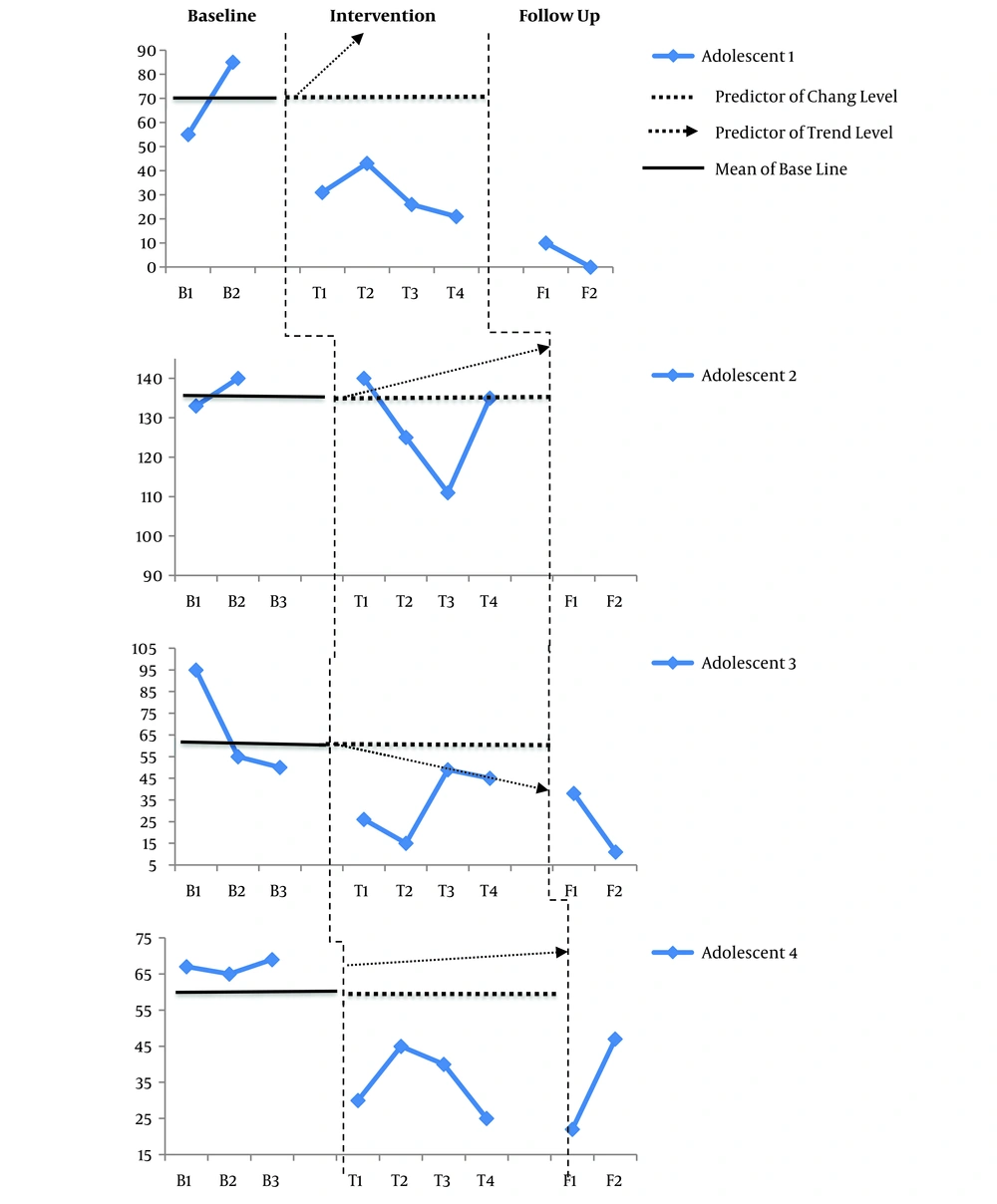
Figure 1.
The trend of changing the scores of the Craving Beliefs Questionnaire
Therefore, in conclusion, the family-based treatment could reduce the craving in substance use among the participants, and they were relatively stable at the follow-up stage.
5. Discussion
The current study aimed to investigate the effectiveness of family-based treatment on the tendency to substance abuse in female students with substance abuse. The results of the graphical analysis, the reliable change index, and improvement percentage showed that family-based treatment reduced the craving for substance use by female adolescents. These findings are in line with the results of previous studies (9, 14). Biestto Pons et al. (14) showed that the family-based intervention program caused a significant improvement in self-esteem, depression, and anger state and decreased negative moods of adolescents. Also, Kirby et al (9) showed that involving parents in their adolescent’s substance abuse treatment was effective.
The goal of family-based treatment in treating adolescents with substance abuse is to empower family members to develop the necessary skills. The immediate goal of this treatment is to reduce drug use, improve the functioning of the addicted person, and reduce side effects, particularly those related to social life, of drug use. This treatment helped the participants change their behavior and adapt to their normal lifestyle. According to the findings, the family-based treatment could help the adolescents to change substance-abuse thoughts and behaviors and to incorporate more rational coping and social skills in the family, school, and community (18). If adolescents find an opportunity to express their emotions and thoughts, they will accept responsibility for their decisions, and the probability of risky behaviors will be reduced. According to the results of this study, cognitive-behavioral therapy provided the adolescents with an opportunity to express their thoughts and to challenge their irrational beliefs about themselves, their family, and the world around them. Parents and other family members use reproach and threats when an adolescent is involved in substance abuse. These interactive patterns can exacerbate the adolescent's tendency to substance use, which deepens the addiction. In the present study, family-based interventions were focused on changing patterns that worsen behavioral problems and the tendency to substance use. Family-based therapy helped the family members to show the adolescents that their problem is common and can be removed by family collaboration.
The family-based treatment probably helped the adolescents to have a more realistic view about their existence and to consider leaving addiction as a factor in paving the way for a better future life and well-being. Adolescents are the most appropriate population to plan to promote healthy habits and changing unhealthy habits such as substance abuse (18). In the present study, the interventions increased parental emotional bond and love. Usually, the family has no realistic attitude about quitting drug abuse and believes that the problem will be resolved if the adolescent wants to. However, the adolescent is involved in a variety of problems and difficult habits that manifest themselves in educational and communication issues. Family-based treatment can help family members to develop compassion and empathy, rather than anger and hatred of adolescents, and not evaluating them from a one-dimensional perspective and solely based on substance use.
This study has some limitations, which meant that we cannot deem its results to be conclusive. The limitations can be attributed to the study design type, sample size, and the fact that it was not possible to follow-up participants for 12 months after providing the intervention. One of the limitations of a single-case study design is the repeated administration of the research instruments in three stages of baseline, intervention, and follow-up, which increases the likelihood of a transition effect. It is suggested that future studies include more participants and use group variance analysis research projects. In the present study, participants were adolescent girls. Hence, it is suggested that further studies examine the effect of the family-based treatment on boys. Of the four adolescents under study, three were marijuana users. It is suggested that further research explore the efficacy of this treatment on users of chemical substances.