
1. Background
Adolescence is a pivotal developmental stage characterized by significant biological and psychosocial changes (1). A major concern in this population is the widespread rise in problematic social media use (PSMU) (2). It has been linked to a range of psychological difficulties, including anxiety, depression, poor academic performance, and diminished social skills (3). The prevalence of PSMU varies significantly by cultural background, with rates reaching 31% in collectivist societies versus 14% in individualist societies (4). Among Iranian adolescents, research indicates that up to 44% experience PSMU ranging from mild to severe (5, 6).
Emerging evidence links adolescent PSMU to underlying attachment styles (AS), suggesting that early relational patterns are associated with how young people navigate the digital world (7). Adolescents with insecure attachment may use social media as a compensatory mechanism to regulate distress or seek external validation (8). Although secure attachment typically aligns with adaptive coping and balanced relationships (9), insecure patterns have distinct digital associations. Specifically, preoccupied attachment styles often coexist with heightened online engagement and a need for reassurance (10). Adolescents with fearful attachment often exhibit ambivalent online behaviors, reflecting the tension between a desire for intimacy and a fear of rejection (11). Individuals with dismissing attachment frequently use digital platforms for social interaction while maintaining emotional distance (12).
Research identifies shame and guilt as factors associated with PSMU in adolescence (13). Shame involves a global negative self-evaluation in which individuals perceive themselves as inherently flawed, whereas guilt pertains to specific behaviors or moral transgressions (14, 15). Shame correlates with social disconnection and negative self-concepts and often co-occurs with social media use for validation or emotional escape (16). This pattern appears particularly relevant among individuals with insecure AS, which are often linked to early relational experiences such as neglect or inconsistent care (15). Chronic or unresolved guilt, particularly among individuals experiencing emotion regulation difficulties, also correlates with compulsive social media use as a means of self-soothing or conflict avoidance (17, 18).
Self-control (SC) functions as a core executive capacity that enables impulse regulation, delayed gratification, and goal-directed behavior (19, 20). Deficits in SC are consistently associated with various behavioral addictions, including PSMU (21, 22). Adolescents with insecure attachment often demonstrate weaker self-regulatory capacities, which may stem from early relational disruptions that affect the development of internal regulatory systems (23). Within the Interaction of Person-Affect-Cognition-Execution framework, chronic self-conscious emotions deplete available cognitive resources, thereby diminishing SC and increasing reliance on digital platforms as maladaptive coping outlets (24). Lower SC may correlate with reduced resistance to the immediate rewards and social validation provided by digital platforms, increasing vulnerability to compulsive use (25). As a mediating mechanism, SC may either buffer or amplify the indirect link between attachment insecurities and PSMU (26).
2. Objectives
The present study aimed to use path analysis based on structural equation modeling to examine the mediating roles of shame, guilt, and SC in the relationship between AS and PSMU among high-risk adolescents. We hypothesized that (H1) AS are associated with shame and guilt; (H2) AS, shame, and guilt are associated with SC; (H3) SC is associated with PSMU; (H4) shame and guilt mediate the indirect relationship between AS and PSMU; (H5) SC mediates the indirect relationship between AS and PSMU; and (H6) AS are indirectly linked to PSMU through parallel serial mediation pathways involving shame followed by SC and guilt followed by SC.
3. Methods
3.1. Population and Sampling
This study used a cross-sectional design and convenience sampling to investigate PSMU among secondary school students in Tehran, Iran. Following official authorization from the Ministry of Education, 10 public secondary schools disseminated a secure online survey link. Eligible participants were adolescents aged 12 - 17 years who were currently enrolled in school. Participants were excluded if their parents or guardians did not provide informed consent, if the adolescents did not provide assent, or if the adolescents were unable to complete the questionnaires because of cognitive, developmental, or psychological difficulties that might interfere with valid self-reporting. During initial screening, 1,090 adolescents completed the Bergen Social Media Addiction Scale (BSMAS). Using the established cutoff score of 19 or higher (27), 547 adolescents were retained, and 543 who scored below the cutoff were excluded. To ensure confidentiality and anonymity, no identifying information was collected, school staff and parents could not access individual submissions, and technical logs (Internet Protocol filters and cookies preventing duplicate entries) were detached from the analytical dataset. Parental informed consent and adolescent assent were obtained electronically. Automated form validation prevented missing data, and incomplete submissions were excluded. An a priori sample size calculation was performed using the Free Statistical Calculator-4. Based on an anticipated effect size of 0.15, a statistical power of 0.95, and 7 predictor parameters in the structural model, the results indicated that the final screened sample of 547 adolescents was adequate for the analyses.
All procedures adhered to the Declaration of Helsinki and were approved by the ethics committee under code IR.SBMU.RETECH.REC.1403.435. Participation was voluntary and anonymous, and data were securely stored and accessible only for research purposes. To safeguard vulnerable participants, the survey's final page provided contact details for school counseling services and free national helplines, ensuring access to professional support for adolescents experiencing distress.
3.2. Measures
3.2.1. Bergen Social Media Addiction Scale
The BSMAS is a self-report instrument developed by Andreassen et al. (28) to assess PSMU. Its 6 items are rated on a 5-point scale from 1 ("very rarely") to 5 ("very often"). A score of 19 or higher has been identified as the cutoff for PSMU (27). In this study, only participants who scored 19 or above were included. The Persian version was standardized by Lin et al. (29), with a reported Cronbach's alpha of 0.70.
3.2.2. Attachment Style Questionnaire
The Attachment Style Questionnaire, based on Bartholomew and Horowitz's model (30), contains 24 items and evaluates 4 distinct attachment styles: secure (7 items), fearful (5 items), preoccupied (7 items), and dismissing (5 items). Each item is rated on a 5-point Likert scale from 1 ("strongly disagree") to 5 ("strongly agree"). For the present analyses, each of these 4 attachment styles was modeled as a continuous dimension. The Persian version was standardized by Firoozabadi et al. (31), with an overall Cronbach's alpha of 0.70. In the present study, the scale's Cronbach's alpha was 0.74.
3.2.3. Brief Shame and Guilt Questionnaire
The Brief Shame and Guilt Questionnaire was developed by Novin and Rieffe to assess self-conscious emotions in children and adolescents aged 8 - 16 years (32). In the Iranian educational system, students aged 16 and 17 years typically attend the same classrooms because of birth-date entry regulations and thus share similar peer and learning environments. The questionnaire includes 12 items: 6 measuring shame and 6 measuring guilt. Items are rated on a 3-point Likert scale (1 = not at all, 2 = a bit, 3 = a lot). The Persian version was standardized by Ahandany et al. (33), with a reported Cronbach's alpha of 0.70. In the present study, the instrument demonstrated consistent reliability across this age range; the reliability coefficients were 0.71 for shame and 0.73 for guilt, and Cronbach's alpha for the total score was 0.74.
3.2.4. Tangney Self-Control Scale
The Brief Self-Control Scale is a 13-item instrument developed by Tangney et al. (34). Responses are rated on a 5-point Likert scale from 1 ("not at all") to 5 ("very much"). The total score ranges from 13 to 65, with higher scores indicating higher SC. The Persian version was standardized by Asgarian et al., with a Cronbach's alpha of 0.81 (35). In the present study, the scale's Cronbach's alpha was 0.70, indicating acceptable internal consistency.
3.3. Data Analysis
To examine the direct and indirect effects of AS on PSMU through shame, guilt, and SC, path analysis based on structural equation modeling was conducted using AMOS 22. Observed variables were used, and composite scores were computed as subscale item means. Because the analysis relied entirely on observed variables rather than latent constructs, a separate measurement model was not tested. Model identification was confirmed on the basis of the degrees of freedom and the ratio of free parameters to available data. The hypothesized model specified paths from AS to PSMU, both directly and through the mediating roles of shame, guilt, and SC. Maximum likelihood estimation was used with a convergence criterion of a change in the fit function of less than 0.00001, and a residual covariance between shame and guilt accounted for their theoretical overlap. Model fit was assessed using χ2, χ2/df, the comparative fit index, incremental fit index, goodness-of-fit index, root mean square error of approximation, and standardized root mean square residual. Indirect effects were evaluated using bias-corrected bootstrapping with 2,000 resamples (95% confidence interval [CI]), and the Benjamini-Hochberg false discovery rate procedure was applied to adjust for multiplicity.
4. Results
Participants (N = 547; Table 1) were aged 12 - 17 years (mean = 14.41, standard deviation [SD] = 1.34; 66.9% female, n = 366), with no missing data. Before structural modeling, the assumptions of normality and multicollinearity were met (acceptable skewness and kurtosis, tolerance > 0.40, variance inflation factor < 10). Bivariate correlations (Table 2) showed that PSMU was negatively correlated with guilt (r = -0.10, P < 0.05) and positively correlated with SC (r = 0.12, P < 0.05). Among the AS, only preoccupied attachment was positively correlated with PSMU (r = 0.16, P < 0.01).
Table 1.
Demographic Variables (N = 547) a
| Variables | Values |
|---|---|
| Gender | |
| Male | 181 (33.1) |
| Female | 366 (66.9) |
| Age (y) | 14.41 ± 1.34 |
a Values are expressed as No. (%) or mean ± SD. Abbreviation: SD, standard deviation.
Table 2.
Descriptive Statistics and Pearson Correlation Matrix a
| Variables | M | SD | 1 | 2 | 3 | 4 | 5 | 6 | 7 | 8 |
|---|---|---|---|---|---|---|---|---|---|---|
| 1. PSMU | 3.54 | 0.43 | 1 | |||||||
| 2. SC | 3.08 | 0.53 | 0.12 b | 1 | ||||||
| 3. Shame | 2.66 | 0.69 | 0.01 | 0.17 b | 1 | |||||
| 4. Guilt | 2.64 | 0.74 | -0.10 c | 0.15 b | 0.54 b | 1 | ||||
| 5. Secure | 3.91 | 0.79 | 0.08 | 0.11 b | -0.10 c | -0.06 | 1 | |||
| 6. Fearful | 3.74 | 0.93 | 0.13 b | 0.21 b | -0.08 | -0.07 | 0.08 | 1 | ||
| 7. Preoccupied | 3.75 | 0.88 | 0.16 b | 0.24 b | 0.09 c | -0.13 b | 0.28 b | 0.36 b | 1 | |
| 8. Dismissing | 3.81 | 0.89 | 0.09 c | 0.19 b | -0.08 | -0.02 | 0.27 b | 0.40 b | 0.10 c | 1 |
a Abbreviations: M, mean; SD, standard deviation; PSMU, problematic social media use; SC, self-control.
c P < 0.05
b P < 0.01.
Grounded in attachment and self-conscious emotion frameworks, the structural model was trimmed by sequentially removing nonsignificant direct paths, yielding good fit (Table 3). As detailed in Table 4, the removed paths included all paths from AS to PSMU; from secure attachment to SC; from dismissing attachment to shame; from secure, fearful, and dismissing attachment to guilt; and from shame to PSMU.
Table 3.
Structural Model Fit Indices a
| Fit Index | Criterion | Initial | Final |
|---|---|---|---|
| χ2 | — | 206.690 | 13.697 |
| χ2/df | < 5 | 206.690 | 1.370 |
| CFI | > 0.90 | 0.648 | 0.994 |
| IFI | > 0.90 | 0.664 | 0.994 |
| GFI | > 0.90 | 0.927 | 0.994 |
| RMSEA | < 0.08 | 0.614 | 0.026 |
| SRMR | < 0.08 | 0.093 | 0.030 |
a Abbreviations: df, degrees of freedom; CFI, comparative fit index; IFI, incremental fit index; GFI, goodness-of-fit index; RMSEA, root mean square error of approximation; SRMR, standardized root mean square residual.
Table 4.
Direct Effects of Variables a
| Independent Variable | Dependent Variable | B | β | SE | t | P |
|---|---|---|---|---|---|---|
| Secure | PSMU | 0.016 | 0.028 | 0.025 | 0.625 | 0.532 |
| Fearful | PSMU | 0.028 | 0.060 | 0.023 | 1.227 | 0.220 |
| Preoccupied | PSMU | 0.039 | 0.079 | 0.024 | 1.640 | 0.101 |
| Dismissing | PSMU | 0.016 | 0.032 | 0.023 | 0.677 | 0.499 |
| Shame | PSMU | 0.046 | 0.072 | 0.027 | 1.695 | 0.090 |
| Guilt | PSMU | -0.079 | -0.134 | 0.025 | -3.172 | 0.002 |
| SC | PSMU | 0.074 | 0.090 | 0.036 | 2.026 | 0.043 |
| Secure | SC | 0.019 | 0.029 | 0.029 | 0.655 | 0.512 |
| Fearful | SC | 0.054 | 0.095 | 0.027 | 2.009 | 0.045 |
| Preoccupied | SC | 0.118 | 0.197 | 0.027 | 4.293 | 0.001 |
| Dismissing | SC | 0.084 | 0.142 | 0.027 | 3.103 | 0.002 |
| Shame | SC | 0.075 | 0.098 | 0.031 | 2.400 | 0.016 |
| Guilt | SC | 0.095 | 0.133 | 0.029 | 3.277 | 0.001 |
| Secure | Shame | -0.121 | -0.139 | 0.040 | -3.054 | 0.002 |
| Fearful | Shame | -0.094 | -0.127 | 0.036 | -2.579 | 0.010 |
| Preoccupied | Shame | 0.141 | 0.181 | 0.037 | 3.842 | 0.001 |
| Dismissing | Shame | -0.007 | -0.009 | 0.037 | -0.186 | 0.853 |
| Secure | Guilt | -0.031 | -0.033 | 0.043 | -0.723 | 0.470 |
| Fearful | Guilt | -0.028 | -0.035 | 0.040 | -0.701 | 0.483 |
| Preoccupied | Guilt | -0.094 | -0.112 | 0.040 | -2.354 | 0.019 |
| Dismissing | Guilt | 0.011 | 0.013 | 0.040 | 0.279 | 0.780 |
a Abbreviations: β, standardized coefficient; B, unstandardized coefficient; SE, standard error; PSMU, problematic social media use; SC, self-control.
As shown in Table 4 and Figure 1, none of the AS had a direct association with PSMU. Guilt had a negative direct association with PSMU (β = -0.134, P = 0.002), SC had a weak positive direct association (β = 0.090, P = 0.043), and shame had no significant direct association with PSMU (β = 0.072, P = 0.090).
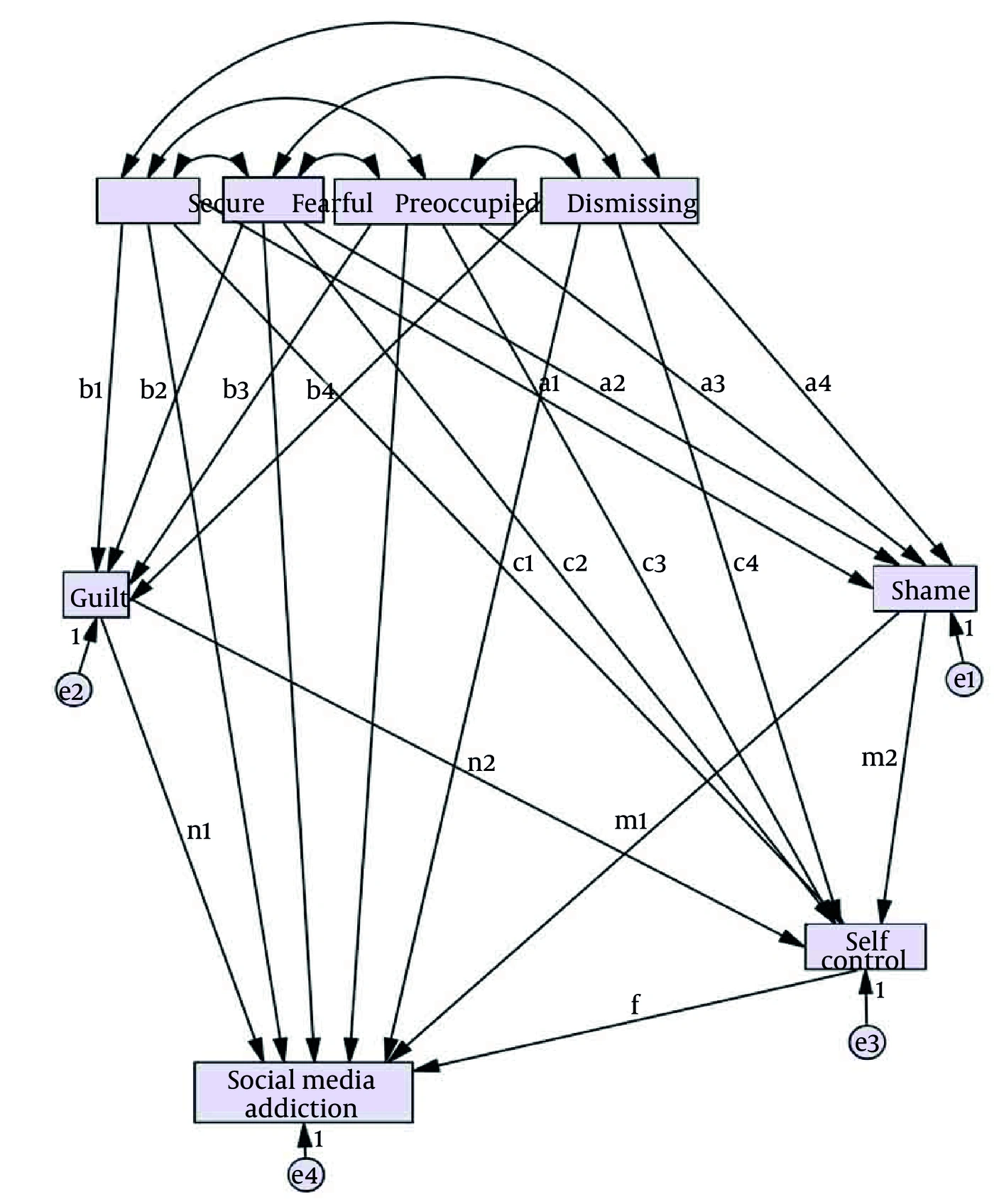
Figure 1.
Standardized path coefficients of the path analysis based on structural equation modeling. Note: Solid lines indicate significant paths; dashed lines indicate nonsignificant paths.
Indirect associations were examined using bootstrapping with 2,000 resamples and 95% bias-corrected confidence intervals, with intervals excluding zero indicating statistical significance without assuming normal sampling distributions. As shown in Table 5, preoccupied attachment had a significant indirect association with PSMU through guilt. In serial mediation analyses, secure, fearful, and preoccupied attachment each had significant indirect associations with PSMU through the sequential pathway of shame and SC. These findings indicate that guilt, shame, and SC mediate the links between these attachment styles and adolescent PSMU.
Table 5.
Indirect Effects Based on Bootstrapping (2,000 Samples) a
| Independent Variable | Mediator 1 | Mediator 2 | Dependent Variable | B | Lower CI | Upper CI | P value |
|---|---|---|---|---|---|---|---|
| Secure | Shame | – | PSMU | -0.005 | -0.021 | 0.002 | 0.119 |
| Fearful | Shame | – | PSMU | -0.004 | -0.017 | 0.001 | 0.132 |
| Preoccupied | Shame | – | PSMU | 0.006 | -0.002 | 0.020 | 0.147 |
| Dismissing | Shame | – | PSMU | 0.000 | -0.007 | 0.003 | 0.596 |
| Secure | Guilt | – | PSMU | 0.002 | -0.005 | 0.014 | 0.405 |
| Fearful | Guilt | – | PSMU | 0.002 | -0.005 | 0.011 | 0.422 |
| Preoccupied | Guilt | – | PSMU | 0.007 | 0.001 | 0.019 | 0.015 |
| Dismissing | Guilt | – | PSMU | -0.001 | -0.008 | 0.006 | 0.690 |
| Secure | SC | – | PSMU | 0.001 | -0.002 | 0.009 | 0.342 |
| Fearful | SC | – | PSMU | 0.004 | 0.000 | 0.013 | 0.072 |
| Preoccupied | SC | – | PSMU | 0.009 | -0.001 | 0.020 | 0.070 |
| Dismissing | SC | – | PSMU | 0.006 | 0.000 | 0.017 | 0.051 |
| Secure | Shame | SC | PSMU | -0.001 | -0.003 | 0.000 | 0.047 |
| Fearful | Shame | SC | PSMU | -0.001 | -0.002 | 0.000 | 0.041 |
| Preoccupied | Shame | SC | PSMU | 0.001 | 0.000 | 0.003 | 0.038 |
| Dismissing | Shame | SC | PSMU | 0.000 | -0.001 | 0.000 | 0.617 |
| Secure | Guilt | SC | PSMU | 0.000 | -0.002 | 0.000 | 0.280 |
| Fearful | Guilt | SC | PSMU | 0.000 | -0.002 | 0.000 | 0.288 |
| Preoccupied | Guilt | SC | PSMU | -0.001 | -0.003 | 0.000 | 0.050 |
| Dismissing | Guilt | SC | PSMU | 0.000 | -0.001 | 0.001 | 0.548 |
a B = unstandardized coefficient. Lower CI and Upper CI represent the lower and upper bounds of the bias-corrected 95% confidence intervals derived from 2,000 bootstrap resamples; P values reflect two-tailed significance. Abbreviations: CI, confidence interval; PSMU, problematic social media use; SC, self-control.
Overall, the AS demonstrated statistically significant indirect links with PSMU via guilt and the sequential pathway of shame and SC, with the structural model explaining 6% of the variance in PSMU (R2 = 0.06).
5. Discussion
The present study examined indirect pathways between AS and adolescent PSMU, focusing on shame, guilt, and SC. Attachment styles showed no direct associations with PSMU. Instead, AS operated through indirect pathways involving guilt and the sequential effects of shame and SC. This pattern aligns with attachment accounts suggesting that attachment influences operate through emotional and regulatory processes rather than direct behavioral links (36, 37). A small indirect association emerged between preoccupied attachment and PSMU via guilt, consistent with evidence linking self-blame and interpersonal failure to PSMU in preoccupied adolescents (10, 17).
Accordingly, guilt may reflect internal pressure to repair relational ruptures or validate self-worth rather than adaptive moral evaluation (18, 38), consistent with findings linking guilt to rumination, exhaustion, and digital reassurance-seeking (13, 17, 38). Although shame is theoretically linked to avoidance and social withdrawal (14, 16), its direct association with PSMU was nonsignificant. This may reflect a distinction between inward-focused shame, which is often associated with isolation, and outward-directed guilt, which correlates with compensatory online engagement to restore connection (15, 17).
The current data revealed a significant positive association between SC and PSMU. This finding contrasts with the established expectation that higher SC buffers against problematic use (19, 20), as the present findings showed a small positive path from SC to PSMU. Rather than indicating a true mechanism contrary to theory, this pattern likely reflects range restriction inherent in the study's target population, which comprised adolescents exceeding the clinical threshold. Within such a high-risk group, restricted variance can alter the typical protective gradient of SC. In the absence of multicollinearity, this link should be viewed as a context-dependent artifact of the screening threshold rather than as a generalizable psychological process.
Indirect pathways for preoccupied attachment align with prior work linking this style to rejection sensitivity and external validation (8, 10). Fearful and dismissing attachment styles showed weaker pathways, although small indirect associations via shame and SC are consistent with observations that avoidance often co-occurs with dampened emotional expression and compulsive coping (11, 12, 23).
Taken together, these cross-sectional findings provide preliminary support for exploring AS, self-conscious emotions, and SC in relation to PSMU. Although the observed associations were small and require cautious interpretation, they highlight emotional and regulatory patterns that co-occur with PSMU (7, 13, 17, 19). Conceptually, these findings underscore the value of considering attachment patterns, self-conscious emotions, and SC together when examining adolescents' PSMU. Although the observed associations do not establish causal processes or support direct clinical recommendations, the proposed model offers a framework for further research on how these factors may relate to PSMU.
Several limitations constrain these findings. The cross-sectional design precludes causal inferences and definitive conclusions about temporal ordering because the observed pathways reflect concurrent associations rather than established mechanisms. Analyzing only adolescents who met the BSMAS screening cutoff (N = 547) truncated outcome variance, which may attenuate path estimates. Additionally, convenience sampling of a predominantly female sample from Tehran and reliance on self-reports limit generalizability and introduce shared method variance. Furthermore, because composite scores were used in manifest path modeling, formal item-level measurement invariance across age and sex groups was not evaluated. Given that the structural model explained 6% of the variance in PSMU (R2 = 0.06) and holdout cross-validation could not be performed, these results should be interpreted as preliminary exploratory patterns requiring further longitudinal validation before informing clinical practice.
5.1. Conclusions
Attachment styles were not directly associated with adolescent PSMU. However, preoccupied attachment was indirectly linked to PSMU through guilt, which displayed a negative direct association with PSMU, while shame had no direct link. Secure, fearful, and preoccupied attachment styles showed significant serial indirect associations through shame and SC. These findings suggest that emotional and self-regulatory factors may help explain attachment-related patterns in PSMU. Given the cross-sectional design, the preliminary nature of these indirect pathways, and the lack of temporal ordering, assessment efforts should treat these links cautiously until longitudinal research in diverse samples confirms their stability.