
1. Background
Suicide is the second leading cause of mortality among adolescents aged 10 - 24 years. Despite its importance, few studies have examined suicidal ideation (SI) during this developmental period, although adolescents report substantially higher rates of SI and suicidal behaviors than adults. Suicidal ideation, defined as thoughts or plans to end one’s life, is highly prevalent; for example, 17.2% of adolescents report serious SI, and up to 40% of those who attempt suicide experience SI (1-5).
Evidence from Iranian populations also indicates that SI is a significant mental health concern among young people. For example, a recent study among medical students at Zahedan University of Medical Sciences (6) reported higher levels of SI among students in the clinical phase of training than among those in basic sciences, highlighting the substantial psychological pressures experienced during demanding educational transitions.
According to stress-sensitivity models, SI may be understood in terms of the interaction between stressful life events and individual vulnerability. A meta-analysis showed that SI is significantly higher among individuals with internet addiction (IA) (7). Recent evidence continues to support a robust association between IA and SI among adolescents. For instance, Chen et al. (8), in a clinical sample of Chinese adolescents with SI, found that SI was positively associated with IA and that maladaptive cognitive factors, such as low self-esteem, partially mediated this relationship. These findings, grounded in the cognitive-behavioral model of pathological internet use, highlight the role of underlying psychological vulnerabilities in strengthening the SI-IA association. This evidence underscores the importance of examining emotional and interpersonal mediators to clarify how IA is linked to suicidality during adolescence.
Internet addiction is characterized by excessive use, craving, loss of control, and psychological dependence (9). Adolescents are particularly vulnerable because they are among the most active internet users and may experience psychosocial problems associated with IA, including isolation, loneliness, depressed mood, anxiety, academic difficulties, and sleep or health disturbances (10, 11).
Self-conscious emotions, such as shame, also contribute to SI. Excessive shame is linked to negative self-evaluation, feelings of worthlessness, and escape-motivated behaviors, all of which have been associated with SI (12, 13). Internet addiction may be associated with shame through processes such as negative social comparisons and fear of rejection. Consistent with prior studies, shame is associated with problematic internet use and emotion-focused maladaptive coping (14, 15).
Loneliness is another factor related to both IA and SI. Emotional and social loneliness reflect deficiencies in attachment and social networks, and adolescents may turn to the internet to compensate for unmet relational needs. Although loneliness increases vulnerability to SI, recent evidence suggests that it may not always act as a direct mediator, particularly when other psychological factors are involved (11, 16, 17). However, findings regarding the mediating role of loneliness in SI have been inconsistent. For instance, a recent structural modeling study among Iranian adolescents (18) found that although childhood trauma was significantly associated with SI, loneliness did not significantly mediate this relationship (β = 0.108, P = 0.186). These mixed findings highlight the need for further investigation of contextual and psychological factors that may influence the role of loneliness in adolescent suicidality. The interpersonal theory of suicide further emphasizes thwarted belongingness as a central driver of SI (19).
Family processes also shape adolescent mental health and technology use. High levels of parent-adolescent conflict (PAC) are linked to internalizing and externalizing problems, lower well-being, and an increased risk of SI (20-22). Psychological control and dysfunctional parenting may be associated with excessive internet use, potentially reflecting adolescents’ attempts to meet autonomy and competence needs in online contexts (23). In this context, family dynamics, particularly parenting styles and PAC, are important correlates of IA (24).
Overall, IA has emerged as a growing concern among adolescents and may be associated with SI in the context of psychological and interpersonal factors such as loneliness, shame, and family PAC. Although prior research has examined these variables individually, few studies have evaluated their combined associations and statistical indirect pathways, particularly among female adolescents. The present study addresses this gap by examining the association between IA and SI and evaluating statistical indirect associations through loneliness, shame, and PAC within a cross-sectional SEM framework (Figure 1).
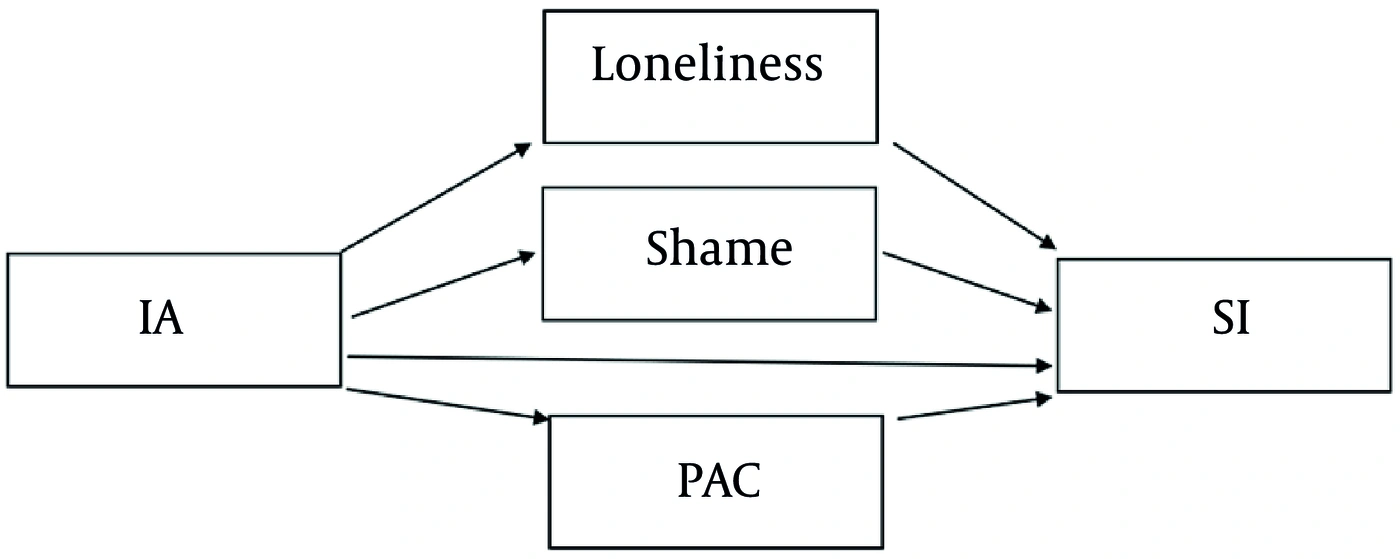
Figure 1.
Proposed conceptual model of the associations between Internet addiction and suicidal ideation with loneliness, shame, and parent-adolescent conflict (PAC) as statistical indirect pathways. Note: IA = Internet Addiction; SI = Suicidal Ideation; PAC = Parent-Adolescent Conflict.
2. Objectives
This study aimed to clarify the psychological and interpersonal correlates that may help to explain the observed association between IA and SI in this population.
3. Methods
3.1. Participants
This cross-sectional study was conducted in 2025 among female adolescent students in Tehran, Iran. The target population comprised all girls aged 14 - 19 years enrolled in secondary schools in Tehran, Iran. Participants were recruited using convenience sampling from schools located in different districts of the province. The required sample size was estimated using Free Statistics Calculators software, assuming an effect size of 0.30, statistical power of 0.95, five latent variables, an alpha level of 0.05, and an anticipated dropout/incomplete response rate. This procedure indicated that a minimum sample of approximately 400 participants would be sufficient. To increase the stability and validity of the model estimates, data were ultimately collected from 441 students using paper-and-pencil questionnaires.
The inclusion criteria were as follows: 1) female sex; 2) age 14 - 19 years; 3) current enrollment in a secondary school in Tehran, Iran; 4) ability to read and write Persian; and 5) provision of informed consent, with parental consent where required. The exclusion criteria were unwillingness to participate or complete the questionnaire and submission of substantially incomplete questionnaires.
Before data collection, the study objectives and procedures were explained to the students, participation was emphasized as voluntary, and confidentiality and anonymity were assured. All participants, and their parents when applicable, provided informed consent.
3.2. Measurements
3.2.1. Beck Scale for Suicidal Ideation
The Beck Scale for Suicidal Ideation (BSSI) was developed by Beck et al. (25). The scale consists of 19 items rated on a 3-point scale from 0 to 2. The total score is calculated by summing the item scores and ranges from 0 to 38, with higher scores indicating greater severity of SI. The BSSI is generally scored as a single total scale and does not include standard subscales. The reliability and validity of the scale are high, with Cronbach alpha coefficients of 0.87 - 0.97 (25).
3.2.2. Cell-Phone Over-Use Scale
The Cell-Phone Over-Use Scale (COS) was developed by Jenaro et al. (26) to evaluate pathological internet and cell-phone use. This questionnaire contains 23 questions and has appropriate validity and reliability (26). The Persian version of this scale contains 21 items and has appropriate validity and reliability.
3.2.3. UCLA Loneliness Scale
The UCLA Loneliness Scale (UCLA-LS) was developed by Russell (27). The UCLA Loneliness Scale Version 3 consists of 20 items rated on a 4-point Likert scale ranging from 1, never, to 4, always. Several positively worded items are reverse scored. Item scores are summed to obtain a total loneliness score ranging from 20 to 80. Higher scores indicate greater perceived loneliness. The reliability of this test has been reported as 0.78 in the revised version (27). The Persian version of the UCLA-LS Version 3 was validated in Iran by Zarei et al. (28). The internal consistency of the scale was acceptable (Cronbach alpha = 0.91) (28).
3.2.4. Other As Shamer Scale
The Other As Shamer Scale (OAS) was developed by Goss et al. (29) to measure external shame. This scale is based on the internal shame scale developed by Cook in 1993. The OAS consists of 18 items rated on a 5-point Likert scale ranging from 0, never, to 4, almost always. Total scores are obtained by summing all items, yielding a score range of 0 to 72. Higher scores indicate higher levels of external shame. The scale is generally interpreted using a total score and does not contain standard subscales. This questionnaire has high internal consistency, with a Cronbach alpha of 0.92 (29). The Persian version of this scale has also reported acceptable reliability.
3.2.5. Conflict Behavior Questionnaire
The Conflict Behavior Questionnaire (CBQ) was developed by Prinz et al. (30). The original version contains 75 items, and the short-form version contains 20 statements to evaluate adolescents’ perceptions of conflict and negative relationships with their parents. The short form of the CBQ contains 20 items and is available in separate forms for assessing conflict with the mother and father. Items are scored dichotomously as true or false, and responses are summed to obtain a total conflict score ranging from 0 to 20. Higher scores indicate greater PAC and a more negative parent-child relationship. The CBQ short form is typically scored as a single total scale and does not include standard subscales. The reliability of this tool has been reported as 0.57 for the adolescent version and 0.82 for the parent version (30).
3.3. Procedure
Ethical approval for the study was obtained from the Ethics Committee of Shahid Beheshti University of Medical Sciences (IR.SBMU.RETECH.REC.1403.273). After ethical approval was obtained, participants were recruited using convenience sampling from secondary schools in Tehran. Before data collection, the study objectives and procedures were explained to the students, and they were informed that no personally identifying information would be collected. Informed consent was obtained from the participants and their parents when required. Participants then completed a set of paper-and-pencil questionnaires, including the BSSI, COS, UCLA-LS, OAS, and CBQ.
3.4. Data Analysis
Frequencies and percentages were used to describe demographic characteristics, while means, standard deviations, skewness, and kurtosis were calculated for the study variables. Before testing the conceptual model, the assumptions of SEM were examined, including adequate sample size, normal distribution of variables assessed through skewness, kurtosis, normality plots, and Mahalanobis distance, absence of multicollinearity among predictors, independence of errors, correlations among variables, and data reliability. After these assumptions were confirmed, SEM, comprising confirmatory factor analysis (CFA) and path analysis, was used to test the research hypotheses and evaluate the proposed model. The significance of indirect effects was tested using bootstrapping with 2000 resamples and 95% confidence intervals. Because the data were cross-sectional, the tested indirect effects were interpreted as statistical indirect associations within the specified SEM rather than as evidence of temporal or causal mediation. Data analyses were performed using SPSS version 25 and AMOS version 24.
4. Results
A total of 441 questionnaires were collected and included in the final analysis. The demographic characteristics of the participants are presented in Table 1. Regarding age distribution, 7.9% of participants were aged 14 - 15 years, 83.9% were aged 16 - 17 years, and 8.2% were aged 18 - 19 years. In terms of educational level, 43.1% of participants were in the 10th grade, 49.2% were in the 11th grade, and 7.7% were in the 12th grade. Regarding parental marital status, 91.4% of participants reported that their parents were living together, 5.4% reported parental divorce, 1.8% reported the death of their father, 0.7% reported the death of their mother, 0.2% reported their mother’s remarriage, and 0.5% reported the death of both parents.
Table 1.
Descriptive Statistics of the Participants (N = 441)
| Variables | Frequency | Percentage |
|---|---|---|
| Age (y) | ||
| 14 - 15 | 35 | 7.9 |
| 16 - 17 | 370 | 83.9 |
| 18 - 19 | 36 | 8.2 |
| Total | 441 | 100 |
| Education status (grade) | ||
| 10th | 190 | 43.1 |
| 11th | 217 | 49.2 |
| 12th | 34 | 7.7 |
| Total | 441 | 100 |
| Parents’ marital status | ||
| Living together | 403 | 91.4 |
| Divorced | 24 | 5.4 |
| Father’s death | 8 | 1.8 |
| Mother’s death | 3 | 0.7 |
| Mother’s remarriage | 1 | 0.2 |
| Death of both parents | 2 | 0.5 |
| Total | 441 | 100 |
Descriptive statistics for the main study variables, including IA, SI, loneliness, shame, and PAC, are presented in Table 2. The mean ± standard deviation values were as follows: IA, 61.72 ± 20.51; SI, 7.83 ± 8.39; loneliness, 49.62 ± 6.54; shame, 16.57 ± 14.59; and PAC, 13.42 ± 5.62. To assess normality, skewness and kurtosis values were computed. As shown in Table 2, the skewness and kurtosis values for all variables were within the acceptable range of -2 to +2, indicating that the normality assumption was met.
Table 2.
Descriptive Statistics of the Research Variables a
| Variables | Minimum | Maximum | Mean | SD | Skewness | Kurtosis |
|---|---|---|---|---|---|---|
| IA | 21 | 114 | 61.72 | 20.51 | 0.18 | -0.59 |
| SI | 0 | 34 | 7.83 | 8.39 | 1.16 | 0.61 |
| Loneliness | 22 | 65 | 49.62 | 6.54 | -0.56 | 1.49 |
| Shame | 0 | 72 | 16.57 | 14.59 | 1.24 | 1.71 |
| PAC | 0 | 20 | 13.42 | 5.62 | -0.65 | -0.69 |
a Abbreviations: IA, Internet addiction; SI, Suicidal ideation; SD, Standard deviation; PAC, Parent-adolescent conflict.
Reliability coefficients were calculated using Cronbach’s alpha for the study variables (Table 3). Cronbach’s alpha values for IA, SI, loneliness, shame, and PAC were 0.91, 0.94, 0.53, 0.94, and 0.91, respectively.
Table 3.
Cronbach Alpha Reliability Coefficients
| Variables | Internet Addiction | Loneliness | Shame | Parent-Adolescent Conflict | Suicidal Ideation |
|---|---|---|---|---|---|
| Cronbach alpha | 0.91 | 0.53 | 0.94 | 0.91 | 0.94 |
4.1. The Research Conceptual Model
To analyze the data, the research conceptual model was first specified in the AMOS version 24 software environment (Figure 2). To obtain acceptable fit indices, the initial model was modified. The modified model is shown in Figure 3. Table 4 presents the fit indices of the modified research model. According to Table 4, the root mean square error of approximation (RMSEA) was less than 0.001. The comparative fit index (CFI) was 1.000, the goodness-of-fit index (GFI) was 1.000, Bentler-Bonett’s normed fit index (NFI) was 0.99, and the minimum discrepancy of confirmatory factor analysis/degrees of freedom (CMIN/DF) was 0.259 (CMIN/DF < 5). Thus, the fit indices were within an acceptable range. Therefore, the modified model showed a good fit, and the research hypotheses could be assessed. Table 5 presents the regression weights of the modified model based on the investigated variables.
Table 4.
Fit Indices of the Modified Research Model a
| Index | RMSEA | CFI | GFI | NFI | CMIN/DF |
|---|---|---|---|---|---|
| Value | < 0.001 | 1.000 | 1.000 | 0.99 | 0.259 |
a Abbreviations: RMSEA, root mean square error of approximation; CFI, comparative fit index; GFI, goodness-of-fit index; NFI, normed fit index; CMIN/DF, minimum discrepancy of confirmatory factor analysis/degrees of freedom.
Table 5.
Standardized Direct Path Coefficients in the Structural Model a
| Path | Direct Model Estimate | Direct Model C.R. | Direct Model P | Indirect Model Estimate | Indirect Model C.R. | Indirect Model P | Total Model Estimate | Total Model C.R. | Total Model P |
|---|---|---|---|---|---|---|---|---|---|
| IA -> SI | 0.085 | 5.259 | 0.000 | - | - | - | 0.087 | 4.733 | 0.000 |
| Loneliness -> SI | 0.029 | 0.518 | 0.604 | 0.076 | 1.345 | 0.178 | - | - | - |
| Shame -> SI | 0.107 | 3.934 | 0.000 | 0.135 | 4.869 | 0.000 | 0.109 | 4.013 | 0.000 |
| PAC -> SI | -0.045 | -6.508 | 0.000 | -0.519 | -7.331 | 0.000 | -0.455 | -6.482 | 0.000 |
| IA -> Loneliness | - | - | - | 0.109 | 7.581 | 0.000 | 0.109 | 7.581 | 0.000 |
| IA -> Shame | - | - | - | 0.296 | 9.589 | 0.000 | 0.296 | 9.589 | 0.000 |
| IA -> PAC | - | - | - | -0.110 | -9.176 | 0.000 | -0.110 | -9.176 | 0.000 |
a Abbreviations: IA, Internet addiction; SI, Suicidal ideation; PAC, Parent-adolescent conflict.
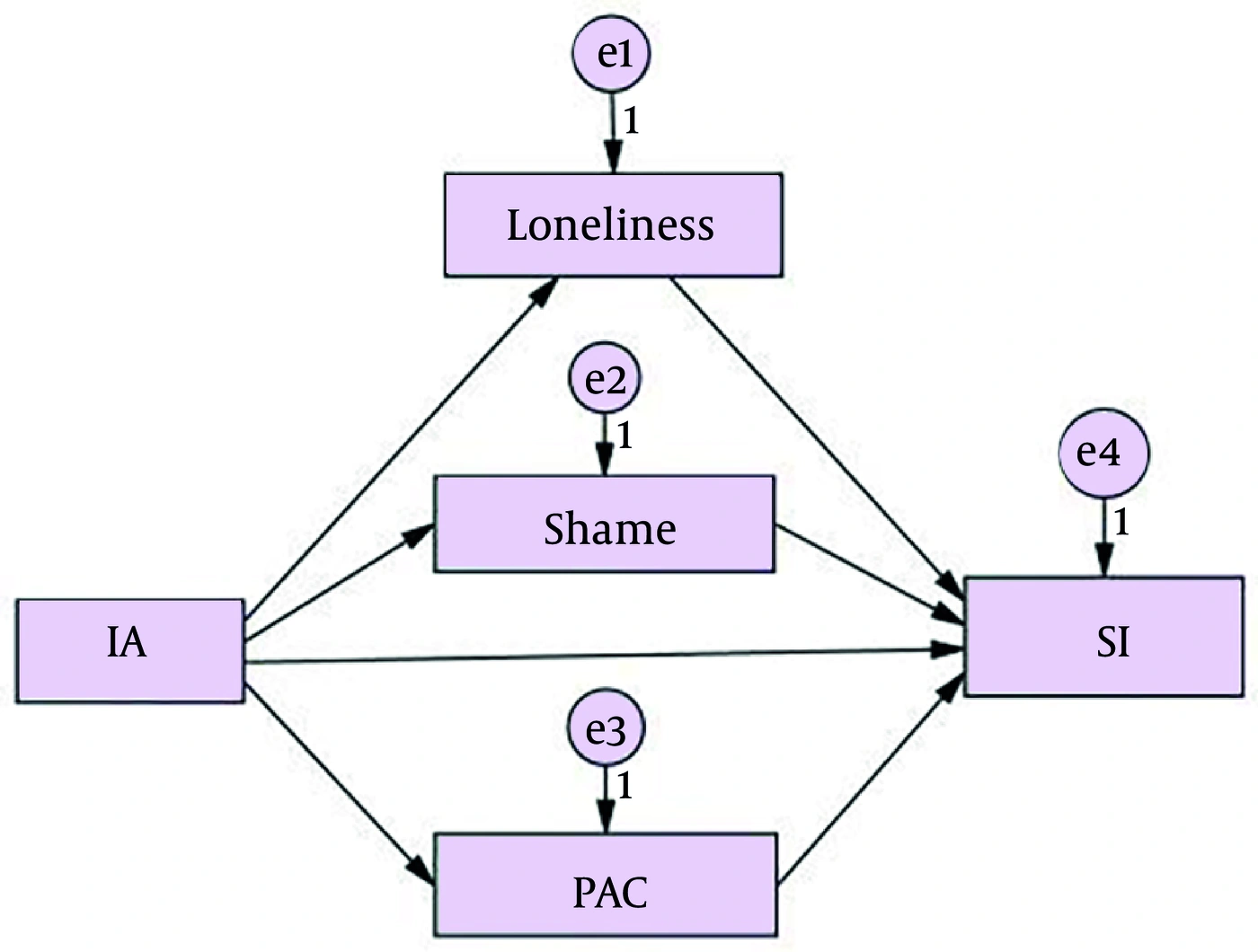
Figure 2.
The conceptual model of the study. Note: IA = Internet Addiction; SI = Suicidal Ideation; PAC = Parent-Adolescent Conflict.
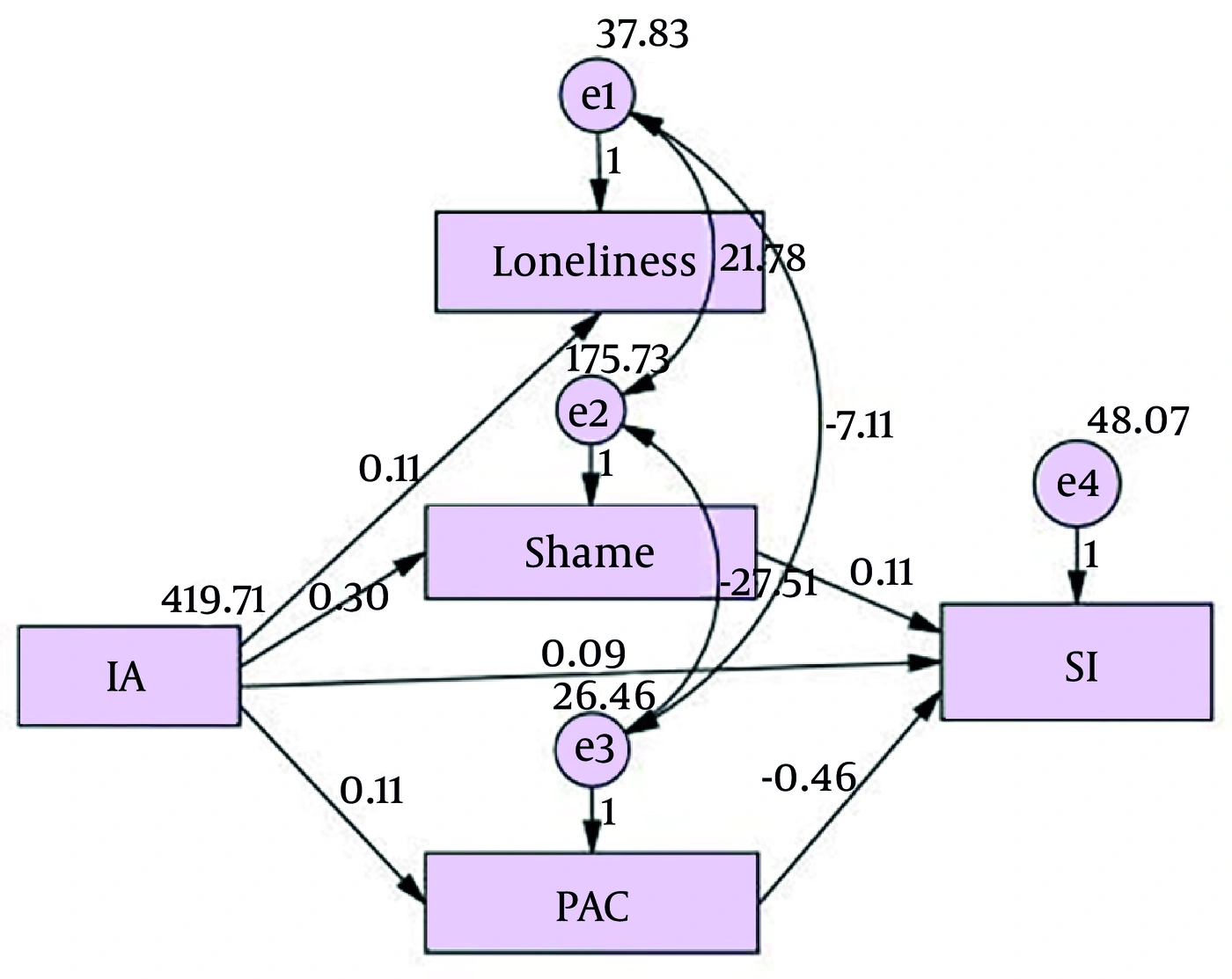
Figure 3.
The modified structural model. Note: IA = Internet Addiction; SI = Suicidal Ideation; PAC = Parent-Adolescent Conflict.
According to Table 5, the coefficient of determination for SI was 0.32, indicating that the variables included in the model accounted for 32% of the variance in SI. This suggests a moderate level of explanatory power for the model.
5. Discussion
The present study examined a cross-sectional SEM of the association between IA and SI and evaluated statistical indirect associations through loneliness, shame, and PAC among adolescent girls. The SEM results indicated a significant association between IA and SI, and the model accounted for 32% of the variance in SI.
The structural model indicated that IA was positively and significantly associated with SI (P < 0.001), supporting the hypothesized relationship between these variables. This finding is consistent with the meta-analyses by Cheng et al. and Wang et al. (7, 31), which showed that SI is considerably higher among individuals with IA than among those without IA. IA has been associated with adverse mental health outcomes, including depression and SI. According to these studies, the prevalence of SI was significantly higher in adolescents younger than 18 years than in adults, which is consistent with the adolescent population in the present study. In addition, Zhang et al. (32) identified IA as a significant correlate of SI. According to Richer’s theory, IA is an interaction that occurs in the form of isolation from reality. Isolation may reduce an individual’s awareness of the surrounding environment and may lower behavioral inhibition. Therefore, adolescents with higher levels of IA may become less sensitive to the negative consequences of risky behaviors because of prolonged engagement in cyberspace.
Recent studies suggest that the relationship between IA and SI may not be strictly unidirectional. For example, Chen et al. (8) reported that among adolescents with SI, SI was positively associated with IA, and this relationship was partially mediated by self-esteem. Taken together, these findings indicate that IA and SI may be dynamically interconnected and may operate reciprocally. This evidence highlights the importance of longitudinal research to clarify the temporal direction of this relationship.
Furthermore, IA shares neurobiological similarities with addictive disorders and impulse-control problems (32). The present study differs from previous studies by focusing on the role of female gender.
Previous research focusing specifically on adolescent girls suggests that the psychological mechanisms underlying IA may differ from those observed in mixed-gender samples. For example, a recent SEM study conducted among Iranian adolescent girls (33) demonstrated that the association between IA and SI was mediated by perceived social support, externalizing problems, and alexithymia. These findings indicate that, among girls, problematic internet use may be closely linked to emotional dysregulation and interpersonal vulnerabilities. Adolescents who have difficulty identifying and expressing emotions, or who perceive low levels of social support, may increasingly rely on online environments as a maladaptive coping strategy to regulate distress. However, such reliance may co-occur with greater emotional difficulties, social withdrawal, and relational disconnection, which may be associated with higher levels of SI. Moreover, adolescence is a particularly sensitive developmental period characterized by identity formation, heightened emotional reactivity, and increased reliance on peer relationships. In this context, excessive engagement with the internet may amplify existing vulnerabilities, reduce real-world interpersonal interactions, and further increase the risk of SI (34).
The model further showed that IA was significantly associated with loneliness. However, the results did not show a significant association between loneliness and SI because the significance level of the direct effect of loneliness on SI was greater than 0.05 (P > 0.05). Therefore, the hypothesis that loneliness is related to SI in female adolescents in Tehran was not confirmed, whereas the effect of IA on loneliness was significant (P < 0.001). Thus, the hypothesis that IA is related to loneliness in female adolescents in Tehran was confirmed. This finding is partly consistent with the study by Hung et al. and inconsistent with the hypothesis proposed by Kwon and Jang (35, 36). One possible explanation is that loneliness follows a U-shaped distribution across age groups, with the highest levels observed among young people aged 15 - 24 years and older adults aged older than 80 years. Loneliness is also more common among women. Adolescence is a period of rapid growth associated with physical, sexual, social, and emotional changes, and a range of emotions are experienced as a result of these changes. IA has been linked to changes in biological, psychological, and behavioral functioning; therefore, adolescents may use the internet to modify their mood and reduce loneliness, and IA may consequently be associated with higher levels of loneliness. Similarly, loneliness is often characterized as a psychological state accompanied by a deep feeling of isolation and emptiness. When a lonely and depressed individual has no connection with family or other important individuals to talk to, the risk of ideation may increase (36). The present research differs from these studies by investigating both shame and guilt. Unlike the present research, data in these studies were collected online, which may have increased information bias.
The results indicated that IA was significantly associated with shame (P < 0.001), and shame was significantly associated with SI (P < 0.001). Therefore, shame showed a significant statistical indirect effect in the association between IA and SI. In line with the study by Shim (37), the present research suggests that internet and cell-phone addiction may represent maladaptive emotion-regulation strategies, and negative emotions, such as shame, loneliness, depression, and anxiety, may increase the likelihood of internet use among adolescents. This strategy may induce a vicious cycle of addiction because adolescents’ strong dependence on internet use can negatively affect their lives and stimulate negative emotions. In this regard, shame may become a primary feeling that triggers and intensifies the vicious cycle of addiction (37).
In addition, Szeto et al. (38) reported that the fluid vulnerability theory of suicide posits that activation of the suicidal mode depends on an individual’s predisposition, stimuli, and primary or acute risks, and shame has been linked to SI. The present study differs from the mentioned studies because it used an external shame tool.
According to the SEM results, the effect of IA on PAC was significant in the total model (P < 0.001). In addition, the effect of PAC on SI in the total model was significant (P < 0.001). Therefore, PAC showed a significant statistical indirect effect in the association between IA and SI within the cross-sectional model; however, this finding should not be interpreted as evidence of temporal or causal mediation. This result aligns with the study by Wei et al. (39), indicating that family factors, such as parents’ education level and PAC, are linked to a higher risk of adolescent IA. Family systems theory conceptualizes family conflict as a highly interdependent system, and conflict between two family members may contribute to increased vulnerability to SI (39, 40).
The observed statistical indirect effect involving PAC is consistent with previous research indicating that social and familial stressors, including dysfunctional parenting and bullying, are associated with problematic internet use (24). These factors likely contribute to a cycle in which adolescents who are unable to secure belongingness at home turn to the internet as a compensatory mechanism. The present research differs from this study by assessing the aggravating effect of IA on conflict with parents. In line with studies conducted by Mushtaque et al. and Zhang et al. (22, 41), adolescence is a vulnerable period, underscoring the importance of the parent-child relationship as a primary mechanism through which the effect of conflict between parents on children is processed. Perceiving the effects of parental conflict and chronic environmental adversity may compromise adolescents’ mental health, resulting in SI (22, 41). The present study differs from the mentioned studies because of its focus on the mediating role of PAC in the relationship between IA and SI.
The model accounted for 32% of the variance in SI (R2 = 0.32), indicating a moderate level of explanatory power. Overall, the SEM results supported the adequacy of the proposed model and provided evidence for the statistical mediating roles of shame and PAC in the association between IA and SI.
Cultural and sociocultural factors may also shape the manifestation and interpretation of suicidality within the Iranian context. A recent systematic review and meta-analysis conducted in Iran (42) indicates that although the overall prevalence of suicide deaths is relatively lower than the global average, suicide attempts remain a growing concern, particularly among adolescents and young adults. The review emphasizes the role of sociocultural determinants, such as PAC, economic stressors, gender-related expectations, and prevailing societal norms, in influencing suicidal behaviors among Iranian youth. In sociocultural settings where family cohesion and social expectations strongly regulate adolescents’ roles and behaviors, interpersonal tensions and internalized emotional distress may heighten vulnerability to SI. These contextual dynamics may help explain why interpersonal and self-evaluative constructs, particularly shame and PAC, emerged as significant statistical indirect pathways in the present study.
5.1. Limitations
This study has several limitations that should be considered when interpreting the findings. First, the cross-sectional design precludes causal inferences regarding the relationships among IA, shame, loneliness, PAC, and SI. Accordingly, the indirect effects observed in the SEM should be interpreted as statistical indirect associations rather than evidence of temporal or causal mediation. Longitudinal or prospective studies are needed to clarify the temporal ordering and potential causal directions of these associations. Second, participants were recruited using a convenience sampling method and included only female adolescents from Tehran, which may limit the generalizability of the findings to other populations, including male adolescents and individuals from different cultural or geographical contexts. Third, the study relied exclusively on self-report measures, which may increase the risk of response bias, including social desirability and recall bias, particularly for sensitive constructs such as SI and shame. Fourth, although the COS was used as a proxy measure of IA, it primarily assesses problematic mobile phone use and may not fully capture generalized internet addiction. Finally, other potentially relevant psychological variables, such as depression, anxiety, and peer relationship difficulties, were not included in the proposed model. Future research should incorporate these factors and further examine additional interpersonal and emotional processes that may be associated with SI among adolescents.
5.2. Conclusions
The findings suggest that IA is significantly associated with SI and that shame and PAC represent significant statistical indirect pathways within this cross-sectional SEM. To our knowledge, this study is among the first to examine PAC as a statistical indirect pathway in the association between IA and SI among adolescent girls. Overall, these findings highlight the potential importance of considering IA, shame, and PAC in future longitudinal research and in the development of preventive strategies for adolescent girls with elevated SI. Given the cross-sectional design, these findings should be interpreted as associative rather than causal.