
1. Background
Nosocomial infections are one of the fundamental health problems in all societies (1). These infections do not exist at arrival to the hospital but occur within 48 to 72 hours or more after hospitalization. If an infection occurs within less than 48 hours, the person is likely to be in the latency stage before being admitted to the hospital (2). According to the World Health Organization (WHO), 1,400,000 people suffer from complications of nosocomial infections annually. The prevalence of nosocomial infections is estimated at 40% or more in developing countries (3). However, the rate of nosocomial infections in Iran was reported as 9.4% (4). Risk factors associated with nosocomial infections are the length of stay, misuse of antibiotics, improper use of suction catheters, refusal of health care personnel to wash their hands, and lack of use of sterile techniques during treatment (5). These infections increase the length of hospitalization, disability, and discomfort of patients. They also noticeably accelerate complications and mortality rates and impose high costs on patients (6, 7).
Regarding the harmful effects of nosocomial infections on the individual and society, it is necessary to make decisions to control infections. One of the appropriate solutions in infection control is to improve the performance of personnel (8). Researchers believe that given the caring role of nurses and nursing students and their frequent exposure to clients and families that require their caring role, more opportunities are provided for the propagation of organisms, so nurses and nursing students play a key role in the cycle of infection control (9-11). Hence, the awareness of the personnel's performance and providing necessary training, which is part of the main infection control strategies at the national and international levels, will enable staff to provide accurate and adequate scientific information on the types of nosocomial infections and procedures (10, 12). Nurses can protect patients from nosocomial infections by using this information on corrective and preventive care interventions (10, 12).
Studies on assessing the performance of personnel in nosocomial infection control have shown different results. A study by Yousefi et al. claimed that the performance scores of personnel regarding nosocomial infection control were in good condition (13). In a study by Alavi Moghaddam et al. at Imam Hossein Hospital in Tehran, the performance of subjects regarding nosocomial infection control and hand hygiene observation was not appropriate (14). Although studies have been performed to evaluate the performance of nosocomial infections in personnel (15-17), due to the inconsistency in the results of different studies, more studies need to be done to evaluate the performance of nursing staff and students in the control of infections. The hospitals need more investigations in this vein. Therefore, in this study, we compared the performance of students and nursing staff of different wards of hospitals in the control of nosocomial infections.
2. Objectives
In this study, we compared the performance of students and clinical ward staff in the control of nosocomial infections.
3. Methods
This cross-sectional analytical study aimed to compare the performance of students and staff of clinical wards in nosocomial infection control in Behbahan city in 2019. The research population included nurses and field training students of nursing in Shahidzadeh, Farideh Behbahani, and Shahid Mustafa Khomeini public hospitals. The population size was 500 people; thus, according to the Morgan table, the sample size was 217, which was selected using stratified random sampling. Participants were provided with the necessary information about the study and signed consent forms consciously. Staff was required to have a practical nursing diploma, bachelor of nursing and midwifery, and at least one-year work experience, and students were required to pass at least six semesters as the inclusion criteria.
The data collection tool was a researcher-made questionnaire designed by Yousefi et al. Part one included demographic characteristics such as age, gender, place of work, hospital ward, work experience, field, education level, and passing related workshops. Part two included the performance questionnaire in five representative daily nursing procedures, including 1) Before doing anything, 2) Bandaging, 3) Peripheral venous catheter insertion, 4) Intravenous injections, and 5) Suctioning. A Likert-scale scoring system was used that included always (3), sometimes (2), and never (1). Performance measurement criteria were divided into three levels based on whether each of the standards is met or not, and after summing the scores, the performance scores were categorized as poor (1-58), moderate (59-116), and good (117-174). The split-half method was used to determine the content validity and reliability of the performance section. The Pearson correlation coefficient was calculated as 0.84.
Data were analyzed using ANOVA, t-test, and Pearson correlation coefficient in SPSS 16 software. The Pearson correlation coefficient was used to calculate reliability by test-rates (r = 0.84). The independent t-test was used to compare the performance scores of the two groups based on gender and passing training courses, as well as to compare the performance scores of the two groups (students and staff). One-way analysis of variance was used to compare the mean performance scores of the two groups (students and staff) based on age, work experience, hospital, and ward in SPSS 16 software.
4. Results
In this study, the performance of 157 nursing staff (11% males and 89% females) and 60 students (30% males and 70% females) regarding nosocomial infection control was assessed using a questionnaire. In terms of education, 12% of the staff were nurse aides, and 88% were bachelor of nursing graduates.
The mean performance score of students and nursing staff was at a good level, and in both groups, the performance score was almost good (Table 1). Also, there was no statistically significant difference between the two groups of nursing staff and students (P = 0.08) (Figure 1). There was no statistically significant difference between the mean scores of students and nursing staff in different age groups (P > 0.05). Therefore, it can be said that there was no relationship between age and performance. There was no statistically significant difference between the performance scores of students regarding sex. However, the performance score of female medical personnel was higher than that of male personnel, and this difference was statistically significant (P = 0.011). There was no statistically significant difference between the performance scores of trained and untrained individuals (P > 0.05). In both groups, the performance score was almost good (Table 2).
Table 1.
Comparing the Performance of Nursing Staff and Students in Nosocomial Infection Control
| Group | Number | Mean ± Standard Deviation | P Value |
|---|---|---|---|
| Nursing staff | 157 | 156.5 ± 13.2 | 0.08 |
| Students | 60 | 152 ± 12.5 | |
| Total | 217 |
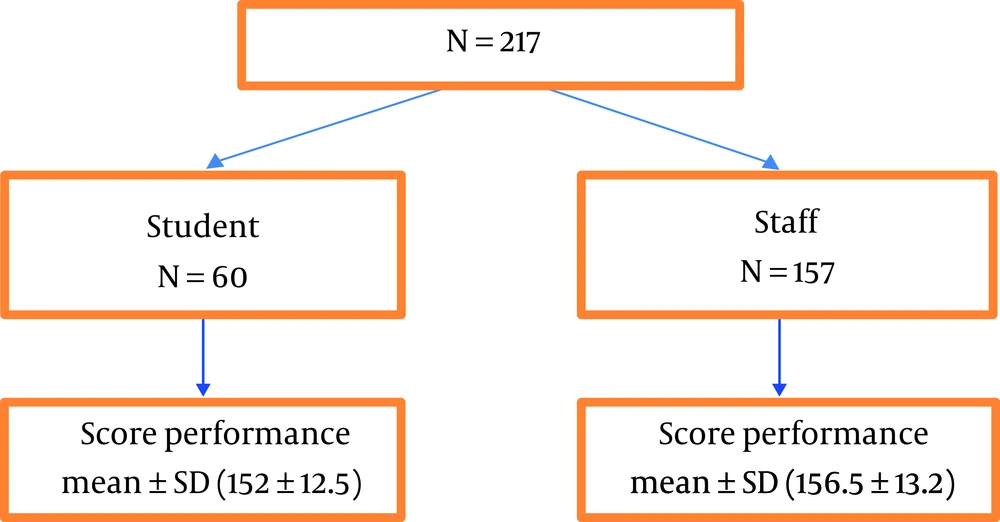
Figure 1.
Diagram of Comparing Students and Staff by Performance Score
Table 2.
Performance of Nursing Staff and Students in Nosocomial Infection Control in Terms of Age, Sex, and Passing Training Workshops
| Variable | Mean ± Standard Deviation | |
|---|---|---|
| Students | Nursing Staff | |
| Age, y | ||
| 20-30 | 153.4 ± 12.1 | 154.7 ± 13.7 |
| 31-40 | 148.7 ± 15.7 | 157.7 ± 13.2 |
| 41-60 | - | 156 ± 11.5 |
| P value | 0.44 | 0.38 |
| Sex | ||
| Male | 148 ± 12.5 | 149.2 ± 17.7 |
| Female | 154.8 ± 12.1 | 157.5 ± 11.7 |
| P value | 0.075 | 0.011 |
| Passing training workshops | ||
| Yes | 153.3 ± 10.9 | 156.1 ± 13.5 |
| No | 152.8 ± 13.3 | 157.3± 12.5 |
| P value | 0.89 | 0.59 |
There was no statistically significant difference between the mean score of nursing staff performance (P = 0.36). Therefore, it can be said that there was no relationship between work experience and performance. There was no statistically significant difference between the staff performance scores of the three hospitals (P = 0.76); however, there was a statistically significant difference between the scores of staff performance in different wards (P < 0.001). This difference was because of the difference between the performance scores of CCU and NICU staff and those of people in other wards (Table 3).
Table 3.
Performance of Nursing Staff in Nosocomial Infection Control in terms of Work Experience, Hospital, and Ward
| Score Variable | Number | Mean ± Standard Deviation | P Value |
|---|---|---|---|
| Work experience, year | 0.36 | ||
| Less than one | 20 | 160.4 ± 10.3 | |
| 1-10 | 74 | 155.1 ± 14.9 | |
| More than 10 | 63 | 156.9 ± 12.5 | |
| Total | 157 | 156.5 ± 13.2 | |
| Hospital | 0.76 | ||
| Shahidzadeh | 90 | 155.9 ± 15.2 | |
| Farideh Behbahani | 37 | 154.8 ± 12.2 | |
| Shahid Mustafa | 30 | 160.2 ± 8.2 | |
| Total | 157 | 156.5 ± 13.2 | |
| Ward | < 0.001 | ||
| Emergency Room | 33 | 156.7 ± 14.5 | |
| Internal | 26 | 156.7 ± 10 | |
| Surgical | 31 | 157.2 ± 12.9 | |
| ICU | 11 | 159.5 ± 12.4 | |
| CCU | 10 | 168.8 ± 5.6 | |
| Pediatric | 16 | 140.3 ± 12.1 | |
| Clinical | 4 | 158.7 ± 16.1 | |
| Dialysis | 3 | 161.7 ± 14.2 | |
| Nursery | 18 | 156.5 ± 12.5 | |
| NICU | 5 | 164 ± 4.1 | |
| Total | 157 | 156.5 ± 13.2 |
5. Discussion
In line with the main objective of the study, comparing the performance of students and clinical ward staff in nosocomial infection control, the results showed that the mean performance scores of students and nursing staff were good among the three levels of poor, moderate, and good. There was no statistically significant difference between the two groups (nursing staff and students) (P = 0.08). This is consistent with the results of most studies, including studies by Fashafsheh et al. (18), Darawad et al. (19), Ghalya (20), Sharif et al. (21), Alexandria et al. (22), and AL Rawajfah et al. (23), but is not consistent with studies by Yaghoubi et al., Ghanbari et al. (7, 24), and Shinde et al. that declared the performance of nursing staff was lower than the performance of students. The reasons for the inconsistency and poorer performance of the staff in these studies were factors such as considerable work stress, poor knowledge, lack of training, having too much workload, and avoiding hand contact with cleaners and disinfectants.
There was no significant relationship between staff performance and age, work experience, and passing training courses. This is consistent with research by Fashafsheh et al. (18), Hamid et al. (25), and Gijare et al. Similarly, AL Rawajfah et al. (23) noted that there was no significant relationship between performance and having long work experience. However, the relationship between work experience and performance regarding nosocomial infections was significant in Sharif et al.'s study (21). There was no statistically significant difference between the performance scores of staff from three hospitals. However, there was a statistically significant difference between the scores of personnel from different wards in which, CCU and NICU personnel outperformed people from other wards. This could be explained by the fact that patients in these wards have general weaknesses due to illnesses, a weakened defense system, and long hospitalization; thus, these patients are highly susceptible to infections. Therefore, the staff of these wards are more sensitive and careful in their work.
5.1. Limitation
One of the limitations of this study was the method of self-reporting in data collection, which could be influenced by the characteristics of individuals in reporting their performance.
5.2. Conclusion
In this study, the performance of medical staff and students was at a good level. Also, there was no significant difference between the performance of medical staff and students. In addition, it was not related to demographic components, and only people from CCU and NICU departments scored higher. Based on these findings, it can be concluded that nurses at different levels of education, with different demographic characteristics, and different work environments have a good performance in controlling infections. This is a strong point in the nursing profession.