1. Background
Nosocomial infections (NIs) are the most important cause of morbidity and mortality worldwide, according to the center for disease control (CDC) (1). NIs are defined as infections that develop 48 - 72 hours after hospitalization and within the first 10 days after discharge or 30 days following surgery (2-5). As a major global health problem, NIs cause functional disorders, prolongation of hospitalization, and significant morbidity and mortality (3, 6-8).
Patients hospitalized at intensive care unit (ICU) account for almost 20 - 25% of all NIs. The risk of NIs in ICU is 5 - 10 times greater than in other departments due to the more severe course of patients and the presence of concomitant diseases, mechanical ventilation, tracheostomy, invasive procedures, use of antibiotics, more frequent use of enteral or parenteral nutrition, and frequent contact of healthcare personnel with patients (3, 9-12). According to the literature, the prevalence of NIs in ICU ranges from 7.2% to 51%. (7, 13-15). Ventilator-associated pneumonia (VAP), urinary system infection, blood infection-related to the catheter, and surgical site infections (SSI) are reported as the most common NIs (3, 13, 16). Knowledge of transmission routes of NIs and taking necessary precautions are of crucial importance to prevent NIs (17). In this context, the compliance of nurses responsible for the care and treatment of patients with infection control assessment is essential for safe and quality health care (13, 18). In the literature, it has been seen that the knowledge of ICU nurses about NIs is not sufficient, and they do not apply standard-contamination precautions (1, 18).
2. Objectives
It is clearly seen in the literature that the knowledge level and behaviors of ICU nurses should be assessed, and training programs should be planned for them. This study aimed to examine ICU nurses' knowledge and behaviors regarding NIs.
3. Methods
Following a descriptive-observational design, this study was carried out in the surgical ICUs of public and training and research hospitals in Turkey from 15.07.2019 to 15.05.2020. The population of the study consisted of 138 nurses. One hundred and three ICU nurses, volunteering to participate in the study, receiving training on NIs, and with a bachelor, master, or doctorate degree in nursing were included in the study. A total of 74.6% of the population has been reached in the research. Data collection was performed using face-to-face interviews and follow techniques by researcher-developed forms on "sociodemographic information", "knowledge for prevention of NIs", and "behaviors for prevention of NIs", which were developed based on the literature and regarding the opinions of five specialists in nursing. The sociodemographic information form contained items on gender, age, the clinic where s/he works, education level, professional experience, weekly working hours, number of patients s/he cares for, and blood-related infection in the past.
Knowledge for prevention of NIs form contained items on VAP (items 1 to 10), catheter-related bloodstream infection (items 11 to 18), catheter-related urinary tract infection (items 19 to 22), and SSI (items 23 to 26). Data for this form were collected by face-to-face interviews, and each item was organized as true or false. In this context, the answers to the 3., 4., 7., 8., 10., 11., 16., 17., 18., 20., 22., 24., 25., and 26. items were determined as wrong, and others were determined as true. The lowest and highest scores were 26 and 52, respectively. The higher the score, the higher the knowledge. The alpha internal consistency coefficient was found to be 0.74.
The form on behaviors on prevention of NIs consists of items on VAP (items 1 to 6), catheter-related bloodstream infection (items 7 to 10), catheter-related urinary tract infection (items 11 to 14), and SSIs (item 15). In this context, the nurses' behaviors regarding evidence-based practice were followed during shifts (i.e., whether they apply the behavior specified for each item). The lowest and highest scores were 15 and 30, respectively. The higher the score, the better the adherence to the behavior. In this study, the alpha internal consistency coefficient was found to be 0.76.
An 80% classification system was used to evaluate the data (19). In this context, nurses are required to score at least 41.6 points for knowledge proficiency and at least 24 points for behavioral proficiency on the prevention of NIs.
Data analysis was administered using SPSS version 19. Mean, and standard deviation are used to describe quantitative variables, which were determined using measurement. Also, qualitative variables, determined by counting, are described using numbers and percentages.
The Skewness-Kurtosis test was applied to test for a normal distribution (-1.5 - +1.5). Parametric tests were used in the statistical analysis of the data, which indicated a normal distribution. Independent t-test was used for pairwise comparisons between variables with two categories, and one-way analysis of variance (ANOVA) was used for differences between variables with three or more categories.
Statistical significance was considered when P-value < 0.05. The post hoc Bonferroni test was used to determine the difference in the independent variable groups causing significance. In this context, the significance level was accepted as 0.017 for groups of 3 and 0.008 for groups of 4 in the post hoc Bonferroni test.
4. Results
The mean age of participants was 28.17 ± 5.08 (min 23; max47), 37.9% were 25 - 30 years old, 83.5% of them were women, 94.2% had bachelor's degree, and the experience of 44.7% of them was more than 5 years. The mean weekly working hour of the participants was 46.15 ± 6.88 (min 40; max 56 hours). In this context, 65.0% of the nurses worked 40 - 48 hours during a week. Also, 82.5% of participants took care of 3 patients during a shift, and none of them had a blood-borne infection.
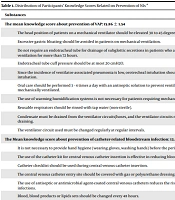
The mean score of knowledge on the prevention of NIs was 41.52 ± 2.86 (min 29; max 48). The mean score of knowledge on prevention of VAP, catheter-related bloodstream infection, catheter-related urinary tract infection, and SSIs was 15.86 ± 1.54 (min 10; max 19), 13.08 ± 1.54 (min 9; max 16), 5.98 ± 0.83 (min 4; max 8), and 6.59 ± 0.95 (min 4; max 8) respectively. The highest score on sub-dimensions of knowledge on prevention of NIs was related to the prevention of SSI, followed by catheter-related bloodstream infection, VAP, and catheter-related urinary tract infection (Table 1). The mean score of behaviors on prevention of NIs was found to be 15.86 ± 1.54 (min 15; max 23). The mean scores on prevention of VAP, catheter-related bloodstream infection, catheter-related urinary tract infection, and SSIs were 6.93 ± 0.89 (min 6; max 9), 4.77 ± 0.82 (min 4; max 7), 4.67 ± 0.71 (min 4; max 7), and 1.10 ± 0.31 (min 1; max 2). It was determined that the highest score on the sub-dimensions of behaviors on prevention of NIs was related to the prevention of catheter-related bloodstream infection, followed by catheter-related urinary tract infection, VAP, and SSIs (Table 2).
Table 1.
Distribution of Participants' Knowledge Scores Related on Prevention of NIs a
| Substances | False (%) | True (%) |
|---|---|---|
| The mean knowledge score about prevention of VAP: 15.86 ± 1.54 | ||
| The head position of patients on a mechanical ventilator should be elevated 30 to 45 degrees on the bed. | 1.9 | 98.1 |
| Excessive gastric bloating should be avoided in patients on mechanical ventilation. | 6.8 | 93.2 |
| Do not require an endotracheal tube for drainage of subglottic secretions in patients who are expected to require mechanical ventilation for more than 72 hours. | 60.2 | 39.8 |
| Endotracheal tube cuff pressure should be at most 20 cmH2O. | 33.0 | 67.0 |
| Since the incidence of ventilator-associated pneumonia is low, orotrecheal intubation should be preferred over nasotrecheal intubation. | 70.9 | 29.1 |
| Oral care should be performed 3 - 4 times a day with an antiseptic solution to prevent ventilator-associated pneumonia in patients on mechanically ventilated. | 10.7 | 89.3 |
| The use of warming humidification systems is not necessary for patients requiring mechanical ventilation for more than 48 hours. | 48.5 | 51.5 |
| Reusable respirators should be rinsed with tap water (non-sterile). | 76.7 | 23.3 |
| Condensate must be drained from the ventilator circuits/hoses, and the ventilator circuits must be kept closed during condensate draining. | 58.3 | 41.7 |
| The ventilator circuit used must be changed regularly at regular intervals. | 16.5 | 83.5 |
| The mean knowledge score about prevention of catheter-related bloodstream infection: 13.08 ± 1.54 | ||
| It is not necessary to provide hand hygiene (wearing gloves, washing hands) before the peripheral venous catheter insertion. | 91.3 | 8.7 |
| The use of the catheter kit for central venous catheter insertion is effective in reducing bloodstream infection. | 52.4 | 47.6 |
| Catheter checklist should be used during central venous catheter insertion. | 24.3 | 75.7 |
| The central venous catheter entry site should be covered with gas or polyurethane dressing. | 15.5 | 84.5 |
| The use of antiseptic or antimicrobial agent-coated central venous catheters reduces the risk of catheter-related bloodstream infections. | 36.9 | 63.1 |
| Blood, blood products or lipids sets should be changed every 48 hours. | 44.7 | 55.3 |
| Central venous catheters need to be changed on a routine basis. | 53.4 | 46.6 |
| To prevent infections, topical antibiotic ointments or creams should be applied at the central venous catheter entry site. | 48.5 | 51.5 |
| The mean knowledge score about prevention of catheter-related urinary tract infection: 5.98 ± 0.83 | ||
| To prevent urinary tract infections, a sterile and permanently closed urinary drainage system is required. | 17.5 | 82.5 |
| To prevent urinary tract infections, urine bags should be kept at or above the bladder level. | 86.4 | 13.6 |
| To minimize the risk of urethral trauma, use as small a catheter as possible. | 44.7 | 55.3 |
| If the catheter connection system is disconnected, the connection area can be disinfected and the same drainage system can be continued to be used. | 46.6 | 53.4 |
| The mean knowledge score about prevention of SSI: 6.59 ± 0.95 | ||
| Infections distant from the surgical site should be treated before elective surgery. | 35.9 | 64.1 |
| Only the hairs that may prevent the operation should be removed before the operation, and if shaving is necessary, it should be taken on the morning of the operation. | 77.7 | 22.3 |
| Any device or chemical can be used to remove hair from the surgical area. | 55.3 | 44.7 |
| Infection that occurs 30 or 90 days after surgery is called surgical site infection. | 62.1 | 37.9 |
a Total mean score of knowledge: 41.52 ± 2.86
Table 2.
Distribution of Participants' Behavioral Scores on Prevention of NIs a
| Substances | Not-applying (%) | Applying (%) |
|---|---|---|
| The mean behavior score about prevention of VAP: 6.93 ± 0.89 | ||
| Elevating the head of the bed by 30 to 45 degrees in patients on mechanical ventilators | 1.0 | 99.0 |
| Avoidance of excessive gastric bloating in patients on mechanically ventilated. | 2.9 | 97.1 |
| Use of closed aspiration system for aspiration of endotracheal secretions. | 14.6 | 85.4 |
| Checking that the endotracheal tube cuff pressure is at least 20 cmH2O. | 10.7 | 89.3 |
| Oral care 3 - 4 times a day with an antiseptic solution in mechanically ventilated patients. | 36.9 | 63.1 |
| Rinse reusable respirators with sterile water. | 27.2 | 72.8 |
| The mean behavior score about prevention of catheter-related bloodstream infection: 4.77 ± 0.82 | ||
| Ensuring hand hygiene (wearing gloves, washing hands) before peripheral venous catheter insertion. | 10.7 | 89.3 |
| Closure of the central venous catheter insertion site with gas or polyurethane dressing. | 10.7 | 89.3 |
| Changing the blood, blood products, or lipid sets at 24-hour intervals. | 12.6 | 87.4 |
| Not applying topical antibiotic ointment at the central venous catheter insertion site. | 43.7 | 56.3 |
| The mean behavior score prevention of catheter-related urinary tract infection: 4.67 ± 0.71 | ||
| Implementation and use of a sterile and permanently closed urinary drainage system. | 6.8 | 93.2 |
| Implementation of the urinary bags below the level of the bladder. | 3.9 | 96.1 |
| Use as small a catheter as possible to minimize the risk of urethral trauma. | 32.0 | 68.0 |
| Performing routine meatus cleaning and do not cleaning the meatal area with antiseptic solutions. | 25.2 | 74.8 |
| The mean behavior score prevention of SSI 1.10 ± 0.31 | ||
| Keeping the surgical incision closed with the primary technique for 24 hours after surgery. | 10.7 | 89.3 |
a Total mean score of behavior: 15.86 ± 1.54
In Table 3, mean scores of some variables and knowledge and behaviors of participants regarding the prevention of NIs are compared. Female nurses obtained higher scores on preventing NIs in comparison to the males, which was statistically significant (P < 0.05). There was no statistically significant difference between nurses' education level, age groups, experiences, the number of patients in a shift, and their knowledge and behavior scores (P > 0.05). A statistically significant difference was found between nurses' weekly working hours and their knowledge and behavior scores (P < 0.05). According to the Bonferroni test analysis, the level of knowledge was found to be statistically significantly higher in the nurse group whose weekly working hours was ≤ 40 and > 48 compared to the other group. In addition, the level of behaviors was found to be statistically significant in the group with > 48 working hours compared to the other groups (P < 0.017) (Table 3).
Table 3.
Comparison of the Participants' Variables and Knowledge and Behavior Mean Scores on Prevention of NIs
| Variables | Knowledge Mean Scores | Behavior Mean Scores |
|---|---|---|
| Gender | ||
| Female | 41.94 | 17.38 |
| Male | 39.41 | 18.05 |
| P | t = 2.7; df = 19.0; P = 0.014 | t = -1.0; df = 18.2; P = 0.302 |
| Education level | ||
| Undergraduate | 41.55 | 17.51 |
| Postgraduate | 41.00 | 17.16 |
| P | t = 0.74; df = 7.0; P = 0.479 | t = 0.68; df = 6.4; P = 0.517 |
| Age group | ||
| 22 - 25 | 41.44 | 17.26 |
| 25 - 30 | 17.87 | |
| ≥ 30 | 41.23 | 17.26 |
| P | f = 0.31; P = 0.728 | f = 1.54; P = 0.219 |
| ICU experience (y) | ||
| < 1 | 41.14 | 17.07 |
| 1 – 3 | 41.69 | 17.61 |
| 3 – 5 | 42.70 | 18.05 |
| > 5 | 41.10 | 17.34 |
| P | f = 1.41; P = 0.244 | f = 0.36; P = 0.369 |
| Weekly working hours (h) | ||
| ≤ 40 | 42.65 | 17.56 |
| 40 - 48 | 40.94 | 17.16 |
| > 48 | 42.53 | 19.07 |
| P (ANOVA) | f = 4.22; P = 0.017 | f = 7.75; P = 0.001 |
| Number of patients | ||
| 2 | 41.40 | 17.73 |
| 3 | 41.51 | 17.42 |
| 4 | 42.33 | 18.33 |
| P (ANOVA) | f = 0.13; P = 0.877 | f = 0.57; P = 0.564 |
5. Discussion
NIs is the biggest problem of modern health services, and it is an indicator of the quality of the care provided in hospitals (20). The risk of NIs in ICU is 5 - 10 times greater than in other departments (21). Necessary precautions should be taken in the ICU to reduce the risk of infection. Nurses not only should know the risk factors that cause urinary, VAP, catheter-related bloodstream infections, and SSIs in the ICU but also should follow high-risk patients for signs of infection. The use of evidence-based practices and multidisciplinary training in all interventions play an important role in preventing such infections (19). It can be recommended to raise awareness of nurses in the prevention of NIs (3).
In our study, it was determined that the knowledge and behaviors of intensive care nurses about NIs were insufficient. A study showed that the lack of knowledge of healthcare professionals about infection control practices leads to decreased compliance with such practices (22). Yuceer and Bulut's study (2010) determined that nurses' knowledge and practices regarding NIs were insufficient. They emphasized that with a sufficient number of well-trained intensive care nurses, it was thought that NIs in the ICU would decrease significantly (23). Fashafsheh et al. found that 53.9% of the nurses had moderate knowledge and good practice regarding NIs. They found no significant difference between knowledge about preventing NIs and variables of age, experience, and education. There was a significant difference between the practice of preventing NIs and gender (24). Based on the findings, they recommended updating the knowledge and practices of nurses through continuous in-service training programs; It has been determined to emphasize the importance of following evidence-based practices on infection control in the continuing education/training programs (24). In another study, nearly 70% of the nurses had knowledge about NIs and the role of nursing care in preventing NIs. In addition, it was determined that only 55% of the nurses had sufficient knowledge about NIs transmission (20). Sodhi et al. stated that nurses had good knowledge of infection control, but regular training programs for infection control, transmission-based precautions, and service-based education programs were included in various care packages developed for training (22). In a study by Öztürk et al. (25), aimed to evaluate the knowledge level of healthcare personnel working in the ICU about infection control and to determine factors that may contribute to their knowledge level, the success rate before education was 72%, while it increased to 83% after receiving the training (P < 0.05).
In addition, it was determined that the level of knowledge increased with education in both genders and all age groups. As a result, it is thought that renewing, updating, and evaluating the knowledge of health personnel through continuous in-service training will be beneficial in the prevention of healthcare-associated infections (25). Another study found that nurses' knowledge about preventing NIs was moderate. It was determined that the knowledge scores of the nurses did not differ according to their education on the prevention of NIs (P > 0.05). In addition, the lowest score was related to the prevention of SSIs (1). In a study on the prevention of catheter-related urinary tract infections, the mean score of nurses is evaluated to be moderate-good. Regarding the results of the study, it has been suggested to provide an in-service training program about evidence-based practices (26). In another study, the level of nurses' knowledge about NIs was low. In addition, there was a significant difference between age, gender, and level of knowledge. The knowledge level of men and nurses aged 25 and over was found to be higher than the others (8). In another study, nurses' knowledge scores about catheter-related urinary tract infections were found to be high. Based on the findings, it was reported to determine the training needs of nurses for urinary catheter infection control measures to increase the quality and safety of patient care (27). The present study's findings were found to be in line with the literature. In addition, it was determined that nurses' knowledge and behaviors about preventing NIs were affected by some factors.
5.1. Conclusions
It was determined that the knowledge and behaviors of intensive care nurses regarding the prevention of NI were insufficient. In addition, according to the findings, gender and weekly working hours affect the knowledge and behaviors related to NI prevention. As a result of the study, it was suggested that in-service training should be carried out periodically through simulations in hospitals and all health professionals in the field should be supervised.