
1. Background
Measles, caused by a single-stranded RNA virus of the genus Morbillivirus in the Paramyxoviridae family, remains one of the most contagious diseases known to humanity (1). Its characteristic clinical presentation—a prodrome of high fever, malaise, and the classic “three Cs” (cough, coryza, and conjunctivitis), followed by a pathognomonic maculopapular rash—has been described for centuries (2). Despite the availability of a safe, effective, and inexpensive vaccine for more than 5 decades, measles remains a leading cause of vaccine-preventable mortality among children globally, particularly in developing regions (3).
In Iran, several outbreaks have been reported in recent years, with varying coverage and complication rates (4). In neighboring countries such as Afghanistan, Pakistan, and Iraq, conflict and low vaccination coverage have sustained measles endemicity (5, 6). The Eastern Mediterranean Region faces unique challenges related to population movement and health system disparities. In the Eastern Mediterranean Region (EMRO), to which Iran belongs, measles control efforts have yielded mixed results. The Islamic Republic of Iran has historically maintained a strong Expanded Program on Immunization (EPI), achieving high national coverage rates for the first dose of a measles-containing vaccine (MCV) (4). However, national averages can mask substantial subnational disparities. Southeastern Iran, particularly Sistan and Baluchestan Province and its capital, Zahedan, faces distinct socioeconomic and geopolitical challenges. The region hosts a large population of Afghan refugees and migrants, who often encounter barriers to accessing health care, including vaccination services, because of poverty, mobility, legal status, and cultural differences (5). This situation creates a vulnerable subpopulation that can serve as a reservoir for the virus, potentially triggering and sustaining outbreaks that can spill over into the broader community.
2. Objectives
This study aimed to conduct a comprehensive analysis of the demographic, clinical, and paraclinical characteristics of children hospitalized with measles at Ali Ibn Abi Talib Hospital in Zahedan during 2022 - 2023.
3. Methods
3.1. Study Design and Setting
A descriptive-analytical cross-sectional study was conducted by reviewing the medical records of children hospitalized with measles at Ali Ibn Abi Talib Hospital in Zahedan, a major referral center in southeastern Iran.
3.2. Participants and Sampling
The study included all 210 children aged < 18 years with a laboratory-confirmed measles diagnosis who were admitted between March 21, 2022, and March 20, 2023 (12 consecutive months). An a priori sample size calculation indicated that this number would estimate proportions with a 7% margin of error at the 95% confidence level. Consecutive (census) sampling was used to include all eligible cases during the study period. Patients with incomplete medical records were excluded. Immunocompromised children (e.g., those receiving chemotherapy or long-term corticosteroids or those with primary immunodeficiency) were not specifically excluded because the study aimed to include all laboratory-confirmed measles cases.
3.3. Case Definition
Measles was confirmed by laboratory criteria: Positive serum anti-measles IgM using a commercial ELISA kit (Pishtaz Teb, Iran) or a positive RT-PCR test for measles virus RNA using a commercial kit (GeneProof). Clinically diagnosed cases without laboratory confirmation were excluded. The proportion of missing data was < 5% for all variables; no imputation was performed. Vitamin A supplementation was administered routinely as 2 doses (100,000 IU for infants < 12 months and 200,000 IU for older children), according to national guidelines.
3.4. Data Collection
A data collection form was used to extract information from patient records, including the following:
Demographics: age, sex, nationality, and place of residence (urban/rural).
Vaccination Status: categorized as “complete” (receipt of both recommended doses: the first dose at 12 months and the second dose at 18 months, according to Iran's EPI schedule), “incomplete” (one dose), or “unvaccinated,” based on vaccination cards or records.
Clinical Features: presence of fever, rash, cough, coryza, conjunctivitis, and Koplik's spots.
Complications: pneumonia, diarrhea, otitis media, encephalitis, and blindness.
Paraclinical Findings: white blood cell (WBC) count, platelet count, and liver function tests (AST/ALT) from the first blood sample obtained within 24 hours of admission.
3.5. Statistical Analysis
Data were analyzed using SPSS version 27. Normality of continuous variables was assessed using the Shapiro-Wilk test. Descriptive statistics were presented as frequencies (percentages) for categorical variables and as the mean (± standard deviation) or median (interquartile range) for continuous variables, depending on their distribution. Comparisons between vaccination groups were performed using the chi-square test for categorical variables and the Kruskal-Wallis test for continuous variables. A P value < 0.05 was considered statistically significant.
3.6. Ethical Considerations
The study protocol was approved by the Ethics Committee of Zahedan University of Medical Sciences (code: IR.ZAUMS.REC.1403.267). Because of the retrospective design and use of anonymized data, the requirement for informed consent was waived. Patient confidentiality was maintained throughout the study.
4. Results
4.1. Demographic Characteristics and Vaccination Status
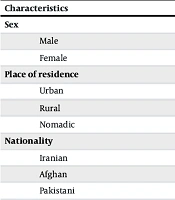
The median age was 12 months (IQR, 9 - 17), and the mean age was 18.6 ± 12.4 months (range, 1 - 86 months), reflecting a right-skewed distribution. Most children (54.3%) were male. Most patients were Iranian (85.7%), and 14.3% were Afghan nationals. Most participants (74.8%) lived in urban areas. Regarding vaccination status, more than half (54.8%) were fully vaccinated, 40% had received no measles vaccine, and 5.2% had an incomplete vaccination history (Table 1). Among the 115 fully vaccinated children, 102 (88.7%) had received only 1 dose (aged 12 - 18 months and not yet eligible for the second dose), and only 13 (11.3%) had received both doses.
Table 1.
Demographic Characteristics and Vaccination Status of Hospitalized Children with Measles (N = 210) a
| Characteristics | Values |
|---|---|
| Age (mo) | |
| Mean ± SD | 18.6 ± 12.4 |
| Median (IQR) | 12 (9 - 17) |
| Sex | |
| Male | 114 (54.3) |
| Female | 96 (45.7) |
| Nationality | |
| Iranian | 180 (85.7) |
| Afghan | 30 (14.3) |
| Residence | |
| Urban | 157 (74.8) |
| Rural | 53 (25.2) |
| Vaccination Status | |
| Complete | 115 (54.8) |
| Unvaccinated | 84 (40.0) |
| Incomplete | 11 (5.2) |
a Values are expressed as No. (%) unless otherwise indicated.
4.2. Clinical Manifestations and Complications
The classic symptoms of measles were highly prevalent. Fever and rash were present in nearly all patients (99%). Cough was observed in 73.8% of children, coryza in 64.8%, and conjunctivitis in 40%. The most frequent complication was pneumonia, affecting 43.8% of patients, followed by diarrhea (30%) and otitis media (11.9%). Severe neurological complications were uncommon; encephalitis was reported in 1% of cases and blindness in 0.5%. Overall, 35.7% of children had no serious complications (Table 2, Figure 1). The median duration of hospitalization was 5 days (IQR, 3 - 7). Intensive care unit (ICU) admission was required for 12 (5.7%) children. All patients recovered, with no deaths.
Table 2.
Clinical Manifestations and Complications in Hospitalized Children with Measles (N = 210)
| Variables | No. (%) |
|---|---|
| Clinical Features | |
| Fever | 208 (99.0) |
| Rash | 208 (99.0) |
| Cough | 155 (73.8) |
| Coryza | 136 (64.8) |
| Conjunctivitis | 84 (40.0) |
| Complications | |
| Pneumonia | 92 (43.8) |
| Diarrhea | 63 (30.0) |
| Otitis Media | 25 (11.9) |
| Encephalitis | 2 (1.0) |
| Blindness | 1 (0.5) |
| No Complications | 75 (35.7) |
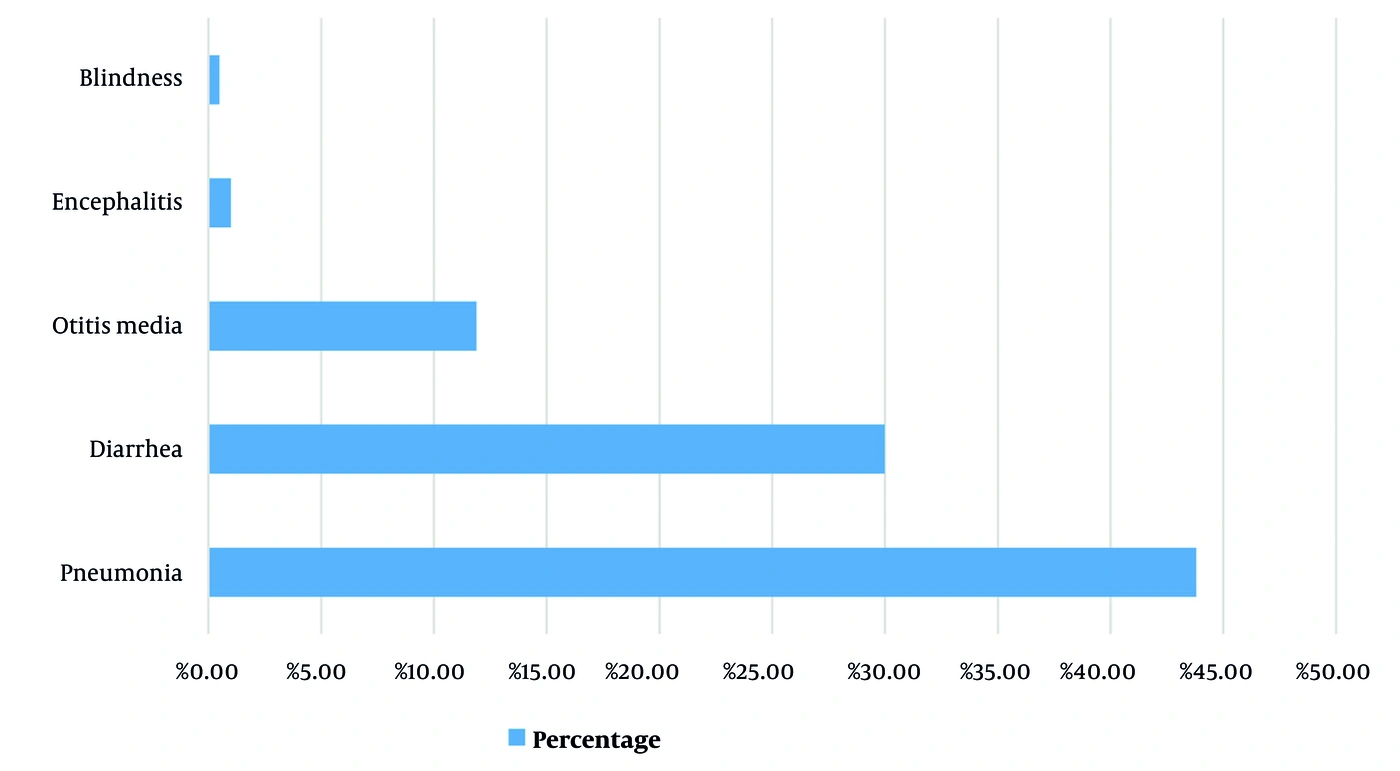
Figure 1.
Frequency of common complications among hospitalized children with measles: pneumonia, 43.8%; diarrhea, 30%; otitis media, 11.9%; encephalitis, 1%; blindness, 0.5%.
4.3. Paraclinical Findings
Hematological and biochemical parameters are summarized in Table 3. The WBC count was within the normal range in 71% of patients, whereas 19% had leukocytosis and 10% had leukopenia. Platelet counts were normal in 81% of cases, elevated in 12.4%, and decreased in 6.7%. The most notable finding was elevated liver function tests (LFTs), which were increased in most patients (79.5%). No patient had LFT values below the normal range. Elevated liver enzymes were not significantly associated with pneumonia (P = 0.34) or prolonged hospital stay (P = 0.21). Elevated LFTs were transient in all cases, normalizing at discharge or at the 2-week follow-up, suggesting self-limited, immune-mediated hepatitis rather than a direct viral cytopathic effect.
Table 3.
Paraclinical Findings in Hospitalized Children with Measles (N = 210)
| Laboratory Parameters | No. (%) |
|---|---|
| White Blood Cell (WBC) Count | |
| Normal | 149 (71.0) |
| High | 40 (19.0) |
| Low | 21 (10.0) |
| Platelet Count | |
| Normal | 170 (81.0) |
| High | 26 (12.4) |
| Low | 14 (6.7) |
| Liver Function Tests (LFT) | |
| High | 167 (79.5) |
| Normal | 43 (20.5) |
| Low | 0 (0.0) |
4.4. Comparison by Vaccination Status
Table 4 compares clinical and laboratory findings among unvaccinated, incompletely vaccinated, and fully vaccinated children. No statistically significant differences were observed in the frequency of pneumonia, diarrhea, or elevated liver enzymes across the 3 groups (P > 0.05 for all comparisons).
Table 4.
Comparison of Clinical and Laboratory Findings by Vaccination Status a
| Variables | Unvaccinated (n = 84) | Incomplete (n = 11) | Complete (n = 115) | P-Value |
|---|---|---|---|---|
| Pneumonia | 38 (45.2) | 5 (45.5) | 49 (42.6) | 0.89 |
| Diarrhea | 25 (29.8) | 3 (27.3) | 35 (30.4) | 0.95 |
| Elevated LFT | 66 (78.6) | 9 (81.8) | 92 (80.0) | 0.93 |
| WBC count | 8.2 ± 3.1 | 8.5 ± 2.9 | 8.0 ± 3.3 | 0.76 |
a Values are expressed as No. (%) or mean ± SD. Statistical test used for comparisons: Chi-square test for categorical variables (pneumonia, diarrhea, elevated LFT) and one-way ANOVA for continuous variables (WBC count).
5. Discussion
This study provides a critical analysis of a recent measles outbreak among pediatric patients in southeastern Iran, a region characterized by unique sociodemographic challenges. The findings demonstrate a concentration of disease in vulnerable age groups, a high rate of complications, and a substantial proportion of cases among vaccinated children, against a backdrop of regional inequities.
The demographic profile of our patients, with a mean age of 18.6 months and a median age of 12 months, is consistent with the epidemiological pattern observed in regions with intermediate or fluctuating vaccine coverage. This age distribution highlights a critical window of susceptibility. Infants are protected by maternal antibodies during the first several months of life, but this immunity wanes, leaving them vulnerable until they can mount a robust immune response to the first dose of MCV, typically administered at 12 months in Iran (6). Our data suggest that the period between the loss of passive immunity and the induction of active immunity is a high-risk interval. This pattern is echoed in recent outbreaks globally. A 2023 study from Jordan similarly found that 69.7% of hospitalized measles cases occurred in children younger than 1 year, underscoring the universal vulnerability of this cohort in the face of viral exposure (7). Furthermore, a large community-wide outbreak in Israel also reported a substantial concentration of cases among infants and toddlers, reinforcing the concept of this age-dependent susceptibility gap (8).
One of the most concerning findings of our study is that more than half (54.8%) of the hospitalized children had a complete measles vaccination history. This phenomenon, termed “vaccine failure,” warrants careful scrutiny. In Iran's EPI, the first dose is given at 12 months and the second at 18 months. Local EPI data suggest potential cold-chain breaches in remote health posts in Sistan and Baluchestan Province, which may contribute to primary vaccine failure. Further programmatic audits are warranted. Given that the median age of our patients was 12 months, the majority of “completely vaccinated” children (102/115, 88.7%) had actually received only the first dose. This suggests that most cases among vaccinated children represent primary vaccine failure—failure to seroconvert after 1 dose—rather than waning immunity after 2 doses. Primary failure can occur because of interference from maternal antibodies, cold-chain issues, or host factors (9-11). The high number of vaccinated cases in our study aligns with a 2022 report from the Philippines, which documented that 45% of measles cases during an outbreak had received at least 1 dose of vaccine, pointing to similar operational challenges and potential immune gaps. Another study from India in 2024 also reported a considerable proportion of vaccinated children among measles cases, emphasizing that high nominal coverage does not automatically translate into perfect population immunity (12). This underscores a crucial public health message: achieving high vaccination coverage is necessary but not sufficient. The quality of the vaccination program, including a robust cold chain, trained personnel, and a reliable tracking system to ensure timely second doses, is paramount.
Importantly, when we compared clinical severity across vaccination groups, we found no significant differences in pneumonia, diarrhea, or elevated liver enzymes (Table 4). This indicates that, once infected, vaccinated children were as likely as unvaccinated children to develop severe complications, reinforcing the need for prevention rather than reliance on milder disease in breakthrough cases.
The clinical severity of the cases in our cohort is concerning. The high rate of pneumonia (43.8%) is a primary concern because pneumonia is a leading cause of measles-associated mortality (13). Measles virus induces profound and transient immunosuppression by infecting and depleting memory lymphocytes, effectively erasing immune memory and leaving the host susceptible to secondary bacterial and viral infections (14, 15). This biological mechanism explains the high frequency of severe pulmonary complications. The prevalence of diarrhea (30%) further complicates the clinical course by leading to dehydration and exacerbating malnutrition, creating a cycle that increases mortality risk (16). Our complication rates are higher than those reported in a 2023 study from Poland, which found pneumonia in 23% of hospitalized pediatric cases, but are similar to those in a 2024 report from Guinea, where bronchopneumonia was a leading complication (17, 18). This discrepancy may reflect differences in baseline nutritional status, access to early care, or the virulence of the circulating viral strain. The finding that 79.5% of our patients had elevated liver enzymes, although largely subclinical, indicates direct or immune-mediated hepatic involvement by the virus. This is a recognized but often underemphasized aspect of measles, as noted in a 2024 case series from Romania, and warrants monitoring because it can influence drug metabolism and overall recovery (19).
From a public health perspective, the distribution of cases reveals critical inequities. The predominance of urban cases (74.8%) likely reflects higher population density and more intense transmission networks in cities. More notably, Afghan nationals accounted for 14.3% of our cohort, compared with an estimated 5% - 7% of the general population of Sistan and Baluchestan Province, indicating a 2- to 3-fold higher risk of hospitalization and signaling a substantial gap in health equity. Migrant and refugee populations often face substantial barriers to health care access, including legal, financial, linguistic, and cultural obstacles (5, 20). A 2023 systematic review from Iran explicitly identified these barriers among Afghan migrants, including fear of deportation, lack of awareness, and economic hardship, leading to delayed or forgone vaccination (21). This creates pockets of susceptibility that can fuel and sustain outbreaks, ultimately threatening the health of the entire community. Our findings are consistent with a 2024 analysis of measles transmission dynamics in Europe, which identified unvaccinated migrant communities as key nodes in outbreak propagation (22). However, it is important to note that 85.7% of cases were Iranian nationals, indicating that immunity gaps are widespread in the general population. Thus, while migrant populations represent a high-risk subgroup, the outbreak is sustained by systemic gaps affecting the entire population.
5.1. Study Limitations
This study has several limitations. Its hospital-based, retrospective design means that our data capture the more severe end of the disease spectrum and may not be generalizable to all measles cases in the community. Reliance on medical records introduces the potential for missing data or inconsistencies in documentation. Furthermore, we could not perform more advanced immunological assays to definitively characterize the nature of the vaccine failures observed. The circulating measles virus genotype was not determined, which could have provided insights into transmissibility and vaccine matching. The single-center design limits generalizability to other regions with different health care infrastructures or measles epidemiology.
5.2. Conclusions and Recommendations
In conclusion, our findings indicate that measles remains a serious and persistent threat to child health in southeastern Iran, characterized by a high complication rate and failure to protect a substantial proportion of vaccinated children. The disease disproportionately affects infants during a window of vulnerability and highlights marked health inequities, particularly among migrant populations. A multifaceted strategy is required to alter this trajectory. We recommend the following:
1) Enhance vaccine program quality, including cold-chain strengthening and digital tracking.
2) Conduct targeted catch-up campaigns in high-density urban areas and migrant communities.
3) Ensure equitable access policies that provide free vaccination for all children regardless of nationality.
4) Maintain clinical vigilance for complications such as pneumonia and hepatitis, with routine vitamin A supplementation.
Future studies should investigate the duration of maternal antibody protection in this region and assess the feasibility of an early measles vaccination schedule (e.g., 9 months) for high-risk populations. Our findings underscore the need to reevaluate measles elimination timelines and booster strategies for high-risk Iranian children, particularly in underserved provinces.