
1. Background
Excessive crying poses challenges not only for infants but also for parents and healthcare practitioners. Approximately 20% of infants experience excessive crying, which is categorized as infantile colic and can cause substantial parental concern (1, 2). Infantile colic refers to excessive crying in infants and is typically defined as crying for more than 3 hours per day, more than 3 days per week. This condition is benign and self-limiting, is often managed with conservative interventions, and usually improves over time (3-5).
The causes of infantile colic involve parental and infant-related factors, as well as other factors that are not yet fully understood. Parental factors such as stress and anxiety, particularly in cases of postpartum depression and social challenges, can adversely affect infants and may increase infant stress. In addition, inadequate education about breastfeeding and breastfeeding positions can lead to infant overfeeding and discomfort for both infants and mothers during breastfeeding. Infant-related factors that may contribute to colic include gastrointestinal problems such as cow’s milk protein intolerance, lactase deficiency, intestinal prematurity, intestinal hypermobility, and changes in bacterial flora. Biological factors, such as elevated serotonin levels and early-onset migraine in infants, may also play a role in infantile colic (6, 7).
For the prevention and treatment of infantile colic, various interventions can be considered, including parental education, probiotics, dietary modifications, and, if necessary, pain-relieving medications (8). The laid-back breastfeeding position has been shown to reduce air intake and improve latch, which may help mitigate gas-related discomfort in infants. This position supports optimal alignment of the head, neck, and esophagus, promotes smoother digestion, and reduces abdominal pressure (9).
2. Objectives
This study aimed to compare the effectiveness of the laid-back breastfeeding position and the cradle-hold position in reducing the frequency of colic among infants and neonates attending the Children’s Medical Center Hospital in Tehran.
3. Methods
3.1. Research Design
This prospective interventional cohort study included neonates and infants aged 8 days to 3 months who visited the neonatal clinic at Children’s Medical Center Hospital in Tehran from 2021 to 2024. Participants were examined by neonatologists, and infantile colic was diagnosed when infants cried for more than 3 days per week and more than 3 hours per day after other potential causes had been excluded by physical examination and, when necessary, laboratory tests.
3.2. Sample
Participants were randomly assigned to the intervention group (laid-back position) or the control group (cradle-hold position) using computer-generated block randomization. Allocation concealment was ensured using sealed, opaque envelopes that were opened after informed consent was obtained. Randomization helped minimize selection bias.
The inclusion criterion was as follows:
- Breastfed infants with infantile colic.
The exclusion criteria were as follows:
- Infants with underlying disorders;
- A history of asphyxia;
- Gestational age (GA) of less than 35 weeks;
- Cow’s milk allergy;
- Probiotic use.
3.3. Setting
Based on the inclusion and exclusion criteria, participants were referred to an expert midwife to learn appropriate breastfeeding techniques and positions. Breastfeeding education, guidance on appropriate breastfeeding positions, and conservative treatment for colic relief were provided by the midwife to 50 participants. Participants were then divided into case and control groups. Infants whose mothers used the laid-back position at least twice daily were assigned to the case group, whereas infants whose mothers did not use the laid-back position and used only the cradle-hold position were assigned to the control group. In the laid-back position, the mother lies supine while the infant lies prone on the mother’s abdomen. In the cradle-hold position, the infant is held across the mother’s lap, facing her, while the mother supports the infant’s head on her forearm during breastfeeding.
3.4. Data Collection
Demographic characteristics, including age, sex, age at colic onset, GA, current weight, maternal age, maternal education level, and maternal employment status, were collected. Mothers were also asked about colic frequency in days, colic duration, and any use of formula in addition to breastfeeding. Mothers were instructed to record the breastfeeding positions used and their infant’s crying status daily for 1 week. At the end of the week, a pediatric resident who was blinded to the positions of the 2 groups contacted the mothers to collect information on colic frequency in days and duration. Participants who did not follow the instructions for the laid-back position or chose to switch exclusively to formula feeding were excluded from the study. Potential confounders, such as prematurity and underlying disorders, were addressed through strict eligibility criteria.
3.5. Sample Size Determination
Based on the study by Sadeghzadeh Fard Sorkhabi and the mean changes in colic severity at the end of the study, the case group had a mean ± standard deviation of 2.4 ± 2.2, and the control group had a mean ± standard deviation of 0.7 ± 1.5. With a type I error (α) of 5%, power (β) of 80%, and an assumed attrition rate of 15%, the sample size was estimated using the appropriate statistical formula. The total sample size was calculated as 50 participants, with 25 participants allocated to each group. The a priori power calculation (80% power, α = 0.05, and effect size = 1.2 based on previous literature) justified the sample size (n = 50). However, we conducted a post hoc power analysis (G*Power 3.1) using the observed effect size of 0.89, confirming 78% power for the primary outcome.
3.6. Data Analysis
The collected data were analyzed using an independent t-test to compare means and evaluate relationships between quantitative and qualitative variables. The chi-square test was used to compare frequencies and assess relationships between qualitative variables, and correlation analysis was performed for quantitative variables. All analyses were conducted using SPSS version 16. Although basic statistical tests, including the independent t-test and chi-square test, were used, the limited sample size restricted our ability to perform complex multivariable regression analyses for all potential confounders.
4. Results
After 7 cases were excluded because of switching to formula feeding or not performing the laid-back position, a total of 50 neonates were included in the study. Among these participants, 40 were term infants, accounting for 80% of the total sample. Regarding educational status, 72% of the participants’ mothers had attained higher education, and 84% were homemakers. In addition, 46% of the participants followed a feeding regimen that included both formula and breast milk. Based on the results presented in Table 1, the independent variables did not differ significantly between the case and control groups.
Table 1.
Independent Variables in the Case and Control Groups of the Studied Neonates a
| Independent Variables | Case Group n = 25 | Control Group n = 25 | Total n = 50 | P-Value |
|---|---|---|---|---|
| Gender | 0.777 | |||
| Male | 13 (52) | 12 (48) | 25 (50) | |
| Female | 12 (48) | 13 (52) | 25 (50) | |
| Parity | < 0.001 | |||
| Multiparity | 6 (24) | 6 (24) | 12 (24) | |
| Nulliparity | 19 (76) | 19 (76) | 38 (76) | |
| Gestational age (wk) | 0.480 | |||
| Term (≥ 37) | 21 (84) | 19 (76) | 40 (80) | |
| Preterm (< 37) | 4 (16) | 6 (24) | 10 (20) | |
| Type of delivery | 0.221 | |||
| Cesarean | 20 (80) | 23 (92) | 43 (86) | |
| NVD | 5 (20) | 2 (2) | 7 (14) | |
| Diet | 0.777 | |||
| BMF + formula | 11 (44) | 12 (48) | 23 (46) | |
| BMF | 14 (56) | 13 (52) | 27 (54) | |
| Mother’s education | 0.529 | |||
| Diploma | 8 (32) | 6 (24) | 14 (28) | |
| Higher education | 17 (68) | 19 (76) | 36 (72) | |
| Mother’s job | < 0.001 | |||
| Homemaker | 21 (84) | 21 (84) | 42 (84) | |
| Employed | 4 (16) | 4 (16) | 8 (16) |
a Values are expressed as No. (%).
The mean values of the independent variables for the case and control groups are presented in Table 2. In the case group, the mean colic frequency was 5.80 days (± 1.32), whereas in the control group, it was 5.96 days (± 2).
Table 2.
Mean Values of Independent Variables in the Case and Control Groups of the Studied Neonates a
| Independent Variables | Case Group | Control Group | Total | P-Value |
|---|---|---|---|---|
| Age (d) | 42.72 ± 29.3 | 37.56 ± 17.4 | 4.14 | 0.985 |
| Age at colic onset (d) | 19.2 ± 13.3 | 16.9 ± 11.3 | 18.05 | 0.668 |
| Current weight (g) | 3760 ± 1009 | 4039.6 ± 957.8 | 3899.8 | 0.480 |
| Mother’s age (y) | 32.3 ± 4.4 | 32 ± 5.0 | 32.15 | 0.837 |
| Colic frequency (d/wk) | 5.80 ± 1.32 | 5.96 ± 1.17 | 5.88 | 0.652 |
a Values are expressed as mean ± SD.
After adopting the laid-back position, the mean colic frequency in the case group was 4.32 days (± 1.70), whereas after adopting the cradle-hold position, the mean colic frequency in the control group was 5.60 days (± 1.00). The difference between the 2 groups was statistically significant (P = 0.003; Table 3).
Table 3.
Mean Colic Frequency in the Case and Control Groups Before and After Position Education a
| Colic Frequency (d/wk) | Case Group | Control Group | P-Value |
|---|---|---|---|
| Before education | 5.80 ± 1.32 | 5.96 ± 1.17 | 0.652 |
| After education | 4.32 ± 1.70 | 5.60 ± 1.00 | 0.003 |
a Values are expressed as mean ± SD.
In the case group, the mean colic frequency (days) among infants who received formula feeding in addition to breastfeeding was 5.36 days, whereas it was 3.50 days among exclusively breastfed infants. This difference was statistically significant (P = 0.007; Table 4).
Table 4.
Comparison of Colic Frequency Between Formula and Nonformula Feeding in the Case and Control Groups a
| Colic Frequency (d/wk) | Case Group | Control Group | ||||
|---|---|---|---|---|---|---|
| BMF + Formula | BMF | P-Value | BMF + Formula | BMF | P-Value | |
| Before education | 6.18 ± 0.87 | 5.50 ± 1.56 | 0.207 | 5.83 ± 1.11 | 6.08 ± 1.26 | 0.614 |
| After education | 5.36 ± 1.29 | 3.50 ± 1.74 | 0.007 | 5.83 ± 1.11 | 5.38 ± 1.04 | 0.309 |
a Values are expressed as mean ± SD.
The participants’ weight status in Figures 1 and 2 indicated that the slope of weight change in the week after the intervention was steeper in the case group than in the control group. Furthermore, within the case group, this change was more pronounced among infants with higher weights than among those with lower weights.
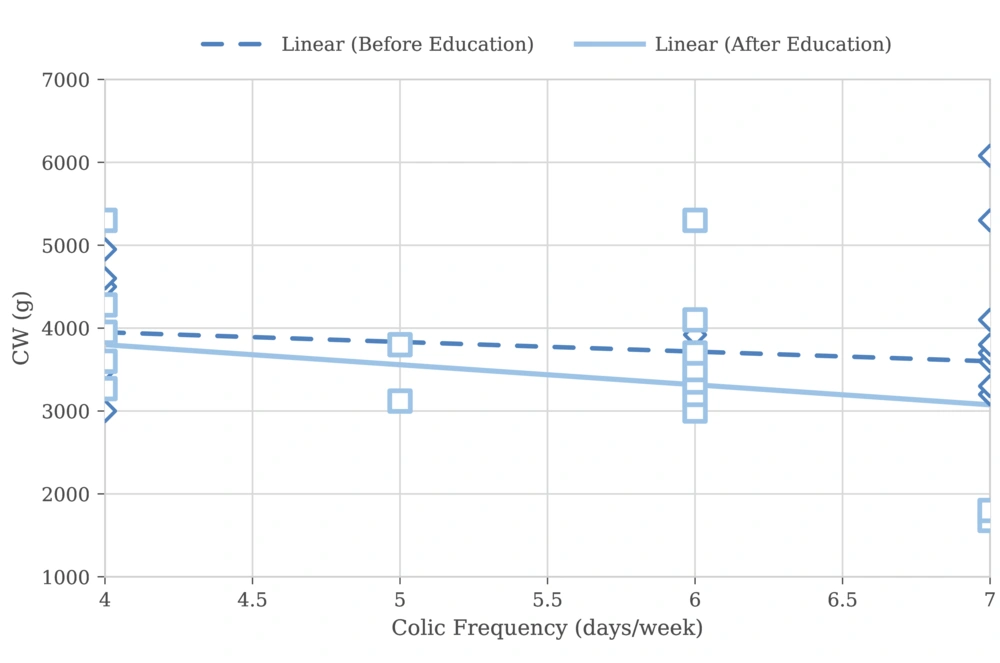
Figure 1.
The colic frequency in case group
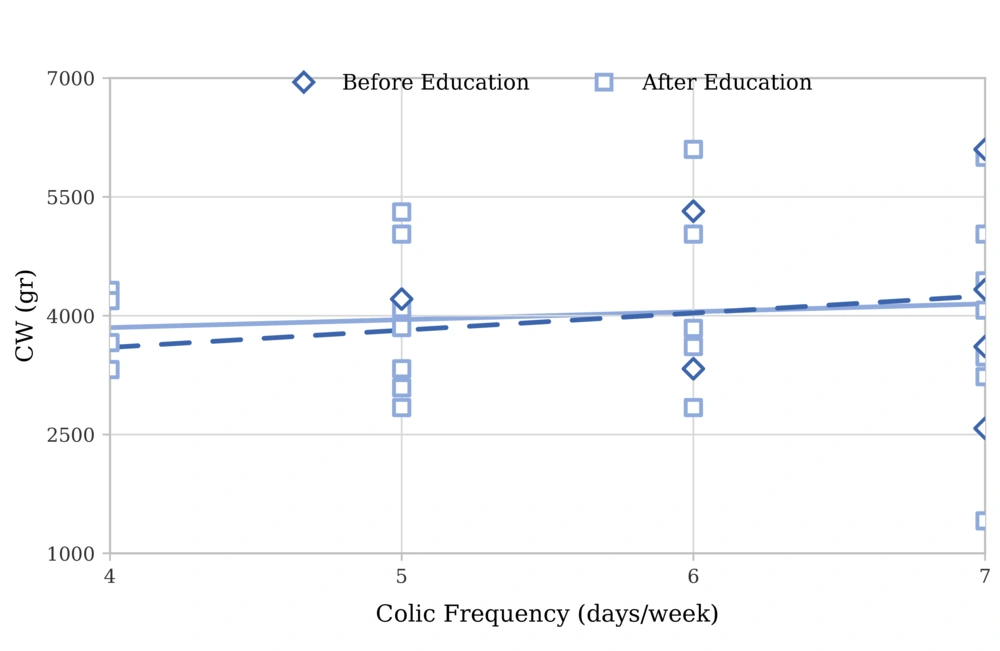
Figure 2.
The colic frequency in control group
5. Discussion
This study showed a significant reduction in colic episodes among neonates held in the laid-back breastfeeding position compared with those held in the traditional cradle-hold position, suggesting that maternal posture during feeding plays an important role in infant comfort and colic mitigation. Furthermore, the incidence of colic was considerably lower among exclusively breastfed infants than among those receiving both formula and breast milk, underscoring the potential soothing and protective effects of exclusive breastfeeding.
Although the analysis of demographic variables revealed no statistically significant differences between the case and control groups, several trends merit consideration. Most participants’ mothers (84%) were homemakers. Although employment status was not significantly associated with colic occurrence, the time availability and attentiveness associated with homemaking may contribute to more effective implementation of colic-reducing strategies, such as responsive feeding and holding techniques. Similarly, parity showed no meaningful statistical impact on colic outcomes; however, multiparous mothers may have experiential knowledge that improves their ability to manage infant distress. The absence of statistical significance could be attributable to sample size limitations or homogeneity within the population, suggesting the need for further investigation.
Maternal educational status was also predominantly high, with 72% of mothers holding advanced degrees. Although maternal education was not directly correlated with colic frequency, it likely plays an indirect role by promoting greater awareness of, adherence to, and implementation of recommended feeding practices and behavioral interventions. These advantages may contribute to the overall effectiveness of care strategies, even in the absence of a measurable effect within this sample.
Educating mothers about appropriate breastfeeding positions is essential to prevent infantile colic, excessive crying, and maternal complications such as nipple pain or breastfeeding fatigue. This knowledge can lead to a more comfortable and positive breastfeeding experience (10). A systematic review of studies conducted from 2007 to 2017 evaluated various approaches to addressing infantile colic. The findings indicated that parental education, particularly regarding breastfeeding techniques and strategies for reducing anxiety and stress, has a positive effect on decreasing the incidence of infantile colic (11).
In the laid-back position, the mother reclines at a slight angle while the infant lies prone across her chest. Gravity gently aids milk flow, ensuring a more consistent and manageable pace. This may help prevent rapid milk intake, which can lead to overfeeding or air swallowing, both of which may exacerbate colic symptoms. When infants are allowed to self-attach in a semi-prone position, they often achieve a deeper and more effective latch. A secure latch minimizes nipple slippage and reduces the likelihood of swallowing air during feeding. Effective suckling promotes smoother digestion and may decrease intestinal discomfort associated with colic. Upright or semi-upright feeding allows gas to rise naturally and be expelled more easily. The infant’s chin and chest remain closely aligned with the breast, positioning the head and neck to support optimal airway and esophageal function. Less swallowed air may lead to less trapped gas and less crying due to abdominal pressure or bloating (9, 11).
Based on our study, the laid-back method was more effective in reducing colic attacks than the cradle-hold position. However, participants in the case group used the laid-back method with varying frequency throughout the study, ranging from as little as twice daily to 8 to 12 times daily. In addition, the effectiveness of this position was greater among breastfed infants than among formula-fed infants. This observation may also explain the lower frequency of laid-back position use among infants receiving formula, as their mothers had fewer opportunities to practice this technique. This finding underscores the importance of breastfeeding over formula feeding in managing colic symptoms.
In the case group, infants with higher weights showed greater improvement when the laid-back position was used. This may be attributable to better maternal adjustment to positioning larger infants in the laid-back position, suggesting that mothers of heavier infants were more likely to adopt this position effectively. In addition, heavier infants may consume less formula, which could also contribute to the observed improvements.
In a study conducted by Sadeghzadeh Fard Sorkhabi at Mofid Children’s Hospital in Tehran involving 62 infants, a group of mothers who were taught the cradle-hold position while following a hypoallergenic diet reported improvements in their infants’ colic attacks. However, the specific contribution of the cradle-hold position remains unclear when compared with the effects of the hypoallergenic diet. In a randomized clinical trial involving 64 infants, researchers investigated the effects of probiotics and abdominal massage on decreasing infantile colic. The results showed that both massage and probiotic consumption were effective in reducing infantile colic; however, the massage group exhibited more significant improvements in the frequency of colic attacks than the probiotics group.
5.1. Limitations
Despite encouraging associations between breastfeeding posture and reduced colic episodes, several methodological and contextual limitations should be considered. First, the study relied on maternal self-reporting, which may be subject to recall bias and subjective interpretation of infant symptoms. In addition, the absence of random group assignment introduced selection bias, potentially affecting internal validity, because mothers who chose the laid-back position may differ systematically in engagement or awareness. The short follow-up period further restricts the ability to evaluate sustained effects over time, and the limited sample size may have obscured meaningful statistical relationships among demographic variables such as parity, maternal education, and employment status.
The relatively uniform participant profile, which consisted predominantly of educated homemakers, also limits the generalizability of the findings. Moreover, cultural and socioeconomic factors likely influenced feeding practices. Access to health information and flexible time availability among participants may have supported adoption of recommended techniques. However, in more constrained settings, such resources and practices may be less accessible. Broader studies incorporating diverse populations and longer-term outcomes are recommended to enhance external validity and build on these preliminary findings.
5.2. Conclusions
Educating mothers about appropriate breastfeeding positions is crucial. The laid-back breastfeeding position was more effective than the traditional cradle-hold position in controlling infantile colic. In addition, this position was particularly effective in infants who were exclusively breastfed and did not consume formula. This underscores the importance of breastfeeding over formula feeding. Further research is needed to confirm the effectiveness of this position.