
1. Background
Type 1 diabetes is the most common chronic metabolic disorder in children and adolescents and is characterized by impaired carbohydrate, protein, and fat metabolism (1). It affects approximately 1 in 300 to 500 children younger than 18 years. In the United States, 1 in 400 children and adolescents is affected, and it is the seventh leading cause of death. Although data on the incidence of type 1 diabetes in Iran are limited, studies have reported an increasing trend in different regions of the country, highlighting the importance of managing and caring for these children to prevent macrovascular and microvascular complications (2).
This condition imposes substantial burdens, including hospitalizations, surgeries, costly diagnostic tests, medications, school absences, and activity limitations, ultimately leading to poorer academic performance. Early recognition and appropriate self-care are essential for controlling diabetes and preventing complications (3). Because of the chronic nature of type 1 diabetes and the lifelong need for blood glucose management, individuals with diabetes must adhere to rigorous self-care behaviors. A previous study indicated that self-care levels among children are low and that education is needed (4).
Effective patient education is crucial for promoting self-care because inadequate self-care increases the risk of complications (5). Poor self-care is one of the most important factors contributing to mortality among patients with diabetes. From both health and economic perspectives, self-care behaviors are important because they help reduce costs (4).
Self-care includes behaviors aimed at promoting and maintaining health (4). In diabetes management, these behaviors include timely insulin injections, adherence to a prescribed diet, regular physical activity, recognition of symptoms of hyperglycemia, and improved quality of life (5). Poor self-care can result in frequent hospitalizations and reduced quality of life. Adherence to self-care practices improves disease control, longevity, quality of life, and treatment outcomes while reducing healthcare costs, hospitalization rates, and blood glucose levels. Research highlights the critical role of families in supporting self-care behaviors in children with diabetes (5).
Because children cannot manage their disease independently, treatment responsibility primarily falls on parents, particularly mothers (6). As primary caregivers, mothers play a pivotal role in ensuring better health outcomes for their children.
Studies indicate that a lack of knowledge and skills in managing chronic diseases is a major barrier to following treatment recommendations, including appropriate nutrition (7). Patient education is essential for developing self-care behaviors and empowering individuals with the knowledge and skills necessary for effective diabetes management (3, 8). However, research suggests that patients retain less than half of the information provided about medication and diet, particularly those with lower education levels (9). Given the limitations of conventional education, identifying effective teaching methods is crucial (10). Among these methods, multimedia education and the teach-back method have been shown to promote active patient learning (11).
Teach-back is an interactive method in which learners demonstrate their understanding by explaining what they have learned in their own words. By responding to open-ended questions, patients help caregivers identify areas that require further instruction, and the process is repeated until full comprehension is achieved (7). Teach-back also assesses patient understanding through post-training questions (12, 13). Despite the advantages of face-to-face training, such as personalized interaction, this method has important limitations, including time and location constraints for both trainers and patients. Recent advances in information and communication technology have led to the emergence of virtual platforms, including multimedia-based applications (14).
2. Objectives
This study aimed to compare the effects of mother–child education delivered using teach-back and multimedia methods on self-care behaviors among children with type 1 diabetes.
3. Methods
This randomized clinical trial was conducted in the pediatric intensive care unit of Amir-al-Momenin Hospital in Zabol, Iran, from February 2024 to September 2024. The inclusion criteria for children were age 6 - 12 years, a diagnosis of diabetes for 6 months to 1 year, a score below 47 on the SDSCA measure (16), no diabetes education during the previous month, and no history of other physical or mental illnesses according to medical records. The inclusion criteria for mothers were no caregiving responsibilities for another chronically ill patient, no known mental, neurological, or chronic illness, and willingness to participate.
The total sample size was 60 child-mother pairs, calculated based on the results of a previous study by Farahaninia (17), with 99% confidence, 80% power, and an allowance for 50% attrition, using the mean difference formula:
The minimum sample size for each group was 19 patients. Participants were selected using convenience sampling and then allocated to 3 groups by simple random sampling: teach-back, multimedia, and control.
To randomly assign participants to groups, 60 sheets of paper of identical shape and size were prepared. Twenty sheets were labeled "control group," 20 were labeled "teach-back group," and 20 were labeled "multimedia group." The sheets were folded, placed in a container, and mixed. Upon admission of each patient, the researcher drew 1 sheet from the container to determine group assignment. Participants were unaware of the existence of other groups.
In the teach-back group, educational content was explained individually to the patient, and questions and ambiguities were addressed. At the end of each session, to ensure the client’s understanding, the content was assessed using open-ended questions. If necessary, the topics were repeated. This process continued until the end of the client’s treatment. At the beginning of each session, the previous session’s training was reviewed using open-ended questions, and the prior content was repeated as needed. The material taught at the end of the first session was provided to the client in booklet form (Table 1).
| Session | Content |
|---|---|
| 1 | Provided education on diabetes, its causes, complications, and strategies for preventing complications. |
| 2 | Provided essential training on diet, meal frequency, and appropriate snack consumption. |
| 3 | Provided instruction on insulin injection techniques and appropriate injection sites. |
| 4 | Provided training on blood glucose monitoring, appropriate testing times, and foot care. |
In the multimedia group, training was delivered via videos and digital files sent to a mobile device. The educational content consisted of 5 videos covering the same material taught in person to the teach-back group.
The control group received only routine hospital education, which included standard instruction from a physician or nurse and informational posters. Data were collected using a demographic questionnaire, the SDSCA scale, and HbA1c testing.
The demographic questionnaire included age, sex, education level, hospitalization rate, insurance status, duration of diabetes, residence, maternal age, maternal education level, family financial status, and maternal occupation. The SDSCA was used to assess diet, physical activity, blood glucose monitoring, and insulin injection. In the another study, the average content validity index was reported as 84.9%, and Cronbach alpha was 0.78. HbA1c levels were measured using standard laboratory techniques with a Hitachi 7180 automatic biochemical analyzer (Japan). All HbA1c metabolic tests in children were performed in 1 laboratory. The reliability of the laboratory instrument was assessed by checking the device calibration each time it was used. In addition, all tests were performed in the same environment by the same person using the same device.
Before the intervention, all 3 groups completed the questionnaires, and the children’s HbA1c levels were measured. The questionnaires were completed by the child’s mother. The number of training sessions was based on individual learning needs, with an average of 4 one-on-one sessions, each lasting 30 - 45 minutes and conducted once per day. The training covered essential diabetes self-care topics, including diet, physical activity, blood glucose monitoring, and insulin injection, as identified by the SDSCA. One month after the final session, the questionnaire was administered again, and HbA1c levels were remeasured by blood test 3 months later (4). Data were analyzed using IBM SPSS version 22, which was selected because it supports the planned descriptive analyses, analysis of variance, chi-square/Kruskal-Wallis tests, and post hoc analyses.
The study received ethical approval from the Ethics Committee of Zabol University of Medical Sciences (approval code: IR.ZBMU.REC.1402.079). Written informed consent was obtained from all mothers, and participant confidentiality was ensured by assigning a code to each participant. Participants were free to withdraw from the study at any time.
4. Results
According to Table 2, this study included 60 children with diabetes and their mothers. Demographic analyses showed that most participants in the teach-back (60%), multimedia (60%), and control (55%) groups were boys, with no significant difference in sex distribution (P = 0.934). All participants were in primary school (P = 1.000). Most children in the teach-back (90%), multimedia (75%), and control (80%) groups had been hospitalized once, with no significant difference in hospitalization rates (P = 0.589). In addition, most participants in all groups were covered by social security insurance (P = 0.918). The mean duration of diabetes was 9.5 months in the teach-back group, 10.45 months in the multimedia group, and 9.6 months in the control group (P = 0.119).
Table 2.
Demographic Profile of Participants a
| Variables | Teach-Back | Multimedia | Control | Test Statistic | P Value |
|---|---|---|---|---|---|
| Gender | 0.13 | 0.934 | |||
| Female | 8 (40) | 8 (40) | 9 (45) | ||
| Male | 12 (60) | 12 (60) | 11 (55) | ||
| Degree | 0 | 1.000 | |||
| Primary school | 20 (100) | 20 (100) | 20 (100) | ||
| Hospitalized | 1.58 | 0.589 | |||
| 1 | 18 (90) | 15 (75) | 16 (80) | ||
| 2 | 2 (10) | 5 (25) | 4 (20) | ||
| Child rank | 7.24 | 0.287 | |||
| 1 | 4 (20) | 4 (20) | 6 (30) | ||
| 2 | 8 (40) | 10 (50) | 7 (35) | ||
| 3 | 3 (15) | 2 (10) | 6 (30) | ||
| ≥ 4 | 5 (25) | 4 (20) | 1 (5) | ||
| Duration of diabetes (mo) | 9.5 ± 2.11 | 10.45 (0.88) | 9.6 ± 1.46 | 2.20 | 0.119 |
a Values are expressed as No. (%) or mean ± SD.
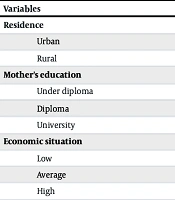
According to Table 3, the mean maternal ages were 36.75, 38.45, and 40.26 years in the teach-back, multimedia, and control groups, respectively (P = 0.423). Most participants lived in urban areas (P = 0.803), and most mothers had a diploma-level education (P = 0.350). Financial status was generally assessed as average (P = 0.343). Most mothers in the teach-back group were housewives, whereas self-employment was more common among mothers in the multimedia and control groups (P = 0.591).
Table 3.
Demographic Profile of Participants' Mothers a
| Variables | Teach-Back | Multimedia | Control | Test Statistic | P Value |
|---|---|---|---|---|---|
| Residence | 0.44 | 0.803 | |||
| Urban | 13 (65) | 14 (70) | 12 (60) | ||
| Rural | 7 (35) | 6 (30) | 8 (40) | ||
| Mother's education | 0.43 | 0.350 | |||
| Under diploma | 2 (10) | 5 (25) | 6 (30) | ||
| Diploma | 10 (50) | 9 (45) | 11 (55) | ||
| University | 8 (40) | 6 (30) | 3 (15) | ||
| Economic situation | 4.49 | 0.343 | |||
| Low | 0 (0) | 0 (0) | 5 (25) | ||
| Average | 10 (50) | 11 (55) | 14 (70) | ||
| High | 10 (50) | 9 (45) | 5 (25) | ||
| Number of children | 9.10 | 0.326 | |||
| 1 | 2 (10) | 1 (5) | 2 (10) | ||
| 2 | 8 (40) | 4 (20) | 7 (35) | ||
| 3 | 2 (10) | 10 (50) | 5 (25) | ||
| 4 | 3 (15) | 1 (5) | 3 (15) | ||
| ≥ 5 | 5 (25) | 4 (20) | 3 (15) | ||
| Mother's job | 3.06 | 0.591 | |||
| Housewife | 11 (55) | 8 (40) | 7 (35) | ||
| Self-employment | 5 (25) | 9 (45) | 10 (50) | ||
| Employee | 4 (20) | 3 (15) | 3 (15) | ||
| Maternal age (y) | 36.75 ± 9.43 | 38.45 (7.59) | 40.26 ± 8.36 | 0.85 | 0.423 |
a Values are expressed as No. (%) or mean ± SD.
According to Table 4, before the intervention, 1-way analysis of variance showed no significant differences among the groups in mean HbA1c levels (P = 0.149) or self-care scores (P = 0.971). However, after the intervention, 1-way analysis of variance showed significant differences among the groups in HbA1c levels (P < 0.001) and self-care scores (P < 0.001). The Scheffé post hoc test was performed to examine pairwise differences. The results indicated that the multimedia group had significantly higher self-care scores than the control group (mean difference = 26.5; P < 0.001). In addition, the teach-back group had significantly higher self-care scores than the control group (mean difference = 24.9; P < 0.001). However, no significant difference was observed between the teach-back and multimedia groups (mean difference = 1.6; P = 0.277). Furthermore, HbA1c levels differed significantly between the control group and both the teach-back (P < 0.001) and multimedia (P < 0.001) groups.
Table 4.
Comparison of Mean HbA1c and Self-care Scores Before and After the Intervention Across the Teach-Back, Multimedia, and Control Groups a
| Variables and Time Points | Teach-Back, Mean | Multimedia | Control | F Statistic (Df) | P Value |
|---|---|---|---|---|---|
| HbA1c | |||||
| Before | 8.53 ± 0.77 | 8.54 ± 0.52 | 8.17 ± 0.71 | 1.97 (2, 57) | 0.149 |
| After | 5.60 ± 0.42 | 5.66 ± 0.37 | 7.84 ± 0.61 | 137.52 (2, 57) | < 0.001 |
| Self-care | |||||
| Before | 34.50 ± 2.56 | 34.35 ± 3.77 | 34.25 ± 3.40 | 0.02 (2, 57) | 0.971 |
| After | 59.15 ± 3.40 | 60.75 ± 2.46 | 34.25 ± 3.40 | 452.68 (2, 57) | < 0.001 |
aValues are expressed as mean ± SD. Abbreviations: Df, degree of freedom; SD, standard deviation.
5. Discussion
This study aimed to evaluate the effect of combined mother–child education delivered using 2 methods, teach-back and multimedia, on self-care behaviors in children with type 1 diabetes. The results indicated that, after the intervention, significant improvements were observed in both intervention groups (teach-back and multimedia) compared with the control group. However, no significant difference was found between the 2 educational methods.
In a similar study on patients with diabetes, multimedia education was associated with an immediate increase in health literacy scores, while the teach-back method also significantly improved literacy levels and learning retention. Oshvandi et al. (3) reported that the teach-back method significantly improved self-care behaviors, such as diet, physical activity, and medication adherence, in patients with type 2 diabetes. Similarly, teach-back training has been shown to significantly improve quality of life in patients with myocardial infarction, supporting our findings regarding improvements in self-care scores.
Varvami Farahani et al. compared multimedia education with face-to-face patient experiences and found a significant improvement in quality of life after the multimedia intervention (17). Similarly, Sadat Manzari et al. (18) demonstrated that both teach-back and smartphone-based education enhanced adherence to treatment in patients with inflammatory bowel disease. Karami Salaheddin Kola et al. (15) reported that teach-back, multimedia, and blended teaching methods all improved self-care and social support among patients with heart failure and their caregivers. Our study provides a more detailed comparison of teach-back and multimedia methods, confirming the effectiveness of both approaches.
Zare et al. (10) found that teach-back and video education improved self-care and self-efficacy in patients with type 2 diabetes, aligning with our conclusions. Hilliard et al. (7) also examined the effects of teach-back and multimedia education on self-care in patients with diabetic foot ulcers, although the disease type and research setting differed.
5.1. Limitations
One limitation of this study is the potential influence of external information sources, such as physicians, mass media, and people around the study participants, which may have affected the results and could not be controlled. In addition, the short follow-up period is a limitation, making it difficult to assess the lasting effects of the combined mother–child education intervention using teach-back and multimedia methods on self-care behaviors in children with type 1 diabetes. Future research with a longer follow-up period is recommended to better evaluate these long-term effects. Furthermore, the study relied on self-reported data for self-care behaviors, such as physical activity, blood glucose control, and foot care, rather than direct observation. To improve data accuracy, future research should incorporate direct performance assessments.
The strengths of this study include its randomized controlled trial design, the direct comparison of 2 distinct active interventions, and the inclusion of a control group, allowing a more robust comparison across conditions.
5.2. Conclusions
Overall, both teach-back and multimedia methods effectively enhanced self-care and diabetes control in children. However, multimedia education, which is more accessible and less reliant on human resources, appears to be a more scalable approach. The development and implementation of multimedia educational programs, such as videos, podcasts, and mobile applications, are recommended for patients with diabetes. These tools can provide vital self-management information to patients with limited access to traditional educational resources. Expanding technology-based educational programs could further improve quality of life in patients with diabetes.
Ethical Considerations: This study was conducted in children with type 1 diabetes and their mothers at Amir-al-Momenin Hospital in Zabol, following approval from the Ethics Committee of Zabol University of Medical Sciences (IR.ZBMU.REC.1402.079). Informed consent was obtained from all participants.