1. Background
Childhood cancers include hematopoietic and lymphoid tumors, soft tissue and bone tumors, central nervous system tumors, and solid tumors (1). Despite their lower overall incidence compared with adult cancers, childhood cancers remain a leading cause of disease-related mortality in children (2). Among these cancers, leukemia is the most frequently diagnosed cancer in children aged 0 - 14 years worldwide (2). Chemotherapy remains a fundamental treatment for most childhood hematologic cancers and is often combined with other therapeutic approaches. Its administration requires reliable central venous access devices (CVADs), primarily peripherally inserted central catheters (PICCs) or implantable venous access ports (PORTs).
Choosing between these devices requires weighing distinct advantages and limitations. Although healthcare providers usually discuss options with parents, considering treatment needs, costs, and practical factors before making a decision and obtaining consent, the child’s own perspective and emotional needs are often overlooked, which may have considerable psychological effects. Shared decision-making (SDM) was developed in the 1990s (3, 4). In this process, healthcare providers and patients act as a team, discussing choices and preferences together. The goal is to reach a medical decision that both parties support (5). Although SDM in adult care is well established, with robust models and evidence, pediatric SDM research remains limited, leading to poorer clinical implementation.
2. Objectives
This study interviewed parents and children to explore factors influencing pediatric SDM from multiple perspectives.
3. Methods
This qualitative study explored the barriers and facilitators of SDM regarding venous access in childhood cancer through qualitative interviews. The interviews were conducted by a single researcher who had received systematic training in qualitative research and grounded theory (GT). The researcher had no prior relationship with the participants, minimizing potential bias. Reflexivity was ensured through bracketing, reflective memos, and regular team discussions. Detailed field notes were completed immediately after each interview.
3.1. Sample and Recruitment
This study was conducted from May 2025 to July 2025 in the oncology/hematology department of a tertiary children’s hospital in Zhejiang Province, China. Purposive sampling was used.
Participants met the following criteria: diagnosis of childhood cancer, age 8 - 18 years, and completion of venous access device selection for treatment.
The lower age limit of 8 years was set for two reasons. First, under Chinese civil law, children younger than 8 years lack civil conduct capacity and cannot independently express informed medical preferences. Second, children aged 8 years and older have sufficient cognitive and communication skills to understand and express their views. This design is ethically appropriate and consistent with standard pediatric qualitative research.
Before the interviews, the researchers explained the study purpose, obtained informed consent, and scheduled the sessions. Parents and children were interviewed separately in a quiet ward room. All interviews were audio-recorded. Written informed consent was obtained from all participants. Children aged 8 years and older signed consent forms together with their primary caregivers.
This was a single-center study. However, the sample reflected typical clinical scenarios among pediatric oncology patients requiring long-term venous access. Thus, the findings may be transferable to pediatric oncology settings in China.
The study was approved by the Medical Research Ethics Committee of the Children’s Hospital, Zhejiang University School of Medicine (2025-IRB-0143-P-01).
3.2. Data Collection
Semi-structured interviews were used for data collection. The interview guide was developed based on a literature review and expert consultation and was pilot-tested with two participants to refine clarity and logic before formal use.
Before the interviews, the researchers contacted parents and children to explain the study purpose, obtain informed consent, and schedule a convenient time and location. Interviews were held in private rooms within the hospital. To avoid reciprocal influence, parents and children were interviewed separately. To minimize participant fatigue, interviews were limited to 30 minutes for parents and 20 minutes for children. All interviews were audio-recorded with consent, and no repeat interviews were performed. Detailed field notes were completed immediately after each interview.
Recordings were transcribed verbatim. The transcripts were cross-checked and verified by two researchers to ensure accuracy. The full interview guide is included in the supplementary material.
3.3. Data Analysis
This study used GT for analysis. Grounded theory was first introduced by Glaser and Strauss in 1967 (6) as a qualitative research method aimed at developing theories of social processes through systematic data collection and analysis. Grounded theory has developed into 3 main approaches: classic Glaserian GT, Straussian grounded theory (SGT), and constructivist GT. This study adopted SGT because it provides a clear and structured analytical framework. A 3-level coding procedure was applied: open coding to label initial concepts, axial coding to connect concepts into categories, and selective coding to integrate categories into a core framework. Thematic categories were finalized based on data saturation and team consensus. All data were coded and managed using NVivo 15 software (QSR International Pty Ltd., Melbourne, Australia). Two researchers independently coded the transcripts, and discrepancies were resolved through group discussion until consensus was reached. A detailed audit trail and coding memos were maintained throughout the analysis to ensure rigor and transparency.
4. Results
During the interviews, 2 children withdrew because of non-cooperation. However, because their parents had already been interviewed, the final sample included 12 children and 14 parents, based on the inclusion and exclusion criteria and data saturation. Saturation was defined as no new concepts, categories, or themes emerging after 3 consecutive interviews in each group.
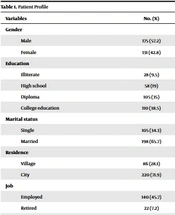
Two researchers independently assessed data saturation during the coding process. Saturation was achieved after interviewing 12 children and 14 parents, with no new substantive information generated in subsequent interviews. Participant demographics are summarized in Table 1.
Table 1.
General Information of Children and Parents
| Characteristics | Values |
|---|---|
| Children | |
| Mean ± SD age, y | 11.6 ± 2.0 |
| Gender | |
| Male | 8 |
| Female | 4 |
| Education level | |
| Primary school | 9 |
| Junior high school | 3 |
| Catheter type | |
| PICC | 9 |
| PORT | 3 |
| Mean ± SD disease duration, mo | 7.3 ± 5.9 |
| First catheterization | |
| Yes | 9 |
| No | 3 |
| Parents | |
| Mean ± SD age, y | 39.9 ± 3.2 |
| Gender | |
| Male | 3 |
| Female | 11 |
| Education level | |
| Junior high school | 3 |
| High school | 5 |
| College | 4 |
| Undergraduate | 2 |
| Marital status | |
| Married | 13 |
| Divorced | 1 |
Abbreviations: PICC, peripherally inserted central catheter; PORT, implantable venous access port; SDM, shared decision-making.
4.1. Three-Level Coding of Children’s Interview Content
During open coding of the children’s interviews, 50 initial concepts were extracted and categorized into 14 categories (C1 - C14). These categories reflected children’s attitudes, behaviors, and feelings during decision-making and provided a basis for axial coding. During axial coding, the 14 categories were further condensed into 4 main categories (D1 - D4). The thematic categories are presented in Table 2.
Table 2.
Open Coding and Axial Coding of Children’s Interview Content
| Main Category | Subcategory |
|---|---|
| D1. Children’s attitudes toward participation in decision-making | C1. Willingness to participate actively |
| C2. Passive acceptance attitude | |
| C3. Indifferent attitude | |
| D2. Children’s preferred decision-making approaches | C4. Preference for parent-led decisions |
| C5. Preference for doctor-led decisions | |
| C6. Preference for joint discussion and decision-making | |
| D3. Factors influencing participation in decision-making | C7. Insufficient information access |
| C8. Inadequate communication from parents or doctors | |
| C9. Concerns about decision outcomes | |
| C10. Fear of pain or discomfort | |
| C11. Fear of disease prognosis | |
| D4. Children’s expectations regarding SDM | C12. Desire for more information |
| C13. Desire to be respected and heard | |
| C14. Preference for convenient options |
Abbreviation: SDM, shared decision-making.
4.1.1. Children’s Attitudes
Patients showed 3 attitudes toward participation. Some actively wanted their opinions to be included, some passively deferred to parents or doctors, and others were indifferent because they believed participation would not affect the outcome.
Representative quotations:
- “I’m not worried about that; I can decide by myself” (Child, ID 06)
- “I can make my own decisions about other things like play, but not when it comes to illness.” (Child, ID 07)
- “I don’t really understand the options, so choosing feels pointless.” (Child, ID 04)
4.1.2. Children’s Preferred Approaches
Regarding decision-making approaches, some children preferred that parents decide, trusting their familiarity with the child’s needs. Others deferred to doctors because of their expertise, whereas some wanted joint discussions to weigh the options together.
Representative quotations:
- “I didn’t want to at first, but then Dad said the shot would be quick, so I agreed.” (Child, ID 02)
- “The treatment plan chosen by the doctor is usually the one that best suits me, so I just follow it.” (Child, ID 04)
- “My parents discussed it with me first, and then I talked with the doctor myself, and it was fine.” (Child, ID 10)
4.1.3. Factors Influencing Participation
Factors influencing participation included patients’ limited understanding of the options, lack of communication from parents or doctors, fear of making wrong decisions, and preference for less painful options.
Representative quotations:
- “No one told me there were other options.” (Child, ID 02)
- “I feel a lot of pressure when making decisions.” (Child, ID 11)
- “I didn’t tell Mom that I didn’t like pain.” (Child, ID 01)
4.1.4. Children’s Expectations
Children wanted more information about treatment options, hoped their opinions would be respected, and tended to choose PORT because of its convenience.
Representative quotations:
- “I only know a little, but I’ll ask.” (Child, ID 06)
- “My opinion should be respected every day.” (Child, ID 05)
- “The PORT is more convenient.” (Child, ID 09)
During selective coding, a theoretical model of children’s involvement in SDM was developed by analyzing the main categories. The analysis identified relationships among influencing factors, children’s attitudes, and expectations toward decision-making, as well as how these attitudes shaped their preferred decision-making approaches. This model revealed children’s psychological and behavioral patterns in SDM, providing a theoretical basis for improving decision-making procedures (Table 3).
Table 3.
Typical Relationship Structure of Children’s Interview Content
| Relationship Structure | Relationship Connotation |
|---|---|
| D3. Factors influencing participation in decision-making → D1. Children’s attitudes toward participation in decision-making | Limited information, poor communication, worries about outcomes, fear of pain, and prognosis concerns may lead children to be passive or indifferent toward decision-making participation. |
| D4. Children’s expectations regarding SDM → D1. Children’s attitudes toward participation in decision-making | Children’s SDM expectations, including wanting more information, respect, and being heard, can increase their willingness to actively participate in decision-making. |
| D1. Children’s attitudes toward participation in decision-making → D2. Children’s preferred decision-making approaches | Children’s attitudes toward participation shape their preferred decision-making approaches. Children eager to participate often prefer joint decision-making, whereas passive children tend to accept parent- or doctor-led choices. |
Abbreviation: SDM, shared decision-making.
4.2. Three-Level Coding of Parents’ Interview Content
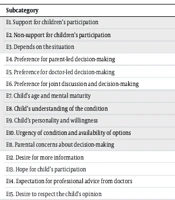
Open coding of the parents’ interviews yielded 87 initial concepts, which were grouped into 15 categories (E1 - E15). These categories covered parents’ attitudes, preferred decision-making approaches, influencing factors, and expectations regarding SDM. They illustrated parents’ multifaceted roles in decision-making and supported subsequent axial coding.
During axial coding, the 15 initial categories were condensed into 4 main categories (F1 - F4), forming the core framework for the parental SDM model (Table 4).
Table 4.
Open Coding and Axial Coding of Parents’ Interview Content
| Main Category | Subcategory |
|---|---|
| F1. Parents’ attitudes toward children’s participation in decision-making | E1. Support for children’s participation |
| E2. Non-support for children’s participation | |
| E3. Depends on the situation | |
| F2. Parents’ preferred decision-making approaches | E4. Preference for parent-led decision-making |
| E5. Preference for doctor-led decision-making | |
| E6. Preference for joint discussion and decision-making | |
| F3. Factors influencing children’s participation in decision-making | E7. Child’s age and mental maturity |
| E8. Child’s understanding of the condition | |
| E9. Child’s personality and willingness | |
| E10. Urgency of condition and availability of options | |
| E11. Parental concerns about decision-making | |
| F4. Parents’ expectations regarding SDM | E12. Desire for more information |
| E13. Hope for child’s participation | |
| E14. Expectation for professional advice from doctors | |
| E15. Desire to respect the child’s opinion |
Abbreviation: SDM, shared decision-making.
4.2.1. Parents’ Attitudes
Parents held varied attitudes. Some believed children should participate if they were mature enough. Others considered young or immature children unsuitable for participation. Some believed participation depended on the child, but that parents should make the final decision.
Representative quotations:
- “I think he can be involved. After all, he is old enough and should have that right.” (Parent, ID 05)
- “The child is still young, so we adults will make the decision for him.” (Parent, ID 02)
- “My child is quite mature, so we can consider his opinion.” (Parent, ID 10)
4.2.2. Parents’ Preferred Approaches
Parents reported 3 decision-making preferences. Some preferred parental decision-making because of their familiarity with the child, others trusted doctors’ expertise, and some favored joint discussion to weigh the options.
Representative quotations:
- “We did consider his feelings at first, but in the end, we felt it was more appropriate for us parents to make the decision.” (Parent, ID 06)
- “We didn’t think deeply about it. Whatever the doctor said, we just followed—it had to be the right thing to do.” (Parent, ID 08)
4.2.3. Factors Influencing Children’s Participation
Parents believed that children’s participation in decision-making should depend on their age, maturity, understanding of the illness, personality, willingness, urgency of the condition, and available options. They also worried that participation might lead to wrong decisions or psychological pressure.
Representative quotations:
- “I think it depends on the child’s age. If they are older and have their own ideas, then it’s okay.” (Parent, ID 01)
- “Because sometimes he can be a bit stubborn and doesn’t think things through as thoroughly as we do.” (Parent, ID 04)
- “Because there is always some uncertainty, and I don’t want that uncertainty to happen to my daughter.” (Parent, ID 07)
4.2.4. Parents’ Expectations
Parents wanted more information to understand the treatment options, hoped patients could participate when possible, valued doctors’ professional advice, and believed children’s opinions should be respected if they were mature enough.
Representative quotations:
- “What matters most is having the information — we really want to know the details.” (Parent, ID 03)
- “We hope the doctor can give us more professional advice and guidance.” (Parent, ID 12)
Selective coding was used to construct a theoretical model of parents’ perspectives on children’s involvement in SDM. The analysis identified relationships between factors influencing children’s participation, parental attitudes toward participation, and parental expectations shaping these attitudes, further clarifying how parental attitudes determined preferred decision-making styles. The model revealed complex parental psychological and behavioral patterns, providing a theoretical basis for optimizing children’s SDM processes (Table 5).
Table 5.
Typical Relationship Structure of Parents’ Interview Content
| Typical Relationship Structure | Relationship Connotation |
|---|---|
| F3. Factors influencing children’s participation in decision-making → F1. Parents’ attitudes toward children’s participation in decision-making | Parents’ perceptions of factors affecting children’s decision-making participation, such as age, mental maturity, and understanding of the condition, directly determine their support for children’s involvement. For instance, viewing a child as mentally immature often leads to less parental support for participation. |
| F4. Parents’ expectations regarding SDM → F1. Parents’ attitudes toward children’s participation in decision-making | Parental expectations, such as respecting the child’s opinions, shape their attitudes toward decision-making participation. Older children are more likely to be supported and adequately involved in the decision-making process. |
| F1. Parents’ attitudes toward children’s participation in decision-making → F2. Parents’ preferred decision-making approaches | Parents’ attitudes toward children’s participation directly influence their preferred decision-making approaches. Supportive parents tend to adopt joint discussion and SDM, whereas parents reluctant to involve children often prefer parent- or doctor-led decisions. |
Abbreviation: SDM, shared decision-making.
5. Discussion
This qualitative study involving children with cancer and their parents examined SDM about venous access devices, specifically PICCs and PORTs. Although both devices enable effective chemotherapy with similar outcomes, making this a relatively low-risk choice, the decision-making process remains complex. Consistent with previous research (7), lower perceived risk was associated with greater willingness among children, parents, and clinicians to involve the child in SDM.
The analysis showed varied attitudes toward SDM among children, ranging from active participation to passive acceptance or indifference. Although most children wished to be involved, many preferred minimal or no participation, highlighting the need to clarify each child’s desired level of involvement. This may reflect younger children’s preference for low-risk decisions (7). Children’s preferred decision-making approaches, including parent-led, doctor-led, and shared approaches, were shaped by their self-perceived abilities, understanding of risk, and views of the doctor-patient relationship. Willingness to participate was influenced by external barriers, such as insufficient information and poor communication, and internal factors, such as fear of pain, anxiety, and concerns about responsibility, consistent with previous studies (7-10). Children’s expectations of being informed, respected, and listened to promoted engagement, underscoring the importance of supportive communication and age-appropriate information.
Parents play a critical role in the decision-making process. Parental attitudes were similarly complex and varied: Supportive, non-supportive, or conditional. These attitudes were influenced by multiple factors, including the child’s age and cognitive maturity, understanding of the illness, personality, willingness, and urgency of the medical condition. Some parents, driven by a protective instinct and concerned that child involvement might lead to poor choices or additional stress, tended to favor parent- or doctor-led decisions (10). Others recognized the long-term value of respecting the child’s autonomy, especially when the child was older, and were more supportive of their participation. Parents’ preferred decision-making approaches, including parent-led, doctor-led, and collaborative discussion, directly reflected their attitudes and ultimately influenced whether the child could be practically involved in the decision-making process.
International pediatric SDM research remains in its early stages, with progress in chronic disease management, informed consent tools, and age-appropriate decision aids. However, most studies have not fully integrated children into core decision-making, and even international pediatric SDM models insufficiently consider children’s roles (11-13). In China, the application of pediatric SDM is relatively limited, with existing studies focusing only on reducing parental decisional conflict and improving parental experiences rather than actively involving children (14, 15). Future research should explore how to meaningfully involve children in SDM and determine appropriate levels of involvement. By focusing on venous access choices for children with cancer, this study used qualitative interviews to analyze parents’ and children’s perspectives on SDM and identify influencing factors, thereby providing a basis for future research.
This study has several limitations. First, it was a single-center study; therefore, the findings may not represent the broader pediatric oncology population. Future large-scale, multicenter studies are needed to better characterize SDM for pediatric venous access in China. Second, the sample of child participants was relatively small. Although data saturation was achieved in both the child and parent groups, this may have been due to the narrow and focused research question. The single-center design may also restrict transferability. Future studies with larger samples are warranted to confirm and extend these findings.
5.1. Conclusions
This study found that SDM for venous access in children with cancer is complex and shaped by child, parent, and clinical factors. Children wish to participate but face limitations, and parental attitudes strongly influence their inclusion. Globally, and especially in China, meaningful child integration into pediatric SDM remains underdeveloped. This study identifies key barriers and facilitators, laying a foundation for inclusive, age-appropriate SDM models in pediatric oncology.