Innovative Journal of Pediatrics
The Scientific Journal of Growth & Development Research Center
e-ISSN 3117-5341
Image Credit:Inn J Pediatr
Outline
Safety and Efficacy of Phenylephrine Nasal Drops in Bronchiolitis
Authors
Published online:Oct 05, 2014
Article type:Research Article
Received:Nov 14, 2013
Accepted:Jun 25, 2013
How to Cite:Soleimani G, Akbarpour M, Mohammadi M. Safety and Efficacy of Phenylephrine Nasal Drops in Bronchiolitis. Inn J Pediatr. 2014;24(5):. doi:
Abstract
Objective: Bronchiolitis is a common lower respiratory tract infection in the first year of life. In this disease upper respiratory tract infection is associated with nasal congestion, respiratory distress and hypoxia. We studied the effect of phenylephrine drops as a decongestant in treatment of light and moderately severe cases of acute bronchiolitis. Methods: This is a double blind randomized trial involving 100 children aged 4 weeks to 12 months. The patients were divided into two groups, the first group received 0.1 ml phenylephrine 0.5% and the second group 0.1 ml sodium chloride (NaCl) 0.9% as placebo in both nostrils. Respiratory rate, heart rate, O2 saturation, dyspnea, retractions and wheezing were assessed before and 30 minutes after medication. Findings: After medication, O2 saturation and respiratory muscles retractions in the phenylephrine group were significantly better than those of the placebo group (P=0.004 and P=0.002, respectively). In the phenylephrine group, O2 saturation, retractions and wheezing were also significantly better before than those after medication (P=0.003 and P<0.0001 respectively). In the placebo group no significant difference before and after intervention was observed. Conclusion: Phenylephrine as a topical decongestant is an inexpensive, easily available and suitable means in the treatment of mild to moderately severe bronchiolitis.
Highlights
References
- 1.References are available on the PDF.
Copyright
© 2014, Author(s). This open-access article is available under the Creative Commons Attribution 4.0 (CC BY 4.0) International License (https://creativecommons.org/licenses/by/4.0/), which allows for unrestricted use, distribution, and reproduction in any medium, provided that the original work is properly cited.
Similar Articles
30
Jun
2012
Comparison of Epinephrine to Salbutamol in Acute Bronchiolitis
Mehrshad Arashpour,
Jamal Faghihinia,
Asadola Asadian,
Firoozeh Mousavinasab,
Mohammad-Reza Modaresi
Arashpour M, Faghihinia J, Asadian A, Mousavinasab F, Modaresi M. Comparison of Epinephrine to Salbutamol in Acute Bronchiolitis. Inn J Pediatr. 2015;22(2):. doi:
25
Feb
2022
Comparison of the Effects of Salbutamol, Epinephrine, and 5% Inhaled Hypertonic Saline on Infants with Acute Bronchiolitis
Leila Barati,
Seyed Ali Mousavi Khosravi,
Safa Ariannejad,
Ali Ahani Azari,
Lobat Shahkar
Barati L, Mousavi Khosravi SA, Ariannejad S, Ahani Azari A, Shahkar L. Comparison of the Effects of Salbutamol, Epinephrine, and 5% Inhaled Hypertonic Saline on Infants with Acute Bronchiolitis. J Compr Ped. 2022;13(1):e120489. doi: https://doi.org/10.5812/compreped.120489
27
Jun
2015
Comparing the Effectiveness of Nasal Continuous Positive Airway Pressure (NCPAP) and High Flow Nasal Cannula (HFNC) in Prevention of Post Extubation Assisted Ventilation
Manizheh Mostafa-Gharehbaghi,
Hooshyar Mojabi
Mostafa-Gharehbaghi M, Mojabi H. Comparing the Effectiveness of Nasal Continuous Positive Airway Pressure (NCPAP) and High Flow Nasal Cannula (HFNC) in Prevention of Post Extubation Assisted Ventilation. Zahedan J Res Med Sci. 2015;17(6):e984. doi: https://doi.org/10.17795/zjrms984
31
Aug
2026
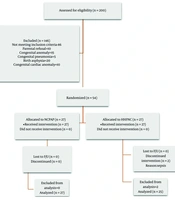
Nasal Continuous Positive Airway Pressure Versus Heated Humidified High-Flow Nasal Cannula for Post-Extubation Management in Preterm Neonates with Respiratory Distress Syndrome: A Pilot Randomized Controlled Trial
Roya Taheritafti,
Atena Hadizadeh,
Naeeme Taslimi Taleghani,
Maryam Khoshnoud Shariati
Taheritafti R, Hadizadeh A, Taslimi Taleghani N, Khoshnoud Shariati M. Nasal Continuous Positive Airway Pressure Versus Heated Humidified High-Flow Nasal Cannula for Post-Extubation Management in Preterm Neonates with Respiratory Distress Syndrome: A Pilot Randomized Controlled Trial. J Compr Ped. 2026;17(3):e174099. doi: https://doi.org/10.5812/jcp-174099
23
May
2017
Effects of Nebulized Albuterol in Transient Tachypnea of the Newborn A Clinical Trial
Mirhadi Mussavi,
Khairollah Asadollahi,
Mirnia Kayvan,
Shahram Sadeghvand
Mussavi M, Asadollahi K, Kayvan M, Sadeghvand S. Effects of Nebulized Albuterol in Transient Tachypnea of the Newborn A Clinical Trial. Inn J Pediatr. 2017;27(3):e8211. doi: https://doi.org/10.5812/ijp.8211
More by these authors
Cited by
- Scopus by DOI: 0
Last Update: 1 week ago
- Scopus by Title: 2
Last Update: 1 week ago
- Scopus by Title (Ref): 2
Last Update: 1 week ago
- CrossRef: 0
Last Update: 3 hours ago
- OpenAlex: 0
Last Update: 6 hours ago
- OpenCitations: 0
Last Update: 5 days ago
Comments
Number of Comments:0