
1. Background
Respiratory Distress Syndrome (RDS) and Bronchopulmonary Dysplasia (BPD) are common in preterm newborn infants. The pathogenesis of BPD in very preterm infants is multifactorial, but ventilator induced lung injury plays a major contributing role. In the recent years, there is a growing trend toward avoidance of intubation and mechanical ventilation for preterm neonates [1, 2], which may reduce lung injury and BPD in preterm infants. Noninvasive ventilation can be provided by a variety of ways including Nasal Cannula (NC), Nasal Continuous Positive Airway Pressure (NCPAP) and Nasal Intermittent Positive Pressure Ventilation (NIPPV). NC is a mode of oxygen administration via two small, thin, tapered tubes (usually < 1 cm in length) inserted inside the nostrils without its obstruction. NC has been used in neonates with low flows (0.5 L/min) for several years. More recently, it has been demonstrated that increasing flow to 1-2 L/min NC (high flow nasal cannula = HFNC) can deliver continuous distending pressure (CDP) [3-5]. Conventional nasal prongs are generally limited to flows of 5 L/min due to potential drying effects of oxygen on nasal mucosa. The warmed and optimally humidified gas may deliver by flows up to 6 - 8 L/min without irritant effect to the nasal mucosa [6, 7]. It has been shown that HFNC generates positive airway pressure between 0.2 - 4.8 cm H2O in neonates and pediatrics [3, 8, 9]. The size of NC, gas flow through it, degree of leak, size of nares and airway anatomy of the neonates affect the obtained pressure [4]. The higher gas flows that can be attained with HFNC made this therapy an alternative to nasal CPAP that is less bulky and easier to use [10].
NCPAP has been used widely as a method of noninvasive respiratory support in preterm infants. It is wellbeing studied and known to improve pulmonary mechanics and stabilize the upper airway. It is known to reduce the mortality and morbidity [11-13]. However, nasal CPAP devices are bulky, may cause nasal injury and can be difficult to maintain in correct position properly. Recently, HFNC has come into widespread use; there are a few studies about its use in the neonatal population. The use of nasal cannula is routine in our NICU for oxygen administration for preterm infants, but its use as an alternate for NCPAP is not routine and there are limited reports about the efficacy and safety of HFNC use for delivering positive distending pressure in preterm infants.
2. Objectives
This study was conducted to compare the efficacy and safety of HFNC and nasal CPAP in respiratory support after surfactant administration in preterm newborn infants with respiratory distress syndrome.
3. Patients and Methods
This randomized controlled clinical trial was conducted in tertiary level Neonatal Intensive Care Unit (NICU) in Al-Zahra hospital in Tabriz, Iran from January 2013 to September 2013. The study was approved by the ethic committee of Tabriz University of Medical Sciences and registered in Iranian registry clinical trials (IRCT 201308283915 N9). A written informed consent was obtained from parents. Preterm newborn infants who had birth weight of 1250-2000 grams and gestational age of 30 - 34 weeks were eligible for the study if they had RDS and were treated by the INSURE method (intubation + surfactant + extubation). Exclusion criteria were Apgar score fewer than 4 at 5 minute, intubation during the initial stabilization after birth, prenatal diagnosis of major congenital anomalies and out born infants. At birth, all infants were stabilized with a face mask or nasopharyngeal tube with a positive end expiratory pressure of 5 cm H2O [Neopuff, Fisher and Paykel Health Care, Inc., Auckland, New Zealand]. After arrival to NICU and initial stabilization, eligible infants received nasal CPAP (Bubble CPAP System Fisher and Paykel Health Care, Inc.) at Positive End Expiratory Pressure (PEEP) 5 - 6 cm H2O. Respiratory Distress Syndrome (RDS) was diagnosed when clinical symptoms of tachypnea (more than 60/min), retractions, expiratory grunting and cyanosis were present in combination with radiological signs of poor lung expansion. Surfactant was given when the infants need a fraction of oxygen (FiO2) more than 0.4 to maintain oxygen saturation above 90%. In all patients, RDS score was determined based on respiratory rate, retractions, presence of grunting and respiratory sounds, received FiO2 and infant gestational age. Exogenous surfactant (Porctant alfa, Crusurf, Chiesi farmaceutici, Italy) was administered at a dose of 200 mg/kg. Infants were extubated after surfactant replacement therapy and then randomly allocated in nasal CPAP or HFNC group according to random number list. Humidified high flow nasal cannula at flow 6 L/min was used for HFNC group using short bi-nasal prong to provide enough distending pressure to minimize work of breathing and optimize oxygen saturation results.
Criteria for CPAP initiation after HFNC included increased respiratory effort and rising FiO2 requirement exceeding 30%. Intubation and mechanical ventilation were initiated either when the arterial oxygen saturation were less than 85% or PaO2 ≤ 50 mmHg while receiving FiO2 ≥ 0.4 or the PCO2 more than 65 mmHg with a pH < 7.2 on arterial blood gas analysis or there were more than four apneic episodes in the first hour or need for more than two episodes of bagging per hour. Cranial ultrasound examination was performed on all infants at days 5 - 7 for diagnosis of intra-ventricular hemorrhage by a pediatric radiologist. Pneumothorax was defined as radiologic evidence of air leak in pleural space. Bronchopulmonary Dysplasia (BPD) was defined as dependence on supplemental oxygen or mechanical respiratory support through 28th day and patients were followed till 36 weeks post conception age for oxygen dependency. All infants were examined for determination of nasal mucosa injury by a neonatologist blinded to patients group. Clinical data, including gestational age, birth weight and severity of RDS according to Downes et al. [14], duration of hospitalization and oxygen dependency at 36 weeks gestational age were recorded. The primary outcome of this study was to determine the percentage of enrolled infants who were re-intubated after initial surfactant administration and the need for mechanical ventilation at three first days after surfactant administration. The secondary outcome was oxygen dependency at 36 weeks post conception age. Statistical analyses were performed using the statistical package for social sciences (SPSS-16). Quantitative data were presented as Mean ± Standard Deviation (SD) and qualitative data as frequency and percent. Independent t-test was used for testing continuous scale data and χ2 or Fisher exact test for categorical data. A P-Value ˂ 0.05 was considered statistically significant.
4. Results
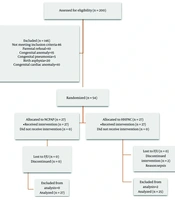
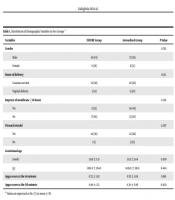
A total of 123 preterm infants with RDS were admitted to neonatal intensive care unit (NICU) between January 2013 and September 2013. Thirty eight infants were excluded from the study because of major congenital anomalies (4 cases), refuse of parent to consent (19 patients) and intubation after arrival to NICU before surfactant therapy (15 cases). Eighty-five preterm neonates were enrolled in this study. The mean gestational age of studied patients was 32.15 ± 1.59 weeks and birth weight was 1895 ± 438 grams. Demographic characteristics of patients in the both groups are shown in Table 1. The mean RDS score was determined in all neonates in initial assessment as 5.4 ± 0.7 in CPAP group and 5.6 ± 0.7 in HFNC group.
Three patients in HFNC group needed FiO2 more than 50% at admission to NICU. The mean received FiO2 in HFNC group was 47.9 ± 7.8 mmHg and in CPAP group was 44.2 ± 8.7 mmHg (P = 0.03). The rate for re-intubation at three first days after surfactant therapy was 8 (18.6%) in CPAP group and 5 (11.9%) in HFNC group. Pneumothorax was diagnosed and treated with chest tube in four neonates that three were from CPAP group.
Table 1.
Demographics of Studied Patients
| CPAP Group (N = 43) | HFNC Group (N = 42) | P-Value | |
|---|---|---|---|
| 32.07 ± 1.48 | 32.24 ± 1.7 | 0.62 | |
| 1885 ± 417 | 1905 ± 464 | 0.83 | |
| 1 minute | 7.4 ± 1.5 | 7.8 ± 1.3 | 0.16 |
| 5 minutes | 8.9 ± 0.9 | 9.2 ± 0.9 | 1 |
| 25 (58.1) | 25 (59.5) | 0.89 | |
| 31 (72.1) | 30 (71.4) | 0.94 | |
| 17 (39.5) | 14 (33.3) | 0.55 |
a Values are presented as Mean ± SD.
b Values are presented as No. (%).
Oxygen dependency was detected at 28 days after birth and 36 weeks post conception age in 4 neonates that three were from CPAP group. Nasal mucosa injury was assessed in patients and determined in 27 neonates in CPAP group and 14 infants in HFNC group (P = 0.007). Intra-ventricular hemorrhage was detected by trans-fontanel ultrasound examination in eight neonates that five cases were in CPAP group. The need for CPAP use after initial stabilization in CPAP group was in one case and in HFNC group 12 cases (P = 0.001).
5. Discussion
This study demonstrated no significant difference in outcome among premature infants with RDS treated by intratracheal surfactant and CPAP or HFNC. There are a few studies that used nasal cannula to deliver end expiratory pressure or gas flow to reduce frequency of desaturation and apnea.
Locke et al. first described the ability of nasal cannula to generate positive end-distending pressure [3]. Courtney et al. documented that nasal cannula can deliver continuous positive airway pressure and changes in lung volume at the cost of increased work of breathing and higher oxygen concentration [15]. It was shown by Sreenan et al. that those nasal cannula at flow rates between 1 and 2.5 L/min for preterm infants, at a mean weight of 1260 grams, deliver CPAP as high as 8 cmH2O [4]. In their study, 68.2% of patients were weaned successfully to room air, but 31.8% were not. Nasal cannula reduces the likelihood of air leak syndromes. Saslow et al. [16] and Woodhead et al. [17] reported that HFNC provides respiratory support comparable to CPAP. They did not compare the duration of supplemental oxygen, rates of BPD and length of hospital stay. CPAP is effective in decreasing ventilator-induced lung injury, but its use may be associated by complications like nasal trauma, obstruction by secretions and patient discomfort. The inability to measure the positive end expiratory pressure generated by high flow nasal cannula limits its widespread use. The major concern about generated PEEP is potential risk of lung injury, BPD and pneumothorax. In our study, pneumothorax, BPD and Intra-Ventricular Hemorrhage (IVH) were less frequent in HFNC group compared with CPAP, but the difference was not statistically significant. Holleman-Duray et al. [18] evaluated the safety and efficacy of a heated humidified high flow nasal cannula system (delivered by vapotherm) in 65 neonates and concluded that HFNC is safe and well tolerated with additional benefits including decreased days on ventilator, rate of ventilator associated pneumonia and improved growth. The actual oxygen concentration delivered through nasal cannula is a blend of inhaled oxygen from nasal cannula and entered room air through nose and opened mouth. This may cause difficulty in oxygen weaning [19, 20]. In the study of 303 infants, the failure rate during the seven days after extubation was 34.2% in nasal cannula group and 25.8% in the nasal CPAP recipients (95% confidence interval: -1.9 to 18.7) [21]. In our patients, the failure rate and need for reintubation were 18.6% and 11.9% for nasal CPAP and HFNC groups, respectively. The use of nasal cannula for oxygen delivery is preferred by caregivers due to its ease of use and the ability to feed and care the infant while continuing oxygen administration and increased mobility of infant. However, instability of delivered oxygen concentration and drying of nasal mucosa limit its widespread use. The variability of the patient population in these studies, the small number of studied patients and the absence of any large scale randomized, controlled trials do not allow delineation of a clear role for HFNC at this time. Vapotherm is not accessible in our country and we used bi-nasal prongs for HFNC. We did not evaluate the end expiratory pressure generated by HFNC. It is recommended to perform further studies with different gas flow rates and larger number of patients to clarify the best flow rate of HFNC in RDS management. In our study, HFNC was as effective as NCPAP for respiratory support in preterm infants after extubation and surfactant administration. The nasal mucosal injury rate was significantly lower in HFNC group in our study. It is recommended to perform further studies with larger number of patients before routine use of HFNC in post extubated preterm infants.