
1. Background
Neonatal respiratory distress syndrome (RDS), caused primarily by endogenous surfactant deficiency and anatomical lung immaturity, remains a major cause of neonatal morbidity and mortality in intensive care settings (1, 2). If untreated, progressive alveolar collapse and reduced pulmonary compliance can culminate in acute hypoxemic respiratory failure (1, 3).
The widespread adoption of noninvasive ventilatory strategies has reduced reliance on invasive mechanical ventilation, thereby mitigating the risks of ventilator-induced lung injury and subsequent bronchopulmonary dysplasia (4). Nasal continuous positive airway pressure (NCPAP) has long served as a standard noninvasive intervention for maintaining end-expiratory lung volume in preterm neonates with RDS (5, 6). However, NCPAP may be complicated by patient intolerance and interface-related nasal injury, prompting continued investigation of alternative noninvasive approaches (6, 7).
Heated humidified high-flow nasal cannula (HHFNC) has gained substantial clinical use as an alternative to NCPAP (8, 9). By delivering heated, fully humidified medical gases at high flow rates, HHFNC facilitates anatomical dead-space washout, reduces upper airway resistance, and provides a variable degree of distending positive airway pressure depending on flow velocity, the cannula-to-nares ratio, and infant size (8, 10). Its simplified prong design may also improve infant comfort, facilitate nursing care, and reduce pressure-related nasal trauma (9, 11).
Despite its increasing use, evidence comparing the post-extubation efficacy and safety of HHFNC with NCPAP in preterm infants recovering from RDS remains equivocal. Some trials have reported comparable post-extubation clinical failure rates between the 2 modalities (12-14), whereas others have raised concerns regarding higher reintubation rates, longer durations of respiratory support, or greater escalation requirements with HHFNC (6, 15). Systematic reviews have emphasized the need for further well-controlled clinical trials, particularly in middle-income settings where respiratory protocols and resource availability may differ from those in high-income settings (16-18).
2. Objectives
This randomized pilot trial was conducted to compare the clinical performance and adverse-event profiles of HHFNC and NCPAP in preterm infants following surfactant administration and extubation, and to generate preliminary effect estimates for future definitive trials.
3. Methods
3.1. Study Design and Setting
This parallel-group, open-label, randomized pilot study was conducted in the level III neonatal intensive care units of Mahdieh Hospital and Shohada Tajrish Hospital in Tehran, Iran, from August 2021 through April 2022. The study protocol was approved by the Institutional Ethics Committee (IR.SBMU.RETECH.REC.1398.135) and prospectively registered with the Iranian Registry of Clinical Trials (IRCT20151122025184N2) on July 29, 2021. Written informed consent was obtained from parents or legal guardians before enrollment.
3.2. Sample Size Determination
Given the exploratory pilot framework of this study, which was intended to assess procedural feasibility and generate effect-size estimates for future definitive studies, the sample size was pragmatically determined based on institutional recruitment capacity during the 9-month accrual period. A total enrollment of 54 preterm neonates (27 infants per arm) was planned.
3.3. Study Population and Eligibility
Preterm neonates diagnosed with RDS who required early exogenous surfactant therapy followed by noninvasive post-extubation respiratory support were screened.
3.3.1. Inclusion Criteria
1) Premature birth.
2) Clinical and radiographic confirmation of RDS (diffuse reticulogranular pattern, air bronchograms, and reduced lung expansion).
3) Clinical requirement for exogenous surfactant replacement.
4) Indication for noninvasive respiratory support after extubation.
3.3.2. Exclusion Criteria
1) Severe birth asphyxia, defined as a 5-minute Apgar score ≤ 3.
2) Major structural or chromosomal anomalies.
3) Complex congenital heart disease, excluding patent ductus arteriosus or small atrial or ventricular septal defects.
4) Alternative or coexisting pulmonary conditions (eg, congenital pneumonia or meconium aspiration).
5) Mechanical ventilation for more than 24 consecutive hours before enrollment.
6) Culture-proven sepsis at baseline on admission.
3.4. Randomization and Allocation Concealment
After surfactant administration and successful extubation, eligible infants were allocated in a 1:1 ratio to either NCPAP or HHFNC. Randomization was generated by an independent biostatistician using a computer-generated block scheme with variable block sizes of 2 and 4, stratified by study site. Allocation concealment was maintained using sequentially numbered, opaque, sealed envelopes, which were opened only after formal enrollment. Because the equipment differed visibly between groups, clinical staff could not be blinded; however, interface-related nasal injuries were graded by a dedicated research nurse who was blinded to treatment allocation.
3.5. Study Interventions
3.5.1. Standardized Surfactant Delivery and Extubation Protocol
All enrolled infants received poractant alfa (Curosurf; Chiesi Farmaceutici, Parma, Italy) at 200 mg/kg using the standard intubation-surfactant-extubation (INSURE) approach. Criteria for administration included an oxygen requirement of FiO2 > 0.30 to maintain a target SpO2 of 90% - 95%, together with clinical and radiographic signs of RDS.
Infants were extubated promptly after meeting the following criteria:
1) Hemodynamic stability and vigorous spontaneous breathing.
2) FiO2 ≤ 0.40 to maintain SpO2 between 90% and 95%.
3) Absence of profound respiratory acidosis (pH ≥ 7.25 and PaCO2 ≤ 60 mm Hg).
All participants received prophylactic caffeine citrate (20 mg/kg loading dose followed by 5 mg/kg/day maintenance), initiated before extubation.
3.5.2. NCPAP Arm
Infants assigned to NCPAP received continuous distending pressure through a dedicated Dräger neonatal ventilator equipped with size-matched binasal prongs. Positive end-expiratory pressure was initiated at 5 cm H2O and titrated between 5 and 7 cm H2O according to clinical work of breathing and arterial blood gas findings, with a fixed circuit flow rate of 8 L/min. FiO2 was initiated at 0.40 and titrated to maintain SpO2 between 90% and 95%. Weaning began by reducing FiO2 to 0.21, followed by stepwise reduction of positive end-expiratory pressure to 4 cm H2O before discontinuation. Supplemental oxygen was discontinued after room-air SpO2 ≥ 90% had been maintained for ≥ 24 consecutive hours.
3.5.3. HHFNC Arm
Infants assigned to HHFNC received heated, humidified gas blends through the MEDIN blender circuit using Nuflow specialized nasal cannulas (medin Medical Innovations GmbH, Germany). Cannula size was selected to occlude approximately 50% - 70% of the nares diameter while avoiding excessive occlusion. Delivered gas was maintained at 37°C and 100% relative humidity. Gas flow was initiated at 4 L/min and titrated between 4 and 7 L/min, with concurrent FiO2 titration to maintain a target SpO2 of 90% - 95%. Weaning involved reducing FiO2 to 0.21, followed by decreasing flow to 2 L/min before discontinuation.
3.6. Treatment Failure Criteria
Treatment failure was predefined as the need for reintubation and invasive ventilation because of clinical deterioration despite maximum assigned support (7 cm H2O positive end-expiratory pressure in the NCPAP group or 7 L/min flow in the HHFNC group). Specific criteria included:
1) Severe respiratory acidosis (pH < 7.20 with PaCO2 > 65 mm Hg).
2) Refractory hypoxemia requiring FiO2 > 0.40 to maintain SpO2 ≥ 90%.
3) Recurrent severe apnea (> 2 episodes/hour requiring positive-pressure bag-mask ventilation).
3.7. Study Outcomes
The primary outcome was the total duration of supplemental oxygen therapy, measured in hours from initiation of noninvasive support to complete, sustained room-air breathing for ≥ 24 hours. Any re-exposure to oxygen was added cumulatively.
Secondary outcomes were:
1) Total hospital length of stay in hours, based on standardized physiological discharge criteria.
2) Extubation/treatment failure rate.
3) Nasal trauma, including erythema, ulceration, skin necrosis, or bleeding.
4) Pulmonary air leaks, defined as radiographically confirmed pneumothorax.
5) Intraventricular hemorrhage (IVH), assessed by routine serial cranial ultrasonography on postnatal days 3 and 7 using Papile grading.
6) FiO2 requirement at 24 hours after randomization.
3.8. Statistical Analysis
Statistical analyses were performed using IBM SPSS Statistics version 25.0. Data normality was assessed using the Shapiro-Wilk test. Continuous variables were expressed as mean ± standard deviation (SD) or median (interquartile range [IQR]), and categorical variables were expressed as frequencies and percentages.
The primary analysis followed the intention-to-treat (ITT) principle (n = 54). A secondary exploratory per-protocol (PP) analysis excluded neonates who developed post-randomization sepsis (n = 52). Baseline characteristics were summarized descriptively; formal hypothesis testing of baseline covariates was intentionally omitted in accordance with CONSORT principles.
For nonnormally distributed continuous outcomes (oxygen duration and hospital stay), multivariable generalized linear models with a gamma distribution and log-link function were used, adjusting for the a priori selected prognostic covariates of gestational age, birth weight, initial FiO2, and postnatal age at surfactant administration. Adjusted mean differences were calculated using average marginal effects. Binary outcomes were evaluated using multivariable logistic regression. A 2-sided P < 0.05 was considered statistically significant.
4. Results
4.1. Participant Flow and Baseline Characteristics
A total of 200 preterm infants were assessed for eligibility, of whom 146 were excluded (Figure 1). Fifty-four neonates were randomized to NCPAP (n = 27) or HHFNC (n = 27) and were included in the ITT analysis. Two infants in the HHFNC group developed late-onset, culture-confirmed sepsis and discontinued the study protocol (Table S1 in the Supplementary File); both remained in the ITT analysis and were excluded only from the exploratory PP analysis (n = 52).
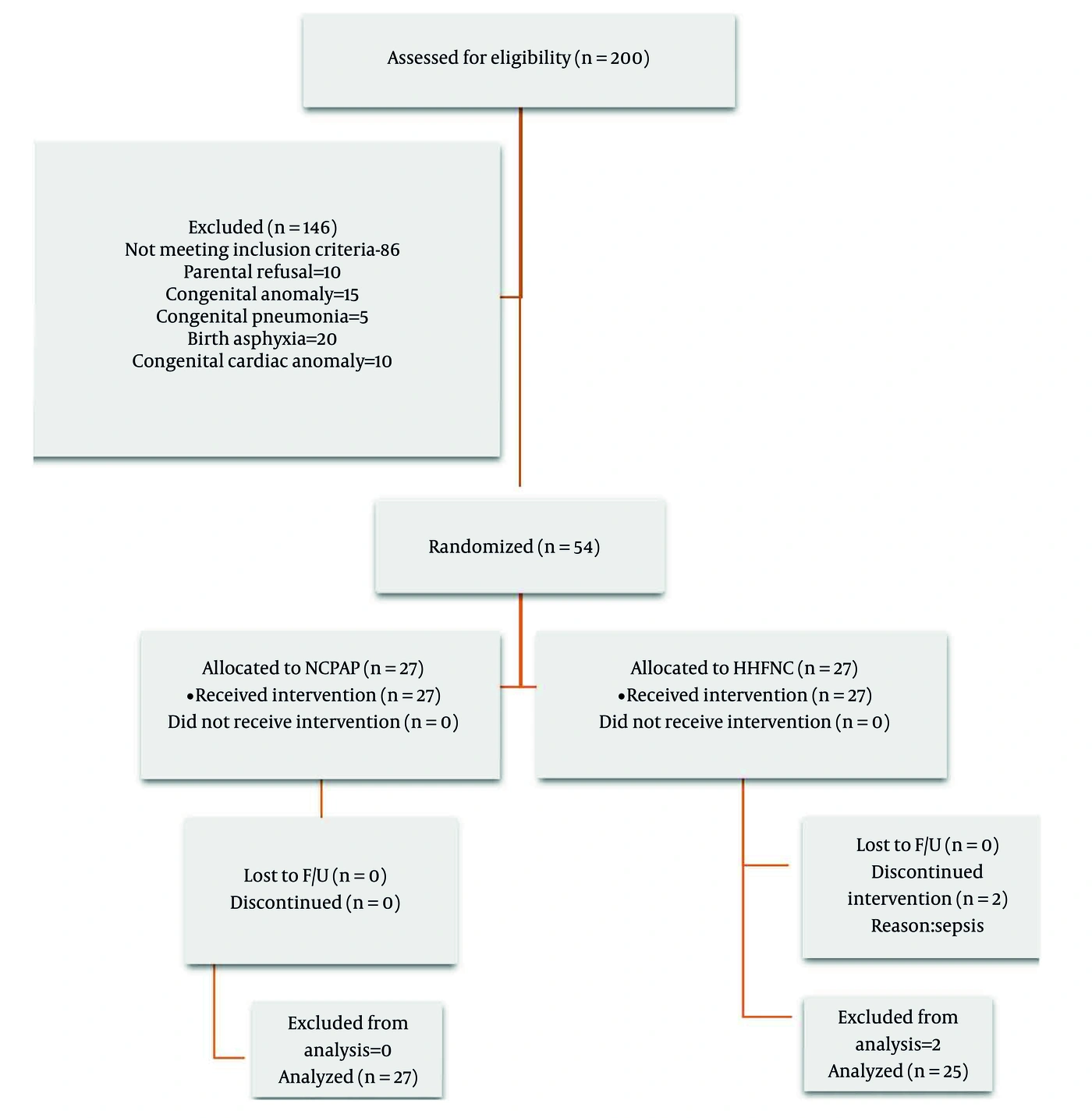
Figure 1.
CONSORT flow diagram
Most baseline demographic, maternal, and clinical characteristics were similar between groups; however, a moderate imbalance was observed for gestational age, birth weight, and initial FiO2, according to the prespecified standardized mean difference (SMD) interpretation (Table 1).
Table 1.
Baseline Demographic and Clinical Characteristics (ITT Population) a
| Clinical Parameter | NCPAP (n = 27) | HHFNC (n = 27) | Standardized Mean Difference (SMD) |
|---|---|---|---|
| Gestational age (wk) | 32.5 ± 1.5 | 33.1 ± 1.1 | 0.46 |
| Birth weight (g) | 2112 ± 574 | 2260 ± 705 | 0.23 |
| Initial FiO2 (%) | 42.7 ± 9.9 | 37.4 ± 14.5 | 0.43 |
| Body length (cm) | 44.6 ± 4.4 | 45.2 ± 3.1 | 0.16 |
| Female sex | 14 (51.9) | 13 (48.1) | 0.001 |
| Antenatal betamethasone | 24 (88.9) | 23 (85.2) | 0.11 |
| Caffeine therapy | 27 (100) | 27 (100) | 0.00 |
| Cesarean delivery | 15 (55.6) | 14 (51.9) | 0.008 |
| Multiple gestation | 8 (29.6) | 6 (22.2) | 0.13 |
| Moderate/severe RDS on X-ray | 18 (66.7) | 16 (59.3) | 0.15 |
| Age at surfactant delivery (h) | 1.8 ± 0.5 | 1.9 ± 0.6 | 0.18 |
| Pre-randomization mechanical ventilation (h) | 2.5 ± 0.8 | 2.6 ± 0.9 | 0.12 |
a Values are expressed as mean ± SD or No. (%). SMD < 0.10 denotes negligible imbalance; 0.10 - 0.20 denotes slight imbalance; > 0.20 indicates moderate imbalance adjusted for in regression models.
4.2. Primary Outcome: Duration of Supplemental Oxygen Therapy
In the primary ITT multivariable generalized linear model, adjusted for gestational age, birth weight, initial FiO2, and surfactant timing, infants treated with HHFNC had a significantly longer duration of supplemental oxygen therapy than those assigned to NCPAP (adjusted mean difference, 18.32 hours; 95% CI, 1.21 - 35.44; P = 0.036; adjusted ratio of means, 1.19; 95% CI, 1.01 - 1.40). The unadjusted median duration of oxygen therapy was 96 hours (IQR, 72 - 120) in the NCPAP group and 115 hours (IQR, 88 - 144) in the HHFNC group (P = 0.04). The PP sensitivity analysis yielded concordant results (adjusted mean difference, 17.94 hours; 95% CI, 0.88 - 35.00; P = 0.039).
4.3. Secondary Outcomes
4.3.1. Hospital Length of Stay
Infants in the HHFNC group had a significantly longer overall hospital stay. The multivariable adjusted analysis showed an adjusted mean difference of 125.38 hours (approximately 5.2 days; 95% CI, 29.66 - 221.10; P = 0.010; adjusted ratio of means, 1.25; 95% CI, 1.05 - 1.49). The unadjusted median hospital stay was 336 hours (IQR, 288 - 384) in the NCPAP group and 462 hours (IQR, 384 - 528) in the HHFNC group (P = 0.008).
4.3.2. Treatment Failure and Adverse Events
No treatment failures occurred in either arm; all neonates were successfully weaned without requiring reinstitution of invasive mechanical ventilation because of respiratory deterioration.
Rates of nasal trauma did not differ significantly between groups (adjusted OR, 2.78; 95% CI, 0.43 - 17.79; P = 0.281). No episodes of pneumothorax or intraventricular hemorrhage were documented in either trial arm. At 24 hours after randomization, median FiO2 requirements were comparable (NCPAP, 0.28 [IQR, 0.25 - 0.32] vs HHFNC, 0.31 [IQR, 0.27 - 0.35]; P = 0.21).
5. Discussion
This pilot randomized trial showed that, among preterm infants extubated after surfactant therapy for RDS, HHFNC was associated with longer dependence on supplemental oxygen and longer hospitalization than standard NCPAP. Both modalities demonstrated favorable short-term safety profiles, with no reintubation events and no documented cases of air leaks or IVH.
The approximately 18-hour adjusted increase in the duration of oxygen therapy associated with HHFNC is consistent with previous studies reporting a tendency toward longer respiratory support or higher weaning thresholds with high-flow devices in specific preterm subgroups (6, 15). Although HHFNC provides warm, humidified gas and dead-space washout, the pharyngeal distending pressure generated is unsealed and highly variable, potentially providing less consistent alveolar recruitment than continuous, ventilator-driven NCPAP (8, 10). Conversely, several prominent trials have demonstrated clinical noninferiority between HHFNC and NCPAP after extubation (12-14). These discrepancies may reflect differences in weaning protocols, flow-titration algorithms, patient birth weights, and institutional discharge policies (13, 16).
The approximately 5.2-day adjusted increase in the length of hospital stay observed in the HHFNC group may be clinically and economically important. In neonatal care, oxygen independence is often a prerequisite for discharge and unmonitored feeding; therefore, prolonged oxygen exposure may delay discharge. However, this pilot study was not powered to determine specific metabolic or physiological contributors to this delay.
Although nasal injury rates were statistically comparable, the wide confidence interval around the adjusted odds ratio (OR, 2.78; 95% CI, 0.43 - 17.79) indicates that the sample size was insufficient to detect smaller differences in interface-related cutaneous safety. Therefore, the absence of evidence should not be interpreted as evidence of clinical equivalence for interface safety.
5.1. Strengths and Limitations
Key strengths of this study include rigorous randomized allocation, adherence to ITT analysis, blinded assessment of nasal trauma, and multivariable modeling for nonnormally distributed continuous data.
Several limitations should be acknowledged. First, the modest pilot sample (n = 54) limited statistical power for rare outcomes such as pneumothorax and treatment failure. Second, the trial was restricted to 2 urban tertiary centers within a single geographical area, which may limit generalizability. Third, NCPAP was delivered via a Dräger mechanical ventilator, whereas HHFNC was delivered using a dedicated, standalone MEDIN system; therefore, device-specific effects cannot be fully separated from modality-specific effects. Fourth, 2 infants developed post-randomization sepsis; however, the PP sensitivity analysis yielded results consistent with the primary ITT analysis.
5.2. Conclusions
In preterm infants with RDS receiving post-extubation noninvasive respiratory support, HHFNC was associated with a significantly longer duration of supplemental oxygen therapy and longer hospitalization than NCPAP. Major complications were infrequent and comparable between groups; however, these findings are derived from a pilot study and should be considered hypothesis-generating. Adequately powered, multicenter randomized trials are needed before changes to noninvasive respiratory-support guidelines are considered.