
1. Background
Developmental evaluation is the main issue in pediatrics field. Developmental delay (DD) affects cognitive, speech, emotional, physical, mental, and spiritual performance, as well as personal and social skills and capacity to benefit in the future. So, early detection of DD and interventions are more efficient and less costly (1-3). Although various prevalence of DD was reported in different countries, approximately 12 - 16% of children have DD in at least one area (4). If there is no screening program among children, just 30% of children with DD would be detected finally. Also, late DD diagnosis can lose the opportunity for early intervention and is costly (5, 6).
Therefore, regular developmental assessment of pediatrics, particularly in young children, is essential for DD detection (7, 8). In Iran, the public health system provides free follow-up for all infants and young children from 2 - 60 months old, and they regularly have checkups for growth index, vaccination, and a developmental assessment. They are monitored by general practitioners (GP) and family physicians in urban or rural health centers. If they have a problem, they will be referred to pediatrician for further evaluation (9).
2. Objectives
This study aimed to evaluate DD prevalence in 12-month-old infants in Urban Health Centers, Shahid Beheshti University of Medical Sciences, Tehran, Iran.
3. Methods
In this descriptive cross-sectional study that was approved by the Ethics Committee of Shahid Beheshti University of Medical Sciences (SBMU), No. 113-M, out of 56 urban health centers affiliated with SBMU, Tehran, Iran, thirty-five centers were selected randomly. Of 27,450 twelve-month-old infants who were referred to these centers from 23 August 2018 to 23 August 2019, ASQ forms were completed by parents, 5,025 questionnaires were randomly selected based on their file numbers and using random number generation software at www.random.org. Questionnaires that were not filled out completely by parents were excluded.
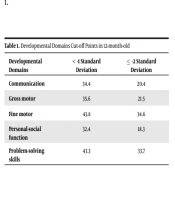
The ASQ scores were extracted, and any abnormal score in each domain or final question was considered positive and referred to the specialties level. The ASQ system assesses five developmental domains in children of different ages: communication, gross motor, fine motor, personal-social function, and problem-solving skills (10). Six questions are included in each developmental domain, and they were scored as “Yes” = 10 points, “Sometimes” = 5 points, and “Not yet” = 0 points. Failure of each domain of ASQ is determined by two or more standard deviations (SD) score below the standard of national guidelines (children with DD). Scores between one and two SD below the standard of national guidelines were considered a child suspected of DD. Cut-off level of scores is summarized in Table 1.
Table 1.
Developmental Domains Cut-off Points in 12-month-old
| Developmental Domains | < -1 Standard Deviation | ≤ -2 Standard Deviation |
|---|---|---|
| Communication | 34.4 | 20.4 |
| Gross motor | 35.6 | 21.5 |
| Fine motor | 43.8 | 34.6 |
| Personal-social function | 32.4 | 18.3 |
| Problem-solving skills | 43.3 | 33.7 |
Also, there are six final and overall questions which are completed by parents. They are about baby’s hearing, using both hands or legs equally, standing with feet flat on the surface, past history of deafness or auditory problem, vision problem, and any concern of parents about baby’s development. They are scaled as “Yes” or “No”. Failure of each of them is considered a problem and needs to consult. The valid ASQ system is available on the Iranian Ministry of Health and Medical Education website (11). Based on the scores and cut-off point all cases were classified into three groups: Children without DD (normal), children suspected of DD, and children with DD. Developmental condition and frequency in all cases and in different genders were evaluated using SPSS software version 20. Chi-squared test was performed for categorical data, and a P-value of less than 0.05 was considered statistically significant.
4. Results
Of 5,025 questionnaires that were extracted, 51.5% had male sex, and 243 cases (4.8%) had a problem in at least one of the five domains. Moreover, 68 cases (1.35%) had DD in two domains, five cases (0.09%) in three domains, four cases (0.07%) in four domains, and two cases (0.03%) had an essential delay in all five domains. Developmental delay was seen more in gross motor (1.6%), followed by communication (1.5%), problem-solving (1%), fine motor (0.4%), and personal-social (0.3%), respectively. There were significant statistical differences in personal-social and problem-solving in boys (P value = 0.00 and 0.01). Among the six final questions in ASQ, the most common problem was in question 4 (1.4%), which is related to auditory problems. Table 2 illustrates the frequency of developmental classification in different genders. ASQ score of five main domains is mentioned in Table 3.
Table 2.
Frequency of Developmental Classification in Different Sex a
| Domain and Questionees | Total (5025) | Boy (2588) | Girl (2437) | P Value |
|---|---|---|---|---|
| Communication | 0.09 | |||
| Children without developmental delay | 4737 (94.3) | 2431 (94) | 2306 (94.6) | |
| Child suspected to developmental delay | 213 (4.2) | 109 (4.2) | 104 (4.2) | |
| Children with developmental delay | 75 (1.5) | 48 (1.8) | 27 (1.1) | |
| Gross motor | 0.40 | |||
| Children without developmental delay | 4757 (94.7) | 2447 (94.5) | 2310 (94.8) | |
| Child suspected to developmental delay | 186 (3.7) | 93 (3.6) | 93 (3.8) | |
| Children with developmental delay | 82 (1.6) | 48 (1.9) | 34 (1.4) | |
| Fine motor | 0.43 | |||
| Children without developmental delay | 4962 (98.7) | 2553 (98.6) | 2409 (98.86) | |
| Child suspected to developmental delay | 45 (0.9) | 23 (0.9) | 22 (0.9) | |
| Children with developmental delay | 18 (0.4) | 12 (0.5) | 6 (0.24) | |
| Problem solving | 0.00 | |||
| Children without developmental delay | 4830 (96.1) | 2468 (95.4) | 2362 (96.9) | |
| Child suspected to developmental delay | 144 (2.9) | 81 (3.1) | 63 (2.6) | |
| Children with developmental delay | 51 (1) | 39 (1.5) | 12 (0.5) | |
| Personal-social | 0.01 | |||
| Children without developmental delay | 4877 (97.1) | 2500 (96.6) | 2377 (97.54) | |
| Child suspected to developmental delay | 131 (2.6) | 74 (2.86) | 57 (2.34) | |
| Children with developmental delay | 17 (0.3) | 14 (0.54) | 3 (0.12) | |
| Question1 | 0.95 | |||
| Nl | 5021 (99.9) | 2586 (99.92) | 2435 (99.92) | |
| Abnormal | 4 (0.1) | 2 (0.08) | 2 (0.08) | |
| Question2 | 0.86 | |||
| Nl | 4991 (99.3) | 2571 (99.35) | 2420 (99.3) | |
| Abnormal | 34 (0.7) | 17 (0.65) | 17 (0.7) | |
| Question3 | 018 | |||
| Nl | 4986 (99.2) | 2572 (99.38) | 2414 (99.06) | |
| Abnormal | 39 (0.8) | 16 (0.62) | 23 (0.94) | |
| Question4 | 0.24 | |||
| Nl | 4953 (98.6) | 2546 (93.4) | 2407 (98.77) | |
| Abnormal | 72 (1.4) | 42 (1.6) | 30 (1.23) | |
| Question5 | 0.08 | |||
| Nl | 4999 (99.5) | 2575 (99.5) | 2424 (99.5) | |
| Abnormal | 26 (0.5) | 13 (0.5) | 13 (0.5) | |
| Question6 | 0.53 | |||
| Nl | 4973 (99) | 2559 (99.88) | 2414 (98.06) | |
| Abnormal | 52 (1) | 29 (1.12) | 23 (0.94) |
a Values are expressed as No. (%).
Table 3.
Mean ± Standard Deviation in Ages and Stages Questionnaire Score of Five Main Domains
| Domains | N: 5025 | N: 2437 (Girl) | N: 2588 (Boy) |
|---|---|---|---|
| Communication | 52.11 ± 8.06 | 53.05 ± 7.53 | 51.22 ± 8.44 |
| Gross motor | 53.64 ± 9.24 | 53.77 ± 9.30 | 53.51 ± 9.19 |
| Fine motor | 56.651 ± 5.61 | 56.61 ± 5.54 | 56.68 ± 5.68 |
| Problem-solving | 55.754 ± 6.68 | 55.93 ± 6.18 | 55.58 ± 7.11 |
| Personal-social | 52.54 ± 8.81 | 53.15 ± 8.45 | 51.97 ± 9.10 |
5. Discussion
In this study, 12-month-old ASQs were selected because all 12-month-old Iranian children refer to a health center for routine vaccination and follow-up. Screening in primary care is a cost-effective tool to assess pediatric developmental status and developmental delay diagnosis. Although there are various tools for developmental evaluation, the ASQ is a parent-centric approach (11, 12). Also, owning to the feasibility and accuracy of ASQ system, it is an appropriate tool for DD detection in primary care centers (13). Early intervention program and ASQ system were introduced by Dr. Bricker at University of Oregon in 1998 and until now, it has been used as a screening tool for developmental status assessment of children younger than 60-month-old and standardization and validation of ASQ is acceptable for Iranian children (14-16).
The ASQ screening test contains 20 questionnaires for different age groups from 2 - 60 months to be completed by the parent or caregiver (11, 17). This questionnaire is designed for parents with primary education. A physician read the question to illiterate parents who could not complete it and marked the desired answer (11, 18). In this study, 51.5% of cases were boys, and DD was 4.8% in at least one of the five developmental domains. Sajadi et al. found that the prevalence of DD among 10,516 Iranian children younger than five years old by ASQ was 3.69 - 4.31%, which is near to the current study finding (19). On the other hand, Zarepour et al. reported DD prevalence was 18.8% in Urmia, Iran, that is higher than our study. Moreover, DD in gross motor and communication domains were more common among our cases, Zareipour et al. found communication and gross motor were the most affected domains, and Sajedi et al. mentioned fine motor and problem-solving were more common problems (19, 20).
There are various ranges of DD prevalence in children in different regions. In fact, some variables such as child sex, age, race/ethnicity, parent education in urban or rural areas, health care, economic situation affect developmental status in early childhood and it might be a cause of differences in DD prevalence in different studies (21). Moreover, in this study, there are significant statistical differences between boys and girls. Boys had low scores in personal-social and problem-solving domains. Chen et al. evaluated 2,343 infants’ ASQ data in 8, 18, and 24 - months between 2006 to 2016 (22). They reported boys had 27.9% DD and girls 19.5%. Also, boys had low scores in communication and personal-social domains (22). It might be due to biological, brain structural differences, and different environmental stimulants in boys and girls (23).
Recently, pediatricians and practitioner physicians have used standardized developmental screening tools more than before. So, early DD detection and intervention in early infancy improved final outcome (21, 24). For community health promotion, providing high-quality care in early childhood is one of the tasks of government and primary care centers in rural and urban areas. This retrospective study included a large sample size of cases, but there were no data about some risk factors such as gestational age and past medical history of babies and their families, and specialist’s feedback assessment was not possible. Further prospective studies are recommended.
5.1. Conclusions
In this study, DD by ASQ was estimated at 4.8% of one-year-old infants. So developmental screening is a basic tool for DD detection. Developmental delay detection and early intervention may be possible through cost-effective screening tools.