
1. Background
Emotion regulation is increasingly being investigated through various lines of research with special attention paid to its role in psychopathology (1, 2). Emotion regulation is defined as processes by which people influence the types of emotions they have, when they experience them, and how they experience and express these emotions (3). Relative to negative emotion, positive emotion has received little attention; however, research in this area is expanding (4, 5). According to broaden-and-build theory of positive emotions, positive emotions broaden thought-action repertoires, undo lingering negative emotions, fuel psychological resiliency, and trigger upward spirals toward improved emotional well-being (6). Moreover, people report more life satisfaction in countries where people pay special attention to positive emotions and their values (7). Also, physiological changes accompanying positive emotion have promising effects on health (8) and performance (9).
The tripartite model has emphasized the low level of positive affectivity as a distinguished factor related primarily to depression (10). Positive affectivity is not solely linked to depression, but evidence shows consistent negative relations to social anxiety (11), generalized anxiety disorder (12), and mania/hypomania (13). Recent research development in the field of positive emotion has paid particular attention to responses to positive emotion or positive emotion regulation strategies (14, 15). A number of positive emotion regulation strategies have been linked to psychopathology, including dampening which is defined as a tendency to reduce the intensity and duration of positive mood state. Also positive rumination is defined as a tendency to respond to positive affect states with recurrent thoughts and mentally reflecting on positive self-qualities and positive experiences and memories (16).
Responses to Positive Affect (RPA) questionnaire was developed by Feldman and colleagues to evaluate the responses to positive mood. RPA questionnaire is a self-report 17- item measure that evaluates rumination on positive moods and dampening. RPA measure is parallel to the Response Style Questionnaire (RSQ) (17) which assesses rumination on negative content. Exploratory factor analysis yielded three factors, two of which reflected forms of rumination on positive experience which are called self-focus rumination and emotion-focus rumination and the third factor reflected a tendency to down-regulate positive mood which is called dampening. Results supported acceptable internal consistency for three factors of the RPA questionnaire. Furthermore, confirmatory factor analysis using structural equation modeling suggested that a three-factor model would provide a better fit for the data than alternative models (16). Studies on Dutch (18) and Swedish (19) versions of the RPA questionnaire have replicated the three factor model using EFA and CFA with adequate internal consistency for subscales; however, there were some discrepancies between these two studies about some items loading on self-focus and emotion focus rumination. In contrast, one study identified a two-factor solution in a Korean-speaking sample (20). Furthermore, some studies have found that differences between model fit indices for two- and three-factor model are absent or small (21, 22). Given the very high correlation between the two factors of positive rumination, these authors recommend the use of a single positive rumination score for the sake of empirical and conceptual parsimony.
In research on the convergent validity of the RPA questionnaire (16, 18, 19), self-focused positive rumination, emotion focused rumination, and dampening are associated with self-esteem, manic, depression and anxiety symptoms in non-clinical samples of adults (23).Given the several lines of evidence indicating the role of positive emotion in the etiology and maintenance of emotional disorders and contributing role of positive emotion regulation in psychopathology and treatment, there is a great need for a measure that assesses RPA in Iranian population. Furthermore, as indicated in previous mentioned studies, there are some discrepancies between studies assessing factor structure of RPA questionnaire (22).
2. Objectives
The aims of the present study are to evaluate the factor structure of the Iranian version of the RPA questionnaire using EFA and CFA and to evaluate convergent validity, incremental validity, and stability of RPA questionnaire using SPSS-23 and AMOS-23 in Iranian population.
3. Materials and Methods
3.1. Participants
The present study is a cross-sectional one. Participants were recruited from the metropolitan Tehran, Iran community through purposive sampling method in public places during 2016 - 2017. Assessors were two psychologist with master degree who were present in public places like markets, cafe, etc. and asked individuals who had at least 1 hour of free time to answer to questions. Participants were selected according to these criteria: (1) age range of 18 to 50, (2) being willing to participate in study, (3) literate enough to understand the concepts of questionnaire battery. It is been recommended to have 20 participants for each item and as our questionnaire has 17 items and considering the attrition, almost 500 participants were calculated for sample size (24). Five hundred and twenty individuals agreed to respond to a packet of questionnaires. After screening the data, 499 participants (male = 44.7%, female = 55.3%) with a mean age of 34.81 (SD = 10.48) were obtained. In terms of marital status, 32.7% were identified as single, 64.5% were identified as married, and 2.8% were identified as divorced. In terms of education level, 10.6% were identified as under diploma (did not graduate from secondary school), 45.1%, 29.5%, 11.8%, and 3% were identified as diploma, bachelor degree, master degree, and doctoral degree respectively.
3.2. Measures
3.2.1. Responses to Positive Affect Questionnaire
RPA is a self-report 17-item questionnaire that is rated on a 4 point Likert scale from 1 (almost never) to 4 (almost always). EFA has demonstrated 3 factors (emotion-focus, dampening, and self-focus). Internal consistency for subscales has been reported to be 0.76, 0.79, and 0.73 respectively (16).
3.2.2. Ruminative Response Scale (RRS)
RRS was developed by Nolen-Hoeksema in 1991. RRS is a 22 item self-report questionnaire that is rated on a 4 point Likert scale from 1 (almost never) to 4 (almost always) and assesses rumination (25). Internal consistency (α = 0.89) and 5 month test retest reliability have been reported acceptable (26). Internal consistency of reflection (5 items) and brooding (5 items) in present research are as 0.75 and 0.76 respectively.
3.2.3. Beck Depression Inventory (BDI-II)
BDI was developed by Beck, Steer, and Garbin in 1988. BDI is a self-report 21-item questionnaire that is rated on a 4 point Likert scale from 0 to 3 and assesses severity of depression symptoms (27). Internal consistency of BDI is reported as 0.86 in psychiatric populations and 0.81 in non-psychiatric populations. Test-retest reliability is also reported as r = 0.86 (27). Internal consistency of BDI in present study is 0.91.
3.2.4. Social Interaction Anxiety Scale (SIAS)
SIAS was developed by Heimberg, Mueller, Holt, Hope and, Liebowitz in 1992. SIAS is a 20-item self-report questionnaire which is rated on a 5 Likert scale from 0 (not at all) to 4 (extremely) and assesses severity of social anxiety disorder (28). Internal consistency of SIAS in social phobia sample, community sample, and undergraduate sample has been reported to be 0.86, 0.95, and 0.85 respectively (28). Internal consistency of SIAS in present study is 0.91.
3.2.5. Generalized Anxiety Disorder 7-Item Scale (GAD-7)
GAD-7 was developed by Spitzer, Kroenke, Williams, Lowe in 2006. GAD-7 is a self-report 7-item scale that is rated on a 4 point Likert scale from 0 (not at all sure) to 3 (nearly every day) and assesses severity of generalized anxiety disorder (29). Internal consistency and test-retest reliability have been reported to be α = 0.92 and r = 0.83 respectively (29). Internal consistency of GAD-7 in present research is α = 0.89.
3.3. Procedure
Before administrating the questionnaire, permission was obtained from the first author of the RPA scale development study (16).Then the questionnaire was translated into Persian, and after that from Persian to English by a bilingual who is expert in English language. Then, the two forms of the original RPA and the translated one were compared by another person who is adept at the English language. Next, the translated questionnaire was edited according to feedback. The final translated RPA questionnaire was reviewed and approved by three university professors familiar with the responses to affect and mood concept. After preparation of the Iranian RPA, at first, the questionnaire was given to 50 individuals living in Tehran in order to assess the concept and initial reliability of the scale. After preparation of final transcription, the study participants were recruited and informed about the goal of study, assured that their responses would be confidential, and told that their participation was voluntary. Then, the participants completed the questionnaire package consisting of all study questionnaires. Inclusion criteria were adults habitants of Tehran, being eager for participating in the study, being in the age range of 18 - 55 and individuals who did not meet these criteria were excluded.
3.4. Data Analysis
Before analyzing the data, normality (Table 2) and nonexistence of outliers’ assumptions were met. Exploratory factor analysis and confirmatory factor analysis were conducted to assess the factor structure of RPA. Bivariate correlation, partial correlation, and regression analysis were conducted to evaluate convergent and incremental validity and test-retest reliability of RPA. Internal consistency of the scale was evaluated using Chronbach alpha. SPSS-23 and AMOS 23 were used for analyzing the data.
4. Results
4.1. Exploratory Factor Analysis
Exploratory principal axis factor analyses with oblique rotation were selected. Item 6 (…think “This is too good to be true.”) loaded on all factors and its loadings was less than 0.3, thus it was eliminated from the scale. It is noteworthy that this item, which may reflect an English-language idiom, has also failed to load consistently on the dampening scale in analyses of both Korean (20) and Dutch (22) versions of the RPA where the item has also been eliminated. Exploratory factor analyses were performed on remaining items. A solution emerged that accounted for 47.84% of the total variance (Table 1). This model contained 2 factors (positive rumination and dampening) with eigenvalues greater than 1. The Kaiser-Meyer-Olkin value was 0.87, which exceeds the recommended value of 0.6 (30). Bartlett’s test of sphericity reached statistical significance and further supported the factorability of the correlation matrix (31). The internal consistency for each scale was acceptable (α = 0.87 and α = 0.77 for positive rumination and dampening respectively). All item total correlations and factor loadings were above 0.30 (Table 2). The pattern of scale and factor inter correlation suggested that positive rumination and dampening are not related to each other.
Table 1.
Pattern Matrix and Corrected Item-Total Correlationsa
| Items | Positive Rumination | Dampening | ra |
|---|---|---|---|
| 1. Notice how you feel full of energy. | 0.68 | -0.2 | 0.67 |
| 2. Savour this moment. | 0.67 | -0.17 | 0.66 |
| 3. Think “I am getting everything done.” | 0.69 | -0.04 | 0.68 |
| 4. Think about how you feel up for doing everything. | 0.77 | -0.09 | 0.75 |
| 5. Think “I am living up to my potential.” | 0.69 | 0.007 | 0.68 |
| 7. Think about how happy you feel. | 0.67 | -0.12 | 0.69 |
| 8. Think about how strong you feel. | 0.67 | -0.04 | 0.68 |
| 9. Think about things that could go wrong. | 0.1 | 0.5 | 0.51 |
| 10. Remind yourself that these feelings won’t last. | -0.17 | 0.69 | 0.67 |
| 11. Think “People will think I am bragging.” | 0.006 | 0.58 | 0.59 |
| 12. Think about how hard it is to concentrate. | -0.08 | 0.4 | 0.45 |
| 13. Think “I am achieving everything.” | 0.58 | -0.02 | 0.61 |
| 14. Think “I don't deserve this.” | -0.12 | 0.55 | 0.65 |
| 15. Think “My streak of luck is going to end soon.” | -0.19 | 0.71 | 0.67 |
| 16. Think about how proud you are of yourself. | 0.53 | -0.01 | 0.57 |
| 17. Think about the things that have not gone well for you. | -0.02 | 0.56 | 0.58 |
ara = Corrected correlation between the item and its subscale.
Table 2.
Descriptive Statistics and Scale and Factor Intercorrelationsa
| M | SD | Skewness | Kurtosis | 1 | 2 | |
|---|---|---|---|---|---|---|
| 1. Positive rumination | 27.31 | 5.64 | -0.42 | -0.48 | (0.87) | -0.08 |
| 2. Dampening | 12.38 | 3.91 | 0.82 | 0.54 | -0.1 | (0.77) |
aAlpha reliabilities of the subscales are found on the diagonal. Correlation coefficients for scale values appear below the diagonal and factor correlations appear above the diagonal.
4.2. Confirmatory Factor Analysis
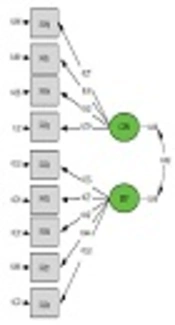
The fit of 2-factor model in which items 1, 2, 3, 4, 5, 7, 8, 13, and 16 were loaded on positive rumination factor and items 9, 10, 11, 12, 14, 15, and 17 were loaded on dampening factor was tested. Maximum likelihood (ML) was used for estimating CFA, because this method is continuous and multivariate normal distribution like this data (32). The model showed a good fit to the data (χ2 = 367.78, df = 103, χ2/df = 3.57, P < 0.001, CFI = 0.89, GFI = 0.91, RMSEA = 0.07). The fitness of model was improved according to modification indices (Figure 1). After modification, fitness indices were as χ2 = 135.51, df = 82, χ2/df = 1.65, P < 0.001, CFI = 0.98, GFI = 0.97, RMSEA = 0.03 which all are in an acceptable domain of fitness (24). To compare the fitness of two-factor model with one-factor and three-factor ones, another two CFAs were done. Results showed an acceptable fitness for three-factor model (χ2 = 345.79, df = 101, χ2/df = 3.42, P < 0.001, CFI = 0.90, GFI = 0.91, RMSEA = 0.07), but the fitness of one-factor model was too poor (χ2 = 1054.54, df = 104, χ2/df = 10140, P < 0.001, CFI = 0.63, GFI = 0.72, RMSEA = 0.13). In the final modified model, analysis of variances of items showed that all items variances were significant except e13 which is the error of RPA12 that has the lowest loading on dampening factor.

Figure 1.
Results of confirmatory factor analysis of RPA after modification (all paths are significant)
4.3. Convergent Validity
Correlational results and descriptive statistics for RPA and criterion variables appear in Table 3. R2 is provided in Table 3 as an indication of the percentage of common variance between the two measures. Results of bivariate correlation showed that higher scores on positive rumination were associated with lower scores on reflection, depression (BDI) and generalized anxiety (GAD) symptoms. Higher scores on dampening were correlated with higher scores on brooding, reflection, depression, social phobia (SAD) and generalized anxiety symptoms.
To evaluate potential role of symptom contamination, partial correlation between RPA factors and criterion variables were conducted controlling for depression symptoms (Table 3). The magnitude of association between RPA factors and criterion variables were minimally affected except that the relation between positive rumination and generalized anxiety symptoms became non-significant when depression symptoms were controlled.
Table 3.
Correlations of RPA Subscales and Criterion Variables
| M | SD | Skewness | Kurtosis | r (r2) | pr Controlling for BDI | |||
|---|---|---|---|---|---|---|---|---|
| Positive Rumination | Dampening | Positive Rumination | Dampening | |||||
| Brooding | 11.1 | 3.12 | 0.29 | -0.14 | 0.01 (0.001) | 0.35a (0.12) | 0.12a | 0.18a |
| Reflection | 10.85 | 3.21 | 0.28 | -0.4 | 0.1a (0.01) | 0.23a (0.05) | 0.18a | 0.13a |
| BDI | 13.72 | 10.88 | 1 | 0.56 | 0.2a (0.04) | 0.39a (0.15) | - | - |
| SIAS | 21.67 | 13.6 | 0.71 | 0.13 | 0.15a (0.02) | 0.36a (0.13) | 0.14a | 0.22a |
| GAD | 8.12 | 5.19 | 0.59 | 0.1 | 0.004 (0.001) | 0.31a (0.09) | -0.06 | 0.12a |
aP < 0.01.
4.4. Incremental Validity
The goal of this analysis was to assess whether RPA subscales could explain amount of variability in depression symptoms above and beyond the established construct of depressive rumination. Brooding and reflection were entered in block 1 and subscales of RPA were entered in block 2. In predicting depressive symptoms, RPA subscales predicted an additional 7% of the variance in symptoms above and beyond depressive rumination (brooding) and reflection which accounted for 29% of the variance in depressive symptoms (Table 4).
Table 4.
Summary of Hierarchical Regression Analysis for RPA Subscales, Reflection, and Brooding Predicting Depression Symptoms (BDI)
| B | SE B | Beta | t | ∆R2 | |
|---|---|---|---|---|---|
| Step 1 | 0.29a | ||||
| Constant | -8.04 | 1.67 | -4.79 | ||
| Brooding | 1.8 | 0.15 | 0.51 | 11.68a | |
| Reflection | 0.16 | 0.15 | 0.04 | 1.1 | |
| Step 2 | 0.07a | ||||
| Constant | -2.65 | 2.58 | -1.02 | ||
| Brooding | 1.51 | 0.15 | 0.43 | 10.007a | |
| Reflection | 0.21 | 0.14 | 0.063 | 1.48 | |
| Positive rumination | -0.36 | 0.07 | -0.18 | -5.16a | |
| Dampening | 0.57 | 0.106 | 0.205 | 5.36a |
aP < 0.01.
4.5. Test-Retest Reliability
In order to assess test- retest reliability, RPA was delivered to 57 of the participants in the present study after 14 days. Results of test-retest reliability were as follows: Positive rumination pre-post = 0.81, P < 0.01, and Dampening pre-post = 0.83, P < 0.01.
5. Discussion
Recent studies suggest that responses to negative emotion are not solely indicated in the etiology and maintenance of psychopathology; responses to positive emotion also play a fundamental role in this process. Consistent with these studies, the present research aimed to investigate the psychometric properties of an Iranian version of the RPA questionnaire. Using exploratory factor analyses, a 2 factor structure was obtained for the RPA questionnaire. The first factor reflected emotional/somatic and self-rumination on positive experiences and the second factor reflected dampening on positive affect. Result of CFA showed good fitness of the 2-factor and 3-factor model, and poor fitness for 1-factor model. This result is consistent with prior studies suggesting a three factor structure for the RPA questionnaire in English (16), Swedish (19), and Dutch (18); and with one study finding a two-factor solution in a Korean-speaking sample (20). Taken together, this latter study and the present study offer further support for their recommendation to score the RPA with a two-factor solution (21, 22). Because results of EFA and CFA of our study showed RPA to be a 2-factor model, it is suggested this questionnaire be considered as a 2-factor model in Iranian population. In addition, we found non-significant associations between the positive rumination and dampening subscale, a finding also consistent with prior study (22). Internal consistency of subscales was acceptable for research use (33) and also the temporal stability of the test was agreeable across a two-week period consistent with prior research assessing test-retest reliability over a 3-month (21, 23).
Tests of convergent validity largely supported the expected links between RPA subscales and depression, generalized anxiety, and social anxiety measures and these associations largely remained significant after controlling for depression symptoms (with the exception of the relationship between positive rumination and generalized anxiety symptoms). These findings are parallel to previous studies demonstrating the relationship between positive affect regulation and depression using the RPA (15). The replication of the finding that the association of dampening and anxiety symptoms remains after controlling for depression symptoms (34) highlights how the tendency to dampen positive affective experience may be a common factor that may partially account for the comorbidity of depression with both social- and generalized-anxiety disorders.
Furthermore, RPA subscales accounted for variance in current depressive symptoms above and beyond depressive rumination and reflection which are in line with previous studies reporting similar cross-sectional analyses (16, 18, 21). Previous studies have also demonstrated that subscales of the RPA prospectively predict mood disorder symptoms in non-clinical samples of adults in analyses controlling for depressive rumination (21, 23). Taken together, the present findings support the value of assessing response to positive emotions using the RPA as a predictor of depressive symptoms that is conceptually and empirically distinct from the more widely-studied measure of rumination in response to negative emotions.
The findings of present study, suggest that emphasizing and valuing the responses to positive affect and investigating their role in psychopathology is crucially helpful for more comprehensive case conceptualization in clinical settings, and planning treatment strategies to ameliorate pathological symptoms.
5.1. Limitations
It is important to acknowledge some limitations in the present findings. First, an adult community sample was used in the present study. On the one hand, this is a valuable extension of existing research on the RPA that has been largely with younger samples of college students as well as children and adolescents (22). Nonetheless, it is unclear to what extent present findings could be generalized to broader and clinical populations. Second, in this study, only a set of constructs was evaluated, and more studies are needed to take into account another variables, especially mania/hypomanic symptoms and other disorders. Third, as the present study is a cross-sectional one, it cannot tease apart causality in the relationships of study variables.
5.2. Conclusion
The results of the present study offer preliminary evidence of the reliability and validity of the RPA in a Persian speaking sample. The availability of such a measure can facilitate more culturally-diverse research on positive emotion regulation. The present study also contributes new findings to the on-going discussion in the literature about the factor structure of the RPA and its correlates in samples representing previously underrepresented age groups and cultural backgrounds.