
1. Background
Interpretation bias refers to the tendency to interpret ambiguous stimuli in a negative or threatening manner, even when alternative, more neutral or positive interpretations are equally plausible. This cognitive bias is particularly relevant in the context of affective disorders, such as depression, where individuals often exhibit heightened sensitivity to negative information and a tendency to interpret ambiguous situations pessimistically or self-critically (1, 2). Research has consistently shown that interpretation bias plays a significant role in the etiology, maintenance, and recurrence of depressive symptoms (3, 4). For instance, individuals with depression are more likely to interpret ambiguous social cues (e.g., a friend not responding to a text message) as evidence of rejection or failure, exacerbating feelings of worthlessness and hopelessness (5).
The concept of interpretation bias is rooted in Beck’s cognitive theory of depression, which posits that negative cognitive schemas — stable patterns of thinking biased toward negative interpretations of the self, the world, and the future — underlie depressive symptomatology (6). According to this theory, individuals with depression are prone to systematic errors in thinking, such as overgeneralization, catastrophizing, and personalization, which contribute to the maintenance of depressive symptoms (7). These cognitive distortions are thought to arise from early life experiences and are activated by stressful or ambiguous situations, leading to a cycle of negative thinking and emotional distress (8).
Given the central role of interpretation bias in depression, there has been growing interest in developing tools to measure and modify this cognitive bias. One such tool is the ambiguous scenarios test (AST), originally developed by Berna et al. to assess interpretive bias in individuals with depressive symptoms (9). The AST presents participants with a series of ambiguous scenarios and asks them to rate the pleasantness of each scenario on a Likert scale. Higher ratings indicate a more positive interpretive bias, while lower ratings reflect a more negative bias. The AST has been shown to effectively discriminate between individuals with high and low levels of depressive symptoms, making it a valuable tool for both clinical and research settings (10).
The AST has been studied in various cultural contexts, including Western populations (e.g., the United Kingdom, Germany, and the United States) (7, 9, 11) and non-Western populations (e.g., China and Iran) (10, 12). In Western cultures, the AST has demonstrated strong psychometric properties, with high internal consistency (Cronbach’s α = 0.87 - 0.90) and good discriminant validity in distinguishing between individuals with and without depressive symptoms (7). In non-Western cultures, such as China, the AST has been adapted and validated, showing similar reliability and validity. In Iran, the AST was first adapted and validated by Nashtdoost, who reported good internal consistency (Cronbach’s α = 0.87) and a three-factor structure (10). However, this study was limited by a small sample size and a lack of concurrent validation with other measures of depressive symptoms and cognitive biases.
2. Objectives
The present study aims to address these limitations by evaluating the psychometric properties of the Persian version of the AST in a larger and more diverse sample of Iranian adults. Specifically, we will examine the internal consistency, test-retest reliability, and factor structure of the AST, as well as its concurrent validity with other measures of depressive symptoms [e.g., Beck’s Depression Inventory-II (BDI-II)], anhedonia [e.g., Dimensional Anhedonia Rating Scale (DARS)], and mental imagery [e.g., Spontaneous Use of Mental Imagery Scale (SUIS)]. By doing so, this study will provide a more comprehensive understanding of the utility of the AST in assessing interpretive bias in the Iranian population and contribute to the growing body of research on cognitive biases in depression.
3. Methods
3.1. Study Design
This study employed a cross-sectional design to evaluate the psychometric properties of the Persian version of the AST in an Iranian population. Data were collected from a sample of 365 participants using a convenience sampling method. Ethical approval was obtained from the University of Social Welfare and Rehabilitation Sciences (approval code: IR.USWR.REC.1400.102).
3.2. Participants
The research design was descriptive and cross-sectional, involving 365 participants. Participants completed several scales, including the SUIS, Beck’s Depression Inventory, the Persian version of the AST, the DARS, and the prospective imagery task (PIT). Inclusion criteria were Iranian nationality, both sexes, age under sixty, and the ability to read and write. Exclusion criteria included individuals who did not complete the questionnaire, psychotic patients, those with traumatic brain injury, apparent intellectual disorders, moderate to severe learning difficulties and disabilities, a history of substance use, a history of epilepsy and seizures, and a history of electroconvulsive therapy (ECT) in the last six months. The AST was translated to adapt the measurement methods to a foreign language, with an actively practicing clinical psychologist first translating the original version into Persian.
3.3. Sample Size Calculation
A power analysis was conducted using G*Power 3.1 to ensure adequate statistical power for detecting significant effects. Based on previous studies examining the psychometric properties of similar scales, we assumed a medium effect size (Cohen’s f2 = 0.15), a significance level of α = 0.05, and a power of 0.95. The analysis indicated that a minimum sample size of 300 participants was required to achieve adequate power for exploratory factor analysis (EFA) and correlation analyses.
3.4. Measures
The following measures were used in this study:
3.4.1. Ambiguous Scenarios Test
The AST consists of 30 ambiguous scenarios rated on an 11-point Likert scale. Higher scores indicate a more positive interpretive bias, while lower scores reflect a more negative bias. The original AST has demonstrated good internal consistency (Cronbach’s α = 0.87) and discriminant validity in distinguishing between individuals with high and low levels of depressive symptoms (7). For example, a scenario might be: "You receive a text message from a friend that says, 'We need to talk'. How pleasant or unpleasant do you find this situation?"
3.4.2. Beck’s Depression Inventory-II
The BDI-II is a widely used 21-item self-report measure of depressive symptoms. Each item is scored on a 4-point scale (0 to 3), with higher scores indicating more severe depressive symptoms (13). The BDI-II has shown excellent reliability and validity in both clinical and nonclinical populations.
3.4.3. Dimensional Anhedonia Rating Scale
The DARS is a 17-item self-report scale assessing four facets of hedonic experience: Hobbies, food/drink, social activities, and sensory experiences. Items are rated on a 5-point Likert scale, with higher scores indicating greater anhedonia. The DARS has demonstrated good internal consistency (Cronbach’s α = 0.84) and convergent validity with other measures of depression (14).
3.4.4. Spontaneous Use of Mental Imagery Scale
The SUIS is a 12-item measure of the tendency to use mental imagery in daily life. Items are rated on a 5-point Likert scale, with higher scores indicating greater use of mental imagery. The SUIS has shown good internal consistency (Cronbach’s α = 0.75) and moderate convergent validity with measures of interpretive bias (15).
3.4.5. Prospective Imagery Task
The PIT consists of 30 scenarios (10 positive and 20 negative) assessing the vividness, likelihood, and emotional experience of future events. Participants rate each scenario on a 5-point Likert scale. The PIT has demonstrated good internal consistency (Cronbach’s α = 0.90) and test-retest reliability (r = 0.75) in previous studies (16).
3.5. Statistical Analysis
Descriptive statistics were used to summarize the demographic characteristics of the sample. Internal consistency was assessed using Cronbach’s alpha, and test-retest reliability was evaluated using Pearson correlation coefficients. The EFA was conducted to examine the factor structure of the AST. Concurrent validity was assessed by examining the correlations between the AST and other measures (BDI-II, DARS, SUIS, PIT). All analyses were performed using SPSS version 24.
3.6. Ethical Considerations
All participants were given the choice to participate in the study or opt out, ensuring their autonomy and respect. The examiners guaranteed the confidentiality of individuals’ data, and each participant had the right to access their data if desired, demonstrating the study’s commitment to ethical conduct and respect for participants’ privacy. This research was conducted after obtaining ethical approval from the University of Social Welfare and Rehabilitation Sciences (IR.USWR.REC.1400.102).
4. Results
Item-total correlations for the 30 AST items ranged from 0.40 to 0.64, with all correlations being statistically significant (P < 0.01). Item 15 ("You receive a compliment from a colleague".) had the highest correlation with the total score (r = 0.64), while Item 26 ("You hear laughter as you walk into a room".) had the lowest correlation (r = 0.40). The difficulty of the items, calculated using SPSS, ranged from 0.25 to 0.78, indicating a good range of item difficulty (Table 1).
Table 1.
Item Analysis of the Ambiguous Scenarios Test
| Items | Item-Total Correlation a | Cronbach’s Alpha if Item Deleted | Squared Multiple Correlation | Corrected Item-Total Correlation | Scale Variance if Item Deleted | Scale Mean if Item Deleted |
|---|---|---|---|---|---|---|
| 1 | 0.48 | 0.903 | 0.397 | 0.440 | 1260.72 | 80.40 |
| 2 | 0.55 | 0.902 | 0.326 | 0.495 | 1224.54 | 82.69 |
| 3 | 0.45 | 0.904 | 0.247 | 0.405 | 1271.55 | 80.48 |
| 4 | 0.42 | 0.905 | 0.265 | 0.357 | 1255.50 | 80.57 |
| 5 | 0.40 | 0.904 | 0.248 | 0.369 | 1290.78 | 79.36 |
| 6 | 0.47 | 0.904 | 0.353 | 0.422 | 1252.58 | 80.89 |
| 7 | 0.40 | 0.905 | 0.217 | 0.348 | 1270.28 | 80.18 |
| 8 | 0.46 | 0.904 | 0.334 | 0.414 | 1267.45 | 80.19 |
| 9 | 0.51 | 0.903 | 0.341 | 0.452 | 1240.34 | 80.72 |
| 10 | 0.56 | 0.902 | 0.407 | 0.513 | 1229.48 | 81.60 |
| 11 | 0.55 | 0.902 | 0.417 | 0.509 | 1253.25 | 80.13 |
| 12 | 0.56 | 0.902 | 0.405 | 0.522 | 1239.11 | 80.91 |
| 13 | 0.63 | 0.900 | 0.521 | 0.590 | 1209.38 | 81.31 |
| 14 | 0.62 | 0.901 | 0.445 | 0.574 | 1204.65 | 81.90 |
| 15 | 0.63 | 0.901 | 0.472 | 0.600 | 1230.61 | 81.14 |
| 16 | 0.56 | 0.903 | 0.437 | 0.531 | 1270.75 | 79.68 |
| 17 | 0.61 | 0.901 | 0.506 | 0.564 | 1226.00 | 80.61 |
| 18 | 0.49 | 0.904 | 0.283 | 0.437 | 1241.40 | 80.59 |
| 19 | 0.64 | 0.900 | 0.469 | 0.597 | 1202.06 | 81.83 |
| 20 | 0.43 | 0.904 | 0.304 | 0.389 | 1276.05 | 80.14 |
| 21 | 0.40 | 0.904 | 0.410 | 0.366 | 1281.46 | 79.46 |
| 22 | 0.54 | 0.902 | 0.409 | 0.507 | 1258.48 | 80.14 |
| 23 | 0.47 | 0.904 | 0.326 | 0.415 | 1254.23 | 80.76 |
| 24 | 0.53 | 0.903 | 0.431 | 0.475 | 1232.50 | 81.44 |
| 25 | 0.61 | 0.901 | 0.485 | 0.576 | 1233.55 | 80.57 |
| 26 | 0.40 | 0.904 | 0.425 | 0.359 | 1278.14 | 79.55 |
| 27 | 0.39 | 0.904 | 0.488 | 0.356 | 1286.48 | 79.34 |
| 28 | 0.54 | 0.902 | 0.426 | 0.508 | 1256.94 | 80.22 |
| 29 | 0.61 | 0.901 | 0.462 | 0.573 | 1232.32 | 80.68 |
| 30 | 0.51 | 0.903 | 0.416 | 0.470 | 1272.21 | 79.85 |
a P < 0.01. Item-total correlations and Cronbach’s alpha values indicate the strength of the relationship between each item and the total score, as well as the internal consistency of the scale if the item were deleted.
The concurrent validity of the AST was assessed by examining its correlations with other measures of depressive symptoms, anhedonia, and mental imagery. The results are summarized below (Table 2). The AST total score showed a moderate negative correlation with the BDI-II (r = -0.42, P < 0.01), indicating that higher levels of depressive symptoms were associated with more negative interpretive bias. The AST total score was negatively correlated with the DARS (r = -0.37, P < 0.01), suggesting that greater anhedonia was associated with more negative interpretations of ambiguous scenarios. The AST total score showed a moderate positive correlation with the SUIS (r = 0.34, P < 0.01), indicating that individuals who used mental imagery more frequently tended to have more positive interpretive biases. The AST total score was positively correlated with the PIT subscales, including vividness (r = 0.30, P < 0.01), likelihood (r = 0.27, P < 0.01), and emotional experience (r = 0.31, P < 0.01). These correlations suggest that individuals with more positive interpretive biases also reported more vivid and emotionally positive mental imagery about future events (Table 2).
Table 2.
Correlations Between Ambiguous Scenarios Test and Other Measures
| Measures | AST Pleasure | AST Vividly | BDI-II | DARS | SUIS | PIT Experience | PIT Likely | PIT Vividly |
|---|---|---|---|---|---|---|---|---|
| AST pleasure | 1.00 | 0.29 a | -0.42 a | -0.37 a | 0.34 a | 0.30 a | 0.27 a | 0.31 a |
| AST vividly | 0.29 a | 1.00 | -0.19 a | -0.18 a | 0.30 a | 0.61 a | 0.27 a | 0.45 a |
| BDI-II | -0.42 a | -0.19 a | 1.00 | 0.37 a | -0.06 | -0.11 | -0.03 | -0.10 |
| DARS | -0.37 a | -0.18 a | 0.37 a | 1.00 | -0.07 | -0.17 a | -0.13 | -0.16 a |
| SUIS | 0.34 a | 0.30 a | -0.06 | -0.07 | 1.00 | 0.31 a | 0.14 | 0.15 |
| PIT experience | 0.30 a | 0.61 a | -0.11 | -0.17 a | 0.31 a | 1.00 | 0.67 a | 0.62 a |
| PIT likely | 0.27 a | 0.27 a | -0.03 | -0.13 | 0.14 | 0.67 a | 1.00 | 0.45 a |
| PIT vividly | 0.31 a | 0.45 a | -0.10 | -0.16 a | 0.15 | 0.62 a | 0.45 a | 1.00 |
Abbreviations: AST, ambiguous scenarios test; BDI-II, Beck’s Depression Inventory-II; DARS, Dimensional Anhedonia Rating Scale; SUIS, Spontaneous Use of Mental Imagery Scale; PIT, prospective imagery task.
a Correlation is significant at the 0.01 level (2-tailed).
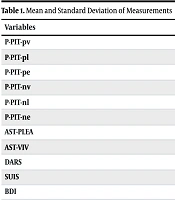
The mean total score on the AST was 83.0 (SD = 36.55), with scores ranging from -44 to 155. There were no significant gender differences in AST scores (t (214) = -0.49, P = 0.62), with men (M = 85.32, SD = 32.94) and women (M = 82.99, SD = 37.56) scoring similarly. A small but significant positive correlation was found between age and AST scores (r = 0.18, P < 0.001), suggesting that older participants tended to have slightly more positive interpretive biases (Table 3). The internal consistency of the AST was excellent, with a Cronbach’s alpha of 0.90 for the total scale. Additionally, McDonald’s omega (ω) was calculated to provide a more robust estimate of internal consistency, yielding a value of ω = 0.91 for the total scale. The subscales also demonstrated acceptable to good internal consistency, as shown in Table 1.
Table 3.
Exploratory Factor Analysis Results for the Ambiguous Scenarios Test
| Factor | Eigenvalue | % of Variance | Cumulative % of Variance | Factor Loadings (Range) |
|---|---|---|---|---|
| 1 | 8.30 | 27.68 | 27.68 | 0.72 - 0.51 |
| 2 | 2.05 | 6.83 | 34.51 | 0.67 - 0.54 |
| 3 | 1.68 | 5.60 | 40.11 | 0.81 - 0.45 |
| 4 | 1.34 | 4.45 | 44.56 | 0.66 - 0.49 |
| 5 | 1.25 | 4.17 | 48.73 | 0.57 - 0.44 |
| 6 | 1.15 | 3.83 | 52.56 | 0.70 - 0.58 |
| 7 | 1.06 | 3.53 | 56.09 | 0.66 - 0.33 |
The EFA was conducted to examine the underlying factor structure of the Persian version of the AST. The Kaiser-Meyer-Olkin (KMO) measure of sampling adequacy was 0.91, indicating that the data were suitable for factor analysis. Bartlett’s test of sphericity was significant (χ2 = 3489.552, P < 0.001), confirming the presence of meaningful correlations among the items (Table 4). EFA using principal axis factoring with Varimax rotation revealed a seven-factor solution that accounted for 56.09% of the total variance. The omega and Cronbach's alpha coefficients of the subscales should be reported to confirm the internal consistency and reliability of each factor. The seven-factor solution demonstrated good interpretability and aligned with the theoretical framework of interpretive bias in depression. All items had factor loadings above 0.40, indicating strong associations with their respective factors.
Table 4.
Factor Loadings of the Items on the Ambiguous Scenarios Test
| Items | 1 | 2 | 3 | 4 | 5 | 6 | 7 |
|---|---|---|---|---|---|---|---|
| 1 | 0.72 | - | - | - | - | - | - |
| 2 | 0.71 | - | - | - | - | - | - |
| 3 | 0.70 | - | - | - | - | - | - |
| 4 | 0.62 | - | - | - | - | - | - |
| 5 | 0.59 | - | - | - | - | - | - |
| 6 | 0.54 | - | - | - | - | - | - |
| 7 | - | 0.67 | - | - | - | - | - |
| 8 | - | 0.60 | - | - | - | - | - |
| 9 | - | 0.56 | - | - | - | - | - |
| 10 | - | 0.54 | - | - | - | - | - |
| 11 | - | - | 0.81 | - | - | - | - |
| 12 | - | - | 0.79 | - | - | - | - |
| 13 | - | - | 0.73 | - | - | - | - |
| 14 | - | - | 0.45 | - | - | - | - |
| 15 | - | - | - | 0.66 | - | - | - |
| 16 | - | - | - | 0.63 | - | - | - |
| 17 | - | - | - | 0.59 | - | - | - |
| 18 | - | - | - | 0.49 | - | - | - |
| 19 | - | - | - | - | 0.57 | - | - |
| 20 | - | - | - | - | 0.56 | - | - |
| 21 | - | - | - | - | 0.50 | - | - |
| 22 | - | - | - | - | 0.48 | - | - |
| 23 | - | - | - | - | - | 0.70 | - |
| 24 | - | - | - | - | - | 0.58 | - |
| 25 | - | - | - | - | - | - | 0.66 |
| 26 | - | - | - | - | - | - | 0.57 |
| 27 | - | - | - | - | - | - | 0.44 |
| 28 | - | - | - | - | - | - | 0.33 |
5. Discussion
The present study aimed to evaluate the psychometric properties of the Persian version of the AST in an Iranian population. The results demonstrated that the AST has strong psychometric properties, including high internal consistency (Cronbach’s α = 0.90; McDonald’s ω = 0.91), good test-retest reliability (r = 0.79), and a robust seven-factor structure that aligns with Beck’s cognitive model of depression. These findings support the utility of the AST as a reliable and valid tool for assessing interpretive bias in the Iranian population.
The EFA revealed a seven-factor structure for the Persian version of the AST, which differs from the three-factor structure reported in the original validation of the AST by Berna et al. and the Iranian adaptation by Nashtdoost (9, 10). The identification of these factors highlights the complexity of interpretive bias and its role in the maintenance of depressive symptoms. The psychometric properties of the Persian version of the AST are consistent with those reported in other cultural contexts. In Western cultures, such as the United Kingdom and Germany, the AST has demonstrated high internal consistency (Cronbach’s α = 0.87 - 0.90) and good discriminant validity in distinguishing between individuals with and without depressive symptoms (7, 11, 12). Similarly, in Iran, the AST has shown good reliability and validity, although cultural differences in the interpretation of ambiguous scenarios have been observed (10).
In the current study, Iranian participants also exhibited a tendency toward negative interpretations of ambiguous scenarios, particularly in the domains of pessimistic prediction and mind reading. These findings suggest that cultural factors may play a significant role in shaping interpretive biases and highlight the importance of culturally adapted versions of the AST. The concurrent validity of the AST was supported by its significant correlations with other measures of depressive symptoms (BDI-II), anhedonia (DARS), and mental imagery (SUIS, PIT). These findings are consistent with previous research, which has shown that interpretive bias is closely related to depressive symptoms, anhedonia, and the use of mental imagery (17). For example, individuals with higher levels of depressive symptoms tend to interpret ambiguous scenarios more negatively, while those who use mental imagery more frequently tend to have more positive interpretive biases (2, 3). These results underscore the utility of the AST as a tool for assessing interpretive bias in both clinical and research settings.
The Persian version of the AST has several potential applications in clinical practice. First, it can be used as a screening tool to identify individuals at risk for depression based on their interpretive biases. Second, it can be used to monitor changes in interpretive bias during cognitive-behavioral therapy (CBT) or other interventions aimed at modifying cognitive biases. Finally, the AST can be used in research to investigate the role of interpretive bias in the etiology and maintenance of depression, as well as the effectiveness of interventions designed to modify these biases.
Despite its strengths, this study has several limitations. First, the sample consisted primarily of university students, which may limit the generalizability of the findings to other populations, such as clinical samples or older adults. Future studies should include more diverse samples to confirm the psychometric properties of the AST in different populations. Second, the study relied on self-report measures, which may be subject to response biases. Future studies could incorporate behavioral or physiological measures of interpretive bias to complement self-report data. Finally, the cross-sectional design of the study limits our ability to draw causal inferences about the relationship between interpretive bias and depressive symptoms. Longitudinal studies are needed to examine the temporal relationship between these variables and to determine whether changes in interpretive bias predict changes in depressive symptoms over time.
5.1. Conclusions
In conclusion, the Persian version of the AST demonstrates strong psychometric properties and is a reliable and valid tool for assessing interpretive bias in the Iranian population. The seven-factor structure identified in this study provides a more nuanced understanding of interpretive bias in the context of depression and underscores the importance of cultural factors in shaping cognitive biases. The AST holds significant potential for use in both clinical and research settings, particularly in the assessment and treatment of depression. Future studies should explore the utility of the AST in diverse populations and investigate its sensitivity to change in response to cognitive bias modification interventions.