
1. Background
Happiness refers to individualism and the focus on pleasure and other positive emotions (1). This feeling comprises three components, namely high-level positive emotion and low-level negative emotion as the emotional aspects of happiness, and satisfaction with life, which involves the cognitive component (2-4). Research suggests that feeling of happiness helps to pursue important goals, extends the scope of attention, and improves the well-being and psychological health of individuals (5). Positive emotions allow people to focus on new stimuli by providing attention flexibility (4). Research reveals that elevated emotions are associated with improved physical health, which in turn improves psychological health (6-9).
Although positive emotions are considered a good phenomenon, experiencing these emotions may cause anxiety (10). Although the concept of happiness has been well addressed in literature, few studies have answered the question of "When a feeling of happiness experiences heavily, does it can be leads to negative consequences?” (5). Gilbert et al. found significantly positive correlations between fear of happiness and depression (11). Joshanloo studied 220 students, and observed significantly negative relationships between fear of happiness and satisfaction with life (10). Although the emphasis placed on controlling feelings of happiness and on the efforts to live happily appears to be global, it is mostly observed in western individualistic cultures (1), and evidence suggests that happiness is of a lower value in eastern cultures (12-15); for instance, Lindberg showed that East Asian people report a limited capacity for gaining and enhancing pleasure in positive experiences; in fact, these people were more willing to modify or shorten their enjoyable periods compared to Americans (16). A study on the perception of Taiwanese and American students of happiness found that, unlike the Taiwanese participants, the Americans described happiness as their ultimate and most precious goal in life (17, 18). “Fear of happiness” does not appear an alienate concept in the Iranian culture; for instance, according to the prevalent “Evil-Eye” belief in Iranian tribes, people who refuse to hide their feelings of happiness and success will soon face failure and inconvenient events (19). Moreover, culture affects human’s attitudes towards positive experiences, especially happiness. Evidence also suggests that being reluctant to show happiness and even being afraid of happiness are more prevalent in Asian cultures than that in other regions of the world (20). Examining the cultural validation of the fear of happiness scales is therefore essential.
Some questionnaires have designed to measure fear of happiness. For example, fear of happiness scale includes five items designed by Joshanloo, whose internal consistency was reported to be 88% (10). The intercultural validity of this scale was confirmed in 14 countries, including Brazil, India and Russia and etc. The single factor construct of this scale was approved and a Cronbach’s alpha of 0.70 - 0.87 was calculated in 13 countries (20). To assess the formal validity of this scale, the valuers’ group was validated and the Cronbach’s alpha for its internal consistency of 0.90 was reported (11). This scale was designed to complete the Joshanloo’s scale, and less has examined in comparison to Joshanloo’s scale. To the best of the authors’ knowledge, this scale has never been examined in the Iranian culture. Demonstrating the cross-cultural validity of the scale developed by Gilbert et al. was therefore essential.
2. Objectives
The present study was conducted to investigate fear of happiness in Iran and examine the psychometric properties of the Persian version of the fear of happiness scale in a student sample.
3. Methods
The present descriptive study was conducted in 2017 - 2018 on a statistical population comprising all the students of Kermanshah University of Medical Sciences, Kermanshah, Iran. Psychometric studies offer different sample size determination guidelines, suggesting 2 - 20 subjects per item (21). The present study selected 20 subjects for each item, and a total of 210 participants were ultimately selected using multistage cluster sampling, including 117 women and 83 men, so as to account for the possibility of failing to complete the questionnaires. The inclusion criteria comprised willingness to participate in the study, submitting informed consent forms and having enough time to complete the questionnaire. The exclusion criteria included unwillingness to respond to the remaining items of the questionnaire. To observe ethical issues, the participants selected were briefed on the study objectives and ensured of the confidentiality of their information, and then asked to complete the questionnaires. After collecting information 10 questionnaires due to incomplete fulfillment or missing data excluded, and the data obtained from the remaining 200 questionnaires were ultimately analyzed. This study was approved by the Ethics Committee of Kermanshah University of Medical Sciences (Ir.kums.rec.1397664). The data associated with demographic details were analyzed using frequency, mean and standard deviation, and those associated with psychometric properties were analyzed using the Pearson correlation coefficient, Cronbach’s alpha and confirmatory and exploratory factor analyses.
3.1. Fear of Happiness Scale (FHS)
The number of items of this newly developed 10-item scale by Gilbert et al. was later reduced to 9. This scale explores people’s perceptions and anxieties about feeling happy and positive feelings in general. The items are rated on a five-point Likert scale ranging from 0: “Never applies to me” to 4: “Definitely applies to me”. The items were obtained from the statements made during the therapy sessions, e.g. ‘I worry that if I feel good something bad could happen’ and were examined in terms of face validity by the research team. This scale yielded an acceptable Cronbach’s alpha of 0.90 (11). A PhD student in clinical psychology translated the present study scale from English to Persian. The translated version was then revised by three faculty members of the department of clinical psychology. The Persian version was retranslated into English by a faculty member of the English language department, and its weaknesses were resolved by comparing it with the original scale. The scale was ultimately translated into Persian by a PhD student in clinical psychology, and was experimentally distributed among 25 students, and its apparent errors were obliterated.
3.2. Fear of Negative Emotions Scale (FNES)
This newly developed 6-item scale by Gilbert et al., examines people’s fear and avoidance of three negative emotions, namely anger, anxiety and sadness. Every emotion is rated using two items. The first item evaluates how frightened the person is of feelings of an emotion. The second question asks “How much they go out of their way to avoid the feelings of that same emotion?” (e.g. for anxiety the two questions are “I’m frightened of my feelings of anxiety” and “I go out of my way to avoid feeling anxious”). The respondents are asked to rate how much of each statement shows their characteristics on a five-point Likert scale ranging from 0: “Never applies to me” to 4: “Definietly applies to me” (22). The present study found the internal consistency of the whole scale to be 0.73, that of the fear of emotions subscale to be 0.70 and that of the avoidance of emotions subscale to be 0.77.
3.3. Positive and Negative Affect Schedule (PANAS)
This 20-item self-report instrument was designed by Watson et al. to measure the two dimensions, namely negative emotions and positive emotions (23). Each subscale has 10 items, which are rated on a five-point Likert scale of 0 - 4. The internal consistency of the positive affect subscale was reported to be 0.88 and that of the negative affect subscale to be 87% (23). The internal consistency was calculated as 0.87 for both the subscales in Iran (24).
3.4. Mindful Attention Awareness Scale (MAAS)
This 15-item single-dimension measure of the trait of mindfulness was designed by Brown and Ryan. The MAAS measures the frequency of open and receptive attention to ongoing events and experiences and awareness of them. Response options ranged from 1:“Almost never” to 6:“Almost always”. The score obtained from this scale is 15 - 90. The developers of the mindfulness validity scale have extracted the single-factor construct in the MAAS structure and reported an MAAS reliability coefficient of 0.82 in a university student sample (25).
4. Results
According to Table 1, the male and female participants are not significantly different in terms of age and gender (P > 0.05). The participants were 18 - 37 years old, and had a mean age of 23.1 ± 2.12 years. Table 2 presents the mean and standard deviation of the items of the fear of happiness scale and the Cronbach’s alpha of the whole scale. To confirm the factors extracted from the fear of happiness scale, the model of confirmatory factor analysis was run in Laser Level. The goodness of the fit indices of the model was insignificant. Exploratory factor analysis was therefore used to identify the factor structure of the scale. The KMO value for sample size (26) was 0.829, suggesting the adequacy of the sample size determined to conduct confirmatory factor analysis. Moreover, Bartlett’s test of sphericity showed that the data were appropriate for factor analysis ( χ2 = 425.87, P = 0.001). Totally two factors were extracted, which explained 52.41% of the variance of the items. The first factor was 40.03 and the second was 12.38. Table 2 reports the factor load of the items on the factors obtained after three rotations using direct oblimin.
Table 1.
Demographic Details of the Participants
| Variables | Statistic | P Value |
|---|---|---|
| Age, y | 0.12 | |
| Female | 22.12 + 2.12 | |
| Male | 24.48 + 3.02 | |
| Gender, No. (%) | 0.07 | |
| Female | 117 (58.5) | |
| Male | 83 (41.5) |
Table 2.
Mean and Standard Deviation (SD) of the Items, the Items Load Factor on the Extracted Factors and the Internal Consistency of the Whole Scale
| Item | Mean ± SD | Cronbach’s Alpha in Case of Eliminating the Items | First Factor | Second Factor |
|---|---|---|---|---|
| 1 | 1.27 ± 1.20 | 0.78 | 0.738 | 0.377 |
| 2 | 0.46 ± 0.90 | 0.79 | 0.216 | 0.559 |
| 3 | 1.04 ± 1.17 | 0.78 | 0.288 | 0.539 |
| 4 | 1.54 ± 1.27 | 0.78 | 0.778 | 0.304 |
| 5 | 1.63 ± 1.27 | 0.79 | 0.789 | - 0.131 |
| 6 | 0.86 ± 1.07 | 0.78 | 0.068 | 0.698 |
| 7 | 1.34 ± 1.03 | 0.80 | - 0.269 | 0.843 |
| 8 | 0.50 ± 0.99 | 0.79 | 0.327 | 0.407 |
| 9 | 0.86 ± 1.12 | 0.77 | 0.539 | 0.332 |
| Total | 9.62 ± 6.30 | 0.81 | 0.703 | 0.246 |
The internal consistency of the whole scale was 0.82, and eliminating an item did not increase the internal consistency coefficient. Furthermore, the internal consistency was 0.73 for the first factor and 0.70 for the second factor. It seems the items that have a higher load factor on the first factor in the questionnaire, somehow they assess fear of the consequences of positive emotions and fear of unpleasant events occurring and the items that are more factor on the second factor of the questionnaire assess the fear of experiencing positive emotions and avoiding them. The first subscale, i.e. the fear of happiness consequences and the second subscale, i.e. the fear of experiencing happiness, were therefore called.
Table 3 reports the correlation coefficient of the scale items with one another as 0.154 - 0.557, and with the total score as 0.476 - 0.774. The correlation coefficient of the total score with the fear of consequences of happiness subscale was 88.2, and with the fear of experiencing happiness subscale was 87.8 (P < 0.01), while the correlation of the two factors was 54.8 (P < 0.01).
Table 3.
The Correlation Coefficient of the Scale Items with One Another and with the Total Score
| 1 | 2 | 3 | 4 | 5 | 6 | 7 | 8 | 9 | Total scorea | |
|---|---|---|---|---|---|---|---|---|---|---|
| 1 | 1 | 0.361a | 0.371a | 0.452a | 0.363a | 0.301a | 0.116 | 0.275a | 0.433a | 0.667 |
| 2 | 1 | 0.343a | 0.317a | 0.165b | 0.446a | 0.224a | 0.268a | 0.424a | 0.599 | |
| 3 | 1 | 0.392a | 0.292a | 0.420a | 0.354a | 0.297a | 0.396a | 0.682 | ||
| 4 | 1 | 0.557a | 0.274a | 0.114 | 0.275a | 0.374a | 0.675 | |||
| 5 | 1 | 0.236a | 0.146b | 0.240a | 0.350a | 0.605 | ||||
| 6 | 1 | 0.302a | 0.342a | 0.254a | 0.620 | |||||
| 7 | 1 | 0.282a | 0.281a | 0.476 | ||||||
| 8 | 1 | 0.496a | 0.589 | |||||||
| 9 | 1 | 0.704 |
a Significant at a significance level of 0.01 (two-tails).
b Significant at a significance level of 0.05 (two-tails).
In the next step, confirmatory factor analysis was performed with two components extracted from exploratory factor analysis. Figure 1 shows the relationship between the fear of happiness and two factors, including fear of experiencing happiness and fear of consequences of happiness.
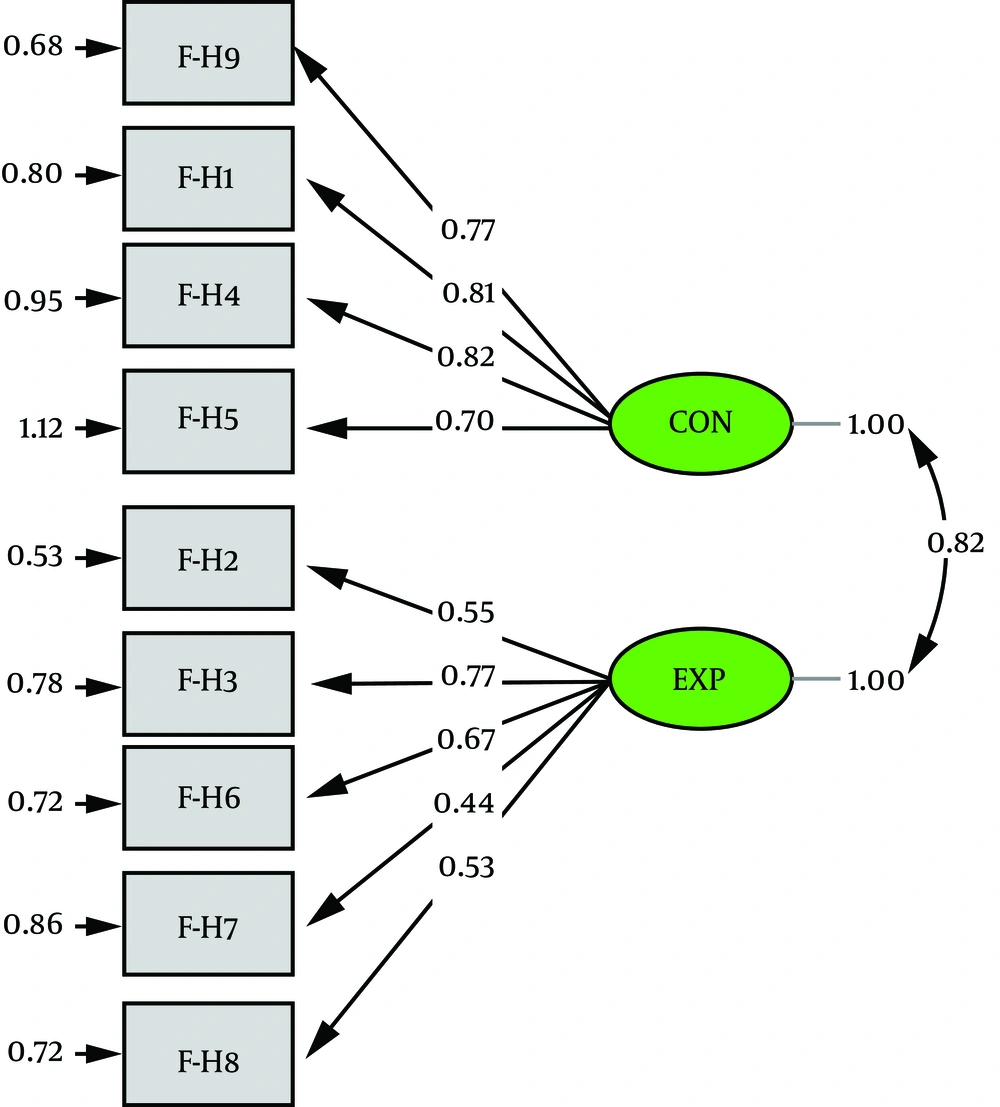
Figure 1.
Confirmatory factor analysis; factor 1: Fear of experiencing happiness and factor 2: Fear of consequences of happiness
The scree plot in Figure 2 shows two distinct components. According to Keiser’s criterion, two factors with a higher-than-one value are considered the main components of the questionnaire. Moreover, the confirmatory factor analysis model had a good fit with the two-factor model.
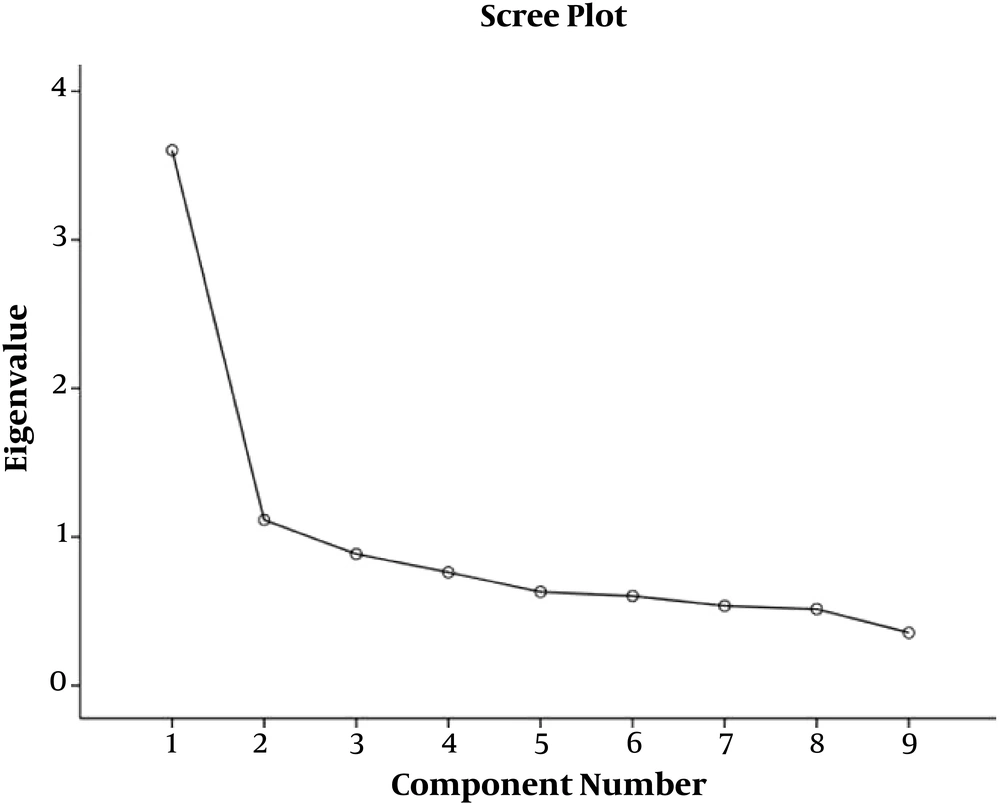
Figure 2.
The scree plot for determining the number of components of the fear of happiness scale
Table 4 presents the results of the fitting indicators. The most important fitting statistic is the chi-square (χ2) statistic, showing the difference between the observed matrix and the estimated matrix. This sensitive-to-sample size statistic is divided into degrees of freedom in high volume sample sizes, and it is considered appropriate if it is below 3, which is the case as observed in table 4. The other indicators are all above 0.90 confirming the appropriateness of the model.
Table 4.
The Goodness of the Fit Indices of the Two-Factor Fear of Happiness Model
| Variables | Values |
|---|---|
| CFI | 0.95 |
| NNFI | 0.93 |
| NFI | 0.95 |
| GFI | 0.94 |
| IFI | 0.95 |
| RMSEA | 0.076 |
| χ2/df | 2.15 |
| Df | 26 |
| χ2 | 59.05 |
The Pearson correlation coefficients of the scale with the mindfulness scale and the positive emotion scale were calculated to examine the divergent validity of the fear of happiness scale and its subscales. The results suggested a negative and moderate correlation between this scale and the positive emotion scale (rho = 0.441, P = 0.01), and a negative correlation with the mindfulness scale (rho = - 0.267). The convergent validity of the scale was also evaluated by calculating its correlation coefficient with the negative emotion scale, the fear of negative emotions scale and its two subscales. The results suggested that the correlation of fear of happiness with negative emotions is positive and moderate (rho = 0.425, P = 0.01) and with the fear of emotional experience subscale is significant (rho = 0.258, P = 0.01), whereas the relationship of fear of happiness with the total score of fear of negative emotions and with the subscale of avoidance of exciting experiences was insignificant. Similar correlations were obtained for the dual subscales of fear of happiness (Table 5).
Table 5.
The Correlation of Fear of Happiness with Positive and Negative Affect, Mindfulness, Fear of Negative Emotions and its Subscales
| Mindfulness | Positive Affect | Negative Affect | Fear of Negative Emotion | Fear of Experiencing Negative Emotion | Avoidance of Experiencing Negative Emotion | |
|---|---|---|---|---|---|---|
| Total Score | - 0.267a | - 0.441a | 0.425a | 0.113 | 0.275a | - 0.096 |
| Fear of Consequences of Happiness | - 0.284a | - 0.391a | 0.453a | 0.147b | 0.296a | - 0.026 |
| Fear of Experiencing Happiness | - 0.185a | - 0.384a | 0.294a | 0.051 | 0.186a | - 0.107 |
aSignificant at a significance level of 0.01 (two tailed).
bSignificant at a significance level of 0.05 (two tailed).
5. Discussion
The present study was conducted to investigate the concept of fear of happiness in the Iranian culture and to examine the psychometric properties of the fear of happiness scale in an Iranian sample. The factor analysis did not confirm the single-factor structure of the questionnaire, and further analyses revealed two factors. The first factor basically showed the fear of consequences of happiness and fear of unpleasant events, while the second showed the fear and avoidance of experiencing happiness. The first factor explained 40.03% of the variance of the items and the second 12.38%. Iran has suffered damage over the past decades, especially by eight years of the Iran-Iraq War as a major disaster of the twentieth century (19). According to Gilbert et al., people who grow in post-traumatic environments do not develop their relaxation system. The experience of positive emotions and warm feelings activate their unfulfilled needs and leads to the experience of negative emotions in these individuals. These individuals are therefore reluctant to experience positive emotions (27, 28). It can be concluded that the significant factor of fear of experiencing positive emotions and avoiding them can be expected in the Iranian culture.
The original version of this scale comprised two factors; nevertheless, given that the load factor of most of the items was on one factor, Gilbert et al. reduced it to one factor, which explained 57.2% of the total variance of all the items (11). This value approximately equals the total load factor of the two components identified in the present study, which explains 52.41% of the total variance. The by Yildirim and Aziz on the psychometric properties of the Joshanloo’s fear of happiness scale showed that the greatest load factor was only on one factor (29). The present study, however, found the two main factors to be “fear of experience of happiness” and “fear of the consequences of happiness” with the maximum loading factor, which contradicts previous studies. Moreover, research suggest that happiness is less favorable in many social situations in the cultural context of Asian countries compared to in Western countries (17, 18, 30), which can be linked to the “fear of experience of happiness” component. Given Iran as an Asian country, more loading factors can be explained in this factor. As previously explained certain cultural beliefs such as “eye wounds” in some Iranian tribes highlight the component of “fear of the consequences of happiness”. Based on this cultural belief, when people talk about positive and happy events, they may be anxious or even try to reduce the tension experienced by special ritual words such as “May the devil’s ear be deaf” (31). In fact, cultural beliefs about the attitude of individuals towards positive experiences determine whether they should be reduced or avoided (16).
In contrast, standardization of the original version, which authors were used only confirmatory factor analysis for identifying factor structures, in the present research both exploratory factor analysis and confirmatory factor analysis were used. Furthermore, the calculated Cronbach's alpha of 0.82 was acceptable comparable with the results obtained for the original version (0.9) (26). A convergent and divergent validity study showed that this scale has negative correlations with the positive affect scale and the mindfulness scale, which is consistent with Gilbert et al.'s results suggesting the same results (22), and with the study by Yildirim and Aziz’s showing a negative correlation between the fear of happiness scale and the positive emotion scale (29). In fact, people who are afraid of happiness do not allow themselves to experience positive emotions, while in mindfulness, individuals have a non-judgmental attitude towards their emotions and accept both positive and negative emotions (32). The results obtained from the present research also suggest that people who believe that happiness is associated with unpleasant consequences suppress their sense of happiness (1, 11, 33).
5.1. Conclusions
The results of the present study generally confirmed the validity and reliability of the fear of happiness scale, which makes it an appropriate self-report instrument, especially for research purposes associated with the “fear of happiness” mechanism. Using the fear of happiness scale, many researchers found less emphasis to be placed on happiness and more stress to be placed on suppressing this feeling in Eastern countries. Translating this questionnaire into Persian and studying its psychometric properties in Iran can therefore lay the foundations for further research on this construct.
5.2. Study Limitations and Recommendations
The present study was conducted in a student sample. Future studies are recommended to focus on the effects of fear of happiness on different disorders, especially depression. Other instruments are also recommended to be used to assess the convergent and divergent validity, including the fear of compassion scale, which is similar to the scale used in the present study. Brown and Ryan's mindfulness questionnaire was used in this study to investigate divergent validity. Moreover, five dimensions of the mindfulness questionnaires are recommended to be used to evaluate all the main components of the mindfulness scale, and to investigate divergent validity (34).