


1. Background
In recent years, the use of social network sites (SNS) has significantly increased and become an inseparable part of people's lives (1). In addition to facilitating communication, SNS have evolved to include features such as information sharing, marketing and branding, entertainment, networking, community building, education and learning, support and advocacy, and event promotion (2). Social network sites are particularly appealing to adolescents as they provide a platform for staying updated with trends, interacting with peers, and engaging in group discussions, gaming, and other activities that align with educational and social interests (3). The various attractions of SNS have led to excessive use among adolescents, resulting in addiction to these platforms (4). Consequently, health systems are continuously seeking to reduce adolescents' dependence on SNS, as there is growing evidence linking addiction to these platforms with various academic problems (5). Furthermore, studies indicate that SNS addiction is associated with increased loneliness, isolation, and a decrease in constructive social relationships (6). It has also been confirmed that SNS addiction leads to increased anxiety, depression, and body image concerns (7, 8).
In Iran, the internet penetration rate has grown from 3.8% in 2000 to over 69.1% in 2018 (9), correlating with a rise in SNS use. An epidemiological study from 2020 found that 44% of Iranian adolescents and young adults were estimated to be addicted to SNS (10), highlighting the urgency of addressing this issue. These findings indicate that Iranian adolescents are at risk of the negative consequences associated with excessive SNS use. Given these negative consequences, interventions to manage SNS usage have gained attention. A review of the research literature indicates that the development of preventive educational programs to reduce SNS addiction has been neglected not only in Iran but also in other countries (11, 12). Previous studies reveal a scarcity of comprehensive and specialized educational programs addressing SNS addiction. In some studies, such as those by Hou et al. (12) and Du et al. (11), cognitive-behavioral techniques (CBT) have been used in a limited way to manage SNS use. A meta-analysis also showed that psychological interventions are effective in reducing the severity of internet/smartphone addiction among adolescents (13).
Given the negative consequences associated with SNS addiction and the lack of comprehensive programs aimed at preventing and managing their use, conducting a study to develop an intervention package for SNS would be highly beneficial. This study features an intervention specifically developed to target the distinctive behavioral patterns and reinforcement mechanisms characteristic of SNS addiction. Whereas conventional CBT adaptations primarily emphasize treatment, the newly developed SNS management package incorporates both early identification of at-risk behaviors and proactive skill-building components tailored to these digital platforms. Furthermore, the package integrates contemporary evidence on impulse control mechanisms that extend beyond standard CBT protocols for SNS addiction. This research is not only necessary due to the increasing prevalence of SNS addiction among adolescents, but it also holds significant importance in addressing a gap in current interventions. The innovative aspect of this study lies in its focus on developing a tailored management approach that incorporates psychological principles and evidence-based strategies, which have yet to be implemented in existing frameworks. By prioritizing prevention, this research could pave the way for effective solutions that promote healthier SNS habits among users.
2. Objectives
This study aimed to develop, validate, and assess the preliminary effectiveness of a package for managing SNS use on daily SNS use, SNS addiction, attitude toward SNS, and media literacy in adolescents.
3. Methods
3.1. Study Design and Participants
This study was conducted using a quasi-experimental method with a pre-test and post-test design involving a control group. The target population included all male and female middle school students in Tehran in 2024. This age group was chosen based on evidence showing that the first peak of SNS usage occurs during this period (14). A purposive sampling method was used, and the sampling process is illustrated in Figure 1. To obtain a qualified sample, 232 male and female students were initially screened. Based on the cutoff score of the Bergen Social Media Addiction Scale (15), 123 students with SNS addiction were identified. After eligibility screening, 73 participants were excluded due to unmet inclusion criteria or refusal to consent, and 50 participants were enrolled in the study (25 in the intervention group and 25 in the control group).
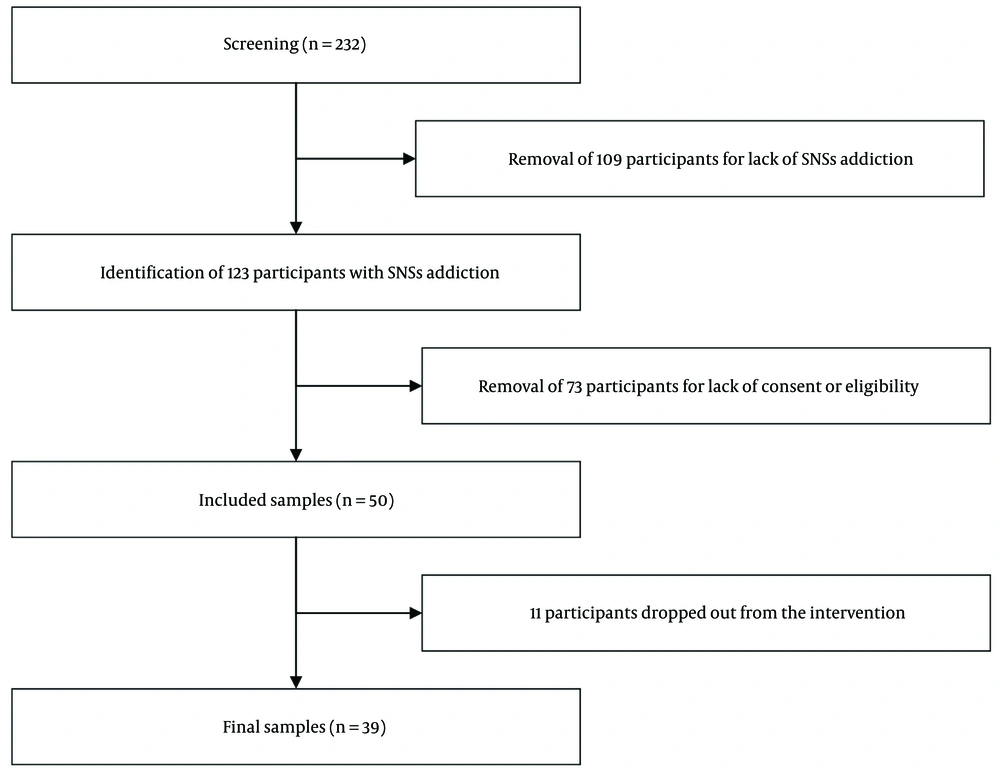
Figure 1.
The sampling process to evaluate the effectiveness of the training package
The inclusion criteria were as follows: (1) A score higher than 19 on the Bergen Social Media Addiction Scale (15); (2) non-academic and non-professional use of SNS during the past week (e.g., recreational use only); and (3) an age range of 13 to 16 years. The exclusion criteria included: (1) Engagement in professional activities on SNS; (2) self-reported diagnosis of any psychiatric disorder; (3) participation in psychotherapy sessions outside the study; and (4) two consecutive absences from training sessions.
While the study utilized a modest sample size (N = 50 at baseline, N = 39 post-attrition), this approach was appropriate for an initial evaluation of the intervention’s feasibility and preliminary effectiveness. The sample size aligns with recommendations for pilot and early-stage behavioral studies (16, 17), where the primary focus is on detecting signals of efficacy, refining protocols, and estimating effect sizes for future larger-scale trials. The use of a homogeneous student population, though limiting generalizability, enhanced internal validity by controlling for confounding variables (e.g., age, gender, education level) that could obscure intervention effects.
3.2. Intervention
The study began with a systematic review of 187 studies to identify factors contributing to SNS addiction (18), aiming to develop an adolescent management training package. Researchers and experts selected session topics and content based on these factors, considering their frequency in the literature and feasibility for group teaching. Following this selection, the training package was developed according to established protocols, with input from three specialists in psychiatry and psychology. The final package consisted of eight 90-minute sessions, detailed in Table 1. After its development, experts evaluated the content validity of the package using two methods: Qualitative (face validity) and quantitative [Content Validity Index, CVI].
Table 1.The Sessions of the Training Package for Managing the Social Network Sites Use
| Sessions | Content |
|---|---|
| First | The introduction of participants in the training sessions, the history of the formation and expansion of virtual social networks, the opportunities and threats posed by these networks, and an emphasis on the consequences of excessive use of virtual social networks based on scientific evidence; Assignments: Identifying potential academic, occupational, and familial consequences of excessive virtual social network use |
| Second | The importance and necessity of media literacy, identifying the various components of messages in virtual social networks, the characteristics of active and creative audiences in these networks, persuasion and techniques for persuading social media influencers, how to select appropriate content in virtual social networks, and making smart use of virtual social networks; Assignments: Detection of content, textual elements, sub-textual messages, and contextual frameworks in potentially harmful or non-productive social network content |
| Third | Training on self-worth, understanding the harmful critic and its consequences, the role of social networks in self-worth, teaching cognitive distortion techniques and thought reframing to manage the harmful critic, discussing the authenticity and credibility of content in virtual social networks, and consciously and actively selecting content; Assignments: Detection of beneficial and harmful content in social media platforms through deliberate and proactive content selection strategies |
| Fourth | Defining feelings of loneliness and the underlying factors during adolescence, examining the consequences of loneliness based on scientific evidence, the role of excessive use of virtual social networks in the development or increase of loneliness, and coping skills for dealing with loneliness; Assignments: Implementation of three recommended strategies for coping with loneliness, along with self-documentation of experiences regarding their strengths and limitations. |
| Fifth | The role of time management in regulating the use of social networks, the three key principles of goal setting, prioritization, and adherence to priorities for effective time management, and managing leisure time with an emphasis on virtual social networks; Assignments: Identifying the detrimental factors affecting time management and strategies for addressing them based on the proposed techniques |
| Sixth | The role of impulses in behavior management, defining impulses and triggers and their role in the use of virtual social networks, teaching strategies for improving self-control and developing good habits, and educating on strategies for learning personal discipline; Assignments: Recording the expected and actual duration of time spent on virtual social networks and prioritizing activities with the aim of assessing progress in impulse management |
| Seventh | The role of virtual social networks in the formation of unpleasant emotions, defining unpleasant emotions and the necessity of managing them, ways to cope with unpleasant emotions, cognitive and behavioral coping methods for dealing with unpleasant emotions, and skills for replacing automatic thoughts; Assignments: Utilizing three proposed strategies for coping with unpleasant emotions and documenting experiences regarding the strengths and weaknesses of these strategies |
| Eighth | The impact of virtual social networks on the formation of emotions, fear of missing out and the continued dependence on these networks, identifying the cycle that triggers the fear of missing information, recognizing irrational beliefs that lead to the fear of missing information, and identifying behavioral change strategies to manage the fear of missing information |
To determine the package's validity using the qualitative method (face validity), the package was presented to five experts in behavioral sciences and psychology for their feedback on any necessary revisions. These experts evaluated the content for clarity, relevance, and appropriateness and were invited to suggest revisions based on their expertise in the field. To determine the validity of the package using the quantitative method (CVI), the Kassam-Adams et al. (19) approach was employed, which provides a method for measuring the content validity of health-related interventions. In this method, the program content was provided to eight experts in behavioral and health sciences, and the Item-level Content Validity Index (I-CVI) was calculated following the methodology established by Waltz and Bausell (20). This index was assessed according to the experts' responses to questions about the relevance of the developed package to the intended objectives, the probability of its effectiveness for those objectives, and the appropriateness of the package for the target population.
The I-CVI for each item was calculated by dividing the scores of experts who rated the items as fully compatible (score 4) or compatible (score 3) for each criterion (relevancy, effectiveness, and appropriateness) by the total number of experts. For each criterion, if the I-CVI coefficient exceeded 0.7, it confirmed the content validity. If the calculated index was below the acceptable threshold, feedback would be obtained from the experts to enhance the validity of the package. Consequently, the process of calculating the qualitative and quantitative validation of the package involved active collaboration between researchers and experts. The calculated index for each session is presented in Table 2.
Table 2.Calculation of the Item-Level Content Validity Index
| Sessions and Index | Expert 1 | Expert 2 | Expert 3 | Expert 4 | Expert 5 | Expert 6 | Expert 7 | Expert 8 | I-CVI |
|---|---|---|---|---|---|---|---|---|---|
| Session 1 | |||||||||
| Relevance | 4 | 3 | 4 | 3 | 4 | 4 | 2 | 3 | 0.875 |
| Effectiveness | 4 | 3 | 3 | 2 | 4 | 3 | 2 | 3 | 0.750 |
| Appropriateness | 4 | 3 | 4 | 3 | 4 | 3 | 2 | 3 | 0.875 |
| Session 2 | |||||||||
| Relevance | 4 | 4 | 4 | 4 | 4 | 4 | 3 | 3 | 1.000 |
| Effectiveness | 4 | 4 | 3 | 3 | 4 | 4 | 2 | 2 | 0.750 |
| Appropriateness | 4 | 4 | 3 | 3 | 4 | 3 | 2 | 2 | 0.750 |
| Session 3 | |||||||||
| Relevance | 4 | 4 | 4 | 4 | 4 | 4 | 2 | 3 | 0.875 |
| Effectiveness | 4 | 3 | 4 | 3 | 4 | 4 | 2 | 2 | 0.750 |
| Appropriateness | 4 | 3 | 4 | 3 | 4 | 4 | 2 | 3 | 0.875 |
| Session 4 | |||||||||
| Relevance | 4 | 3 | 3 | 4 | 4 | 3 | 4 | 3 | 1.000 |
| Effectiveness | 4 | 3 | 3 | 3 | 4 | 3 | 3 | 3 | 1.000 |
| Appropriateness | 4 | 3 | 3 | 4 | 4 | 4 | 3 | 3 | 1.000 |
| Session 5 | |||||||||
| Relevance | 4 | 4 | 4 | 4 | 4 | 4 | 3 | 2 | 0.875 |
| Effectiveness | 4 | 4 | 3 | 3 | 4 | 4 | 2 | 2 | 0.750 |
| Appropriateness | 4 | 4 | 4 | 3 | 4 | 3 | 2 | 2 | 0.750 |
| Session 6 | |||||||||
| Relevance | 4 | 4 | 4 | 4 | 4 | 3 | 3 | 3 | 1.000 |
| Effectiveness | 4 | 4 | 3 | 4 | 4 | 3 | 2 | 2 | 0.750 |
| Appropriateness | 4 | 4 | 4 | 4 | 4 | 3 | 3 | 3 | 1.000 |
| Session 7 | |||||||||
| Relevance | 4 | 3 | 3 | 4 | 4 | 4 | 3 | 3 | 1.000 |
| Effectiveness | 4 | 2 | 3 | 4 | 4 | 4 | 3 | 3 | 0.875 |
| Appropriateness | 4 | 3 | 3 | 3 | 4 | 3 | 3 | 3 | 1.000 |
| Session 8 | |||||||||
| Relevance | 4 | 3 | 4 | 4 | 4 | 2 | 3 | 3 | 0.875 |
| Effectiveness | 4 | 3 | 4 | 4 | 4 | 4 | 2 | 3 | 0.875 |
| Appropriateness | 4 | 3 | 4 | 4 | 4 | 3 | 3 | 3 | 1.000 |
The training package was conducted by two psychologists, and to qualify as a study instructor, package-specific training workshops had to be completed. The training sessions were conducted virtually via Skype due to scheduling conflicts with school programs and time constraints. Before each session, the instructors made the necessary arrangements. To ensure participant attendance and effective reception of the online intervention, several proactive measures were implemented. Prior to the intervention, an orientation session was conducted to familiarize participants with the study objectives. Technical support was readily available to address any connectivity issues. During the intervention, attendance was monitored through automated systems, and interactive elements, such as polls and question-and-answer sessions, were integrated to enhance engagement. Additionally, a feedback mechanism was established for participants to share their experiences.
At the end of each session, the instructors assigned tasks to the participants, and during the subsequent session, they reviewed the previous session along with the participants' completion of those assignments. The post-test was conducted seven days after the completion of the training sessions. The study protocol was approved by the research ethics committee of the Tehran University of Medical Sciences (IR.TUMS.TIPS.REC.1402.050). During the inclusion interview, both parents and adolescents provided written informed consent to participate in the study. All participants were informed about the study's purpose, intervention, assessments, and duration. Written informed consent was mandatory before enrollment. They fully understood the nature of the study, their roles and contributions, and were assured of the voluntary nature of their involvement, including their right to withdraw from the study at any time without any consequences.
3.3. Measures
Data collection was performed from February 2024 to March 2024, ensuring a comprehensive understanding of the subjects involved. Outcome measures were assessed through online evaluations conducted at both the pre-test and post-test stages, allowing for a comparison of results before and after the intervention. To gather demographic and basic information, data were collected on various factors, including participants' age, gender, and educational level. Additionally, information was obtained regarding the type of SNS platforms used by participants. The duration of daily SNS use was measured in minutes over the past week, providing insight into the frequency and extent of engagement with these platforms.
Data on SNS addiction were collected using the Bergen Social Media Addiction Scale (15). This scale assesses SNS addiction based on six main symptoms of addiction: Salience, conflict, mood modification, withdrawal, tolerance, and relapse, using six questions. All questions are rated on a five-point Likert scale, ranging from (1) always to (5) very rarely. The total score ranges from 6 to 30, with a score above 19 indicating problematic use of SNS. In the study by Andreassen et al. (15), the reliability of this questionnaire was found to be 0.88 using Cronbach's alpha method. This scale was standardized in Iran by Lin et al. (21), who not only translated but also properly validated it for the Iranian context, reporting a Cronbach's alpha of 0.86.
Attitudes toward SNS were assessed using the 8-item 'Attitudes Toward the Use of Social Networks' Questionnaire developed by Hejazi et al. (22). All questions are rated on a four-point Likert scale, ranging from (1) strongly disagree to (4) strongly agree. Item number 1 is scored in reverse. A high score indicates a risky attitude and a tendency toward excessive use of SNS. Content validity was assessed to evaluate the validity of the SNS usage questionnaire, which was approved by several experts. In the study conducted by Hejazi et al. (22), Cronbach's alpha coefficient for the questionnaire was reported to be 0.80.
The Media Literacy Questionnaire developed by Falsafi (23) was used to assess media literacy. This questionnaire consists of 20 questions, with responses based on a five-point Likert scale ranging from (1) strongly disagree to (5) strongly agree. It includes five components: Content understanding (questions 1 to 4), awareness of hidden objectives (questions 5 to 8), conscious selection (questions 9 to 12), critical attitude (questions 13 to 16), and analysis of messages (questions 17 to 20). A higher score indicates greater media literacy. The reliability of the questionnaire was reported to be 0.85 using Cronbach's alpha.
3.4. Statistical Methods
The variables and baseline demographic information of the participants were described using mean, standard deviation, frequency, and percentage. An independent t-test was used to compare the mean ages of the experimental and control groups. Additionally, a chi-square test was employed to assess the equality of gender distribution between the two groups. To examine the effect of the intervention on the measured variables, a one-way analysis of covariance (ANCOVA) was used, with the pre-test scores considered as covariates. The Shapiro-Wilk test was used to assess the normality of the variable distributions, while Levene's test was employed to evaluate the homogeneity of variances among the groups. Data analysis was conducted using SPSS version 27, with a significance level set at 0.05.
4. Results
In the pre-test assessment, 50 participants were involved, with 25 adolescents in the intervention group (15 boys and 10 girls) and 25 adolescents in the control group (15 boys and 10 girls). In the post-test, 11 adolescents were excluded from the study, resulting in a final analysis of data from 21 adolescents (13 boys and 8 girls) in the intervention group and 18 adolescents (11 boys and 7 girls) in the control group, totaling 39 participants. Of the initial 50 participants, 11 adolescents were excluded from the final analysis. These exclusions were primarily attributable to: (1) Withdrawal of consent during the intervention period (n = 6), (2) incomplete post-test assessment data (n = 4), and (3) failure to meet the minimum attendance requirement (absence from ≥ 2 sessions, n = 1). Attrition analysis revealed no baseline differences between excluded and retained participants (all P > 0.05), supporting the random nature of these exclusions.
The mean age and standard deviation for participants in the intervention and control groups were found to be 13.40 ± 1.22 and 14.08 ± 1.44, respectively. The independent sample t-test results revealed no significant difference in mean age between the two groups (t = 1.798; P = 0.079). The chi-square test results confirmed that the gender distribution was not significantly different between the two groups. The means and standard deviations in the pre-test and post-test are presented in Table 3. The independent sample t-test results revealed no significant differences in the pre-test scores between the intervention and control groups on most variables (P > 0.05), except for the ‘analysis of messages’ component (t = 2.330; P = 0.024).
Table 3.Mean and Standard Deviation of Variables in Two Groups
| Variables and Assessment | Intervention | Control |
|---|---|---|
| Daily SNSs use in the past week | ||
| Pre-test | 328.40 ± 52.176 | 298.40 ± 61.623 |
| Post-test | 288.10 ± 52.690 | 292.78 ± 63.320 |
| Social media addiction | ||
| Pre-test | 21.44 ± 1.33 | 21.52 ± 1.48 |
| Post-test | 20.57 ± 2.04 | 21.00 ± 1.71 |
| Attitude toward SNSs | ||
| Pre-test | 20.60 ± 4.01 | 19.92 ± 3.98 |
| Post-test | 17.19 ± 4.07 | 19.22 ± 3.50 |
| Media literacy | ||
| Pre-test | 62.76 ± 6.55 | 64.68 ± 5.41 |
| Post-test | 79.38 ± 6.22 | 67.28 ± 6.89 |
| Content understanding | ||
| Pre-test | 12.72 ± 2.41 | 12.60 ± 2.33 |
| Post-test | 16.38 ± 1.36 | 13.22 ± 2.49 |
| Awareness of hidden objectives | ||
| Pre-test | 13.76 ± 2.35 | 13.28 ± 2.44 |
| Post-test | 15.76 ± 1.70 | 13.17 ± 2.96 |
| Conscious selection | ||
| Pre-test | 13.20 ± 3.06 | 14.12 ± 2.03 |
| Post-test | 16.33 ± 1.62 | 14.33 ± 1.88 |
| Critical attitude | ||
| Pre-test | 12.44 ± 2.04 | 12.84 ± 1.46 |
| Post-test | 16.05 ± 1.75 | 13.56 ± 1.65 |
| Analysis of the messages | ||
| Pre-test | 10.64 ± 2.10 | 11.84 ± 1.49 |
| Post-test | 14.86 ± 1.68 | 13.00 ± 1.46 |
Abbreviation: SNS, social network sites.
To evaluate the effectiveness of the intervention, pre-test scores were considered as covariates in a one-way ANCOVA, which controlled for any baseline differences between the two groups (Table 4). Since this is a parametric test, the normality of the measured variables' distributions was confirmed before the analysis using the Shapiro-Wilk test. Additionally, Levene's test indicated that the variances of the measured variables were homogeneous across the groups.
Table 4.Effectiveness of Intervention on Measured Variables
| Variables and Source | df | Mean Square | F | P-Value | Effect Size |
|---|---|---|---|---|---|
| Daily SNSs use in the past week | |||||
| Pre-test | 1 | 86307.45 | 83.13 | 0.000 | |
| Group | 1 | 7529.31 | 7.25 | 0.011 | 0.168 |
| Error | 36 | 1038.26 | |||
| Social media addiction | |||||
| Pre-test | 1 | 20.60 | 6.59 | 0.015 | |
| Group | 1 | 1.71 | 0.55 | 0.464 | 0.015 |
| Error | 36 | 3.13 | |||
| Attitude toward SNSs | |||||
| Pre-test | 1 | 289.26 | 41.81 | 0.001 | |
| Group | 1 | 58.65 | 8.48 | 0.006 | 0.191 |
| Error | 36 | 6.92 | |||
| Media literacy | |||||
| Pre-test | 1 | 630.66 | 23.90 | 0.001 | |
| Group | 1 | 1479.93 | 56.09 | 0.001 | 0.609 |
| Error | 36 | 26.39 | |||
| Content understanding | |||||
| Pre-test | 1 | 72.43 | 37.45 | 0.001 | |
| Group | 1 | 88.58 | 45.80 | 0.001 | 0.560 |
| Error | 36 | 1.93 | |||
| Awareness of hidden objectives | |||||
| Pre-test | 1 | 158.03 | 117.83 | 0.001 | |
| Group | 1 | 24.08 | 17.95 | 0.001 | 0.333 |
| Error | 36 | 1.341 | |||
| Conscious selection | |||||
| Pre-test | 1 | 42.56 | 21.85 | 0.001 | |
| Group | 1 | 44.39 | 22.79 | 0.001 | 0.388 |
| Error | 36 | 1.95 | |||
| Critical attitude | |||||
| Pre-test | 1 | 32.59 | 15.68 | 0.001 | |
| Group | 1 | 65.04 | 31.30 | 0.001 | 0.465 |
| Error | 36 | 2.08 | |||
| Analysis of messages | |||||
| Pre-test | 1 | 21.36 | 10.80 | 0.002 | |
| Group | 1 | 47.09 | 23.81 | 0.001 | 0.398 |
| Error | 36 | 1.98 |
Abbreviation: SNS, social network sites.
The results indicate that the training package for managing SNS use effectively impacts daily SNS use in the past week (F = 7.25; P = 0.011), attitudes toward SNS (F = 8.48; P = 0.006), and media literacy (F = 56.09; P = 0.001). The intervention demonstrated a significant effect on the components of content understanding (F = 45.80; P = 0.001), awareness of hidden objectives (F = 17.95; P = 0.001), conscious selection (F = 22.79; P = 0.001), critical attitude (F = 31.30; P = 0.001), and analysis of the messages (F = 23.81; P = 0.001) as well. However, the intervention did not have an impact on SNS addiction (F = 0.55; P = 0.464).
5. Discussion
The present study aimed to develop, validate, and preliminarily evaluate the effectiveness of an intervention package designed to help adolescents manage their SNS use, with a specific focus on use, attitudes, media literacy, and addiction. Experts deemed the validity of the developed package acceptable in terms of relevance, effectiveness, and appropriateness, with scores ranging from 0.750 to 1.000. These findings confirm the validity of the developed package. The results indicate that the training package effectively impacts daily SNS use in the past week, attitudes toward SNS, and media literacy.
In the research literature, Celik (24) conducted a study with Turkish students and demonstrated that developing an educational program on managing internet use leads to increased conscious internet use and a reduction in problematic internet use tendencies. Similarly, Du et al. (11) found that modified cognitive-behavioral therapy for internet addiction can reduce internet usage and improve components of media literacy among students in China.
For the effectiveness of the intervention on daily SNS use, teaching time management skills (session five) helped adolescents identify their priorities and plan their time more effectively. By learning the principles of goal setting, prioritization, and adhering to those priorities, adolescents were able to spend less time on SNS and engage in more constructive activities. Additionally, teaching impulse control skills (session six) enabled adolescents to manage their immediate reactions and make better decisions (25). When adolescents can control their emotions and impulses, they are less likely to use SNS frequently and impulsively.
Regarding the effectiveness of the intervention on attitudes toward SNS, education about the threats and consequences of excessive SNS use (session one) increased adolescents' awareness of the negative effects of these platforms. This awareness helps them become more mindful of their SNS usage, leading to a change in attitude and a reduction in excessive use (26). In session three, teaching self-worth helped adolescents gain a better understanding of themselves and recognize their values and abilities. This self-awareness reduces dependence on external validation, such as likes and comments on SNS, encouraging adolescents to focus on real interactions and meaningful activities (27).
Regarding the effectiveness of the intervention on media literacy, teaching adolescents how to choose content wisely (session two) enabled them to critique and analyze information effectively. By acquiring techniques to identify credible sources and assess content quality, adolescents were better equipped to make informed choices about the content they engage with on SNS. Additionally, teaching participants how to use SNS wisely improved their media literacy by encouraging them to approach online content critically and enhance their engagement with information (28).
These skills not only heightened adolescents' awareness of published content but also empowered them to select useful and credible information as active media users while steering clear of misinformation and misleading material. However, the results of the present study showed that the intervention had no significant impact on the level of SNS addiction. In contrast, Augner et al. (29) conducted a meta-analysis of 10 studies, demonstrating that psychological intervention strategies are effective in reducing problematic Internet use/problematic smartphone use. Similarly, Malinauskas and Malinauskiene (13) conducted another meta-analysis involving six studies and found that psychological interventions can reduce internet/smartphone addiction among adolescents. Chen et al. (30) concluded that developing a one-month group counseling intervention can decrease levels of SNS addiction.
Given that the current intervention was able to reduce daily SNS use, one possible reason for its ineffectiveness in addressing SNS addiction could be the insufficient number of sessions or the short duration of the intervention. Additionally, it seemed that adolescents lacked the motivation to apply the skills they had learned in their daily lives. If alternative and healthier activities are not promoted or available, adolescents may not find other ways to spend their time aside from using SNS. As a result, even with the acquisition of coping strategies, the constant access to SNS and the internet makes it difficult to reduce their use. Furthermore, students may have learned the skills theoretically but struggled to apply them in real-life situations, necessitating supplementary training and follow-up to receive feedback from adolescents. There may also be underlying psychological problems, such as anxiety or depression, contributing to SNS addiction, which the intervention may not have addressed.
5.1. Conclusions
The results of this study showed that although the educational package for managing SNS use did not improve SNS addiction, it did lead to a reduction in daily SNS use, a change in attitudes toward risky attitudes, and a tendency toward excessive use of SNS, and an improvement in media literacy. Given the importance of these constructs in SNS addiction, it seems that this intervention could be effective for primary prevention. Therefore, it is recommended to implement this intervention in schools and extracurricular activities to empower adolescents to use SNS more effectively.
The limitations of this study include the lack of examination of the sustainability of results during the follow-up phase. Additionally, due to coordination and scheduling issues, the sessions were conducted virtually. The small sample size and the short duration of the training were other limitations of this study.


