
1. Background
Illegal use of psychotropic drugs has become a great problem around the world (1). According to the statistics from the united nations office on drugs and crime in 2014, the abuse of amphetamine compounds has been an increasing epidemic. According to this report, the number of amphetamine compound-producer laboratories has increased from 12,567 in 2011 to 14,322 in 2012. This paper reported that 35 million people all over the world use amphetamine compounds regularly. Iran was introduced as a country with an increasing rate of abuse and production of amphetamine compounds (2). Illicit drug use in Iran and associated problems have been present for a long time in the Iranian society (3). Historically, in Iran recreational drug abuse dates back to the 17th century (4). Iran is currently facing a transition from traditional drugs to the industrial production of illicit drugs, including amphetamines. The abuse of these materials in previous decades was negligible, yet is increasing in the recent years (5). According to a recent study using the rapid situation assessment (RSA) of drug abuse in Iran, the frequency of amphetamine use makes up 5.2% of the total drug abuse frequency (6). Other studies have reported that amphetamine use occurs in 18.5% of young adults aged 15 to 25 years, living in Tehran city (7), 4.3% of Birjand and Gilan university students, and 11% of students of Hamedan universities (8-10). Reasons for the abuse of drugs may be the low price of industrial materials, easy access, and the increasing price of traditional opiates (11). Investigations have shown that parallel to the increasing abuse of such drugs, there has been an increase in the demand for treatment (12). A questionnaire with proper validity and reliability is an important part of a good treatment plan. Withdrawal symptoms occur in individuals with an established history of drug use. McGregor et al. indicate that the most important step in the effective treatment of addicts of amphetamine compounds is determining the time-course and severity of withdrawal symptoms making the timely implementation of appropriate interventions easier to target specific symptoms (13).
Observed symptoms of amphetamine withdrawal could include fatigue, drowsiness, depression, aggression, disorder, excitability, pain, lack of enjoyment, and reduction in concentration (14-18). Unfortunately, most studies investigating amphetamine withdrawal processes lack adequate sample size or include participants, who are experiencing simultaneous drug withdrawal interactions potentially creating confounding results. Additionally, most studies lack the use of a validated scale measure to evaluate withdrawal symptoms (15, 19). Several questionnaires are currently available to measure symptoms of amphetamine withdrawal, including the amphetamine withdrawal questionnaire (AWQ) (20), the severity of amphetamine dependence questionnaire (SAMDQ) (21), and the amphetamine cessation symptoms assessment (ACSA) (13). The ACSA was designed by McGregor et al. by combining AWQ and the Cocaine selective severity assessment questionnaire (CSSA) (22). The new measure purports to assess withdrawal symptoms more accurately, and its validity and reliability have been proved in assessment and evaluation of amphetamine abuse withdrawal symptoms (13). The present study was done to determine the reliability and validity of Persian Version of amphetamine cessation symptom assessment (ACSA) questionnaire in patients of residential medical center in Alborz province of Iran.
2. Patients and Methods
A cross sectional study was completed using the ACSA (13). The ACSA evaluates 3 factors over 16 questions, including anxiety and mood (11), fatigue (3), and amphetamine craving (2). The Persian-version of the ACSA questionnaire was translated from English to Persian language and proofed using the backward-forward translation method (23). To explore the face validity of the questionnaire, 10 experts provided direction for the writing, translating, and arrangement of questions. A group discussion was facilitated through individual sessions where amphetamine withdrawal symptoms were discussed and the questionnaire was provided. While the translated ACSA contributed to minor changes in wording, no question was deleted or added. Patients in residential medical center of the Alborz province of Iran, provided treatment for amphetamine withdrawal, were enrolled in this study. All participants in the study were male. The inclusion criteria in this study required participants to be male being at least 15 years old, having been diagnosed with amphetamine dependence as listed in the DSM-IV, and having provided positive urine test for amphetamine compounds. Also, Psychotic patients, patients with acute medical diseases requiring psychotherapy, and patients, who were hospitalized for issues related to opiates use were excluded from this study. A factor analysis was used to assess this study’s validity, allowing use of a sample size between 100 and 200 participants (24).
One-hundred and six individuals that received care at the residential medical center of Alborz province were enrolled in the study through the convenience sampling method. An informed consent form was completed by all participants. Exploratory factor analysis and principal component analysis were used to assess construct validity. Cronbach’s alpha was used to assess the internal reliability of the questionnaire. The questionnaire was given to experts working in the field of amphetamine abuse. Experts graded each question’s relevance to amphetamine withdrawal symptoms by assigning 1 of 3 valuations a) not related, b) a little related, c) greatly related, and d) completely related. A content validity index (CVI) was used to assess the content validity of the questionnaire. In the first method, a CVI index was calculated for the overall questionnaire. The number of questions identified by each expert as completely related or greatly related was divided by all questions and the result was translated to a percentage: the average of all summed expert percentages was then calculated. In the second method, CVI was calculated for each question, where each question was assigned one point by each expert that qualified it as completely related or greatly related to assessing amphetamine withdrawal. The total points for each question were then summed and divided by the total number of scoring experts to generate a percentage (25).
Kaiser-Meyer-Olkin’s sampling adequacy index and Bartlett’s test of sphericity were used to determine which factor analysis method was appropriate for data computation. Analyses were completed using SPSS software version 16.
3. Results
One-hundred and six male patients were enrolled in this study. The average and median age of participants was 31.14 and 30, respectively. Of the total participants, 24.53% were married, 23.59% were divorced, and 51.88% were single. Overall, 1.89% of the participants were illiterate, 15.09% had elementary education, 37.74% had some level of formal schooling, 36.79% had obtained a diploma, and 8.49% had advanced academic education. Demographic features of these people are presented in Table 1.
Table 1.
Studied Population Distribution Based on Demographic Features (N = 106)
| No. (%) | ||
|---|---|---|
| Age | 20 > | 7 (6.6) |
| 20 - 30 | 52 (49.06) | |
| 30 - 40 | 36 (33.96) | |
| 40 - 50 | 9 (8.49) | |
| > 50 | 2 (1.89) | |
| Marital status | Married | 26 (24.53) |
| Divorced | 25 (23.59) | |
| Single | 55 (51.88) | |
| Education level | Illiterate | 2 (1.89) |
| Elementary school | 16 (15.09) | |
| Guidance school | 40 (37.74) | |
| Diploma | 39 (36.79) | |
| Academic education | 9 (8.49) | |
| Ethnics | Turkish | 29 (27.36) |
| Persian | 37 (34.91) | |
| Kord | 21 (19.81) | |
| Lor | 15 (14.15) | |
| Baloch | 1 (0.94) | |
| Turkmen | 3 (2.83) | |
| Employment status | Employed | 65 (61.32) |
| Unemployed | 41 (38.68) |
Participants reported no problems responding to the Persian version of the ASCA, and both patients being treated for amphetamine withdrawal and administrators appeared engaged during the questionnaires administration. Face validity was demonstrated through both patients and administrators reporting that the questionnaire addressed amphetamine withdrawal (26). Content validity index (CVI) for the overall questionnaire was 87.5%, and was 80% or higher for each individual question. Results demonstrated adequate sampling index (Kaiser-Meyer-Olkin) at 0.79 and Bartlett’s test of sphericity was significant (P < 0.001). According to both criteria, it could be concluded that an appropriate factor analysis was applied for this study (24). Specific value index and the variance determination percentage were used to determine that evaluation of amphetamine withdrawal symptoms constituted of several components. All reliability and validity for the Persian version of the ASCA 65.80% was justified by 5.99, 2.27, and 2.26 loading factors, respectively. The justified variance for the first, second, and third factor was 37.44%, 14.22%, and 14.14%, respectively (Table 2).
Table 2.
Determined Variance by Factors Total Squares of Rotated Functional Loads
| Factors | Specific Value | Justified Variance, % | Accumulative Percentage of Justified Variance |
|---|---|---|---|
| First factor | 5.99 | 37/44 | 37/44 |
| Second factor | 2.27 | 14/14 | 51/58 |
| Third factor | 2.26 | 14/22 | 65/80 |
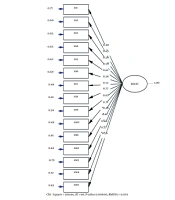
To select questions, functional loads higher than 0.4 were accepted (26). According to the results of the rotated component matrix, 11 questions loaded on the first factor (1, 3, 4, 5, 78, 10, 11, 12, 13, and 14), 3 questions loaded on the second factor (2, 6, 9), and 2 questions (15 and 16) loaded on the third factor. Labeling for the factors was completed based on the original questionnaire. First, second, and third factors were named by anxiety and mood, fatigue, and craving for use of amphetamine, respectively (Table 3).
Table 3.
Rotated Component Matrix for Questions
| Questions | First Factor | Second Factor | Third Factor |
|---|---|---|---|
| 1- Have you had difficulty concentrating? (e.g., on reading, conversation, tasks, or making plans) | 0.71 | 0.12 | 0.10 |
| 2- Have you been sleeping (or wanting to sleep) a lot? | 0.14 | 0.04 | 0.90 |
| 3- Have you been tense? | 0.75 | 0.09 | 0.25 |
| 4- Have you had vivid, unpleasant dreams? | 0.63 | 0.03 | 0.23 |
| 5- Have you felt irritable? | 0.76 | 0.13 | 0.19 |
| 6- Have you been tired? | 0.08 | 0.04 | 0.94 |
| 7- Have you been agitated? | 0.85 | 0.13 | 0.00 |
| 8- Have you felt that life is not worth living? | 0.67 | 0.15 | 0.26 |
| 9- How active have you been compared to your usual level of activity? | 0.08 | 0.11 | 0.71 |
| 10- Have you felt anxious? | 0.79 | 0.06 | 0.02 |
| 11- Have you lost interest in things or no longer take pleasure in them? | 0.68 | 0.23 | 0.03 |
| 12- Have you found it difficult to trust other people? | 0.79 | 0.02 | 0.05 |
| 13- Have you felt sad? | 0.68 | 0.08 | 0.02 |
| 14- Have you felt as if your movements were slow? | 0.86 | 0.01 | 0.10 |
| 15- In the past 24 hours, how much TIME have you spent craving for amphetamines? | 0.06 | 0.93 | 0.13 |
| 16- How STRONG are your cravings for amphetamines? | 0.05 | 0.93 | 0.12 |
Assessment of reliability was done for the entire group and individually for each of the 3 factors. Cronbach’s alpha coefficient for the entire and for the individual factors of anxiety and mood, fatigue, and craving for use of amphetamine was 91%, 77%, and 96%, respectively (Table 4).
Table 4.
Reliability Coefficient (Cronbach’s alpha) of AWS Questionnaire Generally and Individually
| Total | Anxiety and mood | Fatigue | Craving | |
|---|---|---|---|---|
| Cronbach’s alpha | 0.84 | 0.91 | 0.77 | 0.96 |
4. Discussion
When a questionnaire is translated for use with a different society and culture, it is necessary to examine its validity and reliability (27, 28). In this study, the face, content, and construct validity and reliability of the Persian version of ASCA questionnaire was examined. Results demonstrated that this version of the questionnaire had appropriate validity and reliability and that the questions retained their relevance for involved participants (26). Content validity was appropriate, and this version of the questionnaire appeared to assess symptoms and natural processes of amphetamine withdrawal. Factor analysis appeared to be the best application for assessment of this questionnaire’s construct validity, exploring internal consistency of many variables while classifying them to general factors (25). Through factor analysis, 3 factors were determined for the Persian version of the ACSA questionnaire. These results were consistent with that of McGregor et al. (2008). The 3 factors justified 65.8% of the overall variance between question responses. Variance for the first (anxiety and mood), second (fatigue), and third (craving) factor were 37.44%, 14.14%, and 14.22%, respectively. Findings of the current study are relatively consistent with that of McGregor et al., who found 3 factors comprised 64.7% of the overall variance. Individually, the first, second, and third factor justified 45%, 10.1%, and 9% of the total variance, respectively. The results of the current study showed that the first factor covered questions 1 (problem in concentration), 3 (excitement), 4 (unpleasant nightmares), 5 (getting angry), 7 (agitation), 8 (suicide thoughts), 10 (anxiety), 11 (lack of enjoying life), 12 (suspicion), 13 (sadness), and 14 (slow movements), the second factor covered questions 2 (drowsiness), 6 (feeling fatigue), and 9 (non-activity), and the third factor coversed questions 15 (craving) and 16 (severity of craving). The results of the current study are consistent with those of McGregor et al. (16). However, there are some differences between results of the current study and the results of reference questionnaire's designers so that in the current study, the aspect of craving justifies the greatest percentage of variance, followed by fatigue, yet in McGregor’s study, aspect of fatigue justified the greatest percentage of variance, followed by craving. A possible reason for this difference might be due to behavioral differences among the participators in both studies and difference in the justifiable sample. In this study, total internal consistency and also all 3 factors were examined by Cronbach’s alpha coefficient. Internal consistency for the entire questionnaire was 84% and for anxiety and mood, fatigue, and craving, these were 91%, 77%, and 96%, respectively. The Cronbach’s alpha coefficient showed the high consistency of the Persian version of this questionnaire (Cronbach’s alpha = 84%, high consistency = more than 80%) (29). Therefore, it could be concluded that the reliability of the Persian version of this questionnaire was appropriate. Also, the Cronbach’s alpha coefficient in the study of the reference questionnaire for the entire questionnaire was 76%, and for the first, second, and third factor, this was 77%, 82%, and 92%, respectively (13). These differences may be explained by cultural and population differences and also translation procedures (26).
4.1. Conclusions
The results of this study demonstrated that the Persian version of amphetamine cessation symptom assessment questionnaire had appropriate validity and reliability and had usability in related studies and activities in Iran. Hence, it is recommended for researchers and therapists, who work in the addiction field, to seek use of this questionnaire in amphetamine withdrawal treatments.