
1. Background
One of the most important theoretical models related to anxiety and depression symptoms is Robert Leahy’s model of emotional schemas (1). According to this model, individuals vary in how they experience and conceptualize emotions, and depending on their beliefs about emotions, they choose different ways to act. Individuals with many negative emotions tend to take extreme actions in relatively anxiety-provoking or undesirable situations. These individuals often blame themselves, are extremely self-critical, and show excessive sensitivity to others, which can induce emotional problems in the long run (2).
Repetitive negative thoughts (RNTs) are associated with emotional disorders (3-5). Repetitive negative thoughts refer to “repetitive thinking about one or more negative topics that is experienced as difficult to control” (6). Studies reveal that RNT levels are heightened in as many as 13 different disorders, including depression, PTSD, social phobia, and bipolar disorder (6). Findings suggest that RNT serves as both a transdiagnostic correlate and a risk factor for the onset of mental disorders (7). Worry and rumination, components of the RNT construct, are integral to the identification and development of symptoms associated with emotional disorders (6, 8, 9).
Anxiety sensitivity (AS), characterized by the fear of anxiety and its associated physical sensations, has garnered significant attention as a transdiagnostic construct in the developmental psychopathology and treatment of emotional disorders. Due to its multidimensional nature and the similar ways individuals respond to anxiety, numerous studies have examined its role in predicting and sustaining emotional disorders (10). Studies have demonstrated that heightened AS is associated with increased severity of emotional disorder symptoms, as individuals misinterpret physical sensations as indicators of danger, leading to more intense anxiety symptoms (11-13).
Research indicates that a subgroup of two transdiagnostic factors, AS and cognitive flexibility (CF), is more strongly associated with coronaphobia (14). Theoretical models of anxiety and depressive disorders frequently highlight CF and executive function processes as key factors in their development and maintenance (15). Kashdan and Rottenberg identified CF as a fundamental component of psychological well-being and mental health (16). Cognitive flexibility competence encompasses the development of cognitive processing strategies that enable individuals to adjust their responses according to situational demands (17). Individuals with a high level of CF can effectively adjust to changing environmental demands by reorganizing their psychological resources, altering their perspectives, and managing competing desires, needs, and life domains (16). Cognitive flexibility is characterized by an individual’s ability to remain present and self-aware, modify maladaptive behaviors, and engage in actions aligned with personal values. In recent years, it has been increasingly recognized as a framework for understanding psychopathology and mental health. Numerous studies have highlighted its role in alleviating anxiety, depression, and stress while promoting overall psychological well-being (18, 19).
A study suggests that individuals with panic disorder and obsessive-compulsive disorder exhibit some similarities in metacognitive beliefs, emotional schemas, and CF (20). After the announcement of COVID-19, people showed more negative emotions (anxiety, depression, and anger) and fewer positive emotions (happiness), leading to the creation of more negative emotions as a protective mechanism (21). Therefore, psychiatric interventions are necessary during outbreaks of infectious diseases with high mortality rates (22). Anxiety is a common psychological response in times of disaster (23). Public health emergencies often lead to a variety of emotional-stress responses, including higher levels of anxiety and other negative emotions (23). Understanding the potential psychological changes stemming from COVID-19 in a timely manner is necessary. Since mental changes arising from public health emergencies can be directly reflected in emotions and cognition, long-term negative emotions may impair individuals’ immune system function and compromise the balance of their natural physiological mechanisms (21).
Among the factors associated with coping with and overcoming difficult and critical conditions, such as the COVID-19 crisis, are spirituality, seeking God, and seeking help from God (24, 25). Attachment to God is defined as an individual’s relationship with and emotional orientation to God (26). In this relationship model, God possesses many functions of attachment, such as being a safe haven in times of threat, to which believers resort to find the courage to face various life challenges. Although some studies have yielded contradictory results, they have shown a significant positive relationship between attachment to God and anxiety, indicating that greater attachment to God correlates with increased anxiety in performing daily tasks, leading to more anxiety symptoms (27, 28).
Transdiagnostic approaches to psychiatric disorders propose the existence of shared underlying mechanisms that may function as predisposing or perpetuating factors (20). Emotional disorders are among the most common psychological disorders humanity has faced to date. Therefore, the importance and necessity of research lie in identifying the factors influencing these disorders, which can lead to significant progress in controlling, preventing, or treating them. Given that emotional problems are not age-restricted and are prevalent in nearly all individuals, addressing the factors that influence them is of great importance.
Most studies in the field of transdiagnostic psychopathology of anxiety and depression have been conducted in normal populations, while this research explores these processes in clinical populations. Emotional schemas, AS, RNTs, CF, COVID-19 anxiety, and attachment to God have not been extensively studied in the Iranian population, and studies on the association of these processes are also surprisingly lacking. From a transcultural perspective, studies focusing on common processes for psychopathology in different cultures would aid in generalizing treatment recommendations for populations with diverse cultural backgrounds. Therefore, testing whether these proposed transdiagnostic processes are equally valid in the Iranian population might contribute significantly to the literature.
2. Objectives
The present study aimed to compare emotional schemas, AS, RNTs, CF, COVID-19 anxiety, and attachment to God between individuals with mood and anxiety disorders.
3. Methods
3.1. Participants
This cross-sectional study analyzed data from 170 patients, divided into two groups: Eighty four individuals diagnosed with mood disorders and 86 with anxiety disorders, from January to June 2024. The study population included all individuals with emotional disorders residing in Tehran, Iran. These participants were clients who visited Shahid Beheshti University of Medical Sciences hospitals and psychological and psychiatric clinics. They were diagnosed with various mood and anxiety disorders based on the DSM-5-TR. A convenience sampling method was employed. The sample size calculation, conducted using Free Statistics Calculators software, considered an effect size of 0.03, a power of 0.95, and an alpha of 0.5, suggesting a sample size of 170. The groups were matched based on age, gender, education level, marital status, and physical illness.
Inclusion criteria for the study were: Having a diagnosis of emotional disorders recorded in their psychological file based on DSM-5-TR using the Structured Clinical Interview for DSM-5-Research version (SCID-5-RV), being over 18 years of age, having an education level of at least the third middle school, and providing informed consent to participate in the research. Exclusion criteria included severe psychiatric disorders such as psychotic disorders, substance abuse, and personality disorders based on the structured clinical interview for DSM-5 personality disorders (SCID-5-PD).
After obtaining ethical approval, data were collected at the designated center. The study objectives were explained to the patients, and their written consent was obtained. The SCID-5-RV (29) and the SCID-5-PD (30) were administered to participants by two PhD students in clinical psychology, each with 4 to 5 years of experience. Eligible participants received explanations for completing the questionnaires. They were tested individually in a quiet room, first completing the Attachment to God Inventory (AGI), COVID-19 Anxiety Scale (CAS), and Leahy Emotional Schemas Scale (LESS). A 5- to 10-minute break was provided before they answered the Anxiety Sensitivity Index (ASI), Repetitive Negative Thinking (RNT) Questionnaire, and Cognitive Flexibility Inventory (CFI). Data collectors thanked respondents for their time and cooperation. All completed questionnaires were collected and reviewed for completeness. Incomplete questionnaires, partially filled responses, and random answers (e.g., a deviant question with the instruction "Write only the phrase 'I know' in this question" and selecting "I agree") were treated as participant attrition. Twenty-three participants were excluded due to incomplete data.
3.2. Ethical Considerations
Ethical approval for this study was granted by the Research Ethics Committee of the Vice-Chancellor in Research Affairs at Shahid Beheshti University of Medical Sciences (grant No.: 29451, ethical approval number: IR.SBMU.RETECH.REC.1402.192). All procedures adhered to the ethical guidelines outlined in the Declaration of Helsinki and subsequent revisions or similar ethical standards. The research objectives were explained to the subjects, and they were assured that their information would remain confidential. Written consent was also obtained from the subjects.
3.3. Research Instruments
3.3.1. The Leahy Emotional Schemas Scale
Leahy developed 14 self-report subscales for 50 items. In this scale, individuals express their perspectives on 50 statements using a 6-option scale ranging from 1 (completely false) to 6 (completely true) (31). The factor analysis findings for the Persian version of LESS demonstrated 13 subscales, including: (1) Emotional self-awareness, (2) validation by others, (3) comprehensibility, (4) controllability, (5) simplistic view of emotions, (6) higher values, (7) guilt, (8) demands rationality, (9) consensus, (10) acceptance of feelings, (11) rumination, (12) expression of feeling, and (13) blame. In the study by Mazloom et al., Cronbach’s alpha coefficient for this scale was calculated to be 0.58 (32). Additionally, in the validation study of the Relationship Emotional Scale (RES) conducted by Masoudzadeh et al., the Cronbach’s alpha coefficient was reported as 0.71 (33).
3.3.2. The Anxiety Sensitivity Index
This questionnaire, designed by Reiss, Peterson, Gursky, and McNally, is based on a five-point Likert scale (very low = 0 to very high = 4), yielding a score range of 0 - 64. The structure of this questionnaire consists of three factors: Physical, social, and cognitive concerns (34). Its validity in Iran was calculated using three internal consistency methods: Test-retest and half-split, with reliability coefficients of 0.93, 0.95, and 0.97 for the total scale, respectively (35).
3.3.3. The Repetitive Negative Thinking Questionnaire
Designed by McEvoy et al. (36) to measure RNTs, this questionnaire involves two factors: Repetitive negative thoughts and lack of RNTs. Scoring is based on a five-point Likert scale, with responses ranging from never (1) to always (5). The validity and reliability of this questionnaire were evaluated in Iran, with a Cronbach’s alpha coefficient of 0.89 (37). In a study conducted by Sarani Yaztappeh et al., a Cronbach’s alpha coefficient of 93.5% was reported (38).
3.3.4. The Cognitive Flexibility Inventory
Dennis and Vander Wal’s 23-item CFI was used to measure a type of CF necessary for challenging and replacing maladaptive thoughts with more balanced and adaptive thoughts. It is rated and scored on a 7-point Likert scale. The CFI evaluates three aspects of CF: The tendency to perceive difficult situations as controllable, the ability to perceive multiple alternative justifications for life events and human behaviors, and the ability to generate multiple alternative solutions for difficult situations (39). In Iran, the test-retest reliability coefficients for the total scale and subscales — perception of controllability, perception of different options, and perception of behavior justification — were 0.77, 0.55, 0.72, and 0.57, respectively (40).
3.3.5. The COVID-19 Anxiety Scale
The COVID-19 Anxiety Scale (CAS) is a 5-question scale designed by Lee to measure the cognitive, behavioral, emotional, and physiological dimensions related to COVID-19 anxiety over the past two weeks. The questions are scored on a five-point Likert scale from 0 (not at all) to 4 (almost every day). The CAS effectively distinguishes between individuals with and without dysfunctional anxiety, with a cut-off score higher than 9. High scores on this scale are linked to the diagnosis of COVID-19, dysfunction, excessive despair, and suicidal thoughts (41). The psychometric properties of this instrument have been assessed and confirmed in Iran by Mohammadpour et al., with a Cronbach’s alpha coefficient of 91.5, indicating favorable validity and reliability (42).
3.3.6. Attachment to God Inventory
This scale was designed by Rowatt and Kirkpatrick (43) to evaluate individuals’ attachment style toward God. The questionnaire contains 9 questions, with two dimensions: Avoidant attachment and anxious attachment. Six items measure avoidant attachment to God (e.g., God seeming distant and unfriendly), and three items measure anxious attachment (e.g., God being responsive to needs at some times and not at others). In this scale, subjects indicate their level of agreement with each statement based on a Likert scale ranging from 1 (completely disagree) to 7 (completely agree). Rowatt and Kirkpatrick identified the two predicted factors in the factor structure of this test using confirmatory factor analysis. In Iran, Sepah Mansour et al. (44) calculated the internal consistency of this questionnaire for secure, avoidant, and anxious attachment scales to be 0.85, 0.69, and 0.74, respectively.
3.4. Data Analysis
The data were analyzed using both descriptive and inferential statistics. Descriptive statistics included mean, standard deviation (SD), kurtosis, and skewness. Inferential statistics involved the use of independent t-tests. An alpha level of 5% was used for all analyses. ANOVA was employed for data analysis using SPSS version 26.
4. Results
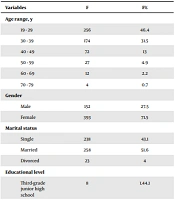
Participants included 84 patients (66 women) with depression and 86 patients (67 women) with anxiety. The results of descriptive statistics related to research variables are shown in Table 1. The skewness and kurtosis for all research variables ranged between -2 and +2, confirming the normality of the data (Table 1). The results of the independent t-test indicated no significant difference in the ages of the two groups (t = -1.76, P > 0.05). Additionally, the chi-square test results showed no significant differences between the two groups in educational status (χ2 = 2.13, P > 0.05), marital status (χ2 = 2.82, P > 0.05), and gender (χ2 = 0.01, P > 0.05). This study reported no missing data. Levene’s test findings revealed no significant differences in the variances of the research variables between the two groups (P > 0.05), upholding the assumption of variance homogeneity.
Table 1.
Demographic Characteristics of Participants
| Variables | x̄ ± SD | P-Value | |
|---|---|---|---|
| Depression | Anxiety | ||
| Literacy | 1.59 ± 0.713 | 1.56±0.623 | 0.54 |
| Age | 32.17 ± 7.72 | 34.32 ± 8.11 | 0.07 |
| Sex | 1.21 ± 0.41 | 1.21 ± 0.415 | 0.91 |
| Marital status | 1.46 ± 0.501 | 1.66 ± 0.474 | 0.09 |
| Attachment to God total | 32.46 ± 8.24 | 33.17 ± 9.02 | - |
| Avoidant | 8.3 ± 6.47 | 7.83 ± 5.96 | - |
| Secure | 15.5 ± 5.23 | 16.56 ± 4.38 | - |
| Anxious ambivalent | 9.27 ± 4.91 | 9.37 ± 4.44 | - |
| Invalidation | 7.27 ± 2.35 | 6.83 ± 2.29 | - |
| Incomprehensibility | 6.63 ± 2.92 | 5.59 ± 2.78 | - |
| Guilt | 7.78 ± 2.92 | 6.50 ± 2.79 | - |
| Simplistic view of emotion | 9.59 ± 2.13 | 8.48 ± 2.74 | - |
| Devalued | 7.44 ± 3.02 | 8.42 ± 2.85 | - |
| Loss of control | 8.47 ± 3.05 | 7.12 ± 2.92 | - |
| Numbness | 6.16 ± 2.61 | 5.93 ± 2.74 | - |
| Overly rational | 9.07 ± 2.72 | 8.27 ± 2.61 | - |
| Duration | 8.07 ± 2.92 | 7.04 ± 2.67 | - |
| Low consensus | 6.45 ± 2.78 | 6.03 ± 2.22 | - |
| Non-acceptance of feelings | 8.52 ± 2.51 | 8.82 ± 2.24 | - |
| Rumination | 9.28 ± 2.88 | 8.64 ± 2.90 | - |
| Low expression | 9.16 ± 2.53 | 7.72 ± 2.59 | - |
| Blame | 8.35 ± 2.76 | 7.82 ± 3.08 | - |
| Emotional schemas total | 112.26 ± 19.68 | 103.28 ± 20.02 | - |
| RNT | 38.29 ± 7.84 | 32.22 ± 9.20 | - |
| Physical concerns | 19.55 ± 7.31 | 19.49 ± 7.48 | - |
| Mental incapacitation concerns | 10.89 ± 3.74 | 10.22 ± 3.81 | - |
| Social concerns | 9.32 ± 2.66 | 9.87 ± 2.88 | - |
| AS total | 39.77 ± 12.12 | 39.59 ± 12.67 | - |
| Alternatives | 44.71 ± 12.01 | 50.90 ± 9.97 | - |
| Control | 38.65 ± 7.71 | 37.02 ± 7.60 | - |
| Alternatives for human behaviors | 8.89 ± 2.95 | 8.40 ± 3.36 | - |
| CF total | 92.26 ± 15.11 | 96.33 ± 12.56 | - |
| COVID‐19 anxiety | 13.48 ± 4.29 | 13.24 ± 4.89 | - |
Abbreviations: SD, standard deviation; RNT, repetitive negative thinking; AS, anxiety sensitivity; CF, cognitive flexibility.
Table 2 displays results from ANOVA, indicating no significant differences in invalidation, incomprehensibility, numbness, overly rational, low consensus, non-acceptance of feelings, rumination, blame, physical concerns, mental incapacitation concerns, social concerns, CF, control, alternatives for human behaviors, COVID-19 anxiety, attachment to God, anxious ambivalent, avoidant, and secure attachment between the two groups of patients with depression and those with anxiety. In contrast, patients with depression had higher scores in incomprehensibility, simplistic view of emotions, loss of control, low expression, emotional schemas total, and RNTs, while patients with anxiety scored higher in invalidation and alternatives.
Table 2.
The Results of Univariate ANOVA Analysis of Variance Related to Research Variables in Two Groups
| Sources and Variables | Sum of Squares | df | Mean Square | F | P-Value | Partial Eta Squared |
|---|---|---|---|---|---|---|
| Group | ||||||
| Invalidation | 8.537 | 1 | 8.537 | 1.571 | 0.212 | 0.009 |
| Incomprehensibility | 46.810 | 1 | 46.810 | 5.713 | 0.018 | 0.033 |
| Guilt | 66.485 | 1 | 66.485 | 8.108 | 0.005 | 0.046 |
| Simplistic view of emotion | 52.062 | 1 | 52.062 | 8.510 | 0.004 | 0.048 |
| Devalued | 39.695 | 1 | 39.695 | 4.582 | 0.034 | 0.027 |
| Loss of control | 72.011 | 1 | 72.011 | 8.112 | 0.005 | 0.046 |
| Numbness | 1.533 | 1 | 1.533 | 0.215 | 0.643 | 0.001 |
| Overly rational | 25.902 | 1 | 25.902 | 3.616 | 0.059 | 0.021 |
| Duration | 43.631 | 1 | 43.631 | 5.527 | 0.020 | 0.032 |
| Low consensus | 7.407 | 1 | 7.407 | 1.165 | 0.282 | 0.007 |
| Non-acceptance of feelings | 3.577 | 1 | 3.577 | 0.629 | 0.429 | 0.004 |
| Rumination | 14.694 | 1 | 14.694 | 1.772 | 0.185 | 0.010 |
| Low expression | 85.985 | 1 | 85.985 | 13.013 | 0.000 | 0.072 |
| Blame | 9.998 | 1 | 9.998 | 1.171 | 0.281 | 0.007 |
| Emotional schema total | 3288.964 | 1 | 3288.964 | 8.335 | 0.004 | 0.047 |
| RNTs | 1462.912 | 1 | 1462.912 | 20.327 | 0.000 | 0.108 |
| Physical concerns | 0.199 | 1 | 0.199 | 0.004 | 0.952 | 0.000 |
| Mental incapacitation concerns | 14.819 | 1 | 14.819 | 1.048 | 0.308 | 0.006 |
| Social concerns | 15.154 | 1 | 15.154 | 1.972 | 0.162 | 0.012 |
| AS total | 0.239 | 1 | 0.239 | 0.002 | 0.968 | 0.000 |
| Alternatives | 1545.073 | 1 | 1545.073 | 12.761 | 0.000 | 0.071 |
| Control | 109.910 | 1 | 109.919 | 1.864 | 0.174 | 0.011 |
| Alternatives for human behaviors | 8.643 | 1 | 8.643 | 0.863 | 0.354 | 0.005 |
| CF | 669.966 | 1 | 669.966 | 3.467 | 0.064 | 0.020 |
| COVID‐19 anxiety | 0.967 | 1 | 0.967 | 0.046 | 0.830 | 0.000 |
| Secure | 45.511 | 1 | 45.511 | 1.950 | 0.164 | 0.011 |
| Avoidant | 9.839 | 1 | 9.839 | 0.426 | 0.515 | 0.003 |
| Anxious ambivalent | 1.040 | 1 | 1.040 | 0.047 | 0.828 | 0.000 |
| Attachment to God | 21.429 | 1 | 21.429 | 0.286 | 0.593 | 0.002 |
| Error | ||||||
| Invalidation | 913.086 | 168 | 5.435 | - | - | - |
| Incomprehensibility | 1376.490 | 168 | 8.193 | - | - | - |
| Guilt | 1377.538 | 168 | 8.200 | - | - | - |
| Simplistic view of emotion | 1027.726 | 168 | 6.117 | - | - | - |
| Devalued | 1455.458 | 168 | 8.663 | - | - | - |
| Loss of control | 1491.336 | 168 | 8.877 | - | - | - |
| Numbness | 1197.620 | 168 | 7.129 | - | - | - |
| Overly rational | 1203.304 | 168 | 7.163 | - | - | - |
| Duration | 1326.281 | 168 | 7.895 | - | - | - |
| Low consensus | 1067.705 | 168 | 6.355 | - | - | - |
| Non-acceptance of feelings | 955.976 | 168 | 5.690 | - | - | - |
| Rumination | 1393.282 | 168 | 8.293 | - | - | - |
| Low expression | 1110.039 | 168 | 6.607 | - | - | - |
| Blame | 1434.879 | 168 | 8.541 | - | - | - |
| Emotional schema total | 66289.060 | 168 | 394.578 | - | - | - |
| RNTs | 12090.641 | 168 | 71.968 | - | - | - |
| Physical concerns | 9118.795 | 168 | 54.279 | - | - | - |
| Mental incapacitation concerns | 2376.175 | 168 | 14.144 | - | - | - |
| Social concerns | 1290.752 | 168 | 7.683 | - | - | - |
| AS total | 25541.737 | 168 | 152.034 | - | - | - |
| Alternatives | 20341.515 | 168 | 121.080 | - | - | - |
| Control | 9904.802 | 168 | 58.957 | - | - | - |
| Alternatives for human behaviors | 1683.245 | 168 | 10.019 | - | - | - |
| CF | 32467.587 | 168 | 193.259 | - | - | - |
| COVID‐19 anxiety | 3524.209 | 168 | 20.977 | - | - | - |
| Secure | 3920.395 | 168 | 23.336 | - | - | - |
| Avoidant | 3884.185 | 168 | 23.120 | - | - | - |
| Anxious ambivalent | 3683.784 | 168 | 21.927 | - | - | - |
| Attachment to God | 12567.277 | 168 | 74.805 | - | - | - |
Abbreviations: RNTs, repetitive negative thoughts; AS, anxiety sensitivity; CF, cognitive flexibility.
5. Discussion
The present study aimed to compare emotional schemas, AS, RNTs, CF, COVID-19 anxiety, and attachment to God between individuals with mood and anxiety disorders. No significant difference was found in CF between patients with depression and those with anxiety. This finding is inconsistent with Otared et al.’s study (45), which indicated that the components of psychological inflexibility vary among depressed, anxious, and normal individuals. However, this difference was more pronounced among normal individuals and between the three patient groups [major depressive disorder (MDD), generalized anxiety disorder (GAD), and social anxiety disorder]. In Otared et al.’s study, depressed individuals scored higher in the components of CF and experiential avoidance, while individuals with GAD scored significantly higher in the components of conceptualized self and past and future mastery than the other two groups. Moreover, no significant difference was observed between the three groups in the components of devalued and committed action (45).
In explaining the present study, it can be stated that CF and cognitive evaluation ability are crucial factors in mood and emotion regulation. If individuals lack these abilities, they may encounter problems in mood and emotion regulation, leading to depression and anxiety. One probable cause of inconsistency between these two studies is their statistical populations. In Otared et al.’s study (45), the subjects were students of the University of Medical Sciences, while in the present study, the subjects were selected from the general population, who were less familiar with psychological concepts. Furthermore, in the current study, more than two-thirds of the subjects were women, among whom depression and anxiety are highly prevalent.
On the other hand, the results of this study demonstrated no difference between depressed and anxious patients in COVID-19 anxiety, which aligns with Kong et al.’s study (46) and many other studies. These studies reveal that the fear of COVID-19 or COVID-19 anxiety is linked to factors such as age, gender, family infection, and weak social support, which themselves are predictors of depression and anxiety. Therefore, depending on individuals’ conditions, such as whether they receive adequate social support or the physical condition of themselves or their family members when infected with COVID-19, they may experience COVID-19 anxiety in both depressed and anxious groups.
In addition, no significant difference was found between depressed and anxious patients in attachment to God, which aligns with studies conducted by Bradshaw et al. (47), Henderson and Kent (48), and Zeligman et al. (49). These studies indicated that secure attachment to God had a negative relationship, while anxious attachment to God had a positive relationship with mental distress and depression. These results are inconsistent with Shoshan et al.’s study (50), which showed no direct relationship between avoidant and anxious patterns of attachment to God, happiness, and depressive symptoms. A possible explanation for the inconsistent results could be that the relationship between patterns of attachment to God and indicators of mental health and subjective well-being may be influenced by participants’ level of religiosity or gender. It can also be claimed that the characteristics and roles attributed to God take different forms in different socio-cultural contexts. Moreover, belonging to a particular socio-cultural context may have a stronger impact on the perceived image of God than religiosity and gender. Additionally, the manifestations and consequences of positive religious coping may vary in different socio-cultural contexts and in response to stressors.
The results of this study show that patients with depression scored higher in incomprehensibility, simplistic view of emotions, loss of control, low expression, emotional schemas total, and RNTs. In explaining these results, it can be said that depressed individuals often feel that others cannot understand them or accept their different feelings. Therefore, they constantly feel guilty and ashamed about their feelings, leading to disapproval from others. This feeling of guilt and incompleteness can indirectly impact depression. Therefore, the difference between depressed and non-depressed individuals is visible, aligning with Akbari and Mohammadkhani’s study (51). Furthermore, the study by Masoudzadeh et al. demonstrated that individuals who feel validated are less likely to attribute blame to their partners, highlighting validation as a fundamental emotional schema in interpersonal relationships (33).
In addition, individuals with depression scored higher in RNTs, a style of thinking about problems and negative experiences characterized by being repetitive, somewhat bothersome, and difficult to eliminate (6). Several emotional problems are associated with high levels of RNTs, such as worry and rumination. These thoughts lead individuals to form a distorted perception of themselves and the world around them (52). The results of Farnam et al.’s study (53) demonstrated that individuals with MDD experience more intense rumination than those with GAD and normal individuals. Also, individuals with GAD experience more intense rumination than normal individuals, with rumination existing in both depression and anxiety, albeit at different intensities. In explaining the obtained results, it can be suggested that depressed individuals focus more passively on the causes of their distress and further seek problem-solving to improve their mood compared to anxious individuals. Individuals with anxiety are strongly inclined to make threatening interpretations of ambiguous information, leading to increased levels of worry, hypervigilance, and even AS (54).
The results of this study, showing that patients with anxiety scored higher in invalidation and alternatives, are consistent with Khaleghi et al.’s study (55). According to the results, techniques such as validation, associating emotions with higher values, emotional expression, and emotional acceptance reduce blame, worry, and anxiety. A patient who feels validated regarding themselves and their emotions will believe they can express their emotions, that others also experience such emotions, and that emotions are not out of control and are meaningful. In explaining the results, it can be said that establishing a relation between emotional experiences and higher values and validation makes individuals consider their emotions a reflection of a valuable life, which is crucial for accepting bothersome emotions. No research was found for the alternatives variable.
5.1. Conclusions
Overall, the research results revealed that both individuals with depressive disorder and those with anxiety disorder experienced RNTs. This cognitive structure is not specific to depression but significantly contributes to the aggravation and maintenance of these disorders. Adaptive emotional schemas can also be considered a shared target for treatment in various types of mood disorders. Addressing RNTs, emotional schemas, and CF in treatment, along with early selective preventive interventions, may help reduce their impact. Shared risk factors highlight the importance of early clinical detection and intervention.
5.2. Limitations and Recommendations
The results of the current research should be interpreted with consideration of its limitations. Among these are the use of self-reporting tools, which may lead to inaccuracies in responses or a desire by subjects to present a false image of themselves, potentially impacting the results. Additionally, the lack of random sampling in the selection of the research sample can affect the study’s internal and external validity. It is recommended that researchers in this field use random sampling methods to control for confounding variables as much as possible and to enhance the generalizability of the results. Further limitations include the small sample size and the absence of a control or normative comparison group. Including such a group could have facilitated a more detailed examination and discussion of the differences and similarities between the study groups and a baseline population. It is also suggested that similar research be conducted on different clinical samples and in other cities.