
1. Background
Chronic diseases are responsible for more than 35 million deaths each year, accounting for nearly two-thirds of all global mortality (1). Individuals with chronic diseases often experience repeated treatments and prolonged hospitalizations, which expose them to a range of physical, psychological, social, and economic challenges, including pain, depression, social isolation, psychological stress, and high medical expenses, all of which significantly diminish their quality of life (2). Psychological distress is one of the most common problems among individuals with chronic diseases and can significantly affect their quality of life and treatment outcomes. Identifying the factors that contribute to psychological distress and predicting its occurrence can help mental health professionals provide more effective interventions (3). In this regard, attachment styles and emotion regulation ability are two key factors that may play an important role in predicting psychological distress among individuals with chronic diseases (4). Attachment styles, which are formed during childhood, significantly shape interpersonal relationships and stress-coping patterns in adulthood (5). Research indicates that individuals with secure attachment styles have a greater capacity to manage stress and maintain psychological well-being compared with those who exhibit insecure attachment styles (avoidant or anxious) (6, 7). In a large study involving 1,200 individuals with chronic diseases, 65% of those with secure attachment reported lower levels of psychological distress, whereas this proportion was only 35% among those with insecure attachment styles (8-10). Moreover, emotion regulation ability is another critical factor in maintaining psychological well-being and coping with the stressors associated with chronic illnesses (5). Individuals with stronger emotion regulation skills are generally better equipped to manage the psychological challenges that accompany chronic disease (2). Studies have shown that training in emotion regulation skills can reduce symptoms of depression and anxiety by up to 40% in individuals with chronic diseases. Similar findings were reported in a study conducted by Brown on patients with cardiovascular diseases. The researchers found that a secure attachment style was associated with stronger emotion regulation abilities and lower levels of psychological distress. They further suggested that enhancing emotion regulation skills could serve as an effective intervention to reduce psychological distress in this patient population (5). From an economic perspective, research in this area can also offer substantial benefits. Studies indicate that individuals with chronic diseases experiencing psychological distress incur higher healthcare costs and have an increased likelihood of hospital readmission. By predicting and preventing psychological distress in these patients, healthcare expenditures can be reduced by up to 30% (11). Given the increasing prevalence of chronic diseases in Iran and worldwide, examining the psychological factors that affect the mental health of these patients is of critical importance. A better understanding of the factors contributing to psychological distress, along with the implementation of appropriate interventions, can help these individuals lead a more satisfying life despite the challenges posed by chronic illness.
2. Objectives
Considering the significance of this issue, the researcher conducted a study aimed at investigating the role of attachment styles and emotion regulation in predicting psychological distress among patients with chronic conditions in Bandar Abbas.
3. Methods
This study employed a descriptive-correlational design and utilized convenience sampling. The target population consisted of all patients with chronic illnesses referred to Persian Gulf Hospital in Bandar Abbas during the six months of (March 21–September 22, 2024). The sample size was determined based on Morgan’s table, which recommends 150 participants for the given population size to ensure adequate representation and statistical reliability.
Inclusion criteria included a confirmed diagnosis of chronic obstructive pulmonary disease (COPD), cancer, or heart failure by a specialist based on medical records, age between 18 and 45 years, willingness to participate and complete the questionnaires, and full consciousness and awareness. Prior to participation, informed consent was obtained from all patients. The study was approved by the Ethics Committee of Islamic Azad University, Bandar Abbas Branch, under the ethics code IR.IAU.BA.REC.1403.038. Participants were provided with detailed explanations about the questionnaires, and those who expressed willingness received the questionnaires. For participants unable to read or write, the questionnaires were completed by the researcher. Participants were assured of the confidentiality of their data. The completion time for the questionnaires ranged from 20 to 30 minutes. In accordance with ethical research guidelines, participants were informed that they could withdraw from the study at any time without any restrictions or need for explanation.
3.1. Data Collection Instruments
In this study, three standardized questionnaires were employed for data collection:
3.1.1. Adult Attachment Inventory
The Adult Attachment Inventory is a self-report measurement tool developed by Hazan and Shaver (12). It is a 15-item questionnaire that assesses three attachment styles — secure, avoidant, and ambivalent — using a 5-point Likert scale (1 = very low, 2 = low, 3 = moderate, 4 = high, 5 = very high). The minimum and maximum possible scores for participants on each subscale range from 5 to 25. The reliability of the attachment style questionnaire was originally assessed by Hazan and Shaver, who reported a test-retest reliability coefficient of 0.81 and a Cronbach’s alpha coefficient of 0.87, indicating acceptable internal consistency (12). In the study by Ghanbari Hashemabadi et al. on an Iranian sample, the Cronbach’s alpha coefficients for the secure, avoidant, and ambivalent attachment subscales were reported to be 0.86, 0.84, and 0.85, respectively, indicating an acceptable level of internal consistency (13).
3.1.2. Kessler Psychological Distress Scale (K10)
Developed by Kessler et al. (2002) to assess psychological distress. The questionnaire consists of 10 items that measure the level of psychological distress experienced by individuals over the past month, using a 5-point Likert scale ranging from "never" (0) to "always" (14). The results of the conducted confirmatory factor analysis supported the unidimensional structure of the K-10 questionnaire, with factor loadings for the main construct ranging from 0.65 to 0.84. The sensitivity, specificity, and overall misclassification error for the optimal cutoff score of 8 on the psychological distress questionnaire were found to be 81%, 80.5%, and 16.5%, respectively. Moreover, the maximum sensitivity (100%) was achieved at a score of 1, and the maximum specificity (100%) at a score of 27. The Cronbach’s alpha coefficient for the questionnaire was 0.93, and the split-half reliability (Spearman-Brown coefficient) was 0.91.
3.1.3. Emotion Regulation Questionnaire (ERQ)
Designed by Gross and John to evaluate emotion regulation, this questionnaire encompasses two dimensions: "Cognitive reappraisal" and "expressive suppression." The tool includes 10 items scored on a 7-point Likert scale ranging from "strongly disagree" to "strongly agree" (15). In a study conducted by Besharat and Bazzazian on a sample of 478 participants, Cronbach's alpha coefficients for the subscales of cognitive reappraisal ranged from 0.88 to 0.91, and for the emotion suppression subscale ranged from 0.78 to 0.89. The overall reliability of the questionnaire was reported between 0.85 and 0.93, indicating good internal consistency. Additionally, test-retest reliability coefficients were reported between 0.92 and 0.93, demonstrating the tool’s stability over time. Regarding validity, the two-factor structure of the questionnaire (cognitive reappraisal and emotion suppression) was confirmed through confirmatory factor analysis (CFA). The factor loadings of the items on both factors were within acceptable ranges. Furthermore, significant positive correlations of these subscales with variables such as mental health, well-being, and adaptive coping styles support the convergent validity of the instrument (16).
3.2. Data Analysis
Data were analyzed using both descriptive and inferential statistical methods. In the descriptive analysis, indices such as frequency, percentage, mean, variance, and standard deviation were calculated. For inferential analysis, the Kolmogorov–Smirnov test was used to assess the normality of data distribution, Pearson’s correlation coefficient was employed to examine relationships between variables, and regression analysis was conducted to determine the extent to which predictor variables influenced the dependent variable. All analyses were performed using SPSS version 26.
4. Results
The total sample in this study consisted of 180 patients. After accounting for participant dropout and incomplete or invalid questionnaires, data from 150 participants were analyzed. Of these, 33% (50 participants) were female, and 67% (100 participants) were male. Regarding marital status, 38% of the participants were single, and 61.33% were married. Additional demographic characteristics are presented in Table 1.
Table 1.
Frequency Distribution of Participants by Age and Education Level
| Variables and Category | Frequency (%) |
|---|---|
| Age (y) | |
| 18 - 25 | 27 (18.00) |
| 26 - 35 | 52 (34.67) |
| 36 - 45 | 71 (47.33) |
| Education | |
| Bachelor’s or higher | 63 (42.00) |
| Associate degree | 28 (18.67) |
| Diploma or less | 59 (39.33) |
Table 2 presents the descriptive statistics for the variables of attachment styles, psychological distress, and emotion regulation among patients with chronic illnesses. Among the attachment style variables, the avoidant attachment style recorded the highest mean score of 22.16 (SD = 4.010), while the secure attachment style had the lowest mean score of 13.38 (SD = 3.681). The anxious attachment style yielded a mean score of 20.69 (SD = 3.198). For the emotion regulation variables, expressive suppression obtained the highest mean score of 17.78 (SD = 3.322), whereas cognitive reappraisal recorded the lowest mean score of 15.69 (SD = 5.709). The overall emotion regulation index had a mean score of 33.48 (SD = 3.112). The psychological distress index, measured by the Kessler Psychological Distress Scale (K10), yielded a mean score of 23.95 (SD = 5.902).
Table 2.
Descriptive Statistics of Attachment Styles, Psychological Distress, and Emotion Regulation Variables in Patients with Chronic Illnesses
| Variables | Mean ± SD | Skewness | Kurtosis | Min-Max |
|---|---|---|---|---|
| Avoidant attachment | 22.16 ± 4.010 | -0.188 | -0.598 | 12-30 |
| Anxious attachment | 20.69 ± 3.198 | -0.348 | 0.064 | 11-27 |
| Secure attachment | 13.38 ± 3.681 | 0.555 | 0.400 | 7-27 |
| Expressive suppression | 17.78 ± 3.322 | 0.036 | -1.005 | 11-24 |
| Cognitive reappraisal | 15.69 ± 5.709 | 0.143 | -1.020 | 6-28 |
| Emotion regulation | 33.48 ± 3.112 | 0.695 | 0.337 | 27-42 |
| Psychological distress | 23.95 ± 5.902 | -0.192 | -0.178 | 7-38 |
As presented in Table 3, the significance values of the Kolmogorov–Smirnov test for all the study variables exceed the 0.05 threshold. Consequently, the data for all variables conform to the assumption of normality.
Table 3.
Kolmogorov–Smirnov Test for the Research Variables
| Variables | Test Statistic | Significance Level (P-Value) |
|---|---|---|
| Avoidant attachment | 0.072 | 0.154 |
| Anxious attachment | 0.088 | 0.146 |
| Secure attachment | 0.140 | 0.081 |
| Psychological distress | 0.056 | 0.200 |
| Emotion regulation | 0.174 | 0.057 |
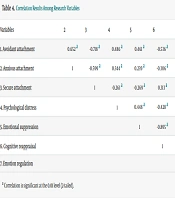
The results indicated a significant positive correlation between avoidant attachment, anxious attachment, and emotional suppression with psychological distress (P < 0.01), suggesting that higher levels of these variables are associated with increased psychological distress. Conversely, secure attachment, cognitive reappraisal, and emotion regulation showed a significant negative correlation with psychological distress (P < 0.01), indicating that higher levels of these variables are associated with lower levels of psychological distress. The results of the multiple regression analysis predicting psychological distress in patients with chronic illness based on attachment styles and emotion regulation are presented in Table 4.
Table 4.
Correlation Results Among Research Variables
| Variables | 2 | 3 | 4 | 5 | 6 | 7 |
|---|---|---|---|---|---|---|
| 1. Avoidant attachment | 0.652 a | -0.718 a | 0.486 a | 0.461 a | -0.536 a | -0.492 a |
| 2. Anxious attachment | 1 | -0.599 a | 0.344 a | 0.239 a | -0.306 a | -0.307 a |
| 3. Secure attachment | 1 | -0.261 a | -0.269 a | 0.313 a | 0.287 a | |
| 4. Psychological distress | 1 | 0.448 a | -0.428 a | -0.307 a | ||
| 5. Emotional suppression | 1 | -0.895 a | -0.574 a | |||
| 6. Cognitive reappraisal | 1 | 0.879 a | ||||
| 7. Emotion regulation | 1 |
a Correlation is significant at the 0.01 level (2-tailed).
Based on the stepwise regression coefficients for psychological distress in patients with chronic illnesses, secure attachment alone accounted for 24% of the variance in psychological distress in the first step (R² = 0.24, P < 0.001). In the second step, with the inclusion of emotional reappraisal in the model, the predictive power increased to 30.8% (R² = 0.308). In the third and fourth steps, anxious attachment and avoidant attachment were subsequently added to the model. The final model explained 33.8% of the variance in psychological distress (R² = 0.338, P < 0.001) (Table 5). The results indicated that secure attachment significantly and negatively predicted psychological distress (β = -0.224, P < 0.001). Higher anxious attachment significantly predicted psychological distress (β = 0.147, P = 0.004), and higher avoidant attachment significantly predicted psychological distress (β = 0.123, P = 0.026) (Table 5).
Table 5.
Stepwise Regression Coefficients for Predicting Psychological Distress in Chronic Patients
| Variables | B | Standard Error | Beta (β) | t | Sig. |
|---|---|---|---|---|---|
| Constant | 21.885 | 2.936 | -- | 7.453 | 0.001 |
| Secure attachment | -0.301 | 0.070 | -0.224 | -4.281 | 0.001 |
| Cognitive reappraisal | -0.188 | 0.039 | -0.226 | -4.814 | 0.001 |
| Anxious attachment | 0.241 | 0.084 | 0.147 | 2.857 | 0.004 |
| Avoidant attachment | 0.199 | 0.089 | 0.123 | 2.236 | 0.026 |
5. Discussion
The present study revealed that attachment styles and emotion regulation strategies are significant predictors of psychological distress among patients with chronic illnesses. Stepwise regression analysis showed that secure attachment was a significant negative predictor of psychological distress (β = -0.224, t = -4.281, P < 0.001). Emotional reappraisal was a significant negative predictor of psychological distress (β = -0.226, t = -4.814, P < 0.001). In contrast, anxious attachment (β = 0.147, t = 2.857, P < 0.05) and avoidant attachment (β = 0.123, t = 2.236, P < 0.05) were positively and significantly associated with higher levels of distress. Overall, the final model accounted for 33.8% of the variance in psychological distress (R² = 0.338, P < 0.001). These findings align with a broad body of research emphasizing the critical role of attachment styles in predicting mental health outcomes, particularly in the context of chronic physical illnesses. Previous studies have consistently shown that individuals with insecure attachment styles tend to report higher levels of anxiety, depression, and emotional distress when faced with chronic illness-related stressors (17-19).
The relationship between attachment and psychological distress can be explained through multiple theoretical and neurobiological frameworks. According to attachment theory, early life experiences shape stable interpersonal patterns and coping mechanisms that persist into adulthood (20). Securely attached individuals typically possess more adaptive internal and external resources for managing stress, whereas those with insecure attachment styles often rely on maladaptive emotion regulation strategies. This distinction is particularly relevant for patients dealing with the persistent and often overwhelming challenges of chronic illness (19, 21). From a neurobiological perspective, insecure attachment styles have been linked to functional and structural alterations in brain regions involved in emotion regulation, including the prefrontal cortex and amygdala. These neural differences may underlie the diminished capacity of insecurely attached individuals to effectively regulate emotions in high-stress situations such as chronic illness (22).
Moreover, individuals with anxious attachment are more likely to engage in ruminative thinking, exaggerate illness-related threats, and focus on negative outcomes, which increases their vulnerability to anxiety and depression. In contrast, avoidantly attached individuals tend to suppress emotional needs and withdraw from social support, which may lead to social isolation and exacerbation of psychological distress (23). Longitudinal research also suggests that insecure attachment not only correlates with greater psychological distress but also negatively influences treatment outcomes. These individuals often demonstrate lower adherence to medical regimens and encounter difficulties in building effective therapeutic relationships with healthcare providers (24).
Health psychology literature further highlights the mediating role of emotion regulation in the relationship between attachment styles and psychological distress. Patients who rely on maladaptive strategies, such as suppression or avoidance, are more likely to report elevated levels of stress and anxiety (2). Conversely, securely attached individuals are better equipped to employ adaptive strategies such as cognitive reappraisal and seeking social support, which in turn help reduce psychological distress (25).
Understanding the complex interplay between attachment styles, emotion regulation, and psychological distress has important clinical implications. Mental health professionals can enhance psychological well-being and quality of life in patients with chronic illness by assessing attachment patterns and implementing interventions that strengthen emotion regulation skills (26). Recent studies have also demonstrated the effectiveness of attachment-based interventions in improving emotion regulation and reducing psychological symptoms in chronically ill populations. These interventions, by focusing on restructuring relational patterns and enhancing self-regulatory abilities, enable patients to respond more adaptively to the challenges posed by chronic illness (9, 27, 28).
In conclusion, the findings of this study underscore the significant role of attachment styles in predicting psychological distress and emotion regulation capacity in patients with chronic conditions. These associations are mediated by complex biological, psychological, and social mechanisms, and understanding them can inform the development of more effective therapeutic interventions for this vulnerable population.
5.1. Conclusions
The present findings clearly demonstrate that attachment styles, particularly insecure ones, play a significant role in increasing psychological distress among chronic patients. This effect primarily operates through maladaptive emotion regulation strategies and disrupted social interactions. Accordingly, identifying attachment patterns and enhancing emotional skills should be considered as integral components of multidimensional psychological interventions for chronic patients.