
1. Background
In late December 2019, a novel coronavirus, named severe acute respiratory syndrome coronavirus 2, led to an acute respiratory illness in Wuhan, China (1, 2). In general, coronavirus disease 2019 (COVID-19) is an acute, curable disease; however, COVID-19 can be fatal, with a mortality rate of 2%. The onset of severe illness may result in severe alveolar damage and progressive respiratory failure (2, 3). Studies have shown that diseases, such as respiratory diseases, can cause health anxiety due to serious physical problems and reduced quality of life (4-6). The aforementioned factors can cause a range of symptoms of serious clinical disorders. It has been observed that a range of problems and disorders include increased feelings of loneliness, decreased social support, reduced life expectancy (7), feeling of fear, anxiety, stress, clinical anxiety, obsessive-compulsive disorder, and practical illness (8). Moreover, even in similar situations, there are signs of post-traumatic stress (9).
In humans, fear of unknown concepts reduces immune perception and has always been a concern. The COVID-19 exacerbates this anxiety with less scientific information (10). One of the types of anxiety during this illness is health anxiety. Health anxiety is a widespread cognitive disorder that develops as a misunderstanding of symptoms and bodily changes that result from a person's beliefs about illness or health (11). Health anxiety is a new diagnosis in the latest US psychiatric classification that has partially replaced the concept of hypochondria disorder (12). However, there exists an overlap with obsessional disorders (13). There is a high level of anxiety about health in this disorder, and individuals are easily afraid of their health condition (14). Moreover, the use of the internet and social media has increased the speed of its spread (15).
Previous studies have shown that anxiety sensitivity and body vigilance predict anxiety responding to health status in general (16), as well as to specific disease outbreaks (17). However, some variables reduce the effects of anxiety in acute situations. Studies have shown that spirituality and religious beliefs play a significant role in individuals’ psychological and physical well-being and are considered among the common ways to deal with health problems (18). Spirituality, with its consequences is a powerful resource in an individual’s life to provide the ability to adapt to individual needs and changes (19). Spirituality in various aspects of human life greatly affects family relationships, health, and illness, and ways to deal with grief (20).
Spirituality reduces disability stress, anxiety, depression, and suicide. Furthermore, spirituality increases the quality of life and longevity (21, 22). The importance of spiritual beliefs is shown to be a source of comfort and patronage in stressful situations (23). Additionally, spirituality has been shown important in emotion regulation for overall health and disadvantageous in regulating emotions related to mental health problems, such as anxiety and depression (24, 25). Martin and Gitzen (26) showed that adults with somatic symptom disorder compared with a healthy control group used maladaptive emotion regulation strategies more than adaptive emotion regulation strategies. Their research findings show that in adults with health anxiety, the use of adaptive emotion regulation strategies is attenuated (26-28). Studies have shown that emotion regulation effectively reduces stress, anxiety, and depression by changing emotional and cognitive processes (29). There has been evidence obtained from several studies to support the hypothesis that defects in emotion regulation generally contribute to the development, growth, and maintenance of anxiety states (30, 31).
2. Objectives
The present study aimed to predict health anxiety based on spiritual well-being and cognitive emotion regulation strategies during COVID-19 in Iranian individuals.
3. Methods
3.1. Study Design and Participants
The present study was applied in terms of purpose and methodology in the category of correlational descriptive studies. The statistical population of this study included all 19-to-79-year-old individuals participating in the study online. This method was chosen due to traffic restrictions when the risk of COVID-19 became serious in Iran. A total of 545 subjects were selected by the convenience sampling method based on inclusion and exclusion criteria. The individuals completed short-form health anxiety questionnaires, spiritual well-being scales, and short-form emotion regulation strategies online. The inclusion criteria were the age range of 19 - 79 years and a minimum education of third-grade junior high school. The exclusion criterion was a history of anxiety and depression before the COVID-19 pandemic.
3.2. Instruments
3.2.1. Short Health Anxiety Inventory
This self-report inventory was designed by Salkovskis and Warwick with 18 items in 2002 (32). As the score gets higher, health anxiety becomes more pronounced (33). The coefficients of internal consistency are variables within 0.71 to 0.95. In the same study, the reliability coefficient was obtained as 0.90 by test-retest within a week, and it has been shown that this scale can distinguish hypochondriasis patients from non-clinical control groups (34).
3.2.2. Spiritual Well-being Scale
The Spiritual Well-Being Scale (SWBS) was developed by Paloutzian and Ellison in 1983, with 20 items (35). Palotzian and Ellison reported test-retest reliability coefficients for the religious well-being, existential well-being, and total scale subscales at 0.63, 0.86, and 0.93, respectively. Moreover, Cronbach’s alpha coefficients for the religious well-being, existential well-being, and total scale subscales were reported as 0.91, 0.93, and 0.91, respectively (35). The SWBS has been used in other studies in Iran, and the psychometric characteristics of the Iranian version of this questionnaire have been documented (36, 37).
3.2.3. Short form of Cognitive Emotion Regulation Questionnaire
This 18-item scale was developed by Garnefski, Kraaij, and Spinhoven (38). It has been designed to identify individuals’ cognitive coping strategies after experiencing events in adverse situations. Minimum and maximum scores are 10 and 50 for five adaptive strategies and 8 and 40 for four maladaptive strategies (39). The validity and reliability of this questionnaire were obtained by Cronbach’s alpha coefficients for subscales within 0.58 to 0.82 (40).
3.3. Statistical Analysis
The Pearson correlation coefficient was used to investigate the relationship between the study variables. In addition, stepwise regression was used to determine the predictive power of the criterion variable based on the predictor variables. Data analysis was performed using SPSS software (version 23).
4. Results
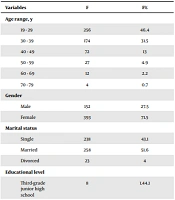
Table 1 shows the sociodemographic characteristics of the study participants, including the frequency and percentage of age range, gender, marital status, and educational level.
Table 1.
Sociodemographic Characteristics of Study Participants
| Variables | F | F% |
|---|---|---|
| Age range, y | ||
| 19 - 29 | 256 | 46.4 |
| 30 - 39 | 174 | 31.5 |
| 40 - 49 | 72 | 13 |
| 50 - 59 | 27 | 4.9 |
| 60 - 69 | 12 | 2.2 |
| 70 - 79 | 4 | 0.7 |
| Gender | ||
| Male | 152 | 27.5 |
| Female | 393 | 71.5 |
| Marital status | ||
| Single | 238 | 43.1 |
| Married | 258 | 51.6 |
| Divorced | 23 | 4 |
| Educational level | ||
| Third-grade junior high school | 8 | 1.44.1 |
| Diploma | 88 | 15.9 |
| Associate degree | 29 | 5.3 |
| Bachelor’s degree | 188 | 34.1 |
| Master’s degree | 169 | 30.6 |
| PhD | 63 | 11.4 |
According to Table 2, health anxiety had a significant negative relationship with spiritual well-being (r = -0.339**) and adaptive cognitive emotion regulation strategies (r = -0.308**). Furthermore, health anxiety had a significant positive relationship with maladaptive cognitive emotion regulation strategies (r = 0.390**) (Table 2). The findings showed that the promotion of spiritual well-being and adaptive cognitive emotion regulation strategies reduced health anxiety. Moreover, increasing maladaptive cognitive emotion regulation strategies increased health anxiety.
Table 2.
Pearson Correlation Coefficient Matrix Between Spiritual Well-being and Cognitive Emotion Regulation Strategies with Health Anxiety a
| Variables | Mean | Standard Deviation | 1 | 2 | 3 |
|---|---|---|---|---|---|
| Spiritual well-being | 79.21 | 11.20 | |||
| Adaptive cognitive emotion regulation strategies | 31.12 | 7.12 | 0.41 ** | ||
| Maladaptive cognitive emotion regulation strategies | 19.88 | 5.01 | -0.301 ** | 0.008 | |
| Health anxiety | 15.45 | 7.52 | -0.339 ** | -0.308 ** | 0.390 ** |
a* P<0.05; ** P < 0.01.
According to the results, the relationship of health anxiety was significant with each of the variables of maladaptive cognitive emotion regulation strategies (β = 0.354), adaptive cognitive emotion regulation strategies (β = -0.259), and spiritual well-being (β = -0.126). Overall, the aforementioned variables in the model explained 26.1% of changes in health anxiety. The regression model obtained a good fit (F = 63.66; P < 0.001; Table 3).
Table 3.
Results of Step-by-Step Regression Analysis to Investigate Relationship Between Study Variables a
| Independent Variable | S.E (Standard Error) | β | P-Value |
|---|---|---|---|
| Constant | 2.67 | 20.155 | 0.000 |
| Maladaptive cognitive emotion regulation strategies | 0.059 | 0.354 | 0.000 |
| Adaptive cognitive emotion regulation strategies | 0.043 | -0.259 | 0.000 |
| Spiritual well-being | 0.029 | -0.126 | 0.003 |
a R = 0.511; R2 = 0.261; F = 63.66; P < 0.001.
5. Discussion
The findings of this study showed that there was a significant negative relationship between spiritual well-being and health anxiety. Health anxiety decreased with increasing spiritual well-being. The aforementioned results are consistent with the results of studies performed by Amjad and Bokharey (41) and Lee and Lee (42). In explaining this finding, it can be stated that spirituality is an important resource for adaptation to stressful life events. Spirituality is the constant search for meaning, purpose of life, deep understanding of values, existing natural forces, and system of personal beliefs through which an individual can understand the meaning of life and manage anxiety caused by these stressful situations. The findings show that there is a relationship between spiritual well-being and greater immunity to disease. On the other hand, spiritual care leads to personal growth and increased hope for life (43, 44).
The results of the present study showed that there was a significant negative relationship between adaptive cognitive emotion regulation and health anxiety. Health anxiety decreased with increasing adaptive cognitive emotion regulation. These results are consistent with the results of studies performed by Martin and Gitzen (26), Bardeen and Fergus (27), and Rey and Extremera (45). In explaining this finding, it can be stated that individuals who are unable to effectively control and monitor their emotional reactions experience more severe periods of sadness and anxiety that can lead to depression or anxiety (46). In general, individuals use adaptive strategies to regulate their emotions, by focusing on the pleasant aspects, thereby reporting less negative emotion (47).
Moreover, the results of the present study showed that there was a significant positive relationship between maladaptive cognitive emotion regulation strategies and health anxiety. Health anxiety increased with increasing maladaptive cognitive emotion regulation. These results are consistent with the results of studies conducted by Bardeen and Fergus (27), Garnefski et al. (48), Dehghanizadeh et al. (49), and Aldao et al. (50). Research findings suggest that maladaptive emotion regulation strategies, such as rumination, self-blame, and catastrophizing, are positively correlated with emotional distress and other pathological aspects (49). Saxena et al. observed that difficulty in emotion regulation and use of maladaptive emotion regulation strategies are important and influential factors in the reduction of mental health (51).
In a study, Marroquín and Nolen-Hoeksema (52) demonstrated that individuals who use more effective coping mechanisms can better manage their negative emotions. In addition, Aldao et al. (50) reported that self-blame, rumination, and catastrophizing acted as predictors of negative emotions. On the one hand, the use of adaptive strategies to regulate emotions is effective in modulating perceptual stress and prevents chronic diseases. On the other hand, the use of maladaptive strategies to regulate emotion can cause some psychological injuries, such as depression, anxiety, aggression, and violence; accordingly, by affecting the level of experienced stress and reducing the efficiency of the immune system, individuals are prone to physical ailments (53).
The limitations of the online sampling method should be considered because they occurred at the time of this study, the widespread outbreak of COVID-19 in Iran. The results of the present study showed the role of spiritual well-being and cognitive emotion regulation strategies in health anxiety. Therefore, it is recommended that training based on spiritual teachings and emotion regulation strategies reduces health anxiety during the outbreak of COVID-19.