


1. Context
2. Objectives
3. Methods
3.1. Study Design
3.2. Search Strategy
3.3. Inclusion and Exclusion Criteria
4. Results
4.1. Collection, Summary, and Reporting of Findings
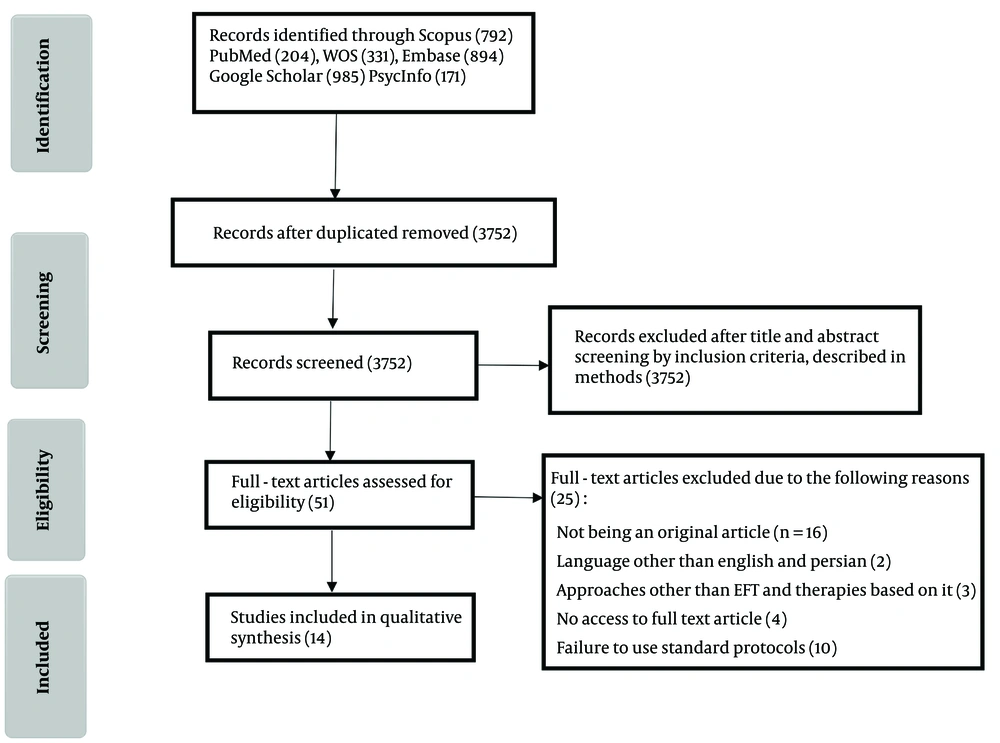
Systematic review search process – PRISMA flow diagram
| Authors, Year, Country | Type of Study | Study Location | Sample Size /Gender | Average Age | How to Use the Intervention | Name of the Intervention (if, any) and its Components | Number of Sessions | Mental Health Outcome/Assessment Tool | Evaluation Stage/Findings |
|---|---|---|---|---|---|---|---|---|---|
| Bloch and Guillory, 2011, America (18) | Descriptive | Treatment room | 1/girl | 13 | Different combinations of family members | EFFT/humanistic and experiential approach + systemic approach | 31 | Behavioral-emotional problems at school/school report and therapist diagnosis | Before and after intervention/changes in family interactions, increased emotional self-awareness, distress tolerance, self-confidence |
| Knatz et al., 2015, America (19) | Descriptive | - | 1/girl | 16 | Caregiver sessions (uncle) | EFPT-EE/principles-based EFT + EFFT | 8 | Bulimia nervosa, depression | Before and after intervention/reduction in depressive symptoms and weight loss |
| Robinson et al., 2015, Canada (20) | Descriptive | - | 1/girl | - | Parent sessions | EFFT/fundamentals-based EFT + FBT | - | Anorexia nervosa and loss of social functions/expert diagnosis | Before and after intervention/disappearance of symptoms and increase in social functioning |
| Lafrance Robinson et al., 2016, Canada (21) | Mixed method | 24 | 24 | 18 | Parent group sessions/ caregivers | EFT-based EFFT for eating disorders | Two-day workshop | Semi-structured interview | Supporting the restoration of the parent-child relationship |
| Foroughe et al., 2019, Canada (22) | Clinical trial | Large meeting room in a health center | 90 | 18 | Parent group sessions/caregivers | EFFT/consists of family-based therapy (23), motivational interviewing (24) and EFT (25) | Two-day workshop | Types of mental health problems other than psychosis/CBCl | Study with control group/before, after and 4 months after intervention/significant improvement in symptoms |
| Robinson, 2020, England (26) | Mixed method | - | 2 girls/1 boy | 14 | Teen group sessions | EFGT with autistic adolescents/based on EFT principles | 11 | DSM-IV and the CEPS-AS | Improving emotion processing, discovering self-agency in interpersonal ruptures, and strengthening self-esteem and increasing cognitive-emotional empathy. |
| Wilhelmsen-Langeland et al., 2020, Norway (27) | Clinical trial | - | 9 boys/8 girls | 8.71 | Parent/caregivers group sessions | EFFT/based on the models of Foroughe et al. (22), LaFrance Robinson (28), Strahan et al. (29) | Two-day workshop | Mental health problems/CBCl | Baseline, post-treatment, and 3-month follow-up /improvement in internalizing and externalizing symptoms |
| Ansar et al., 2022, Norway (30) | Clinical trial | Two mental health clinics | 93 boys/50 girls | 8.92 | Parent/caregivers group sessions (group-individual) | EFST/based on EFT two versions: (1) based on the principles of experiential therapy and (2) version based on psychoeducation | 2-day group training and 6 hours of individual supervision | Externalizing and internalizing problems/ BPM, BPM-P and BPM-T | Before and after intervention and follow-up at 4, 8, and 12 months/reduction in child’s symptoms at 12-month follow-up intervention/disappearance of symptoms and increase in social functioning |
| Cordeiro et al., 2022, Canada (31) | Clinical trial | Family Mental Health Center | 170 | 10.80 | Parent/caregivers group sessions | EFFT/Based on the model presented by LaFrance Robinson | Two-day workshop | Mental health problems/emotion regulation questionnaire and behavioral and emotional problems in children | Reducing negativity, instability, and emotional and behavioral problems in children |
| Foroughe et al., 2022, Canada (32) | Descriptive, presenting the online EFFT model | Virtual platform/video conferencing platform | - | - | Parent/caregivers group sessions | Online EFFT/adapted form of the model used in Foroughe et al.’s study (32) for virtual sessions | Two-day workshop | Consequences of children’s mental health | - |
| Foroughe et al., 2023, Canada (33) | Clinical trial | Family Psychology Center | 179 boys/156 girls | Boys 9.90/girls 12.12 | Parent/caregivers group sessions | EFFT/consists of family-based therapy (23), motivational interviewing (24) and EFT (25) | Two-day workshop | Mental health problems/Goodman Strengths and Weaknesses Questionnaire (34) | One week before the intervention, immediately after the intervention, and at 4, 8, and 12-month follow-ups; reduction in symptoms at follow-ups |
| Robinson and Yong, 2023, Canada (35) | Qualitative study | - | - | - | Parent/caregivers group sessions | EFFT and a customized training program for parents of adolescents with autism spectrum disorders RU | Two-day workshop | - | Main extracted theme: Discovering painful stimuli and repairing the autistic parent-child relationship |
| Smith et al., 2023, Canada (36) | Case study | Get A-Head video conferencing platform virtual platform | - | 8 | Parent/caregivers group sessions | EFT-based EFFT | 8 | Anger, depression, and anxiety/Patient-Reported Outcome Measurement Information System (PROMIS®) | Before and after intervention/reduce symptoms of anger, depression, and anxiety |
| Ansar et al., 2024, Norway (37) | Clinical trial | Two mental health clinics | 136 | 143; 8.9 boys/93 girls | Group-individual for parents with two experimental methods and psychoeducation | EFST/based on EFT two versions: (1) based on the principles of experiential therapy and (2) version based on psychoeducation | 2-day group training and 6 hours of individual supervision | Externalizing and internalizing problems/ BPM, BPM-P and BPM-T | Before and after intervention and follow-up at 4, 8, and 12 months/reduction in child’s symptoms at 12-month follow-up/reduced symptoms in children resulting in improved outcomes for parents |
Abbreviations: EFGT-AS, emotion-focused group therapy with autistic adolescents; EFST, emotion-focused skills training; BPM, brief problem monitor; BPM-P, brief problem monitor for parents; BPM-T, brief problem monitor for teachers; RU, relationships and understanding for parents of teenagers on the autism spectrum; PROMIS®: Patient‐reported outcomes measurement information system; EFFT, emotion-focused family therapy; EFGT, emotion-focused group therapy; EFPT-EE, emotion-focused parent training for adolescents with eating disorders; EFT, emotion-focused therapy; CBCl, Child Behavior Assessment Checklist; CEPS-AS, the emotional processing scale for autism spectrum disorders; DSM, diagnostic and statistical manual.




