


1. Background
Evaluating the effectiveness of psychotherapy has long been a central concern in the development and quality assurance of psychological services (1). Traditionally, such evaluations have relied heavily on symptom-focused instruments, such as the Beck Depression Inventory and related symptom checklists, which primarily assess reductions in psychopathology and improvements in functioning (2, 3). Although these measures have clear advantages, including facilitating the integration of psychotherapy into medical systems and enabling standardized outcome tracking, they have been increasingly criticized (4, 5). In particular, symptom reduction alone may not fully capture the complexity of therapeutic change, as it overlooks the richness of clients' subjective experiences and the meaningful psychological transformations that occur during therapy (6, 7). These include processes such as gaining insight, improving interpersonal functioning, enhancing self-acceptance, and strengthening personal agency (8). This limitation is especially relevant for therapeutic approaches that extend beyond symptom reduction, such as psychodynamic and process-oriented therapies, which may not be adequately evaluated using symptom-based criteria (9). Accordingly, recent research has increasingly emphasized clients' subjective experiences as central to understanding therapeutic change (10). Building on this perspective, Levitt et al. (4) developed the Clients' Experience of Therapy Scale (CETS) based on a comprehensive qualitative meta-analysis of 109 studies examining clients' experiences of psychotherapy (11). The CETS is designed to assess the quality of the therapeutic process from the client's perspective across five dimensions:
1) Pattern identification: Gaining insight into thought, emotional, behavioral, and relational patterns.
2) Disconnection/disengagement: Experiencing emotional distance or ineffectiveness in the relationship with the therapist.
3) Therapist responsiveness: The client's perception of the therapist's flexibility and tailoring of interventions to their needs.
4) Client agency: Feeling empowered and capable of guiding the session, discussing painful issues, and influencing the course of therapy.
5) Transformative acceptance/safety: The experience of acceptance from the therapist that leads to the client's acceptance of parts of themselves (4).
A key strength of the CETS is its grounding in clients' reported experiences across diverse therapeutic approaches and cultural contexts, which supports its content and face validity. Unlike traditional outcome measures, the CETS focuses on in-session processes that clients perceive as meaningful and potentially transformative. Items are scored such that higher scores indicate a higher perceived quality of experience. Results from two studies supported the five-factor structure of the CETS and demonstrated acceptable reliability and validity indices (4).
The CETS can serve as a complementary tool alongside symptom-based measures in routine outcome monitoring. By capturing in-session processes and relational dynamics, it may provide actionable feedback to therapists and help improve therapeutic effectiveness and reduce dropout. However, the application and validation of the CETS have thus far been largely limited to Western populations. Cultural factors are known to influence expectations of therapy, conceptualizations of the therapeutic relationship, and the expression of emotional experiences (12). Constructs such as client agency, emotional disengagement, and therapist responsiveness may therefore be interpreted differently in non-Western contexts, including Iran. Consequently, using the CETS without appropriate cultural adaptation and validation may lead to biased interpretations and reduced measurement validity. Furthermore, exclusive reliance on symptom-based measures may disadvantage populations exposed to ongoing structural stressors, such as poverty or social inequality (13), for whom symptom reduction may not fully reflect therapeutic benefit (14). In such cases, process-oriented measures such as the CETS may offer a more comprehensive and context-sensitive evaluation of psychotherapy outcomes.
2. Objectives
To date, no study has examined the psychometric properties of the CETS in an Iranian context. Addressing this gap is important not only to facilitate the clinical and research use of the instrument in Iran but also to contribute to the broader literature on the cross-cultural applicability of psychotherapy process measures. Therefore, the present study aimed to evaluate the psychometric properties of the Persian version of the CETS in a sample of Iranian individuals with psychotherapy experience.
3. Methods
3.1. Study Design and Participants
This cross-sectional methodological study used a convenience sampling approach. Participants were recruited primarily through online advertisements posted on mental health platforms and social media channels, including Telegram and Instagram. Eligible participants were adults aged 18 years or older who had experienced psychotherapy, defined as participation in at least one structured course of psychological treatment delivered by a trained mental health professional (e.g., a psychologist, psychiatrist, or licensed counselor). Individuals currently undergoing psychotherapy and those with past therapy experience were included. Information on the type of psychotherapy (e.g., cognitive-behavioral, psychodynamic, or other approaches) and treatment duration was collected and is presented in Table 1. No minimum number of therapy sessions was required for inclusion. A total of 458 participants were included in the final analysis. The sample size was considered adequate based on the recommended respondent-to-item ratio of at least 10:1 for factor analysis (15). The study was approved by the Research Ethics Committee of Iran University of Medical Sciences (approval code: IR.IUMS.REC.1402.510).
Table 1.Demographic and Clinical Characteristics of the Study Participants (N = 458) a
| Characteristics | Values |
|---|---|
| Gender | |
| Male | 206 (45.0) |
| Female | 252 (55.0) |
| Marital status | |
| Single | 346 (75.5) |
| Married | 112 (24.5) |
| Education level | |
| Below diploma | 10 (2.2) |
| Diploma | 50 (10.9) |
| Bachelor's degree | 158 (34.5) |
| Master's degree | 201 (43.9) |
| PhD | 39 (8.5) |
| Type of psychotherapy | |
| Cognitive-behavioral therapy | 162 (35.4) |
| Psychoanalytic | 112 (24.5) |
| Other psychotherapies | 184 (40.2) |
| Duration of psychotherapy | |
| < 6 (mo) | 192 (41.9) |
| 6 (mo) to 1 (y) | 93 (20.3) |
| 1 to 2 (y) | 68 (14.8) |
| > 2 (y) | 105 (22.9) |
| Age (y), mean (standard deviation) | 34.75 ± 8.291 |
a Values are expressed as No. (%) or mean ± SD.
3.2. Translation and Cross-Cultural Adaptation
The translation and cross-cultural adaptation of the CETS were conducted in accordance with established guidelines recommended by the World Health Organization (WHO). In the forward-translation stage, two independent bilingual translators fluent in English and Persian produced separate Persian versions of the instrument. These translations were compared and synthesized into a single preliminary version through discussion and consensus among the translators and the research team. In the back-translation stage, two independent translators blinded to the original instrument translated the synthesized Persian version back into English. An expert committee of clinical psychologists and methodological experts reviewed all versions, including the original, forward translations, and back-translations, to ensure semantic, conceptual, and cultural equivalence. Discrepancies were resolved by consensus, prioritizing the preservation of conceptual meaning over literal translation. No major cultural adaptations were required; however, minor wording modifications were made to improve clarity, readability, and cultural appropriateness for Iranian respondents. The pre-final version was pilot tested in a sample of 30 psychology students. Feedback indicated that all items were generally clear and comprehensible; nevertheless, minor revisions were implemented to simplify wording and improve item clarity. The finalized Persian version of the CETS is provided as a supplementary Appendix File.
3.3. Procedures
Data were collected between December 2024 and March 2025 using an online survey platform (Porsline). The survey link was distributed via social media channels, primarily Telegram, with an invitation describing the study and eligibility criteria. Individuals with current or past psychotherapy experience were invited to participate. The online survey included an informed consent form, a brief introduction to each questionnaire, demographic questions, and the study measures. To encourage participation, the study description emphasized the importance of understanding key psychotherapy processes and their role in improving the quality of therapeutic services. A total of 512 individuals accessed the survey. Of these, 54 responses were excluded due to incomplete questionnaires. In addition, 13 responses were excluded because of invalid response patterns, defined as identical answers across all items, indicating inattentive responding. The final analytic sample consisted of 458 participants, corresponding to a completion rate of 89.4%. To enhance data quality, responses were collected through a single online platform, and cases with clearly inattentive response patterns were screened and removed. However, due to the anonymous nature of the survey, more advanced controls, such as IP tracking or duplicate-response detection, were not implemented. It was also not possible to compare included and excluded participants. Demographic variables (e.g., age, gender, and education level) and clinical characteristics are presented in Table 1.
3.4. Measures
3.4.1. The Clients' Experience of Therapy Scale
The Clients' Experience of Therapy Scale, developed by Levitt et al., is a 15-item self-report instrument designed to assess clients' overall experiences in psychotherapy. Items are rated on a 7-point Likert scale ranging from 1, "not at all," to 7, "to a very great degree." The instrument measures five interrelated dimensions: pattern identification, disconnection/disengagement, therapist responsiveness, client agency, and transformative acceptance/safety. Previous research has shown moderate to strong correlations among these dimensions. In the original validation study, the CETS demonstrated acceptable psychometric properties, including evidence of convergent validity with measures of therapeutic alliance and treatment outcomes. Reported Cronbach's α coefficients for the subscales were 0.79 for pattern identification, 0.83 for disconnection/disengagement, 0.47 for therapist responsiveness, 0.56 for client agency, and 0.61 for transformative acceptance/safety. The CETS was selected for this study because it is grounded in qualitative analyses of clients' reported psychotherapy experiences, supporting its relevance for capturing process-oriented aspects of therapy (4).
3.4.2. Real Relationship Inventory-Client Short Form
The Real Relationship Inventory-Client Short Form (RRI-C-SF) is an 8-item self-report measure that assesses the client's perception of the "real relationship" with the therapist. This construct refers to a genuine and realistic personal connection between the therapist and client, characterized by authenticity and accurate perception. The scale includes two subscales: Genuineness and Realism. Items are rated on a 5-point Likert scale ranging from 1, "strongly disagree," to 5, "strongly agree," with higher scores indicating a stronger perceived real relationship. The original study reported excellent internal consistency (Cronbach's α = 0.91 for the total scale) (16). In the present study, Cronbach's α coefficients were 0.79 for Realism and 0.81 for Genuineness.
3.4.3. In-Session Patient Affective Reactions Questionnaire
The In-Session Patient Affective Reactions Questionnaire (SPARQ), developed by Stefana et al., is an 8-item self-report instrument designed to assess patients' in-session emotional responses toward their therapist. The instrument comprises two independent 4-item subscales, Positive Affect and Negative Affect, which are not combined into a total score. The Positive Affect subscale reflects experiences of safety and comfort within the therapeutic relationship, whereas the Negative Affect subscale captures experiences such as shame, fear of disclosure, perceived lack of support, and relational discomfort. Items are rated on a 5-point Likert scale ranging from 0, "not at all true," to 4, "very true." In the original study, Cronbach's α coefficients were 0.86 for Positive Affect and 0.75 for Negative Affect (17, 18). In the present study, these values were 0.82 and 0.76, respectively.
3.4.4. Rift In-Session Questionnaire
The Rift In-Session Questionnaire (RISQ), developed by Stefana et al., is a brief 4-item self-report measure designed to assess the risk of ruptures in the therapeutic relationship. The instrument captures patients' immediate in-session experiences, including feelings of rejection, criticism, discomfort, or concern about potential emotional harm. Items are scored dichotomously as "yes" or "no," with higher total scores indicating a greater perceived risk of relational rupture. The RISQ demonstrated acceptable internal consistency for a brief scale (Cronbach's α = 0.67) (17). In the present study, the Cronbach's α coefficient for the RISQ was 0.78.
3.5. Data Analysis
Statistical analyses were conducted using SPSS version 25 and AMOS version 28. Incomplete questionnaires were excluded before analysis; therefore, no item-level missing data remained in the final dataset. Confirmatory factor analysis using maximum likelihood estimation was performed to examine the factorial validity of the proposed five-factor model. Although the CETS items were rated on a 7-point Likert scale, they were treated as continuous indicators because the number of response categories exceeded five and the observed distributional properties were considered acceptable. Model fit was evaluated using χ2/df, CFI, IFI, GFI, AGFI, and RMSEA.
Convergent and discriminant validity were evaluated using Pearson correlation coefficients between the CETS and conceptually related measures, including the RRI-C, SPARQ, and RISQ. Based on theoretical and empirical literature, it was hypothesized that the CETS total score would demonstrate positive moderate-to-strong correlations with measures of therapeutic relationship quality and positive in-session affect, and negative moderate correlations with measures of relational rupture and negative in-session affect. The assumptions underlying parametric analyses were evaluated using skewness and kurtosis statistics, which were within acceptable ranges.
4. Results
4.1. Sociodemographic Characteristics
Demographic and clinical profiles are presented in Table 1. Descriptive statistics, including means and standard deviations, are reported in Table 2.
Table 2.Descriptive Statistics for All Study Measures
| Measure | N | Min | Max | Mean | SD | Skewness | Kurtosis |
|---|---|---|---|---|---|---|---|
| CETS total | 458 | 27 | 97 | 70.83 | 14.45 | -0.36 | -0.54 |
| Pattern identification | 458 | 4 | 28 | 18.46 | 5.60 | -0.39 | -0.49 |
| Disconnection/disengagement | 458 | 3 | 21 | 7.54 | 3.60 | 1.00 | 1.17 |
| Therapist responsiveness | 458 | 2 | 14 | 8.91 | 3.07 | -0.29 | -0.80 |
| Client agency | 458 | 4 | 28 | 19.42 | 5.08 | -0.47 | -0.35 |
| Transformative acceptance/safety | 458 | 2 | 14 | 9.50 | 3.06 | -0.49 | -0.54 |
| RISQ | 458 | 0 | 4 | 0.43 | 0.97 | 2.48 | 5.50 |
| SPARQ Positive Affect | 458 | 0 | 16 | 9.93 | 3.65 | -0.16 | -0.51 |
| SPARQ Negative Affect | 458 | 0 | 16 | 4.02 | 3.29 | 1.17 | 1.24 |
| RRI-C Genuineness | 458 | 4 | 20 | 16.19 | 2.94 | -0.81 | 0.88 |
| RRI-C Realism | 458 | 4 | 20 | 15.21 | 3.04 | -0.28 | -0.06 |
4.2. Convergent and Discriminant Validity
To evaluate the convergent and discriminant validity of the 15-item Persian CETS, correlations were estimated between the total score and subscale scores and among theoretically related and unrelated constructs. Evidence of convergent and discriminant validity is presented in Table 3.
Table 3.Matrix of Intercorrelations Between the CETS, Its Subscales, and Other Study Measures
| Measures | 1 | 2 | 3 | 4 | 5 | 6 | 7 | 8 | 9 | 10 | 11 |
|---|---|---|---|---|---|---|---|---|---|---|---|
| CETS total score | 1 | ||||||||||
| Pattern identification | 0.858 a | 1 | |||||||||
| Disconnection/disengagement | -0.476 a | -0.223 a | 1 | ||||||||
| Therapist responsiveness | 0.826 a | 0.669 a | -0.325 a | 1 | |||||||
| Client agency | 0.854 a | 0.656 a | -0.292 a | 0.593 a | 1 | ||||||
| Transformative acceptance/safety | 0.846 a | 0.711 a | -0.324 a | 0.688 a | 0.619 a | 1 | |||||
| RISQ | -0.406 a | -0.273 a | 0.312 a | -0.313 a | -0.363 a | -0.325 a | 1 | ||||
| SPARQ Positive Affect | 0.673 a | 0.550 a | -0.294 a | 0.648 a | 0.597 a | 0.516 a | -0.343 a | 1 | |||
| SPARQ Negative Affect | -0.363 a | -0.268 a | 0.317 a | -0.232 a | -0.365 a | -0.218 a | 0.317 a | -0.281 a | 1 | ||
| RRI-C Genuineness | 0.607 a | 0.452 a | -0.386 a | 0.407 a | 0.604 a | 0.512 a | -0.302 a | 0.516 a | -0.477 a | 1 | |
| RRI-C Realism | 0.649 a | 0.525 a | -0.411 a | 0.519 a | 0.556 a | 0.552 a | -0.343 a | 0.613 a | -0.395 a | 0.783 a | 1 |
a Pearson correlation coefficients are reported. The correlation is statistically significant at the P < 0.01 level (two-tailed).
4.3. Reliability Analysis
The internal consistency of the Persian CETS was evaluated using Cronbach's alpha coefficients. The total scale demonstrated good reliability (α = 0.84), and most subscales showed acceptable to good internal consistency. The Disconnection/Disengagement subscale demonstrated relatively lower reliability (α = 0.66); however, this value remained within the minimally acceptable range for brief psychological subscales. A detailed summary of Cronbach's alpha values for the total score and each subscale is presented in Tables 4 and 5.
Table 4.Internal Consistency of the Persian Version of the CETS
| Scale | Number of Items | Cronbach's Alpha (α) |
|---|---|---|
| Pattern identification | 4 | 0.882 |
| Disconnection/disengagement | 3 | 0.659 |
| Therapist responsiveness | 2 | 0.723 |
| Client agency | 4 | 0.729 |
| Transformative acceptance/safety | 2 | 0.723 |
| CETS | 15 | 0.837 |
Table 5.Goodness-of-Fit Indices for the Confirmatory Factor Analysis of the CETS
| Fitness indicators | RMSEA | CFI | GFI | AGFI | CMIN/DF | IFI | Degrees of freedom |
|---|---|---|---|---|---|---|---|
| Initial | 0.082 | 0.92 | 0.91 | 0.87 | 4.07 | 0.92 | 80 |
| Modified | 0.07 | 0.93 | 0.92 | 0.90 | 3.27 | 0.93 | 78 |
4.4. Confirmatory Factor Analysis
The hypothesized five-factor structure of the Persian CETS was examined using CFA. The initial model demonstrated marginal-to-suboptimal fit to the data. Examination of modification indices suggested localized areas of model strain. Specifically, residual covariances were added between Item 7 and Item 9, reflecting pattern identification, and between Item 6 and Item 12, reflecting disconnection/disengagement. These modifications were considered theoretically justifiable because the item pairs reflected conceptually overlapping relational and experiential content within the same latent dimensions. Following these modifications, model fit improved to acceptable levels (CFI = 0.93, GFI = 0.92, RMSEA = 0.07). Standardized factor loadings ranged from 0.50 to 0.89 and were statistically significant. Nevertheless, because the modified model involved post hoc adjustments, support for the original five-factor structure should be considered preliminary. Accordingly, the modified model is best interpreted as an exploratory-within-confirmatory analysis in this dataset. Replication in independent samples is recommended. The modified model is presented as the final model in this study (Figure 1).
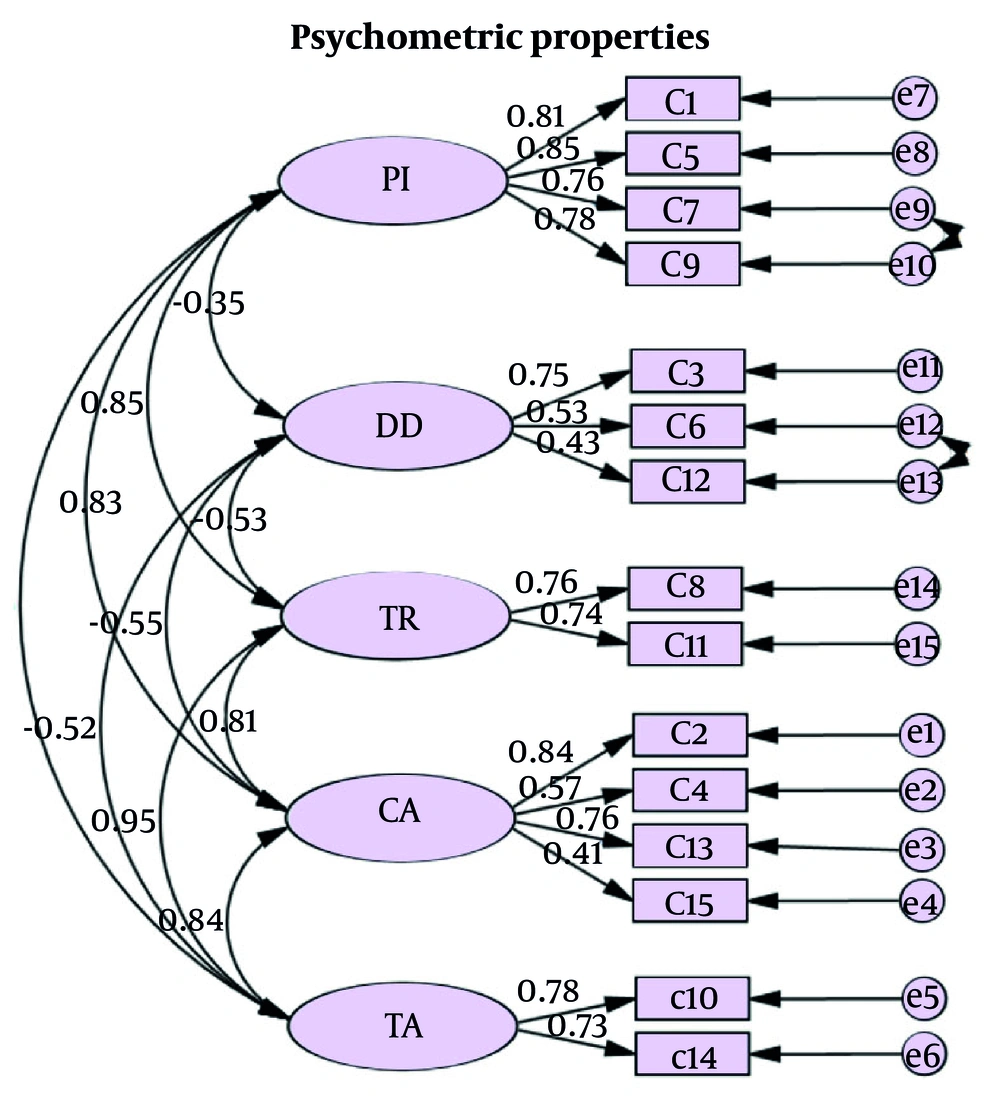
Figure 1.
The Final Confirmatory Factor Analysis Model of the Persian CETS With Standardized Estimates
5. Discussion
The present study aimed to evaluate the psychometric properties of the Persian version of the CETS in an Iranian sample. Overall, the findings provide preliminary support for the reliability and validity of the Persian CETS and suggest that the instrument may be useful for assessing clients' subjective experiences of psychotherapy within the Iranian cultural context. The results were generally consistent with those reported in previous validation studies of the original instrument (4, 19). However, it is important to note that the CFA model required data-driven modifications to achieve acceptable fit. Therefore, the findings should be interpreted with caution, and further studies are needed to replicate the factor structure in independent samples. These findings are consistent with previous psychometric validation studies conducted in Iranian populations, which have similarly reported acceptable reliability and validity indices for adapted psychological instruments (20, 21).
5.1. Factor Structure and Internal Consistency
The results provided partial support for the proposed five-factor structure of the CETS. Although the initial CFA indicated suboptimal fit, acceptable model fit was achieved after theoretically justifiable modifications. The resulting fit indices were broadly comparable to those reported in the original validation studies, suggesting that the core dimensions of the CETS may be applicable across cultural contexts (4). These findings are consistent with the theoretical framework proposed by Levitt et al., which was derived from a large-scale qualitative synthesis of clients' psychotherapy experiences (11). The Pattern Identification dimension, for example, is directly linked to the Gaining Insight category in that meta-analysis, in which clients describe understanding their own cognitive, emotional, and relational patterns as a helpful factor (22). Our findings also align with the meta-analysis by Ladmanová et al., which examined the helpful and hindering impacts of therapy events and identified new categories for helpful impacts, emphasizing that tools such as the CETS can help identify hindering events (23).
The internal consistency of the Persian CETS was acceptable to good for the total scale and most subscales. However, the relatively lower reliability of the disconnection/disengagement subscale is noteworthy. This pattern is consistent with previous research and may reflect the complexity and multidimensional nature of negative or hindering therapeutic experiences (24). Such experiences may be more difficult for clients to identify, articulate, or report consistently, particularly within brief subscales (25). In addition, negative or hindering experiences in psychotherapy have historically received less empirical attention than positive or helpful processes. Clients may also be less willing to disclose such experiences or may interpret them in more complex ways over time (26). These factors may contribute to the lower internal consistency observed for this dimension.
5.2. Convergent and Discriminant Validity
The findings supported the a priori hypotheses regarding construct validity. As expected, the CETS showed positive moderate-to-strong correlations with measures of therapeutic relationship quality and positive in-session affect, including the RRI-C and SPARQ Positive Affect, supporting convergent validity. This pattern aligns with the original study, which showed that higher perceptions of therapy quality are associated with stronger therapeutic alliances and positive in-session affect (4). The strong positive correlations of the CETS with the RRI-C and SPARQ Positive Affect corroborate the findings of Podolan and Gelo, in which safety was introduced as a fundamental prerequisite for building trust, vulnerability, and ultimately change in the therapeutic relationship (27, 28).
Conversely, the CETS demonstrated negative moderate correlations with measures of relational rupture and negative in-session affect, including the RISQ and SPARQ Negative Affect, supporting discriminant validity. The association between lower CETS scores and higher levels of relational rupture and negative affect is consistent with theoretical models of alliance rupture and repair. A qualitative meta-analysis by Vybíral et al. (29) indicates that clients' negative experiences often revolve around negative in-session emotions, such as shame and fear, and ruptures in the therapeutic relationship, such as feeling rejected or criticized; these experiences correspond precisely to the RISQ and SPARQ Negative Affect scales, as well as the Disconnection/Disengagement subscale of the CETS.
Importantly, the Disconnection/Disengagement subscale performed as expected for a scale measuring a negative therapeutic process. Its negative correlations with all other CETS subscales confirm that it assesses an opposing dimension of the therapy experience. More importantly, its positive correlations with both the RISQ and SPARQ Negative Affect provide strong evidence for its validity. In other words, feelings of disengagement in the therapeutic relationship are associated with increased perceived rupture risk and negative in-session affect. This pattern reflects what patient-oriented qualitative studies have reported regarding reasons for therapy failure and dropout: therapist behaviors perceived by clients as unresponsive, judgmental, or cold can diminish the quality of the therapy experience and increase the likelihood of termination (29, 30). These results are also consistent with the role of relational rupture (31). Therefore, these correlation patterns not only replicate the findings of Levitt et al. but also align with other studies emphasizing the importance of the therapeutic relationship and in-session emotions in shaping clients' overall experiences (11).
5.3. Implications
The findings have several implications for clinical practice and research. The Persian version of the CETS may serve as a useful complement to symptom-based outcome measures, enabling clinicians to assess in-session processes and relational dynamics that are not captured by traditional symptom-focused instruments. By providing structured feedback on clients' subjective experiences, the CETS may help therapists identify areas for improvement, enhance therapeutic engagement, and potentially reduce dropout. In addition, the use of process-oriented measures may be particularly important in contexts in which symptom reduction alone does not fully capture therapeutic benefit. This is especially relevant in populations exposed to ongoing stressors, where improvements in relational and experiential domains may represent meaningful therapeutic outcomes. More broadly, the findings highlight the importance of culturally adapting and validating psychotherapy process measures to ensure their relevance and accuracy in diverse populations.
5.4. Limitations and Future Directions
Several limitations should be considered when interpreting the findings. First, the use of online convenience sampling may have introduced selection bias and limited the representativeness of the sample. Individuals with greater psychological insight, stronger interest in psychotherapy, or more favorable therapy experiences may have been more likely to participate. Second, participants varied substantially in psychotherapy orientation, treatment duration, current versus past therapy status, and level of therapeutic exposure. Because no minimum number of sessions was required for inclusion, some participants may have had relatively limited psychotherapy experience. Third, because of the anonymous nature of the survey, it was not possible to compare included and excluded participants, limiting the assessment of potential nonresponse bias. Fourth, the data-driven modifications made to the CFA model require replication in an independent sample; the current results should therefore be considered preliminary. Finally, the cross-sectional design precluded the evaluation of temporal stability and sensitivity to change over time.
Future research should replicate these findings in more diverse and clinically representative samples, including individuals with specific diagnostic profiles, such as major depression, anxiety disorders, or trauma-related disorders. Longitudinal studies are also needed to assess the stability and responsiveness of the CETS over the course of psychotherapy. Additionally, future studies should examine measurement invariance across different treatment modalities, such as cognitive-behavioral therapy versus psychodynamic therapy, current versus past therapy status, and different phases of treatment, including early, middle, and late phases.
5.5. Conclusions
In conclusion, the Persian version of the CETS demonstrates acceptable preliminary psychometric properties, including evidence of reliability and construct validity. Although the findings support the potential utility of the instrument in Iranian clinical and research settings, further studies are needed to confirm its factor structure and generalizability. Overall, the CETS represents a promising tool for assessing clients' subjective experiences of psychotherapy and may complement traditional outcome measures by capturing meaningful relational and experiential aspects of psychotherapy.


