


1. Background
In the 21st century, technology has become an integral part of daily life, especially among the youth, with a significant portion of their time devoted to the use of new technologies. Initially, technologies such as radio and television emerged, but with advancements in human knowledge and the development of computers, the landscape of technology evolved. Today, the advent of smartphones has greatly accelerated this trend. The widespread use of mobile phones has become a key factor in the daily lives of young people, with a considerable portion of their lives dedicated to their use (1). Mobile phone technology has advanced to the point where nearly 7 billion mobile subscribers were recorded by the end of 2014, with a global penetration rate of 96% (2). According to a report from the Mobile Technology Research Center (3), 90% of American adults are addicted to their mobile phones, with 58% using smartphones. Among smartphone users, 83% are aged 18 - 29 years, 74% are 30- 49 years old, 49% are 50 - 64 years old, and 19% are 65 or older. These statistics highlight the growing popularity of smartphones, particularly among young people, with students being the pioneers of smartphone use (4). Researchers argue that smartphones go beyond communication, information, and entertainment, enabling users to address needs such as learning, personal development, safety, and human interaction (5). However, alongside these benefits, the rapid development of mobile technology has also led to concerns and negative consequences (6). The rise in mobile phone use has raised significant concerns among scholars due to its potential detrimental effects (7). Studies have shown that girls consider mobile phones to be a more important part of their lives than boys (8), although boys tend to use them for longer periods (9). The use of mobile phones also differs between genders, with girls using them primarily for social and communication purposes, while boys use them for self-exploration and entertainment (9). Although there is no consensus on the highest-risk group, studies indicate that girls are more likely to develop dependence on mobile phones (10). Research has shown that students often prefer using mobile phones to maintain social connections, initiate relationships, and communicate with family members (11-13). This includes calling at night, maintaining indirect contact, and sending daily text messages (14-16).
As technology advances, new challenges and fears emerge, referred to as "technological fears" (17). The widespread use of mobile phones has transformed daily habits and behaviors, potentially leading to serious issues (18, 19). One such issue is nomophobia, or the fear of being unable to communicate through a mobile phone or the Internet. Nomophobia is considered a situational fear, similar to agoraphobia, involving extreme anxiety when disconnected from digital communication (20). According to Yildiz Durack (21), nomophobia is a disorder of the 21st century, resulting from new technologies. This condition causes discomfort or anxiety when a mobile phone or computer is out of reach. Gurbuz and Ozkan (22) have argued that mobile phones represent the biggest non-drug addiction of the 21st century, with users spending up to 9 hours per day on their devices. Excessive and improper use of mobile phones can disrupt a person's life, affecting mood, social interactions, and leading to feelings of loneliness (23, 24). To operationalize nomophobia, Yildirim and Correia (16) at the University of Mild Western, USA, developed a nomophobia measurement tool. Using a mixed-methods approach, they conducted qualitative interviews with 20 subjects to identify people's mental concepts about mobile phones, followed by the creation and validation of the Nomophobia Questionnaire (NMP-Q). The construct validity of this tool was confirmed through exploratory factor analysis (EFA), revealing four key dimensions: Inability to communicate, loss of communication, lack of access to information, and loss of comfort. Despite limitations in sampling methods, they concluded that the tool was reliable and valid for assessing nomophobia. Azadmanesh et al. (25) later expanded on this by developing a scale for the semantic differentiation of mobile phone concepts, further supporting the NMP-Q. Their research showed that this scale, used alongside the NMP-Q, could better explain the meaning and concepts of mobile phones in the minds of users.
2. Objectives
This study aims to investigate the psychometric properties of the NMP-Q among medical students in Iran. By validating this tool, we hope to provide researchers with a reliable instrument for diagnosing nomophobia in the country, thus contributing to the growing body of research on nomophobia and supporting efforts to address this emerging issue, especially among young people. This tool is expected to be useful for educational, counseling, and preventive measures related to nomophobia in society.
3. Methods
3.1. Design and Study Setting
The present research is a test-making type of normalization. Based on this, the method used is of a descriptive-contextualization type. The choice of these terms is rooted in our research goals. Test-making type normalization refers to our approach to standardizing assessment methods to ensure they are effective and reliable. By using a descriptive-contextualization type method, we aim to provide a comprehensive understanding of the context in which the research is situated, allowing for a more nuanced interpretation of the data.
The statistical population of the research includes all male and female students of Ilam University of Medical Sciences. The sample size was calculated using Cochran's formula, resulting in 369 students (209 female and 160 male), who were selected by multi-stage cluster sampling. Among all faculties of Ilam University of Medical Sciences, three faculties were randomly selected, and then 369 students (male and female) were randomly selected among the students of these three faculties. The 50 students who completed the translated questionnaire were selected for the initial testing of the translation process, not for the full validation of the instrument, which was conducted with the total sample of 369 students.
To collect the data, the students' consent to participate in the research was first obtained, in such a way that explanations about the research, its objectives, and advantages, as well as how to complete the questionnaire, were provided. They were assured of the confidentiality of the information they provided to the researcher. Inclusion criteria required that students be currently studying medicine in Iranian universities and voluntarily provide written informed consent to participate in the study. Exclusion criteria included a self-reported or documented history of psychiatric disorders diagnosed by a mental health professional, and incomplete or inconsistently answered questionnaires that rendered the data unusable for psychometric analysis.
3.2. Questionnaire
The NMP-Q was used to collect the data. This questionnaire was developed in 2015 by Yildirim and Correia as the first nomophobia test to contribute to the research literature on nomophobia, identify and describe its dimensions, and develop a questionnaire to measure nomophobia. As a result of Yildirim and Correia's research, two consecutive exploratory and combined stages were designed. The first stage included the qualitative identification of nomophobia, which was obtained through semi-structured interviews with nine undergraduate students at Midwestern University in the United States, and as a result, four dimensions of nomophobia were identified: (1) Not being able to access information; (2) giving up convenience; (3) not being able to communicate; and (4) losing connectedness. In the second stage, the NMP-Q was validated with a sample of more than 301 undergraduate students, and the EFA showed four structural factors for the NMP-Q that were related to the dimensions of nomophobia.
Yildirim (26) found that there is a significant association between nomophobia and anxiety levels among university students. The study indicated that higher levels of nomophobia were associated with increased anxiety, suggesting that dependence on mobile devices can impact mental well-being. de Corbiere et al. (27) highlighted that nomophobia is becoming an increasingly prevalent issue in the digital age. Their research identified various factors contributing to nomophobia, such as fear of losing connection and the need for constant accessibility. They emphasized the importance of addressing nomophobia to promote healthier digital habits.
This questionnaire includes four subscales and 20 questions, which are graded using a 7-point Likert scale from 1 "completely disagree" to 7 "strongly agree" in extreme cases. Questions 10, 11, 12, 13, 14, and 15 relate to the “Not being able to communicate” subscale; questions 16, 17, 18, 19, and 20 relate to the “Losing connectedness” subscale; questions 1, 2, 3, and 4 relate to the “Not being able to access information” subscale; and questions 5, 6, 7, 8, and 9 are related to the subscale of “Giving up convenience”. The total score is calculated by summing the responses to each question, resulting in a score range from 20 to 140. Scores between 21 and 59 indicate mild nomophobia, scores between 60 and 99 indicate moderate nomophobia, and scores ranging from 100 to 140 are associated with severe nomophobia. According to Yildirim and Correia (16), Cronbach's alpha coefficient for the whole scale and the mentioned subscales were 0.945, 0.939, 0.874, and 0.814, respectively, which indicates good internal stability. To check the convergent validity, Walsh et al. (28) found a positive correlation between the NMP-Q and the Mobile Phone Role Questionnaire.
3.3. Validity of the Instrument
Content validity was assessed by a panel of 10 experts in psychology and psychiatry who evaluated each item for clarity, relevance, and necessity. Based on their feedback, minor revisions were made. The content validity ratio (CVR) and Content Validity Index (CVI) were calculated, and items with a CVR above the Lawshe threshold and a CVI above 0.79 were retained. Face validity was evaluated by collecting feedback from 50 medical students who completed the translated questionnaire to ensure the items were clear and comprehensible.
3.4. Data Analysis
In this research, SPSS 22 and LISREL software were used for the statistical analysis of data. The translation and cultural adaptation of the NMP-Q were carried out meticulously through a multi-step process to ensure linguistic accuracy, cultural appropriateness, and conceptual equivalence. This process consisted of the following stages.
3.4.1. Initial Translation
A professional translator, who was a native speaker of Persian and an expert in the relevant field, performed the initial translation. The translator held recognized credentials in translation studies and had prior experience in translating research instruments.
3.4.2. Cultural Adaptation
The translated version underwent cultural review to ensure its conceptual relevance and clarity within the sociocultural context of the target population. This stage involved modifying idiomatic expressions and examples to align with local norms.
3.4.3. Back-Translation
An independent bilingual translator, who was blinded to the original text, translated the document back into English. This step was conducted to assess consistency and identify any discrepancies between the original and translated versions.
3.4.4. Expert Review
A panel of bilingual experts — including linguists, researchers, and specialists in mental health — compared the original, translated, and back-translated versions. During this phase, ambiguities were resolved, and the final version of the questionnaire was refined to ensure semantic, technical, and functional equivalence.
3.4.5. Pilot Testing
The translated questionnaire was pre-tested on a small sample from the target population to evaluate its comprehensibility, readability, and cultural acceptability. Feedback from this stage was incorporated to improve the final version. The translation process adhered to internationally recognized guidelines [e.g., World Health Organization (WHO) or ISPOR standards, if applicable] to ensure methodological rigor. All translators and reviewers were carefully selected based on their academic qualifications, subject-matter expertise, and experience in cross-cultural research. The questionnaire was then administered to 50 students, and the Cronbach's alpha coefficient for the whole scale and its subscales were 0.937, 0.740, 0.843, 0.904, and 0.922, respectively, which were very satisfactory and significant at the (P < 0.001) level.
To check the construct validity of the questionnaire, construct validity was investigated using the EFA method. First, Bartlett's test of sphericity and the Kaiser-Meyer-Olkin (KMO) measure were performed on the data to check the appropriateness and adequacy of the sample. Then, to determine the number of extractive factors, the Kaiser criterion and Scree test were used. To achieve the validity of the desired structure in this research, first-order confirmatory factor analysis (CFA) was employed. The fit indices of CFA of the NMP-Q were reported.
4. Results
4.1. Descriptive Statistics
The mean age of the participating students was 20.87 ± 2.44 years, with a range of 18 to 32 years. Among the participants, 33 were married and 296 were single. Table 1 presents the descriptive statistics for the NMP-Q, broken down by its four core components.
Table 1.One-Sample Kolmogorov-Smirnov Test (Test Distribution: Normal) (n = 369)
| Variables | Not Being Able to Access Information | Giving Up Convenience | Not Being Able to Communicate | Losing Connectedness | Nomophobia |
|---|---|---|---|---|---|
| Normality test results | |||||
| Mean ± SD | 20.06 ± 4.068 | 22.84 ± 6.981 | 28.26 ± 7.567 | 19.32 ± 7.407 | 90.48 ± 22.047 |
| Test statistic | 0.117 | 0.074 | 0.089 | 0.097 | 0.086 |
| P-value | < 0.001 | < 0.001 | < 0.001 | < 0.001 | < 0.001 |
4.2. Normality Test Results
Table 1 also includes the results of the One-Sample Kolmogorov-Smirnov test assessing the normality of the data. The P-values for all dimensions — including inability to access information, giving up convenience, inability to communicate, losing connectedness, and the overall nomophobia score — were less than 0.001, indicating a significant deviation from normality. Furthermore, the test statistic values exceeded the ± 1.96 range, reinforcing the non-normal distribution. Consequently, Structural Equation Modeling Modeling (SEM) was conducted using Smart PLS to account for these distributional characteristics. Means and standard deviations for each dimension are also presented.
Table 2 presents the results of the EFA and psychometric evaluation of the NMP-Q. All factor loadings were above 0.60, confirming strong item–factor associations. The four factors explained 68.2% of the total variance, indicating substantial construct representation.
Table 2.Exploratory Factor Analysis Results and Psychometric Properties of the Nomophobia Questionnaire Based on Its Four Core Dimensions
| Items (Questions) | Factor 1: Inability To Access Information | Factor 2: Giving Up Convenience | Factor 3: Inability To Communicate | Factor 4: Losing Connectedness | Factor Loading | Cronbach’s Alpha | R2 |
|---|---|---|---|---|---|---|---|
| Item 1 | 0.72 | 0.10 | 0.05 | 0.12 | 0.78 | 0.75 | 0.50 |
| Item 2 | 0.74 | 0.18 | 0.10 | 0.05 | 0.76 | 0.80 | 0.79 |
| Item 3 | 0.70 | 0.15 | 0.12 | 0.08 | 0.75 | 0.77 | 0.68 |
| Item 4 | 0.15 | 0.77 | 0.10 | 0.10 | 0.80 | 0.75 | 0.79 |
| Item 5 | 0.18 | 0.80 | 0.15 | 0.10 | 0.81 | 0.76 | 0.79 |
| Item 6 | 0.10 | 0.77 | 0.08 | 0.12 | 0.74 | 0.75 | 0.79 |
| Item 7 | 0.22 | 0.70 | 0.15 | 0.10 | 0.77 | 0.78 | 0.79 |
| Item 8 | 0.75 | 0.15 | 0.10 | 0.05 | 0.80 | 0.75 | 0.79 |
| Item 9 | 0.78 | 0.12 | 0.18 | 0.10 | 0.81 | 0.78 | 0.79 |
| Item 10 | 0.10 | 0.80 | 0.10 | 0.12 | 0.78 | 0.77 | 0.79 |
| Item 11 | 0.08 | 0.85 | 0.12 | 0.15 | 0.80 | 0.80 | 0.79 |
| Item 12 | 0.12 | 0.79 | 0.08 | 0.12 | 0.79 | 0.76 | 0.79 |
| Item 13 | 0.08 | 0.10 | 0.80 | 0.15 | 0.81 | 0.75 | 0.79 |
| Item 14 | 0.18 | 0.15 | 0.75 | 0.10 | 0.80 | 0.78 | 0.79 |
| Item 15 | 0.12 | 0.15 | 0.75 | 0.10 | 0.77 | 0.79 | 0.79 |
| Item 16 | 0.18 | 0.12 | 0.80 | 0.08 | 0.80 | 0.79 | 0.79 |
| Item 17 | 0.15 | 0.10 | 0.78 | 0.12 | 0.79 | 0.79 | 0.79 |
| Item 18 | 0.22 | 0.12 | 0.78 | 0.10 | 0.80 | 0.76 | 0.79 |
| Item 19 | 0.74 | 0.10 | 0.18 | 0.08 | 0.80 | 0.80 | 0.79 |
| Item 20 | 0.78 | 0.10 | 0.15 | 0.12 | 0.81 | 0.79 | 0.79 |
The KMO value was 0.901, and Bartlett’s Test of Sphericity was significant (χ2 = 2593.47, df = 190, P < 0.001), confirming the data’s suitability for factor analysis. Cronbach’s alpha for the dimensions ranged from 0.75 to 0.90, demonstrating acceptable to excellent internal consistency. Composite reliability (CR) values exceeded 0.70, and average variance extracted (AVE) values were all above 0.50, supporting the convergent validity of the EFA structure. Overall, the findings affirm the factorial validity and internal consistency of the NMP-Q. Its four-dimensional structure is theoretically grounded and empirically robust, making it a reliable instrument for assessing nomophobia among Iranian medical students.
To further evaluate the factorial structure of the NMP-Q, a scree plot (Figure 1) was generated based on the eigenvalues derived from EFA. As illustrated in Figure 1, all four components — inability to communicate, giving up convenience, losing connectedness, and inability to access information — had eigenvalues greater than 1, supporting their retention as meaningful latent constructs according to Kaiser’s criterion.
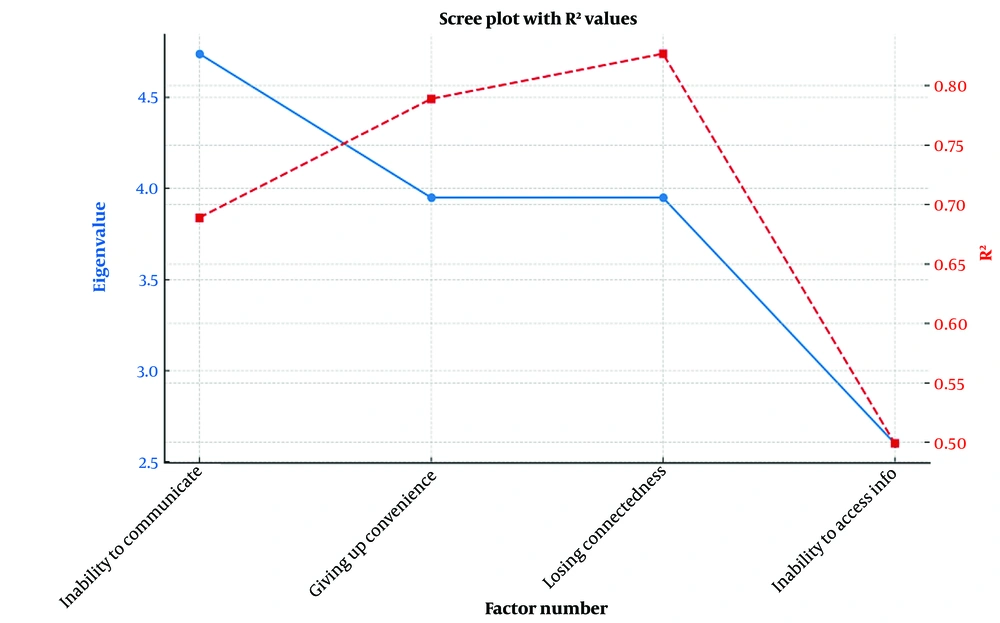
Figure 1.
Scree plot and R2 values of the Nomophobia Questionnaire (NMP-Q) components
Among these, inability to communicate showed the highest eigenvalue (4.74), explaining approximately 68.9% of the variance (R2 = 0.689). This was followed by losing connectedness and giving up convenience, both with an eigenvalue of 3.95, explaining 82.7% (R2 = 0.827) and 78.9% (R2 = 0.789) of the variance, respectively. Inability to access information had the lowest eigenvalue (2.6), but still accounted for a considerable proportion of the variance (R2 = 0.499).
Visual inspection of the scree plot (Figure 1) revealed a clear inflection point after the fourth factor, confirming the four-factor solution as both statistically and theoretically appropriate. The alignment between eigenvalues and R2 coefficients further supports the structural integrity and discriminant clarity of the extracted components, reinforcing the factorial validity of the instrument.
4.3. Confirmatory Factor Analysis
This section reports the CFA results to evaluate the construct validity and reliability of the NMP-Q. Figure 2 displays the standardized factor loadings and t-values for the four dimensions of the nomophobia construct: Inability to access information, giving up convenience, inability to communicate, and losing connectedness. All factor loadings exceeded the 0.60 threshold, indicating strong associations between each dimension and the overall construct. Corresponding t-values were all above 2.56, suggesting that these associations were statistically significant at the 0.01 level.
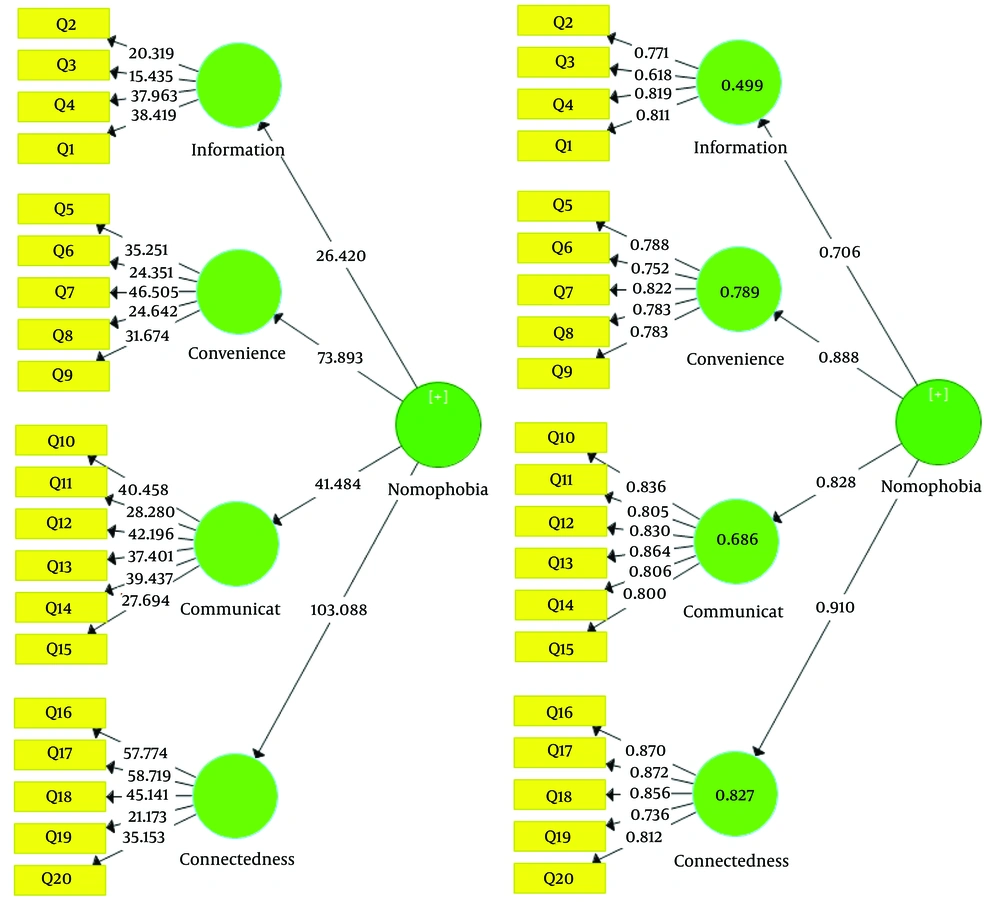
Figure 2.
Standardized factor loadings and t-values for the dimensions of nomophobia
4.4. Reliability and Validity
This research considers various types of validity, including factor loadings, convergent validity (AVE), and discriminant validity. There is no consensus among scholars regarding the minimum acceptable value for factor loadings. In this study, a factor loading below 0.60 is considered weak. According to the results presented in Table 3, the t-values for all dimensions and items exceed 2.56 (t > 2.56), and the factor loadings for all dimensions and items are greater than 0.60. This indicates that the dimensions of the 'Nomophobia' variable exhibit significant and acceptable correlations with their respective variables at the 0.01 significance level. The same holds for the items related to each dimension. Specifically, the items in the 'Inability to Access Information' dimension show a significant and acceptable correlation with their respective items. Similarly, the items in the other dimensions — 'Giving Up Convenience', 'Inability to Communicate', and 'Loss of Connectedness' — also demonstrate significant and acceptable correlations with their corresponding items.
Table 3.Reliability and Validity
| Variables; Factors | Number | Questions for Each Factor | AVE | R2 | CR | Cronbach's Alpha |
|---|---|---|---|---|---|---|
| Nomophobia | 20 | - | 0.50 | - | 0.94 | 0.93 |
| Not being able to access information | 4 | 1-2-3-4 | 0.57 | 0.49 | 0.84 | 0.75 |
| Giving up convenience | 5 | 5-6-7-8-9 | 0.61 | 0.78 | 0.89 | 0.84 |
| Not being able to communicate | 6 | 10-11-12-13-14-15 | 0.67 | 0.68 | 0.92 | 0.90 |
| Losing connectedness | 5 | 16-17-18-19-20 | 0.69 | 0.82 | 0.91 | 0.88 |
Abbreviations: AVE, average variance extracted; CR, composite reliability.
Convergent validity was assessed through AVE, with all values exceeding the recommended minimum of 0.50. The highest AVE was observed for the losing connectedness dimension (AVE = 0.69), while the lowest was for inability to access information (AVE = 0.57), indicating acceptable convergent validity across all dimensions. In terms of reliability, the CR values for all dimensions were greater than 0.90, reflecting excellent internal consistency. Additionally, Cronbach’s alpha values ranged from 0.75 to 0.90, confirming the consistency of items within each subscale. The highest alpha was for the inability to communicate dimension (α = 0.90), and the lowest was for inability to access information (α = 0.75).
Table 3 summarizes the R2 values for each dimension. The overall Nomophobia construct explained: 49.9% of the variance in inability to access information (R2 = 0.499), 78.9% of the variance in giving up convenience (R2 = 0.789), 68.9% of the variance in inability to communicate (R2 = 0.689), and 82.7% of the variance in losing connectedness (R2 = 0.827). These results provide strong evidence of the model’s explanatory power.
4.5. Divergent Validity
Table 4 presents the results for discriminant validity. Diagonal values (highlighted) were greater than the inter-construct correlations, indicating that each dimension was more strongly correlated with its items than with items from other dimensions, thus confirming adequate discriminant validity.
Table 4.Differential Validity
| Variables | Not Being Able to Communicate | Losing Connectedness | Giving Up Convenience | Not Being Able to Access Information |
|---|---|---|---|---|
| Not being able to communicate | 0.824 | - | - | - |
| Losing connectedness | 0.667 | 0.831 | - | - |
| Giving up convenience | 0.589 | 0.738 | 0.786 | - |
| Not being able to access information | 0.451 | 0.562 | 0.669 | 0.759 |
Content validity was assessed using CVR and CVI indices from a panel of 10 experts (Table 5). All items had acceptable CVR values (≥ 0.60) and I-CVI values ranging from 0.80 to 1.00. The average scale-level CVI (S-CVI/Ave) was 0.885, and the Universal Agreement Index (S-CVI/UA) was 1.00, confirming that the items met required standards for content validity.
Table 5.Content Validity Ratio and Content Validity Index for the Nomophobia Questionnaire
| Factors | Ne (Number of Experts Who Considered It Essential) | CVR | I-CVI |
|---|---|---|---|
| 1 | 9 | 0.8 | 0.9 |
| 2 | 10 | 1.0 | 1.0 |
| 3 | 8 | 0.6 | 0.8 |
| 4 | 10 | 1.0 | 1.0 |
| 5 | 10 | 1.0 | 1.0 |
| 6 | 8 | 0.6 | 0.8 |
| 7 | 8 | 0.6 | 0.8 |
| 8 | 8 | 0.6 | 0.8 |
| 9 | 8 | 0.6 | 0.8 |
| 10 | 10 | 1.0 | 1.0 |
| 11 | 9 | 0.8 | 0.9 |
| 12 | 8 | 0.6 | 0.8 |
| 13 | 10 | 1.0 | 1.0 |
| 14 | 8 | 0.6 | 0.8 |
| 15 | 9 | 0.8 | 0.9 |
| 16 | 8 | 0.6 | 0.8 |
| 17 | 9 | 0.8 | 0.9 |
| 18 | 10 | 1.0 | 1.0 |
| 19 | 8 | 0.6 | 0.8 |
| 20 | 9 | 0.8 | 0.9 |
Abbreviation: CVR, content validity ratio.
Based on the results of Table 6, the CFA model demonstrated a good fit to the data: Root mean square error of approximation (RMSEA) = 0.017, NFI = 0.95, Non-normed Fit Index (NNFI) = 0.99, Comparative Fit Index (CFI) = 0.99, Goodness of Fit Index (GFI) = 0.95, and Adjusted Goodness of Fit Index (AGFI) = 0.88. All indices fall within acceptable thresholds, supporting the adequacy of the model.
Table 6.Fit Indices of the Confirmatory Factor Analysis for the Nomophobia Questionnaire
| Index Name | Fit Index Value |
|---|---|
| Chi-square statistic | 182.80 |
| RMSEA | 0.017 |
| NFI | 0.95 |
| NNFI | 0.99 |
| CFI | 0.99 |
| GFI | 0.95 |
| AGFI | 0.88 |
Abbreviations: RMSEA, root mean square error of approximation; NFI, Normed Fit Index; NNFI, Non-normed Fit Index; CFI, Comparative Fit Index; GFI, Goodness of Fit Index; AGFI, Adjusted Goodness of Fit Index.
5. Discussion
This study aimed to assess the psychometric properties of the NMP-Q among Iranian medical students. The findings revealed that the questionnaire demonstrates good internal consistency and construct validity, making it a reliable tool for measuring the severity of nomophobia in this population. In recent years, mobile phones have evolved beyond their original purpose of fulfilling professional needs, becoming multifunctional devices. These devices are especially popular among the younger generation due to their wide range of services and capabilities (29). Michael Hanley (30) predicted that in the next four years, mobile phones would become an integral part of young people's lives and, consequently, a significant social issue. Hanley argued that the basic social need for young people to communicate is increasingly fulfilled through mobile phones and the development of mobile phone addiction, especially among individuals aged 18 - 24, could interfere with essential aspects of personal growth, such as nurturing talents (31).
In this context, there is a growing need for standardized tools to assess the severity of nomophobia and guide appropriate interventions, particularly given the rapid spread of information and communication technologies, especially among young people and students, who are at the forefront of smartphone usage. To evaluate the construct validity, EFA was conducted. The results of the EFA revealed that the questionnaire consists of four distinct factors.
5.1. Not Being Able to Access Information
This factor includes four items (questions 1 - 4) that reflect the anxiety and frustration participants experience when they are unable to access information via their smartphones. This reflects the importance of smartphones as a key tool for obtaining information in everyday life.
5.2. Giving Up Convenience
The second factor includes five items (questions 5 - 9) and represents the discomfort and loss of convenience participants feel when they are unable to use their smartphone for personal or professional tasks. This includes concerns about battery life and the need to keep the phone charged.
5.3. Not Being Able to Communicate
Six items (questions 10- 1 5) are associated with this factor, which pertains to the anxiety of being unable to communicate immediately with others, either through calls or messaging services. This factor underscores the importance of connectivity in modern social interactions.
5.4. Losing Connectedness
The final factor includes five items (questions 16 - 20), which relate to feelings of disconnection from one's social identity, particularly in online communities and social networks. Participants expressed concerns about losing their online presence or the ability to maintain digital connections.
These four factors align with the theoretical model of nomophobia proposed by Yildirim and Correia (16) and are consistent with previous studies. In their research, Yildirim and Correia (16) identified four key dimensions of nomophobia, which are largely reflected in the current study's findings. This study showed that the NMP-Q produces valid and reliable scores, making it a useful tool for evaluating the severity of nomophobia.
Nomophobia, as described in the literature, is characterized by the anxiety people experience when they are unable to access their mobile phones. This anxiety can stem from various situations, such as losing a phone, missing a call, or experiencing technical failures like a dead battery or lack of network coverage (32). According to a study by the British Post Office, nearly 58% of men and 48% of women report feeling panic when their phone is malfunctioning. Furthermore, 9% of participants experience symptoms of anxiety when their phones are turned off, out of battery, or out of network coverage (33).
Several studies have indicated that younger generations are more susceptible to nomophobia than older adults, with mobile phones playing a central role in shaping their interactions with the world around them (34). Research by Elhai et al. (35) also found that people tend to use their mobile phones excessively as a means of escaping reality, either to cope with boredom or to avoid emotionally challenging situations. Furthermore, studies such as that of Navabi et al. (36) highlight how young people may use their phones as a means of gaining control over their communication, particularly in online interactions, where they feel a greater sense of autonomy (37).
Despite these strengths, the study has limitations. The sample was drawn exclusively from Ilam University of Medical Sciences, limiting generalizability to broader populations. Cultural, regional, and institutional factors may influence how individuals experience and express nomophobia. Moreover, the cross-sectional design restricts causal interpretations regarding the associations between nomophobia and psychological variables. It is recommended that future studies validate the Persian version of the NMP-Q in diverse populations to enhance its generalizability. Additionally, longitudinal studies are needed to examine changes in nomophobia over time and evaluate intervention effects. Finally, investigating the associations between nomophobia and mental health constructs such as anxiety, depression, self-esteem, and interpersonal sensitivity could provide valuable insights into the psychological mechanisms underlying this emerging phenomenon.
5.5. Conclusions
The results of this study demonstrate that the NMP-Q is a valid and reliable tool for assessing nomophobia among Iranian students. Given its high reliability and ease of use, this questionnaire can be effectively employed in research and clinical settings.

