
1. Background
Patients in intensive care are exposed to alarms, staff conversations, equipment noise, and repeated clinical procedures. These stimuli may disrupt rest and exacerbate fear, stress, or agitation, all of which can interfere with monitoring and treatment (1, 2). Nonpharmacological approaches that reduce the salience of environmental sound are therefore of interest as adjuncts to routine care.
White noise has a specific acoustic meaning: it is a broadband signal with approximately equal power across frequencies. Recordings of rain, ocean waves, or running water are natural soundscapes with distinct spectral and temporal properties and should not automatically be classified as white noise (3, 4). This distinction is important for reproducibility and comparison with previous trials.
Studies of white noise and related auditory interventions have reported variable effects on sleep, pain, anxiety, heart rate, and oxygen saturation across populations (5-8). These findings cannot be directly extrapolated to critically ill adults because intervention content, volume, duration, clinical context, and comparator conditions differ substantially.
A brief sound-based intervention is attractive in the intensive care unit (ICU) because it is nonpharmacological and inexpensive. Nevertheless, headphones and auditory stimulation may cause discomfort, reduce awareness of staff communication, or increase sensory load. The content and sound level therefore require careful characterization and monitoring (9, 10).
Agitation is clinically important but may result from pain, delirium, hypoxemia, withdrawal, medication effects, neurological impairment, or environmental stress. A reduction in an agitation score is not automatically beneficial if the patient transitions to a negative sedation category. Behavioral findings should therefore be interpreted in conjunction with the clinical context and physiological observations.
The present trial evaluated the immediate response to a single 30-minute afternoon session of a composite nature-sound recording delivered through headphones. Because the recording was not acoustically verified as broadband white noise, the intervention is described throughout this report as a headphone-delivered natural soundscape.
2. Objectives
The primary objective was to compare the Richmond Agitation-Sedation Scale (RASS) score immediately after the 30-minute study period between patients assigned to the natural-soundscape intervention and those assigned to routine care. Heart rate, systolic and diastolic blood pressure, mean arterial pressure, and peripheral oxygen saturation (SpO2) were assessed as exploratory secondary outcomes.
3. Methods
3.1. Study Design and Participants
This parallel randomized clinical trial was conducted from April through July 2025 in the ICUs of Shohadaye Tajrish Hospital, a teaching hospital affiliated with Shahid Beheshti University of Medical Sciences in Tehran, Iran. Eligible participants were 18 - 68 years old, had a Glasgow Coma Scale score of 7 - 10, had no documented hearing impairment, and were not receiving medication intended to induce deep sleep. The protocol allowed withdrawal after death, withdrawal of consent, ICU discharge or transfer, surgery, or a diagnostic procedure before completion of the post-assessment.
The trial records available for this report did not include a standardized delirium assessment, pain score, withdrawal assessment, illness-severity score, ventilation status, diagnosis category, or detailed information on sedative and analgesic exposure. Agitation was managed clinically by the ICU team; however, the causes of agitation were not classified for research purposes. These omissions limit clinical characterization and the ability to distinguish agitation from delirium, pain, hypoxemia, medication effects, or neurological impairment.
3.2. Sample Size and Outcome Hierarchy
The original sample size calculation used a two-sided alpha of 0.05, 80% power, equal allocation, and an anticipated standardized between-group effect size of 0.70 for comparison of two independent means. This yielded 34 participants per group; the target was increased to 38 per group to allow for attrition (11). In the revised reporting hierarchy, immediate post-assessment RASS is identified as the primary outcome, whereas the physiological variables are exploratory. The original calculation was not based on a RASS-specific minimal clinically important difference, which is acknowledged as a limitation.
3.3. Randomization and Allocation Concealment
Participants were assigned in a 1:1 ratio using a computer-generated variable-block sequence with block sizes of four and six in random order. The sequence was not available to enrollment personnel until an eligible participant had completed the baseline assessment. Because the intervention required headphone-delivered audio, participants and personnel could not be fully masked after allocation.
3.4. Intervention and Comparator
Before each session, the Environmental Health Unit measured ambient ward sound. Practical noise-reduction measures were implemented when needed, and the session began only when the measured ambient level was no greater than 65 dB. Sessions were scheduled between 4:00 and 5:00 p.m.
Intervention participants listened through headphones for 30 minutes to a composite recording containing ocean waves, rainfall, and running water. No spectral analysis was performed; therefore, the recording cannot be verified as white noise. The same recording and session duration were used for all intervention participants, and the researcher checked for discomfort or sensory overload. The source file, file format, spectral characteristics, playback device, headphone model, and calibrated participant-level sound-pressure level were not retained in the study records, and adherence beyond completion of the 30-minute session was not quantified.
Control participants received routine ICU care without study headphones or comparison audio. Both groups underwent the same scheduled pre- and post-assessments, but the comparator was not attention-matched: intervention participants received additional contact related to headphone placement and tolerance. The design therefore evaluates the complete intervention package and does not isolate the recording content from headphone use, ward-noise attenuation, or researcher attention.
3.5. Outcome Measures
RASS immediately after the 30-minute period was the primary outcome. RASS ranges from -5 (unarousable) to +4 (combative); positive values indicate agitation, 0 indicates an alert and calm state, and negative values indicate increasing sedation. Scores from +2 to +4 indicate clinically important agitation. The scale is ordinal. Mean ± SD values are retained because only the original aggregate summaries were available, whereas the original rank-based tests were retained for inference. Category-level frequencies, assessor identity across time points, and inter-rater reliability were not available.
Exploratory outcomes were systolic blood pressure, diastolic blood pressure, mean arterial pressure, heart rate, and SpO2. Blood pressure and SpO2 were measured with calibrated Saadat devices (Saadat Co., Tehran, Iran), and heart rate was obtained from a calibrated Saadat ECG monitor. RASS and physiological measurements were recorded immediately before and immediately after the study period using a standardized sequence. Medications, procedures, repositioning, and nursing interventions delivered during the 30-minute interval were not recorded in the trial dataset.
3.6. Ethical Considerations
The Ethics Committee of the Islamic Azad University, Tehran Medical Sciences, approved the study (IR.IAU.TMU.REC.1403.396). The protocol was registered in the Iranian Registry of Clinical Trials on April 17, 2025 (IRCT20250406065224N1). Written informed consent was obtained from participants or their legal representatives, as appropriate. Participation was voluntary, withdrawal did not affect clinical care, and study information was handled confidentially.
3.7. Statistical Analysis
Continuous variables are summarized as mean ± SD, and categorical variables as number and percentage. The original analysis assessed distributional assumptions with the Kolmogorov-Smirnov test and used independent-samples t tests or Mann-Whitney U tests for between-group comparisons, paired-samples t tests or Wilcoxon signed-rank tests for within-group comparisons, and chi-square or Fisher exact tests for categorical variables. For the revised presentation, the randomized treatment contrast is emphasized by reporting unadjusted post-assessment mean differences with 95% confidence intervals for key comparisons. Mean changes are reported descriptively when paired-change variability was unavailable.
The analysis was complete-case and included 70 of 76 randomized participants. No imputation was performed because no post-assessment outcomes were available for the six participants who did not complete follow-up. Participant-level data and baseline-outcome covariance were not available for this revision; therefore, a valid baseline-adjusted analysis of covariance (ANCOVA) and an intention-to-treat missing-data analysis could not be reconstructed from the aggregate summaries. No multiplicity adjustment was applied; all physiological findings are exploratory. Analyses were performed in SPSS version 22, and two-sided P < 0.05 was used as a descriptive threshold.
4. Results
4.1. Participant Flow
Ninety ICU patients were screened, and 14 did not meet the eligibility criteria. Seventy-six participants were randomized (38 per group). Three participants in each group had no post-assessment data. The specific group-level reasons were not retained in the study records, and no post-randomization outcome data were available for these six participants. The complete-case analysis included 35 participants in each group (Figure 1).
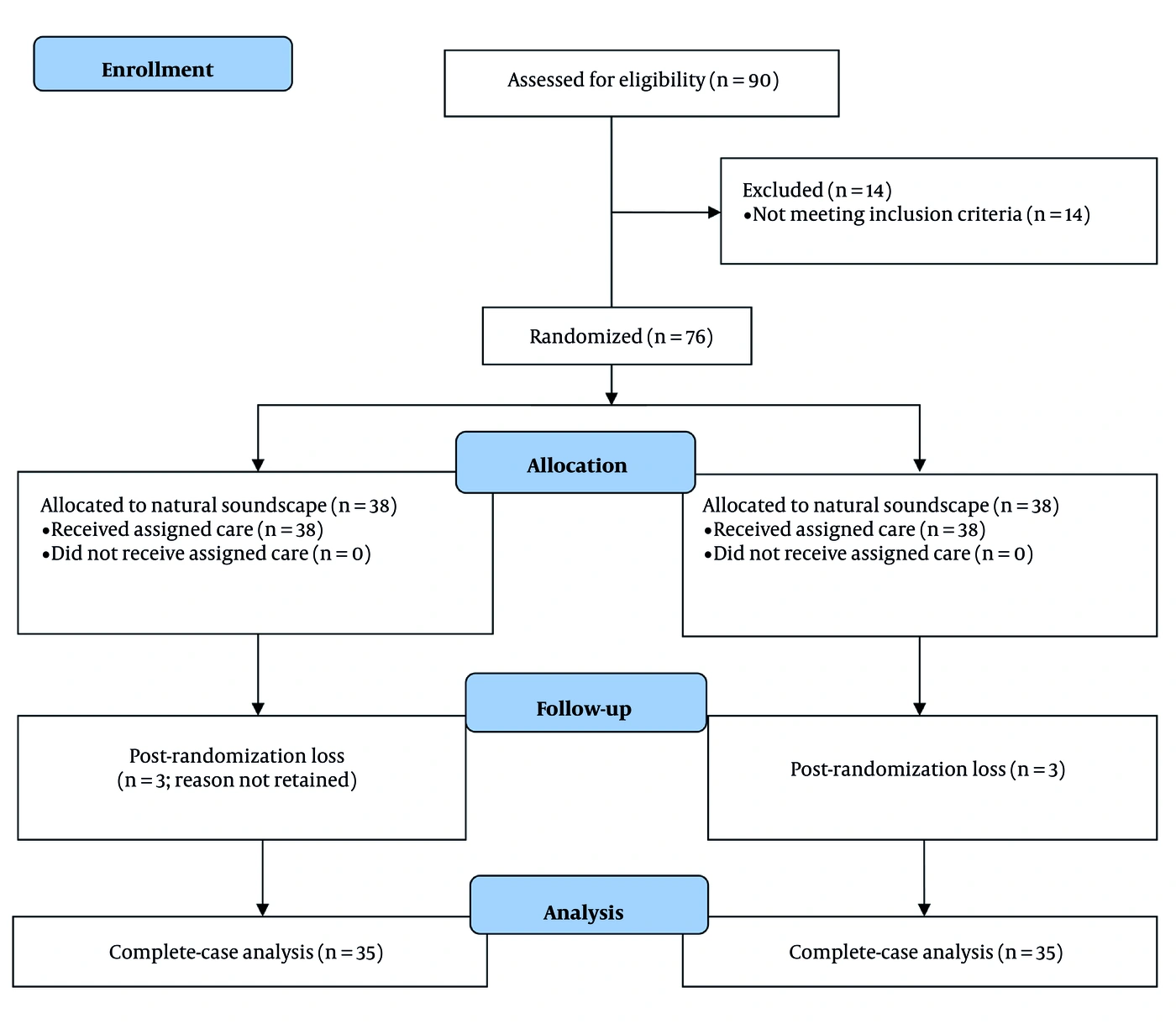
Figure 1.
CONSORT flow diagram (complete-case analysis)
4.2. Baseline Characteristics
The mean age was 47.26 ± 12.26 years in the intervention group and 45.66 ± 14.98 years in the control group (P = 0.626). Women comprised 48.6% and 34.3% of the groups, respectively (P = 0.225). No additional baseline clinical variables were available (Table 1).
Table 1.
Available Baseline Characteristics of the Study Groups a
| Characteristic | Intervention (n = 35) | Control (n = 35) | P-Value |
|---|---|---|---|
| Age, y | 47.26 ± 12.26 | 45.66 ± 14.98 | 0.626 |
| Women | 17 (48.6) | 12 (34.3) | 0.225 |
| Men | 18 (51.4) | 23 (65.7) |
a Values are expressed as mean ± SD or No. (%). Age was compared with an independent-samples t test; sex was compared with a chi-square test. Additional clinical baseline variables were not available.
4.3. Primary Outcome: Agitation
The mean RASS changed from 2.97 ± 1.10 to -0.91 ± 1.64 in the intervention group and from 3.00 ± 1.13 to -0.03 ± 0.85 in the control group. The descriptive mean changes were -3.88 and -3.03, respectively, yielding a between-group difference in mean change of -0.85 points. At post-assessment, the unadjusted mean difference was -0.88 (95% CI, -1.50 to -0.26; original Mann-Whitney U test P < 0.001) (Table 2). Because category frequencies were unavailable, the numbers of participants who became alert/calm or entered individual negative sedation categories could not be determined.
Table 2.
Primary Outcome: RASS Before and After the 30-Minute Study Period a
| Assessment | Intervention (n = 35) | Control (n = 35) | Unadjusted Difference | P-Value |
|---|---|---|---|---|
| Before | 2.97 ± 1.10 | 3.00 ± 1.13 | -0.03 | 0.742 |
| After | -0.91 ± 1.64 | -0.03 ± 0.85 | -0.88 (95% CI, -1.50 to -0.26) | < 0.001 |
| Mean change | -3.88 | -3.03 | -0.85 | Not calculated |
a Values are expressed as mean ± SD unless otherwise indicated. RASS is ordinal. P values are from the original Mann-Whitney U tests. The post-assessment confidence interval is an unadjusted difference in means. The difference in mean change is descriptive because the SD of paired change was unavailable. Abbreviations: CI, confidence interval; RASS, Richmond Agitation-Sedation Scale.
4.4. Exploratory Physiological Outcomes
At baseline, systolic blood pressure, diastolic blood pressure, mean arterial pressure, and heart rate did not differ statistically between groups. Baseline SpO2 was lower in the intervention group (88.74 ± 2.13% vs 90.26 ± 3.67%; P = 0.039).
After the study period, the unadjusted between-group differences were 8.26 mmHg for systolic blood pressure (95% CI, -3.04 to 19.56; P = 0.149), -0.17 mmHg for diastolic blood pressure (95% CI, -4.87 to 4.53; P = 0.943), and 0.00 mmHg for mean arterial pressure (95% CI, -4.91 to 4.91; P = 1.000). Heart rate was lower in the intervention group by 8.03 beats/min (95% CI, -9.93 to -6.13; P < 0.001). SpO2 was lower in the intervention group by 2.52 percentage points (95% CI, -4.12 to -0.92; P = 0.003) (Table 3). Descriptive mean changes were -9.37 versus -2.08 beats/min for heart rate and +3.40 versus +4.40 percentage points for SpO2 in the intervention and control groups, respectively.
Table 3.
Exploratory Physiological Outcomes Before and After the 30-Minute Study Period a
| Variables | Intervention pre | Control pre | Pre P | Intervention post | Control post | Difference (95% CI); P |
|---|---|---|---|---|---|---|
| Systolic BP (mmHg) | 155.09 ± 19.89 | 146.46 ± 26.65 | 0.129 | 147.57 ± 20.33 | 139.31 ± 26.63 | 8.26 (-3.04 to 19.56); P = 0.149 |
| Diastolic BP (mmHg) | 77.63 ± 9.94 | 77.86 ± 9.20 | 0.921 | 74.46 ± 10.35 | 74.63 ± 9.35 | -0.17 (-4.87 to 4.53); P = 0.943 |
| Mean arterial pressure (mmHg) | 103.45 ± 10.04 | 103.45 ± 10.04 | 1.000 | 98.83 ± 10.29 | 98.83 ± 10.29 | 0.00 (-4.91 to 4.91); P = 1.000 |
| Heart rate (beats/min) | 93.40 ± 3.60 | 94.14 ± 3.82 | 0.531 | 84.03 ± 3.84 | 92.06 ± 4.12 | -8.03 (-9.93 to -6.13); P < 0.001 |
| SpO2 (%) | 88.74 ± 2.13 | 90.26 ± 3.67 | 0.039 | 92.14 ± 2.52 | 94.66 ± 4.01 | -2.52 (-4.12 to -0.92); P = 0.003 |
a Values are expressed as mean ± SD unless otherwise indicated. Post-assessment differences are intervention minus control and are unadjusted. Secondary outcomes are exploratory; no multiplicity adjustment was applied. Abbreviations: BP, blood pressure; CI, confidence interval; SpO2, peripheral oxygen saturation.
5. Discussion
This trial compared a 30-minute headphone-delivered natural soundscape with routine ICU care. The primary complete-case comparison showed a lower post-assessment RASS in the intervention group, and exploratory analysis showed a lower post-assessment heart rate. Blood pressure outcomes did not differ, and the SpO2 finding favored the control group in the context of baseline imbalance.
The RASS result requires cautious clinical interpretation. Both groups shifted from mean scores near +3 to values at or below 0 within 30 minutes, including a large improvement under routine care. This pattern may reflect natural fluctuation, regression to the mean, routine medication or nursing care, reduced stimulation during observation, or reactivity to repeated assessment. In addition, negative RASS values indicate sedation rather than a uniformly therapeutic benefit. Without category frequencies and concurrent-treatment data, the proportions of participants who became alert and calm versus sedated cannot be determined.
Auditory interventions have produced mixed physiological findings across populations. Some studies report changes in pain, anxiety, heart rate, or oxygenation, whereas others show limited or inconsistent hemodynamic effects (5, 6, 12-15). Differences in acoustic content, volume, exposure duration, patient population, and comparator design make direct comparison difficult. The current recording was a natural soundscape rather than verified white noise; therefore, mechanistic claims regarding broadband white-noise masking are not justified.
The lower heart rate may be compatible with reduced arousal, but the present design cannot attribute the difference specifically to the natural sounds. Headphones may attenuate ward noise, the intervention required additional researcher contact, and expectation or comfort effects were not controlled. A sham-headphone or attention-matched comparator is needed to identify the active component.
The absence of between-group differences in blood pressure suggests that any immediate cardiovascular response was not consistent across physiological measures. The SpO2 result should not be interpreted as harm or benefit because the groups differed before the session and no baseline-adjusted model was available. Studies of ICU sound and light also show that measured exposure and perceived disturbance may diverge, underscoring the need for both acoustic and patient-reported measurements (16).
Clinically, a tolerated natural soundscape may be considered only as a supportive adjunct. It should not replace the evaluation and treatment of pain, delirium, hypoxemia, withdrawal, medication effects, or neurological causes of agitation. Future trials should register a single primary endpoint, retain participant-level data, document concurrent care and illness severity, calibrate ear-level sound exposure, use an attention-matched headphone control, and analyze outcomes using baseline-adjusted intention-to-treat methods.
5.1. Study Limitations
This single-center study assessed one immediate session and provides no evidence regarding durability. The recording source, format, spectral profile, headphone model, and calibrated ear-level sound level were not retained. Baseline diagnosis, ICU type, ventilation status, delirium, pain, illness severity, medication exposure, comorbidities, and interventions during the observation period were not collected for analysis. The comparator did not control for headphones, noise attenuation, expectation, or additional researcher contact. Six randomized participants were excluded from the complete-case analysis, and specific reasons for attrition were not retained. RASS category distributions and assessor reliability were unavailable. Finally, baseline-adjusted and intention-to-treat analyses could not be reconstructed from aggregate summaries, and multiple exploratory outcomes were assessed without multiplicity correction.
5.2. Conclusions
The complete headphone-delivered natural soundscape intervention was associated with lower unadjusted post-assessment RASS and heart rate than routine care in the 70 participants with complete data. No additional effect was observed for blood pressure or mean arterial pressure, and SpO2 remained higher in the control group. Because of the large control-group RASS change, lack of acoustic verification, incomplete clinical characterization, unmatched comparator, missing post-randomization data, and absence of baseline-adjusted intention-to-treat analysis, the findings should be considered exploratory rather than confirmatory.