
1. Background
Neurodevelopmental disorders (NDDs) are a class of disorders that emerge during early development and substantially affect cognitive, social, and emotional functioning. The DSM-5-TR identifies NDDs as autism spectrum disorder (ASD), attention-deficit/hyperactivity disorder (ADHD), intellectual disability (ID), learning disorders (LD), and communication disorders (1). The worldwide prevalence of NDDs ranges from 4.70% to 88.50%. In Iran, data on the prevalence of ASD and ADHD also indicate high rates. NDDs have high comorbidity rates and substantial phenotypic overlap, suggesting a common neurodevelopmental origin. Recent advances in genetics may improve the identification and classification of these disorders (2, 3).
Caregivers of children with NDDs experience higher levels of stress than caregivers of typically developing children. This stress is largely attributable to children’s behavioral difficulties and caregiving demands (4). Parents play a crucial role in providing support through rehabilitation and education to mitigate disability and improve development and quality of life (5). However, caregiving demands may also lead to psychosocial problems, such as anxiety and depression, and may negatively affect parental functioning and child development (6). Interventions that promote parental resilience and well-being can reduce stress and improve quality of life for both parents and children (7). Supporting caregivers is therefore essential for healthy developmental pathways in children with NDDs.
Caregivers of children with NDDs encounter challenges that can adversely affect their physical and psychological health. Caregiving may contribute to long-term physical problems, such as back pain and migraine headaches, as well as other stress-related health concerns (8). Caregivers often report poorer physical health than that of the general population (9). The severity of a child’s behavioral problems may also affect caregivers’ mental health and the family’s ability to function (10).
Research on parental caregivers of children with NDDs has varied by outcome and population, and the caregiving experience has not yet been fully described or synthesized. For example, a scoping review provided insight into caregiver stress and indicated a high prevalence of stress, particularly among caregivers of children with ASD and intellectual disabilities, underscoring the importance of family-centered care (5). A study of rural caregivers in Nepal also documented common mental disorders and substantial psychological distress among caregivers (11).
Despite these findings, important gaps remain in the literature. A scoping review of parents caring for autistic adults noted limited research on diverse social contexts and the longitudinal effects of caregiving (12). The experiences of fathers also remain underexplored because much of the literature focuses on mothers. Further research is needed to examine the complex, interconnected experiences of caregivers from diverse cultural and socioeconomic backgrounds and to inform improvements in support systems.
2. Objectives
This study was conducted to address gaps in the literature on caregivers of children with NDDs and to generate evidence that may inform effective service-delivery mechanisms and educational practices, particularly in Gorgan. Qualitative studies have shown that caregivers in Gorgan face diverse obstacles and that cultural and sociological factors play important roles in shaping their experiences and coping mechanisms. This study aimed to explore parents’ experiences and the unique challenges they face in caring for children with NDDs. By examining these experiences, the study sought to identify factors that may affect caregivers’ physical and psychological well-being. This information may help health care professionals and policymakers improve the quality of life of caregivers and their children and develop targeted interventions that foster a resilient and supportive caregiving environment.
3. Methods
3.1. Study Design and Setting
A conventional qualitative content analysis approach was used to explore parents' lived experiences of caring for children with NDDs. The study was conducted from September 2024 to May 2025. A qualitative methodology was selected to facilitate exploration of the complex, sensitive, and context-dependent nature of caregiving experiences.
3.2. Participants and Sampling
Participants were parents of children diagnosed with NDDs. Parents were referred through a hospital or an affiliated clinic at Golestan Hospital. All diagnoses were established by a licensed neuropsychiatrist using standard diagnostic criteria. Participants were recruited using purposive sampling to identify parents who could provide meaningful and relevant insights into caregiving experiences.
The inclusion criteria were: a) provision of informed consent; b) being the primary caregiver of a child with an NDD; c) providing care for the child at home; and d) having provided care for at least 2 years. The only exclusion criterion was withdrawal from the study at any time.
To ensure maximum variation, participants were selected to represent different parental genders, ages, education levels, occupations, socioeconomic backgrounds, types of NDD diagnoses, and durations of caregiving. This approach was intended to capture a broad range of caregiving experiences and thereby enhance the depth and transferability of the findings.
3.3. Data Collection
Data were collected through in-depth, semi-structured interviews conducted face-to-face or by telephone, according to participants' preferences. Participants selected the time and location of the interviews. Most face-to-face interviews were conducted in the Nursing Instructors' Room at hospital clinics in Gorgan.
At the beginning of each interview, informed consent was obtained, and participants were asked to briefly introduce themselves. Demographic and contextual information was then collected, including the type of NDD; the child's age, birth order, and gender; and the parent's age, education, and occupation. The primary interview questions were:
"Could you describe your experiences of caring for your child with an NDD at home?"
"What challenges do you face while caring for your child?"
To deepen understanding of participants' perspectives, probing questions such as "What type of care does your child require?" and "What factors contribute to your stress while caregiving?" were used. Additional exploratory prompts, such as "Could you elaborate on this?", encouraged richer descriptions.
The interviews had a mean duration of 52.66 minutes (SD = 15.67). They were conducted by F.T., a doctoral nursing student who had previously conducted qualitative interviews in five studies. The interviewer was trained in qualitative research methods and was supervised throughout the study by two senior qualitative researchers to support ethical sensitivity, methodological rigor, and consistency in interviewing. Each interview was recorded and transcribed verbatim after completion to support ongoing analysis and subsequent interviews.
3.4. Data Analysis
Data analysis was conducted concurrently with data collection and was guided by the content analysis framework developed by Elo and Kyngäs (13). The analysis involved three phases: open coding, categorization, and abstraction. First, the authors immersed themselves in the data by repeatedly reading the transcripts. During open coding, meaning units were identified and coded using OneNote software, and all codes were systematically documented. All authors independently reviewed and discussed the codes to strengthen rigor and incorporate multiple interpretive perspectives. During category development, codes were grouped into subcategories and categories according to similarities and differences. Similar categories were consolidated to reduce redundancy and improve conceptual clarity. At this stage, the coauthors critically assessed the data for potential bias and refined the analysis.
During abstraction, subcategories and main categories were synthesized to develop a comprehensive understanding of the caregiving experience. Each category was assigned a label that best represented its central concept and the meaning of the underlying data. Data analysis involved repeated cycles of review and modification to develop a comprehensive and coherent presentation of the findings (14).
3.5. Trustworthiness
The authors sought to enhance credibility through prolonged engagement with participants, relationship building, and member checking with selected participants (P1, P7, P9, P10, and P13) to confirm the accuracy of coding and categorization.
Dependability and confirmability were supported through ongoing monitoring and peer debriefing by faculty advisors, who reviewed and critiqued interview transcripts and analytic decisions throughout the study. Data collection and analysis included an extended period of interaction with the data (5 months). Transferability was supported by achieving maximum variation in participant characteristics, including gender, age, NDD type, and duration of caregiving experience.
3.6. Ethical Considerations
Ethical approval was obtained from the Research Ethics Committee of Golestan University of Medical Sciences (IR.GOUMS.REC.1402.474). Written informed consent was obtained from all participants. Anonymity was maintained throughout the research process. Audio recordings were kept confidential and deleted after transcription.
4. Results
4.1. Participant Characteristics
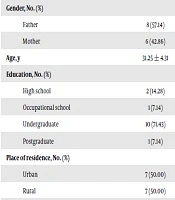
A total of 13 parents participated in the study, including 5 fathers (38.46%). Most parents were cohabiting (12, 92.3%), whereas only 1 parent, participant P8, was divorced. Participant characteristics are presented in Table 1.
Table 1.
Participant Characteristics a
| Participant Number | Type of NDD | Age of Affected Child (y) | Child Order and Gender | Parent, Age (y) | Parents' Occupations |
|---|---|---|---|---|---|
| 1 | Intellectual disability (ID) | 5 | Only child; B | M, 27 | Mother: nurse; Father: farmer |
| 2 | Autism spectrum disorder (ASD) | 13 | Second of two; G, B | F, 43 | Mother: housewife; Father: employee |
| 3 | Attention-deficit/hyperactivity disorder (ADHD) | 8 | Second of two; B, B | M, 35 | Mother: housewife; Father: farmer |
| 4 | Learning disorders | 9 | First of two; B, G | M, 33 | Mother: housewife; Father: worker |
| 5 | Communication disorders | 3 | First of two; B, G | M, 22 | Mother: employed; Father: employee |
| 6 | ADHD | 6 | First of two; B, B | M, 29 | Mother: housewife; Father: worker |
| 7 | ASD | 17 | Third of three; G, G, G | F, 57 | Mother: housewife; Father: employee |
| 8 | Learning disorders | 12 | Only child; B | F, 44 | Mother: housewife; Father: teacher |
| 9 | Intellectual disability | 15 | Second of two; B, B | M, 41 | Mother: housewife; Father: employee |
| 10 | ASD | 4 | Second of two; B, B | M, 27 | Mother: employee; Father: employee |
| 11 | Communication disorders | 4 | Only child; B | F, 22 | Mother: housewife; Father: worker |
| 12 | Learning disorders | 8 | Third of three; G, B, B | M, 33 | Mother: worker; Father: worker |
| 13 | ADHD | 5 | Only child; G | F, 46 | Mother: teacher; Father: employee |
a Abbreviations: B, boy; G, girl; M, mother; F, father.
4.2. Categories and Subcategories of Content Analysis
The analysis yielded 3 categories—emotional disconnection, financial distress, and social dissociation—with 7 subcategories under the overarching theme of burden of care (Table 2).
Table 2.
Categories and Subcategories of Content Analysis
| Theme | Categories | Subcategories | Codes |
|---|---|---|---|
| Burden of care | Emotional disconnection | Parental aggression | Mother's nerve-wracking battle; mother's anxiety following the affected child's behavior; father's anger at the affected child's unconventional behaviors; father's lack of peace at home because of the child's abnormal behaviors. |
| Burden of care | Emotional disconnection | Parental helplessness and inability | Mother's inability to care for the child at home; mother's exhaustion from household chores; mother feeling overwhelmed by discouraging words from speech therapy; complaints to God about living conditions; feeling that the world has collapsed; feeling that parents are aging because of caring for a sick child; every day feels like a century; father's complaint about divine fate; complaints and sadness expressed to God about the child's condition; feeling forced to keep going. |
| Burden of care | Emotional disconnection | Parental confusion | Uncertainty about whether to give medication to the affected child; confusion following contradictory statements from physicians; failure to use medications prescribed by the psychiatrist; lack of belief in medication effectiveness; not obtaining prescribed medication after a pharmacist discussed adverse effects; lack of therapeutic coherence following the child's lack of progress; multiple visits to physicians for a final diagnosis; repeated visits to psychiatrists because parents were not convinced by previous diagnoses. |
| Burden of care | Financial distress | Therapeutic expenses | High cost of occupational therapy contributing to nonadherence; high cost of speech therapy contributing to nonadherence; costs of the treatment program; transportation costs for classes; high cost of educational classes for the child. |
| Burden of care | Financial distress | Nontherapeutic expenses | High cost of private tutoring; choosing a private school to reduce the affected child's difficulties; using a private tutor at home when school begins; searching for the best tutors despite financial difficulties; choosing a school suitable for the affected child's needs; sending the child to a private school despite financial problems. |
| Burden of care | Social dissociation | Being rejected by others | Mother feeling hurt by others' comments about the affected child; mother feeling hurt when others compare the child with peers; father feeling upset by mocking looks; concern about others' views and perceptions of the child; emotional pressure on the mother after gatherings with the affected child; mother's embarrassment at gatherings because of the child's inappropriate behavior; negative perceptions of the affected child; parents' discomfort with the school principal's behavior; mother's distress over the child's rejection from preschool; family undervaluing the mother's efforts; mother feeling hurt following complaints about the child's behavior; parents being blamed by the child's private tutor; lack of understanding from others about caregiving challenges; parents feeling misunderstood by others. |
| Burden of care | Social dissociation | Social stigma | Mother's loss of motivation after the child was labeled; mother's anxiety following labeling of the child; not taking the child to preschool because of fear of judgment; mother's distress over disease labels applied to the child; parents' discomfort with the label of an exceptional child; parents' concern about society labeling the child as autistic. |
4.3. Emotional Disconnection
Parents experienced emotional disconnection accompanied by aggression, helplessness and inability, and confusion.
4.3.1. Parental Aggression
An important aspect of emotional disconnection was parental aggression. Parents described a nerve-wracking struggle, anxiety related to the affected child’s behavior, fathers’ anger at unconventional behaviors, and a lack of peace at home due to the child’s abnormal behaviors. One mother stated, "I generally have a nerve-wracking situation both at home and outside." [P3]
4.3.2. Parental Helplessness and Inability
Parents also described helplessness associated with difficulty caring for the affected child at home, exhaustion from household responsibilities, discouraging messages related to speech therapy, complaints to God about living conditions, and feeling that they were aging due to caring for a sick child. One father stated, "In the peak of my youth, both his father and me grew old." [P2]
4.3.3. Parental Confusion
A major challenge was confusion arising from contradictory statements by physicians and uncertainty about whether to administer prescribed medications. Parents described not using medications prescribed by psychiatrists, doubts about medication effectiveness, not obtaining prescribed medications after pharmacists discussed adverse effects, lack of treatment continuity when the child did not improve, and repeated visits to physicians and psychiatrists because they were not satisfied with previous diagnoses. One parent stated, "Doctors each give a different opinion, and we keep changing doctors because of their contradictory statements, leaving us confused." [P7]
4.4. Financial Distress
Parents reported financial distress in two main areas: therapeutic and nontherapeutic expenses.
4.4.1. Therapeutic Expenses
A major challenge for parents of children with different NDDs was the high cost of treatment, including occupational therapy, speech therapy, treatment programs, transportation to classes, and educational classes. In some cases, these expenses contributed to nonadherence to treatment. One mother stated, "At times, like when my daughter was 4 years old, during the middle of her treatment when we had to take her to classes one after another, I really felt overwhelmed and wanted to quit my job. However, due to financial issues and the cost of my daughter's classes, I was afraid of the consequences and continued with my job again." [P1]
4.4.2. Nontherapeutic Expenses
Caring for a child with an NDD imposed not only treatment costs but also nontherapeutic expenses, such as private tutoring and private schooling. Parents sought appropriate schools and tutors despite financial difficulties and sometimes used private tutors at home when school began. One father stated, "Since the beginning of school, we would bring private teachers home for all subjects like science, math, and English." [P8]
4.5. Social Dissociation
Parents reported social dissociation related to caring for a child with an NDD. Two important dimensions were rejection by others and social stigma.
4.5.1. Being Rejected by Others
Rejection by others added to the caregiving burden. Parents described hurtful comments about their children, comparisons with peers, mocking looks, concern about others’ perceptions, emotional pressure after social gatherings, embarrassment about inappropriate behavior, negative perceptions of the child, difficulties with school personnel, preschool rejection, family members undervaluing mothers’ efforts, complaints about the child’s behavior, blame from private tutors, and a general lack of understanding of caregiving challenges. These experiences intensified parents’ sense of burden. One mother stated, "The way people around my daughter look at her with pity when she stutters, or how younger relatives laugh at her, bothers me." [P11]
4.5.2. Social Stigma
Parents also described social stigma toward their affected children. Experiences included loss of motivation and anxiety after labeling, avoiding preschool because of fear of judgment, distress over disease-related labels, discomfort with the label of an exceptional child, and concern about society labeling a child as autistic. One mother stated, "My only concern, as well as his father's, has been and is that he becomes an ordinary member of society and does not get labeled with autism." [P10]
5. Discussion
The overarching theme of the parental burden of caring extends beyond the mere accumulation of challenges and reflects a dynamic, context-dependent lived reality. In this study, parents were not only managing emotional, financial, and social demands in isolation but were continually negotiating interactions among these dimensions within a constrained support environment. Conceptualizing caregiving burden as a multidimensional phenomenon underscores how emotional disconnection, financial distress, and social dissociation reinforce one another and shape parents’ overall caregiving experiences. This finding contributes to the existing literature by framing caregiving burden as a relational and structural experience rather than solely an individual psychological outcome.
A salient finding was the interaction between parental emotional distress and children’s behavioral difficulties, particularly aggressive behaviors. Consistent with previous research, children with NDDs such as ASD and ADHD may exhibit elevated levels of aggression, which can be exacerbated by parental stress and reactive responses (15). In the Iranian context, our findings suggest that parental aggression may be further intensified by limited access to behavioral support services and insufficient parent-training programs. Previous studies have shown that parental stress and behavior can affect child neurodevelopment and family functioning (16). Biological vulnerabilities, such as serotonergic dysregulation in children with ADHD who are exposed to parental aggression, may further contribute to this cycle (17). These findings suggest a bidirectional feedback loop in which both parents and children experience additional stress in the absence of sufficient systemic support.
Feelings of hopelessness and parental inadequacy were also prominent, consistent with studies showing greater hopelessness among parents of children with NDDs, particularly ASD (18). In this study, these feelings were frequently linked to uncertainty about the child’s future and a perceived lack of effective institutional support. Such emotional strain can adversely affect parental mental health and child psychosocial functioning (19). Consistent with the literature, our findings support a bidirectional association between child behavior and parental mental health, whereby parental helplessness may exacerbate behavioral problems in children and create a persistent cycle of distress (20). Our data further suggest that this cycle may be intensified in contexts in which caregiving responsibilities are culturally framed as a moral obligation, leaving parents with limited opportunities to seek external support.
Parents reported persistent anxiety and frustration while seeking appropriate medical services within fragmented health care and education systems. Previous studies, including research conducted during the COVID-19 pandemic, have shown a direct association between caregiving stress and increased anxiety and depression (21). Our findings also support the view that stress among parents caring for children with NDDs is not necessarily greater than that among parents of children with other disabilities (22). Rather, parents’ experiences may vary according to the type of disorder, availability of services, and individual coping resources. These findings reinforce the need to interpret parental stress within its social and systemic context rather than solely as a consequence of the child’s diagnosis.
Financial strain was a central component of caregiving burden. Consistent with previous research, parents reported substantial financial pressure related to therapy, medical care, and supportive services, which were often accessed through private clinics with limited public funding (23). Financial distress was closely intertwined with emotional exhaustion, amplifying parental anxiety and psychological strain (24). Although financial challenges are widely reported among parents of children with NDDs, previous studies suggest that the nature and severity of financial strain can vary according to the child’s diagnosis (22) and family socioeconomic status (23). Our findings extend this literature by illustrating how financial stress in resource-constrained settings can restrict parents’ capacity to sustain long-term caregiving, further reinforcing emotional and social disengagement.
Social disconnection and stigma were also prominent themes. Most parents described social isolation, reduced community engagement, and stigma related to their child’s diagnosis. Although studies differ regarding the degree of social stress experienced by parents of children with autism compared with parents of children with other NDDs (24, 25), this study suggests that social disconnection may depend less on the specific diagnosis than on societal perceptions, attitudes toward the disorder, and limited community education. Perceived social support is associated with parenting stress (26). Community-based, culturally competent, and inclusive initiatives are therefore important for reducing barriers to social support.
5.1. Conclusions
This study expands current understanding of the multiple forms of caregiving burden experienced by parents of children with NDDs. Emotional disconnection, financial distress, and social isolation all contributed to the caregiving burden and interacted in ways that could restrict access to social support. These interrelationships indicate that child-centered models of care should evolve to explicitly address parents’ needs as well.
The findings have several practical implications. Public awareness initiatives may improve understanding of NDDs, foster greater acceptance, and reduce stigma. Routine psychological screening and emotional support for parents during their child’s clinical care may address parents’ emotional needs alongside the child’s clinical needs. Affordable and accessible services, including counseling, parent-training programs, and respite care, may reduce emotional exhaustion and the long-term burden of caregiving, particularly for families with limited financial resources.
Parents’ psychological well-being is closely connected to their ability to create a supportive family environment and provide sustained care for a child with an NDD. Supportive interventions may therefore provide indirect benefits for child development by strengthening parents’ resilience and coping capacity. Policymakers and providers developing family-focused supports should consider culturally sensitive approaches that respond to the challenges faced by caregivers.
Future research should examine which interventions are most effective for parents of children with NDDs and should consider contextual factors such as emotional distress, social isolation, and financial strain. Such research may help establish more sustainable caregiving practices and improve quality of life for both parents and children.