
1. Context
Sundowning syndrome refers to the worsening of behavioral and psychological symptoms in patients with dementia during the late afternoon, evening, or nighttime. This phenomenon is characterized by increased agitation, confusion, anxiety, pacing, aggression, and sleep disturbances. Although the reported prevalence varies across studies, sundowning occurs in approximately 20 - 30% of individuals with dementia, particularly those with Alzheimer disease (1). The clinical implications of sundowning are substantial. Evening agitation can increase caregiver stress, accelerate institutionalization, and contribute to the use of sedative medications or physical restraints (2).
Sundowning syndrome is thought to arise from multiple interacting factors, including neurodegeneration, circadian rhythm disruption, and environmental influences. Damage to the suprachiasmatic nucleus and reduced responsiveness to light may impair circadian regulation in dementia, leading to sleep-wake disturbances and evening agitation. Altered melatonin secretion may further contribute to late-day confusion and behavioral symptoms (3). Moreover, serotonergic dysfunction appears to play a key role. Serotonin pathways regulate circadian rhythms, sleep, mood, and behavior, and reduced serotonergic transmission in Alzheimer disease has been associated with agitation and sleep disturbances, particularly those involving 5-HT2 receptor signaling (4).
Current management strategies for sundowning syndrome emphasize nonpharmacologic approaches, including environmental modification, structured daytime activities, and light exposure (5). However, pharmacologic treatment is often considered when behavioral symptoms become severe or threaten patient or caregiver safety. Among pharmacologic options, trazodone has attracted attention because of its serotonergic modulation, sedative properties, and relatively favorable tolerability profile compared with antipsychotics (6).
In this clinical perspective, we briefly review the pharmacological characteristics of trazodone, summarize current evidence regarding its use for dementia-related behavioral and sleep disturbances, discuss its potential advantages over commonly used alternatives, highlight key practical issues for clinicians, and outline priorities for future research in this area.
2. Evidence Acquisition
This article is a narrative review intended to provide a clinical perspective on the role of trazodone in sundowning syndrome. A selective search was conducted in PubMed, Scopus, and Google Scholar for English-language articles published up to May 2026. The inclusion criteria prioritized clinical trials, systematic reviews, and meta-analyses addressing trazodone in the context of dementia, agitation, behavioral and psychological symptoms of dementia (BPSD), or sleep disturbances. The exclusion criteria comprised animal studies and articles focusing solely on major depressive disorder without cognitive impairment. Titles and abstracts were screened by the authors, followed by full-text review. No formal quality appraisal or risk-of-bias assessment was performed, which is acknowledged as a limitation of this clinical perspective.
3. Results
3.1. Pharmacological Profile of Trazodone
Trazodone, or 2-{3-[4-(3-chlorophenyl)piperazin-1-yl]propyl} (1, 2, 4)triazolo[4,3-a]pyridin-3(2H)-one hydrochloride, is a phenylpiperazine antidepressant (Figure 1). It is classified as a serotonin antagonist and reuptake inhibitor (SARI). Its pharmacological activity includes antagonism of 5-HT2A and 5-HT2C receptors, weak inhibition of serotonin reuptake, antagonism of histamine H1 receptors, and inhibition of α1 adrenergic receptors (7).
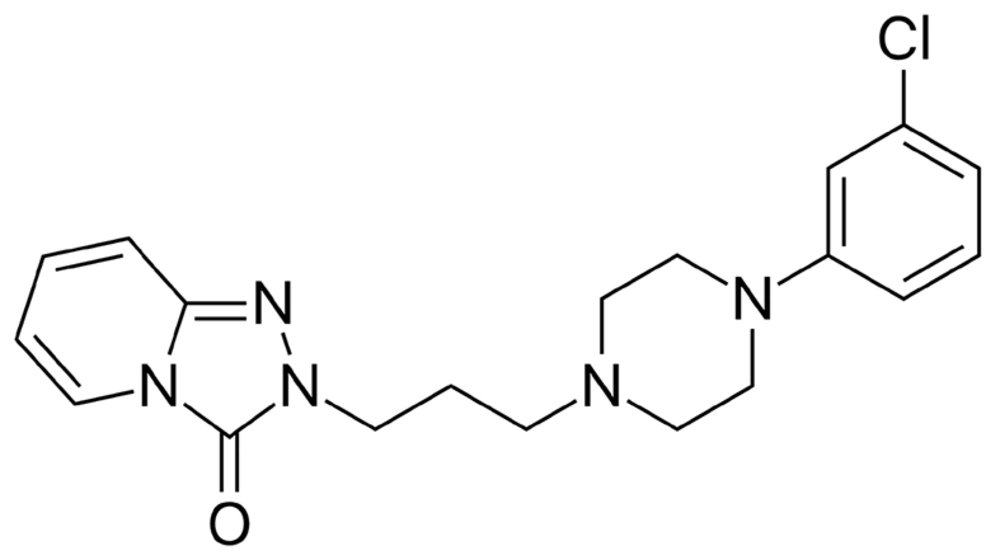
Figure 1.
Chemical structure of trazodone
At low doses (25 - 150 mg), trazodone primarily exerts sedative and hypnotic effects through histamine H1 and α1 adrenergic blockade. These effects contribute to improved sleep initiation and maintenance. At higher doses (150 - 600 mg), serotonergic reuptake inhibition becomes more prominent and contributes to antidepressant effects. In clinical practice, however, trazodone is predominantly used at lower doses for its hypnotic profile because the dose-dependent increase in serotonergic activity and potential adverse reactions, such as orthostatic hypotension and daytime somnolence, often limit its tolerability and clinical utility at higher dose ranges (8).
Trazodone has also been used for a range of psychiatric conditions beyond major depressive disorder. It is frequently prescribed for insomnia and has been used in the management of anxiety disorders, such as obsessive-compulsive disorder and posttraumatic stress disorder. Additional off-label applications include substance use disorders, eating and feeding disorders, behavioral disorders related to cognitive impairment, and specific pain conditions (9).
3.2. Evidence for Trazodone in Dementia-Related Behavioral Symptoms
Although data specifically examining trazodone in sundowning syndrome are limited, several studies have investigated its effects on BPSD.
A randomized controlled trial by Teri and colleagues compared trazodone with haloperidol and behavioral therapy for the management of agitation in persons with Alzheimer disease. Although neither trazodone nor haloperidol differed significantly from placebo for the primary agitation outcome, trazodone was associated with fewer extrapyramidal adverse effects than haloperidol (10). In a subsequent randomized, double-blind trial, Sultzer and colleagues compared trazodone with haloperidol in 28 individuals with dementia and agitation over 9 weeks (11). Both groups showed significant improvement on the Cohen-Mansfield Agitation Inventory; however, in the trazodone arm, the reduction in agitation was significantly correlated with baseline depressive symptoms and the degree of improvement in mood over the course of treatment. These findings suggest that the anti-agitation effects of trazodone may be mediated, at least in part, by its antidepressant properties, making it a particularly rational choice when evening behavioral disturbances are accompanied by mood symptoms. This pattern is common in sundowning, in which dysphoria and anxiety often intensify later in the day.
A recent narrative review by Fagiolini and colleagues examined the role of trazodone in managing major depressive disorder among older patients with dementia and other neurological conditions (12). The authors highlighted that, because of its unique mechanism of action, trazodone can simultaneously address several symptoms commonly observed in this population, including sleep disturbances, irritability, agitation, cognitive impairment, and anxiety. They concluded that trazodone might be particularly suitable when the clinical presentation of depression is accompanied by symptoms such as inner tension, insomnia, irritability, anxiety, or psychomotor agitation, features that frequently overlap with the evening behavioral deterioration characteristic of sundowning syndrome.
Another randomized controlled trial evaluated trazodone for sleep disturbances in individuals with Alzheimer disease. Camargos and colleagues conducted a double-blind, placebo-controlled trial involving patients with Alzheimer disease and sleep problems. Participants receiving trazodone experienced a significant increase in total sleep time compared with those receiving placebo, without substantial adverse effects (13). Further supporting a circadian mechanism, Grippe and colleagues evaluated sleep parameters by actigraphy in individuals with Alzheimer disease before and after 14 days of trazodone use (14). The study demonstrated a significant improvement in relative rhythm amplitude, indicating a more stable daytime behavioral pattern and improved circadian organization. This finding is particularly relevant to sundowning syndrome because it suggests that trazodone may help restore the disrupted rest-activity rhythm that underlies late-day agitation and confusion, rather than merely providing nocturnal sedation.
A systematic review and meta-analysis of 44 randomized controlled trials involving 3935 participants indicated that, although trazodone did not significantly extend subjective total sleep time, it modestly improved sleep quality, continuity, and certain objective sleep metrics, such as time spent awake after sleep onset and overall sleep efficiency (15).
Although these observations are not specific to sundowning syndrome, they underscore the potential benefits of trazodone in addressing symptoms commonly associated with evening behavioral deterioration.
3.3. Potential Advantages Compared with Other Pharmacologic Options
Antipsychotic medications are frequently used for agitation in dementia but are associated with significant risks, including increased mortality, cerebrovascular events, sedation, and extrapyramidal symptoms (16). In contrast, trazodone may offer several potential advantages. First, it can improve sleep disturbances, which are strongly associated with sundowning. By consolidating nighttime sleep, trazodone may reduce circadian disruption and behavioral dysregulation. Second, trazodone has a relatively low risk of extrapyramidal symptoms compared with antipsychotic medications, which may be particularly important in frail older patients susceptible to medication-induced movement disorders. Third, trazodone may simultaneously address multiple symptoms, including anxiety, insomnia, and agitation, which frequently coexist in patients with dementia.
3.4. Clinical Considerations and Safety
Despite its potential benefits, trazodone should be used cautiously in older adults. Common adverse effects include sedation, dizziness, orthostatic hypotension, and an increased risk of falls. Clinicians should initiate therapy at low doses, typically 12.5 - 25 mg administered 1 - 2 hours before the anticipated onset of sundowning symptoms, which is substantially lower than antidepressant doses, and titrate slowly while monitoring tolerability. Monitoring should include assessment of orthostatic blood pressure, fall risk, next-day sedation, and any decline in functional status, particularly during the early phase of treatment. Drug-drug interactions must also be considered, particularly in patients receiving multiple psychotropic medications. Because trazodone is metabolized primarily by CYP3A4, inhibitors or inducers of this enzyme may alter its plasma concentrations. For example, CYP3A4 inhibitors such as ketoconazole may increase trazodone exposure, whereas inducers such as carbamazepine may reduce its effectiveness. Another rare but notable adverse effect is priapism, although this complication is uncommon in older populations (17).
In addition to pharmacologic therapy, clinicians should prioritize nonpharmacologic strategies such as bright light therapy, regular sleep schedules, physical activity, and environmental modifications. These interventions should remain the first-line approach whenever feasible. Pharmacologic treatment should ideally complement, rather than replace, these interventions and may be considered when symptoms cause substantial distress or pose safety concerns.
4. Conclusions
Despite its widespread clinical use, high-quality evidence specifically evaluating trazodone for sundowning syndrome remains limited. Future studies should prioritize randomized controlled trials that specifically target evening behavioral symptoms in dementia.
Studies examining circadian biomarkers, actigraphy-based sleep measurements, and neuropsychiatric symptom scales may help clarify the mechanisms through which trazodone influences sundowning symptoms.
Comparative studies evaluating trazodone alongside other sleep-modulating agents, such as melatonin, ramelteon, or orexin receptor antagonists, may also help identify optimal pharmacologic strategies for managing sundowning syndrome.
Sundowning syndrome is a challenging behavioral phenomenon in patients with dementia and is associated with substantial caregiver distress and healthcare burden. Although nonpharmacologic interventions remain the cornerstone of management, pharmacologic treatment is often required in cases of severe agitation or sleep disruption.
It is important to note that the current evidence supporting trazodone specifically for sundowning syndrome is largely indirect and extrapolated from its efficacy in general BPSD and insomnia. The certainty of the evidence is limited by the lack of large-scale, syndrome-specific randomized controlled trials. Therefore, these recommendations should be considered hypothesis-generating rather than established clinical guidelines.
Through its sedative and serotonergic properties, trazodone may be a potential option for addressing the sleep disturbances and evening agitation that characterize sundowning syndrome. Although current evidence suggests potential benefits, robust clinical trials specifically targeting sundowning symptoms are still needed. Careful patient selection, initiation at low doses, and close monitoring remain essential when using trazodone in older adults with dementia.