1. Context
Body Dysmorphic Disorder (BDD) is classified under Obsessive-Compulsive and Related Disorders in both the DSM-5 and the International Classification of Disorders (WHO) (1). The core feature of BDD is a preoccupation with perceived flaws in appearance that are often unnoticeable to others. BDD affects 1.9% of the general population (2) and is associated with significant psychological distress, including feelings of shame, embarrassment, and social isolation (2, 3). A growing body of evidence highlights the elevated risk of suicidality among individuals with Body Dysmorphic Disorder (BDD). A meta-analysis conducted in 2016 found that individuals with BDD were approximately four times more likely to experience suicidal ideation and nearly three times more likely to attempt suicide than control groups (4). More recent findings corroborate these concerns; for instance, one study reported that nearly 70% of individuals with BDD had experienced suicidal thoughts, and about 60% had a history of self-harm or suicide attempts (5).
Current treatments, including selective serotonin reuptake inhibitors (SSRIs) and cognitive-behavioral therapy (CBT) (6, 7), have shown effectiveness, but 40 - 60% of patients do not respond to CBT (8, 9). BDD often remains chronically untreated, and the rate of spontaneous recovery is low (10, 11). Because shame is central to BDD, targeting shame may improve treatment outcomes (12-16). Many problematic behaviors in BDD, such as social avoidance and self-comparison, are rooted in shame (15). Shame is associated with more severe BDD symptoms and poorer insight (16).
Studies have shown that compassion, particularly Compassion-Focused Therapy (CFT), can act as an antidote to body image-related shame (17-20). CFT, developed by Paul Gilbert, focuses on managing shame and self-criticism, which are highly prevalent in BDD (15). Research suggests that compassion-based interventions can reduce body image concerns (20-22). In one multiple baseline study, acceptance- and compassion-based therapy reduced symptoms in people with BDD (23).
Recent studies indicate that the manifestation and expression of BDD are significantly influenced by cultural and social factors. For example, in East and Southeast Asian cultures, body image concerns often center on features such as skin tone and eyelid shape, whereas in Western societies, preoccupations more commonly relate to body weight or muscularity (24). These differences reflect the impact of culturally shaped beauty ideals on the content of BDD-related concerns. Moreover, the dominance of research conducted in WEIRD (Western, Educated, Industrialized, Rich, and Democratic) societies limits the generalizability of findings to non-Western populations. Systematic reviews have further emphasized that cultural beauty standards play a critical role in shaping body image dissatisfaction, highlighting the need to adapt diagnostic frameworks and therapeutic protocols to diverse cultural contexts (25).
Despite advances in treatment, a substantial proportion of individuals with BDD do not respond adequately to standard interventions such as CBT or medication, underscoring a critical need for alternative approaches. Because shame plays a central role in the persistence and severity of BDD symptoms, therapeutic models that directly target shame are particularly important. CFT, with its emphasis on reducing shame and self-criticism while enhancing self-compassion, represents a promising but underexplored intervention. However, empirical research on the application of CFT for BDD remains scarce, particularly in non-Western populations. Addressing this gap is essential to broaden the evidence base and inform culturally sensitive clinical practices. The present study therefore investigates the effectiveness of CFT in reducing BDD symptoms, highlighting its potential as an innovative approach for individuals who may not benefit sufficiently from conventional treatments.
The objective of this study is to assess the effectiveness of CFT in reducing symptoms of BDD, with a particular focus on its impact on appearance-related anxiety, dysmorphic concerns, body image shame, and body compassion. This study aims to provide preliminary evidence on the potential of CFT as an alternative therapeutic approach for individuals with BDD who may not fully respond to traditional treatments.
2. Evidence Acquisition
2.1. Participants
The study participants were four individuals seeking counseling at the Counseling Center of Shahid Beheshti University. The inclusion of four participants is consistent with methodological standards in single-case experimental design (SCED) research (26). Participants were diagnosed with BDD based on a structured clinical interview conducted by a clinical psychologist. The clinical profile and demographic characteristics of the participants are presented in Table 1.
Table 1.Sociodemographic and Clinical Profile of Participants
| Variables | Age | Gender | Marital Status | Education | Main BDD Concerns | Main BDD Behavior | Comorbidity | DCQ Score |
|---|---|---|---|---|---|---|---|---|
| P1 | 23 | Female | Single | University, bachelor | Facial features, shape of body, height | Comparing, reassurance, social avoidance | MDD | 16 |
| P2 | 27 | Female | Married | University MA | Facial features, breast, teeth, chin | Comparing, camouflaging, checking, mirror gazing | MDD | 15 |
| P3 | 25 | Male | Single | University MA | Facial features, Muscles, nose, genital system, | Camouflaging, checking, social Avoidance, mirror gazing, | SAD | 18 |
| P4 | 19 | Female | Single | University, bachelor | Facial features, shape of body | Social avoidance, Comparing, camouflaging | MDD, SAD | 18 |
The inclusion criteria were a DSM-5 diagnosis of Body Dysmorphic Disorder (BDD), a Dysmorphic Concern Questionnaire (DCQ) score of 14 or higher, and age 18 years or older. The exclusion criteria were active suicidal ideation; a diagnosis of bipolar disorder or substance use disorder in the past 6 months; severe medical conditions affecting appearance; body image concerns related to eating disorders; pregnancy; unavailability during the study; meeting criteria for Cluster A or B personality disorders; schizophrenia spectrum disorders; use of weight reduction medications; prior CBT treatment (more than 8 sessions in the last 6 months); or use of mental health medications within the three months prior to treatment.
2.2. Study Design
In this study, a multiple-baseline-across-participants SCED was used to examine the effectiveness of compassion-focused therapy for BDD. Six individuals with BDD were selected as the sample based on a structured clinical interview conducted by a clinical psychologist. The six participants met the inclusion criteria and fulfilled the nine exclusion criteria for this research. Among the six participants, one individual was unable to continue attending therapy sessions after participating in six sessions due to migration. Another participant was excluded from the study after the fourth intervention session due to active suicidal ideation (accompanied by emotional breakdown and parental involvement) and was referred to a psychiatrist for medication. Therefore, four participants completed all sessions, and the final data analysis includes these four participants. To reduce the potential for attrition bias, baseline data from the two participants who discontinued participation were examined and compared with those who completed the study. The two participants who dropped out did not differ from the other participants in terms of demographic characteristics, symptom severity, type of concern, BDD behaviors, and comorbidity. Participants were randomly assigned to baseline periods of 4, 5, and 6 weeks. Participants completed measures of body dysmorphic concern, appearance anxiety, body image shame, and body compassion weekly during the baseline periods, intervention, and follow-up period, with a one-week gap between each assessment.
2.3. Instruments
2.3.1. Body Compassion Scale (BCS)
The BCS was developed by Altman, Linfield, Salmon, and Beacham in 2017. This 23-item scale provides a total score and three subscales: Inconsistency, Human Connections, and Acceptance. Items are rated from 1 (almost never) to 5 (almost always). Internal consistencies for the subscales of Discrepancy, Human Connections, and Acceptance are 0.92, 0.91, and 0.87, respectively. The Cronbach's alpha for the 23-item scale is 0.92, and use of the total score is recommended (27). The psychometric properties of the instrument have been reported to be suitable in Iran (28). The Cronbach’s alpha coefficient for the scale was 0.90, indicating good reliability.
2.3.2. Body Image Shame Scale (BISS)
The BISS was developed by Duarte, Pinto‐Gouveia, Ferreira, and Batista in 2015. This scale consists of 14 items measuring body image shame and includes two subscales: External Body Shame and Internal Body Shame. Participants rate each item on a 5-point Likert scale (ranging from 0 = never to 4 = almost always) based on the frequency of their experience of body image shame. The average score ranges from 0 to 4. The scale has been validated in non-clinical samples of women from the general population and has demonstrated good convergent and discriminant validity, as well as test–retest reliability (approximately 0.75 over a 4-week period) and high internal consistency, with a reported Cronbach's alpha of 0.96 for the total score (27). In the study conducted in Iran, the two-factor structure of the BISS showed a good fit, and high internal consistencies were reported for the total score, internal body shame, and external body shame, with values of 0.85, 0.79, and 0.82, respectively (29). The Cronbach’s alpha coefficient for the scale was 0.88, indicating good reliability.
2.3.3. Appearance Anxiety Inventory (AAI)
The AAI was developed by Veale et al. in 2014. This self-report questionnaire consists of 10 items and focuses on cognitive processes and safety-seeking behaviors in individuals with Body Dysmorphic Disorder (BDD). Each item is rated from 0 (not at all) to 4 (always). Total scores range from 0 to 40. Scores of 19 or higher indicate a likelihood of BDD (30). In Iran, the Cronbach's alpha and test–retest reliability have been reported as 0.86 and 0.92, respectively (31). The Cronbach’s alpha coefficient for the scale was 0.89, indicating good reliability.
2.3.4. Dysmorphic Concern Questionnaire (DCQ)
The DCQ was designed by Oosthuizen in 1998. This questionnaire consists of seven items assessing concerns about physical appearance. Responses are rated on a 4-point Likert scale (ranging from 0 to 3), with 3 indicating the highest level of concern. The DCQ is a dimensional measure of appearance-related concerns and has been used in various clinical contexts (32, 33). DCQ scores have been found to be significantly correlated with scores on the Body Dysmorphic Disorder Examination (BDDE), a reliable and valid measure of BDD (32). Cut-off points of 11 and 14 have been suggested for BDD screening (34). In Iran, the unidimensional structure of this scale has been confirmed, and it has demonstrated good convergent and discriminant validity as well as satisfactory reliability (29). The Cronbach’s alpha coefficient for the scale was 0.86, indicating good reliability.
2.4. Intervention
The structure and content of CFT sessions were designed based on the treatment approach developed by Paul Gilbert and Russell Kolts, as well as the conceptual model of BDD within the CFT framework by Veale and Gilbert (15). The first two sessions involved assessment and measurement using the Compassion-Focused Therapy approach. The third session focused on how the evolution of the brain has shaped us, distinguishing between the older emotional brain and the newer brain, and introducing the three emotion regulation systems and their role in experiencing different emotions in everyday life. The fourth session emphasized compassionate attention and focus. The fifth session involved compassionate imagery. The sixth session examined the role of self-criticism and shame and introduced self-compassionate selves. The seventh session introduced multiple selves, chair work, and multiple-self exercises. The eighth and ninth sessions focused on compassionate thinking and reasoning. The tenth session focused on writing a compassionate letter to oneself, with an emphasis on body image concerns. Sessions 11 - 14 involved compassionate exposure. In each session, topics discussed in the previous session and home exercises were reviewed, and most of the session was dedicated to teaching therapeutic concepts. Finally, the session was summarized, the assignment for the next session was determined collaboratively with the participants, and feedback was obtained regarding the session.
In the present study, the CFT sessions were delivered by a clinical psychologist with specialized training in clinical psychology. The therapist completed practical and theoretical CFT training under the supervision of two clinical psychologists specializing in CFT, along with clinical supervision. To ensure treatment fidelity, multiple adherence strategies were implemented. The therapist received regular clinical supervision from two CFT experts, and after each session, participants provided written and verbal summaries of the content and therapeutic exercises. These summaries were reviewed by the supervisors to verify consistency with the standardized CFT protocol, and corrective feedback was provided when minor deviations occurred. These procedures served as systematic fidelity checks to ensure that the intervention was delivered as intended.
2.5. Ethical Considerations
This research has the code of ethics IR.IUMS.REC.1398.555. It has been approved by the ethics committee of the Iran University of Medical Sciences.
2.6. Data Analysis
Data analyses were conducted according to established guidelines for single-case experimental designs, with visual inspection of plotted data as the primary method (26). The two-week averages of each participant’s scores for appearance anxiety, dysmorphic concerns, body image shame, and body compassion were plotted in individual graphs. The plotted ratings were visually examined to evaluate the rate of change and data overlap across phases. Effect size was calculated using four nonoverlap methods: 1. Percentage of Post-Effect over Median Pre-Effect (PEM), 2. Extended Celebration line (ECL), 3. Percentage of All Non-Overlapping Data (PAND), and 4. Percentage of Non-Overlapping Data (PND). Effect sizes of 0.90 and greater are indicative of very effective treatments, those ranging from 0.70 to 0.89 represent moderate effectiveness, those between 0.50 to 0.69 are debatably effective, and scores less than 0.50 are regarded as not effective (35). Given the lack of consensus on the appropriate effect size measure in single-case designs (36), the clinical significance of change in BDD outcomes was ultimately assessed based on: 1. Obtaining a score less than 11 on the DCQ, and 2. Lack of full diagnostic criteria according to DSM-5.
3. Results
Based on visual analysis, all measures were stable during the baseline phase for all participants (Figure 1). During the CFT intervention phase, participants demonstrated consistent, positive changes across all variables, with sustained improvements during the follow-up period.
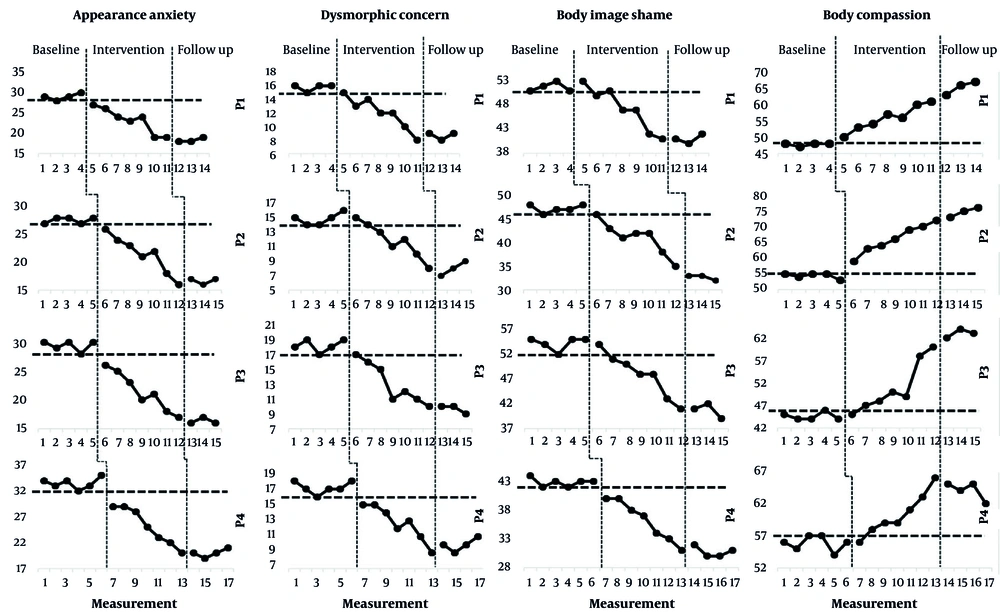
Figure 1.
Visual analysis of research variables
Appearance anxiety steadily decreased for all participants, with scores dropping by 37% to 43% from pre- to post-treatment; gains remained stable at follow-up. The PND, PEM, PAND, and ECL statistics for appearance anxiety were 100, indicating a highly effective intervention (Table 2).
Table 2.Effect Size Using with Nonoverlap Methods Analysis
| Variables | PEM | ECL | PAND | PND (%) |
|---|---|---|---|---|
| Appearance anxiety | ||||
| From baseline to intervention (Participant) | ||||
| P 1 | 100 | 100 | 82 | 86 |
| P 2 | 86 | 100 | 67 | 86 |
| P 3 | 100 | 100 | 84 | 86 |
| P 4 | 100 | 100 | 100 | 100 |
| From intervention to follow-up (Participant) | ||||
| P 1 | 100 | 0 | 40 | 0 |
| P 2 | 100 | 33 | 60 | 33 |
| P 3 | 100 | 0 | 60 | 33 |
| P 4 | 100 | 0 | 28 | 25 |
| Dysmorphic concern | ||||
| From baseline to intervention (Participant) | ||||
| P 1 | 100 | 100 | 82 | 86 |
| P 2 | 86 | 100 | 67 | 86 |
| P 3 | 100 | 100 | 84 | 86 |
| P 4 | 100 | 100 | 100 | 100 |
| From intervention to follow-up (Participant) | ||||
| P 1 | 100 | 0 | 40 | 0 |
| P 2 | 100 | 33 | 60 | 33 |
| P 3 | 100 | 0 | 60 | 33 |
| P 4 | 100 | 0 | 28 | 25 |
| Body image shame | ||||
| From baseline to intervention (Participant) | ||||
| P 1 | 86 | 72 | 72 | 72 |
| P 2 | 100 | 100 | 100 | 100 |
| P 3 | 100 | 100 | 100 | 86 |
| P 4 | 100 | 100 | 100 | 100 |
| From intervention to follow-up (Participant) | ||||
| P 1 | 100 | 0 | 60 | 33 |
| P 2 | 100 | 0 | 100 | 100 |
| P 3 | 100 | 0 | 60 | 33 |
| P 4 | 100 | 0 | 64 | 50 |
| Body compassion | ||||
| From baseline to intervention (Participant) | ||||
| P 1 | 86 | 100 | 100 | 100 |
| P 2 | 100 | 100 | 100 | 100 |
| P 3 | 100 | 72 | 84 | 86 |
| P 4 | 86 | 100 | 85 | 86 |
| From intervention to follow-up (Participant) | ||||
| P 1 | 100 | 33 | 100 | 100 |
| P 2 | 100 | 0 | 100 | 100 |
| P 3 | 100 | 0 | 40 | 100 |
| P 4 | 100 | 0 | 27 | 0 |
For dysmorphic concerns, scores decreased by 43% to 46% from pre- to post-treatment, with no overlap between baseline and follow-up scores. Improvements were sustained during follow-up, and intervention effectiveness was moderate to very high, with PND, PEM, PAND, and ECL statistics ranging from 0.82 to 1.00. Participant P2 showed a slightly lower range of 0.67 to 1.00, suggesting a debatable to very effective intervention (Table 2).
Body image shame scores also showed a consistent decline, decreasing by 22% to 26% from pre- to post-treatment. These improvements were maintained during follow-up, with intervention effectiveness ranging from moderate to very high (PND, PEM, PAND, and ECL statistics: 0.72 - 1.00) (Table 2).
In contrast, body compassion scores increased by 22% to 36% from pre- to post-treatment, with sustained improvements at follow-up. Based on statistical measures, intervention effectiveness ranged from 0.72 to 1.00, indicating moderate to very effective results (Table 2).
Regarding clinical significance (Table 3), three of the four participants met both clinical significance criteria at the end of the intervention and during follow-up. Participant 4 met only the criterion of a DCQ score below 11 at the end of the intervention but did not meet either criterion during follow-up, with a final DCQ score of 11. These findings suggest that CFT led to significant and lasting improvements across all key measures for most participants. In addition, Reliable Change Index (RCI) calculations indicated that all four participants showed reliable improvement in DCQ scores from baseline to post-treatment and follow-up (all |RCI| ≥ 3.69 at post-treatment and |RCI| ≥ 8.54 at follow-up), confirming that reductions in dysmorphic concerns were clinically significant beyond measurement error.
Table 3.Clinical Significance of Change a
| Variables | Score Less Than 11 on the DCQ | Lack of Complete Diagnostic Criteria for BDD | ||
|---|---|---|---|---|
| End of Intervention | Follow-up | End of Intervention | Follow-up | |
| Participant | ||||
| P 1 | + | + | + | + |
| P 2 | + | + | + | + |
| P 3 | + | + | + | + |
| P 4 | + | - | - | - |
a (+) sign: meeting the criteria, (-) sign: not meeting the criteria.
4. Conclusions
The results of this study showed that CFT reduces symptoms of appearance anxiety, body dysmorphic concern, and body image shame and is associated with increased compassion toward participants’ bodies. These findings are consistent with the research of Albertson, Neff, and Dill-Shackleford (20), Toole and Craighead (21), and Seeks, Bradley, and Duffy (22), who showed that self-compassion-based interventions are effective in reducing body image disturbances and concerns. Although the non-overlap indices indicate meaningful improvement for several participants, the substantial variability observed across cases (e.g., PND range of 0 - 100%) indicates marked heterogeneity in treatment response. Such variability may stem from differences in initial symptom severity, engagement with the intervention, or co-occurring difficulties. These patterns underscore the need for cautious interpretation of single-case effect indices and suggest that the clinical applicability of the intervention may vary across individuals. It can be stated that CFT offers clients a novel formulation of their problems that may help them address shame. In this treatment, behaviors such as avoiding situations or people, changing or hiding one’s appearance, or avoiding taking pictures are conceptualized as strategies originating from the threat system (37), which aims to protect individuals from underlying fears (such as ridicule, rejection, criticism, deprivation, worthlessness, and unlovability). However, these strategies have unintended consequences that perpetuate problems and increase their severity. These safety strategies are primarily avoidance-based and rooted in the threat system (37). The behavioral practice of compassionate exposure to disrupt these avoidance patterns enables the person with BDD to act in accordance with their values and relinquish these protective strategies. In self-compassionate encounters, the person approaches previously avoided people and situations from a self-compassionate perspective, which is associated with reduced concern about the imagined defects in a person with BDD. In CFT, appearance-related mental preoccupation and rumination are conceptualized as threat-system-based thinking; in place of this style, a balanced and compassionate thinking style is introduced to help the person with BDD manage these thoughts.
In some cultural contexts, including Iran, individuals may experience frequent commentary or teasing from others about their appearance, and a societal emphasis on physical attractiveness may further heighten body-related shame. CFT’s emphasis on self-compassion may help individuals cope with these experiences and cultural pressures by reducing self-criticism and avoidance behaviors and supporting more adaptive engagement with therapeutic tasks. Although this study did not directly measure cultural influences, future research could further explore how CFT addresses appearance-related shame in such social and cultural contexts.
The relapse observed in Participant 4 at follow-up (DCQ = 11) suggests that treatment gains may not be fully durable for all individuals. Given evidence that people with high shame and self-criticism require sustained practice of compassion-based skills, booster sessions or longer follow-up periods may strengthen long-term maintenance.
This study has several limitations. All outcomes relied on self-report measures, with no objective behavioral indicators. The small sample size (n = 4) limits generalizability, and having only one male participant restricted gender-related analyses. Although comorbidities were identified, their severity was not assessed, limiting interpretation of symptom interactions. The absence of a control condition also restricts causal inference.
5.1. Conclusion
This study provides preliminary evidence that CFT may reduce core BDD symptoms by targeting shame and increasing body-related self-compassion. The findings suggest that CFT can function as a complementary approach to CBT, particularly for individuals with elevated self-criticism and shame. While CBT primarily targets behavioral avoidance through exposure and response prevention, CFT emphasizes reducing shame and self-criticism while fostering self-compassion. This focus may enable individuals with BDD to approach feared situations with a kinder and more accepting mindset, potentially enhancing engagement with therapeutic tasks and providing an additional pathway for symptom reduction that complements traditional CBT techniques. However, the small sample size limits generalizability, and the results should be interpreted cautiously given the study’s pilot nature. Larger and more diverse clinical samples are needed to confirm these effects and clarify the long-term applicability of CFT for BDD. Including extended follow-up assessments (e.g., 6 - 12 months) would further strengthen understanding of the durability of compassion-based interventions.