Fulltext
Full text is available in the PDF.
IJ Psychiatry and Behavioral Sciences
IJPBS is the Official Journal of Mazandaran University of Medical Sciences
Image Credit:Iran J Psychiatry Behav Sci
Authors
Objective: In spite of introduction of novel drugs, Obsessive-Compulsive Disorder (OCD) has still found no suitable treatment. On the other hand, high rates of co-morbidity of OCD with bipolar spectrum disorders are increasingly recognized. Mood switching and development of rapid cycling with antidepressants are significant problems in these patients. From this viewpoint, introducing a non-antidepressant anti-OCD drug has great theoretical and clinical importance. In this open-label clinical trial we evaluated the effects of naltrexone on OCD symptoms
Method: In this study, 23 OCD outpatients treated with a fixed dose of clomipramie, fluoxetine, or both, for at least 3 months before trial underwent treatment with naltrexone, 25 to 100 milligrams a day as adjunctive treatment. Change in symptoms was evaluated by Yale-Brown Obsessive-Compulsive Scale (YBOCS), Persian version, administered at baseline and at the end of the 2 months trial.
Results: Seven patients dropped out of the study before the end of the 2 months: 4 patients for non-response and 3 patients for intolerable side effects. Sixteen patients, 9 females and 7 males, completed the study. The most frequent co-morbid disorders found in these patients were bipolar spectrum disorders (68.7%). Non-parametric (Wilcoxon Signed Ranks Test) and parametric (paired t-test) analyses both showed significant reductions in YBOCS ratings after naltrexone treatment (P<0.001). Two patients remained symptom free over 6 months after discontinuation of all medications
Conclusion: Although small sample size and open design of the trial make the results tentative, it appears that naltrexone may be effective on at least certain subgroups of OCD patients, especially those with both OCD and bipolar spectrum disorders. Long-term effects of the drug after discontinuation should be addressed in future double-blind studies.
© 2007, Author(s). This open-access article is available under the Creative Commons Attribution 4.0 (CC BY 4.0) International License (https://creativecommons.org/licenses/by/4.0/), which allows for unrestricted use, distribution, and reproduction in any medium, provided that the original work is properly cited.
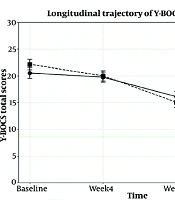
Rostami H, Pourshams M, Abiri R. Effect of Adding Aripiprazole as Adjunctive Therapy for Obsessive-Compulsive Symptoms in Patients with Bipolar I Disorder. Jundishapur J Chronic Dis Care. 2026;15(3):e171658. doi: https://doi.org/10.5812/jjcdc-171658
Akouchakian S, Tarrahi MJ, Mohebati E. Evaluation of Clonidine Augmentation Therapy for Obsessive-Compulsive Disorder Treatment; a Randomized Clinical Trial. Iran J Psychiatry Behav Sci. 2021;15(3):e112131. doi: https://doi.org/10.5812/ijpbs.112131
Vakili Y, Gharaee B, Habibi M. Acceptance and Commitment Therapy, Selective Serotonin Reuptake Inhibitors and Their Combination in the Improvement of Obsessive-Compulsive Symptoms and Experiential Avoidance in Patients With Obsessive-Compulsive Disorder. Iran J Psychiatry Behav Sci. 2015;9(2):-. doi: https://doi.org/10.17795/ijpbs845
Shareh H, Gharraee B, Atef-Vahid MK, Eftekhar M. Metacognitive Therapy (MCT), Fluvoxamine, and Combined Treatment in Improving Obsessive-Compulsive, Depressive and Anxiety Symptoms in Patients with Obsessive-Compulsive Disorder (OCD). Iran J Psychiatry Behav Sci. 2010;4(2):. doi:
Davoudi M, Pourshahbaz A, Dolatshahi B, Nazeriastaneh A, Poshtmashhadi M. Network Analysis for Predicting Treatment Response in Patients with Obsessive-Compulsive Disorder. Iran J Psychiatry Behav Sci. 2023;17(4):e137119. doi: https://doi.org/10.5812/ijpbs-137119
Last Update: 1 month ago
Last Update: 1 month ago
Last Update: 1 month ago
Last Update: 5 days ago
Last Update: 2 days ago
Last Update: 2 days ago