
1. Background
Bipolar I disorder (BP-I), a severe mood disorder, is defined by at least one documented manic episode or a manic episode with mixed features, which can substantially affect the patient’s clinical course (1). With a lifetime prevalence of 5%, most patients experience both depressive and manic/hypomanic episodes. Many individuals with bipolar disorder also have psychiatric comorbidities that exacerbate functional impairment (2, 3). Among the psychiatric conditions associated with BP-I, obsessive-compulsive disorder (OCD) is one of the most frequently encountered comorbidities, with a prevalence of 11 - 12% in population-based studies (3).
Obsessive-compulsive disorder is characterized by recurrent obsessions or compulsions that are sufficiently severe to cause significant distress, are time-consuming, and impair normal routines, occupational functioning, social activities, or interpersonal relationships (2). Its etiology is multifactorial, involving substantial genetic predisposition and environmental influences. In patients with BP-I, OCD symptoms may precede the onset of bipolar disorder or emerge during its course, often in association with mood changes or specific mood symptoms (4-6).
Management of obsessive-compulsive symptoms in patients with BP-I presents a major clinical dilemma and may involve selective serotonin reuptake inhibitors (SSRIs), the tricyclic antidepressant clomipramine, traditional mood stabilizers such as sodium valproate, carbamazepine, lamotrigine, and lithium, and selected first- and second-generation antipsychotics (7). However, in patients with BP-I, serotonergic antidepressants carry a recognized risk of inducing manic switching, accelerating cycling, or precipitating broader affective destabilization (8). Consequently, clinicians may need to balance relief of obsessive-compulsive symptoms against the preservation of mood stability (9).
This clinical challenge highlights the need for adjunctive psychopharmacological agents that can target obsessive-compulsive symptoms without compromising the underlying bipolar course (10). Aripiprazole, approved by the US Food and Drug Administration (FDA) as an antipsychotic for schizophrenia and bipolar disorder, has relatively fewer metabolic adverse effects and a generally favorable cardiovascular tolerability profile (11). It acts as a partial agonist at multiple receptors, including dopamine D2 and serotonin 5-HT1A, 5-HT2A, and 5-HT7 receptors, which may provide a theoretical pharmacological basis for anti-obsessive effects (6). Although studies have explored its utility in primary OCD (12-14) and acute bipolar mania (14-16), its efficacy and safety as an adjunctive treatment specifically for patients with comorbid BP-I and OCD remain understudied and are not yet clinically established.
2. Objectives
Given the substantial clinical burden and the paucity of established pharmacological combinations for managing comorbid obsessive-compulsive symptoms in BP-I, this study aimed to investigate the efficacy of adjunctive aripiprazole. Specifically, we evaluated symptom reduction in patients who remained symptomatic while receiving standard mood-stabilizing regimens. The primary endpoint was defined as the mean change in continuous Yale-Brown Obsessive Compulsive Scale (Y-BOCS) total scores over a 12-week study period, comprising 8 weeks of active treatment and a 4-week off-treatment follow-up.
3. Methods
3.1. Study Design
This randomized, double-blind clinical trial followed the CONSORT 2010 guidelines (16) and was approved by the Ethics Committee of the Faculty of Medicine at Ahvaz Jundishapur University of Medical Sciences (IR.AJUMS.HGOLESTAN.REC.1401.116). The trial was conducted exclusively in an outpatient setting. All 46 participants were recruited and treated as outpatients at the psychiatric clinic of Golestan Hospital, Ahvaz.
The study evaluated aripiprazole as adjunctive therapy in outpatients with BP-I and obsessive-compulsive symptoms at Golestan Hospital, Ahvaz, between 2022 and 2023. Trial procedures were fully explained to the participants, and informed consent forms consistent with the Declaration of Helsinki were provided to the patients or their guardians for review and signature. The independent variable was aripiprazole administration, and the dependent variable was the severity of obsessive-compulsive symptoms, assessed at multiple time points.
3.2. Participants and Sampling
Inclusion Criteria: Participants were aged 18 - 60 years, had a Y-BOCS score of 16 or higher, were diagnosed by a board-certified psychiatrist according to DSM-5 criteria for Bipolar I Disorder, had no cardiovascular, respiratory, renal, or gastrointestinal diseases, were not pregnant, had no history of substance or alcohol abuse, and were receiving an adequate mood-stabilizing regimen of quetiapine and sodium valproate.
Exclusion Criteria: Exclusion criteria included noncompliance with follow-up visits, refusal to participate, a history of aripiprazole allergy or adverse reactions, and the use of gabapentin, topiramate, SSRIs, memantine, or antipsychotics other than quetiapine.
Sampling Method: Simple random sampling was used.
Sample Size Calculation: The sample size was calculated to provide adequate statistical power to detect a clinically meaningful improvement in Y-BOCS scores between the aripiprazole and placebo groups. Based on previous research (17) evaluating aripiprazole in euthymic patients with bipolar disorder and comorbid OCD, we estimated a mean between-group difference of 5.0 points with a standard deviation of 5.6, yielding a large expected effect size of 0.88. To achieve 80% statistical power at a 5% significance level, a minimum of 20 participants per group was required. To account for a potential 15% dropout rate during the 12-week study period, the enrollment target was increased to 23 participants per group, resulting in 46 randomized participants.
3.3. Randomization and Blinding
To minimize selection, performance, and detection biases, the trial used a strict double-blind, placebo-controlled protocol in accordance with CONSORT guidelines. Eligible participants were enrolled by a designated clinical research coordinator and randomly allocated in a 1:1 ratio to receive adjunctive aripiprazole or a visually identical placebo. The randomization sequence was computer-generated by an independent statistician who was not otherwise involved in clinical care or data collection.
Allocation concealment was maintained using sequentially numbered, opaque, sealed envelopes. The intervention was dispensed by an independent hospital pharmacist who held the randomization master list and was the only individual with access to unblinded group assignments. The principal investigators, clinical raters, and all enrolled participants remained blinded to treatment allocation throughout the 12-week study.
Emergency unblinding procedures were established a priori. Sealed code-break documents were securely held by the principal investigator and were to be opened only in the event of a severe, life-threatening adverse medical event requiring immediate knowledge of the pharmacotherapy. No emergency unblinding was required. Blinding success was assessed at week 12 by asking participants and blinded outcome assessors to guess the treatment allocation. Among participants, 24 of 46 (52.2%) correctly guessed their assignment; outcome assessors correctly guessed the assignment for 22 of 46 participants (47.8%). Chi-square tests showed that the accuracy of these guesses did not differ significantly from chance for either participants (P = 0.768) or assessors (P = 0.768), supporting the maintenance of double-blind integrity.
3.4. Intervention Protocol
The trial consisted of an 8-week active treatment phase followed by a 4-week off-treatment observational period. Background pharmacotherapy was maintained within standard therapeutic ranges: sodium valproate was prescribed at 500 - 1500 mg/day, and quetiapine was maintained at 150 - 300 mg/day. The mean baseline sodium valproate dose was 1025 mg/day in the aripiprazole group and 1010 mg/day in the placebo group. The mean baseline quetiapine dose was 225 mg/day in the aripiprazole group and 218 mg/day in the placebo group. These doses remained unchanged at week 8, and no dose changes were recorded during the trial. Medication adherence was monitored and confirmed to be 100% in both study arms. Routine serum valproate levels were not evaluated under this study protocol.
The intervention group received aripiprazole in addition to standard medications for 8 weeks, whereas the control group received a matched placebo with standard medications throughout the 8-week treatment phase. Adjunctive aripiprazole was initiated at an oral dose of 5 mg/day and titrated upward in 5-mg increments to 20 mg/day during the final week of treatment, depending on individual clinical response and adverse-effect profiles (12). At the end of week 8, the blinded study medication (aripiprazole or placebo) was discontinued for all participants, while standard background mood-stabilizing pharmacotherapy was continued without interruption. Although routine therapeutic drug monitoring was not mandated by the study protocol, the adequacy of background mood stabilization was continuously assessed using the Young Mania Rating Scale (YMRS) and the Hamilton Depression Rating Scale (HAM-D). This clinical stability, together with the absence of concurrent medication adjustments, suggests that the observed reduction in obsessive-compulsive symptoms could be associated with the adjunctive intervention; however, continued use of baseline mood stabilizers precludes definitive causal isolation of this effect.
3.5. Data Collection
Baseline clinical evaluations, including the initial Y-BOCS assessment, were conducted by the principal investigator, whereas follow-up assessments at weeks 4, 8, and 12 were performed by the primary collaborator. To mitigate detection bias, both clinical assessors remained blinded to participants' randomization status throughout the trial. Before patient enrollment, the principal investigator and primary collaborator underwent joint standardized training in Y-BOCS administration to calibrate scoring. A clinically significant treatment response was defined as a ≥ 35% reduction in Y-BOCS total score from baseline to the study endpoint, in accordance with established consensus guidelines for OCD (6). The YMRS was used to evaluate manic symptoms, the HAM-D to assess depressive symptoms, and the Abnormal Involuntary Movement Scale (AIMS) to assess extrapyramidal symptoms (EPS), including parkinsonism, akathisia, dystonia, akinesia, bradykinesia, tremor, and muscle rigidity. Assessments were conducted weekly before dose adjustments. In the event of adverse effects, dose reduction or the addition of anticholinergic medication was considered.
3.6. Statistical Analysis
Before evaluation of the main treatment effects, baseline demographic and clinical characteristics were compared between the aripiprazole and placebo groups using independent-samples t tests for continuous variables and chi-square tests for categorical variables. Longitudinal changes in obsessive-compulsive symptom severity were evaluated using a linear mixed model (LMM). Fixed effects included treatment group (aripiprazole vs placebo), time (baseline, week 4, week 8, and week 12), and the group-by-time interaction. To avoid overadjustment and collinearity, baseline Y-BOCS score was included only as the initial time point (week 0) in the repeated-measures outcome vector and was not entered as an independent fixed covariate. Patient identification was specified as the subject variable, and a first-order autoregressive [AR (1)] covariance structure was used for the repeated time points. Restricted maximum likelihood estimation was used to obtain variance estimates. Before the final analysis, standard assumptions of normality and homoscedasticity were assessed.
The primary hypothesis was evaluated by testing the overall group-by-time interaction. All statistical analyses were conducted using IBM SPSS Statistics version 27, with statistical significance defined as a 2-tailed P < 0.05.
4. Results
A total of 55 patients were initially assessed for eligibility. Of these, 9 were excluded before randomization because they did not meet the inclusion criteria (n = 6) or declined participation (n = 3). The remaining 46 eligible participants were randomized in a 1:1 ratio to adjunctive aripiprazole (n = 23) or matched placebo (n = 23), and all received their assigned treatment. During the 8-week active treatment phase, all participants completed assessments at week 4 (aripiprazole, n = 23; placebo, n = 23) and week 8 (aripiprazole, n = 23; placebo, n = 23), with no discontinuations or loss to follow-up. All 46 participants also completed the 4-week off-treatment observational period and were assessed at week 12 (aripiprazole, n = 23; placebo, n = 23). Thus, 23 participants in each group were included in the final efficacy and safety analyses. Participant flow is shown in Figure 1.
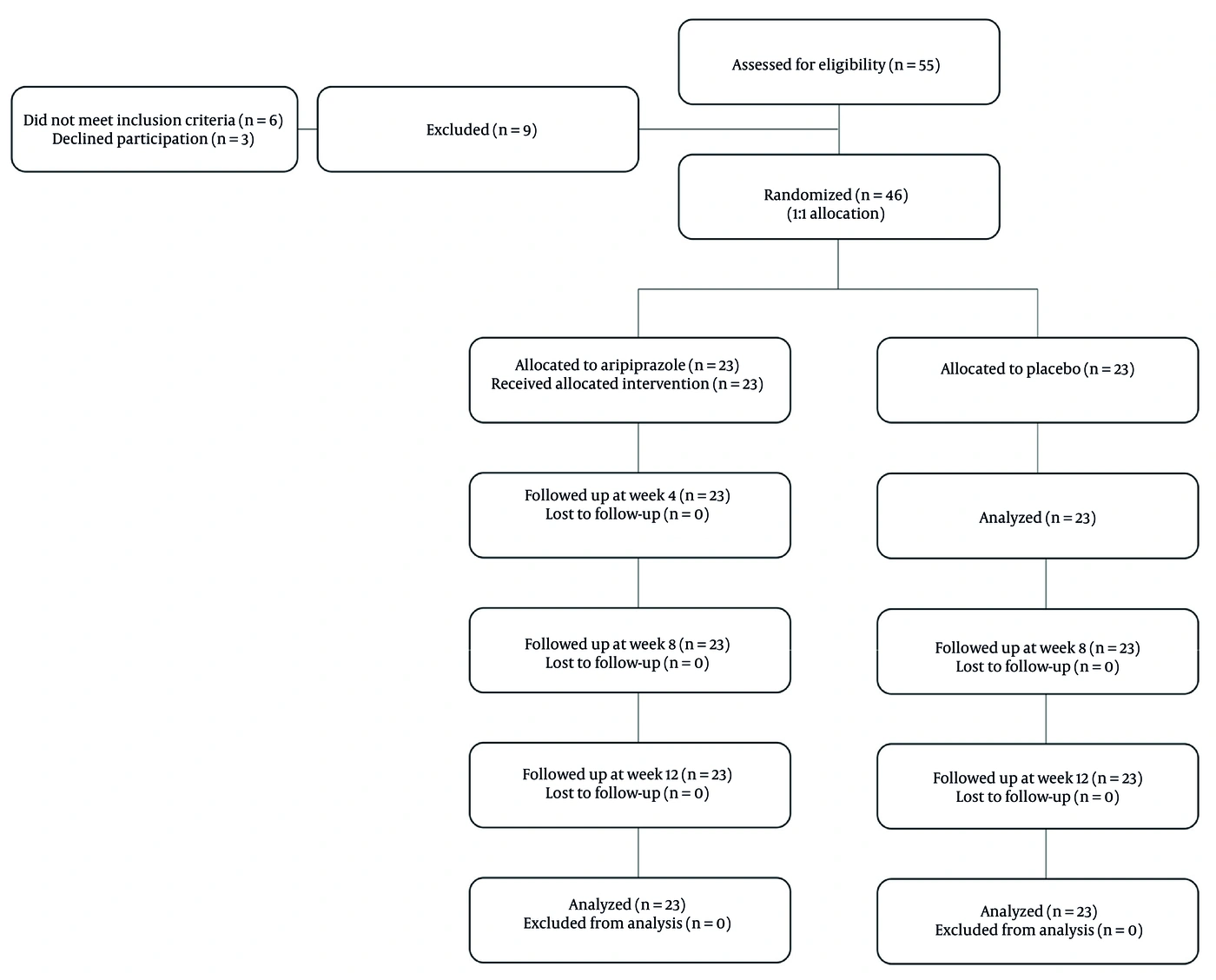
Figure 1.
Participant flow diagram detailing enrollment, allocation, follow-up, and analysis of study participants according to CONSORT guidelines.
All 46 randomized participants were evaluated, and the groups did not differ significantly in baseline demographic or clinical characteristics. Baseline demographic characteristics and group homogeneity are presented in Table 1.
Table 1.
Baseline Demographic, Sociodemographic, and Clinical Characteristics of Patients with Comorbid BP-I and Obsessive-Compulsive Disorder Before Randomization (N = 46) a
| Variables | Case Group | Control Group | P Value |
|---|---|---|---|
| Gender | 0.55 b | ||
| Male | 9 (39.1) | 11 (47.8) | |
| Female | 14 (60.9) | 12 (52.2) | |
| Marital status | 0.76 b | ||
| Single | 11 (47.8) | 12 (52.2) | |
| Married | 12 (52.2) | 11 (47.8) | |
| Outpatient care setting | 23 (100) | 23 (100) | > 0.99 b |
| Baseline euthymic status | 23 (100) | 23 (100) | > 0.99 b |
| Baseline Y-BOCS severity | 0.81 b | ||
| Moderate (score 16 - 23) | 16 (69.6) | 16 (69.6) | |
| Severe (score 24 - 31) | 5 (21.7) | 6 (26.1) | |
| Extreme (score 32 - 40) | 2 (8.7) | 1 (4.3) | |
| Age, y | 37.86 ± 12.39 | 34.82 ± 10.60 | 0.37 c |
| Duration of obsession, y | 20.34 ± 11.94 | 17.26 ± 10.49 | 0.93 c |
| Duration of bipolar disorder, y | 16.82 ± 11.08 | 14.52 ± 10.75 | 0.71 c |
| Sodium valproate dosage, mg/day | 1025.0 ± 150.5 | 1010.5 ± 145.2 | 0.74 c |
| Quetiapine, mg/day | 225.5 ± 45.2 | 218.0 ± 42.8 | 0.56 c |
a Values are expressed as No. (%) or mean ± SD.
b Chi-square test.
ct-test.
Structured monitoring was conducted at each weekly follow-up to evaluate the safety profile and adverse effects of adjunctive aripiprazole. Patients were systematically assessed for expected adverse events, including insomnia, restlessness, tremor (extrapyramidal symptoms), nausea/vomiting, drowsiness (sedation), akathisia, metabolic symptoms, and mood destabilization. None of these adverse events occurred in the intervention group (Table 2). No serious adverse events (SAEs) were observed, and no participants discontinued the trial because of adverse effects.
Table 2.
Frequency of Reported Adverse Events in the Case (Adjunctive Aripiprazole) and Control Groups During Follow-Up a
| Adverse Event | Case Group (n = 23) | Control Group (n = 23) | P Value |
|---|---|---|---|
| Insomnia | 0 (0) | 0 (0) | > 0.99 |
| Restlessness | 0 (0) | 0 (0) | > 0.99 |
| Nausea/vomiting | 0 (0) | 0 (0) | > 0.99 |
| Drowsiness/sedation | 0 (0) | 0 (0) | > 0.99 |
| Akathisia | 0 (0) | 0 (0) | > 0.99 |
| Extrapyramidal symptoms (AIMS) | 0 (0) | 0 (0) | > 0.99 |
| Metabolic symptoms | 0 (0) | 0 (0) | > 0.99 |
| Mood destabilization | 0 (0) | 0 (0) | > 0.99 |
| Discontinuation due to adverse effects | 0 (0) | 0 (0) | > 0.99 |
| Serious adverse events (SAEs) | 0 (0) | 0 (0) | > 0.99 |
a No adverse effects, including insomnia, restlessness, tremor, nausea/vomiting, drowsiness, or akathisia, were observed in the intervention group.
Comparisons of mean HAM-D and YMRS scores before and after follow-up showed no significant between-group differences in mania or depression levels, indicating that mood remained stable during adjunctive therapy. Table 3 summarizes HAM-D and YMRS scores in both groups over the follow-up period.
Table 3.
Comparison of Secondary Psychiatric Outcomes (YMRS and HAM-D) Between Groups at Baseline and the Week-12 Endpoint a
| Variables and Periods | Case Group (n = 23) | Control Group (n = 23) | P-Value |
|---|---|---|---|
| HAM-D score | |||
| Baseline | 2.30 ± 2.75 | 2.26 ± 2.71 | 0.95 |
| Week-12 endpoint | 2.30 ± 2.75 | 2.26 ± 2.71 | 0.95 |
| YMRS score (mania) | |||
| Baseline | 1.00 ± 1.00 | 0.86 ± 1.01 | 0.66 |
| Week-12 endpoint | 0.43 ± 0.84 | 0.43 ± 0.84 | 1.00 |
a Values are expressed as mean ± standard deviation. Between-group comparisons for continuous clinical variables (HAM-D and YMRS scores) were performed using independent-samples t tests. HAM-D, Hamilton Depression Rating Scale; YMRS, Young Mania Rating Scale.
The LMM evaluating Y-BOCS scores showed a nonsignificant overall main effect of group (P = 0.925) and a highly significant main effect of time (P < 0.001), indicating symptom improvement over the course of the trial. The model also showed a highly significant group-by-time interaction (P < 0.001). The estimated marginal mean Y-BOCS score in the aripiprazole group decreased from 22.13 at baseline to 13.17 at week 12, a mean change of -8.96 points. In the placebo group, the score decreased from 20.57 at baseline to 14.44 at week 12, a mean change of -6.13 points. The aripiprazole group achieved an overall mean symptom reduction of 40.5%, exceeding the 35% threshold for clinical relevance, whereas the placebo group showed a mean reduction of 29.8%. Table 4 shows the more pronounced improvement in the intervention group, with Y-BOCS means decreasing from 22.130 ± 0.973 to 13.174 ± 0.973 over the trial.
Table 4.
Primary Outcome: Y-BOCS Total Scores and Change from Baseline a
| Assessment Timepoint | Case Group (n = 23) | Control Group (n = 23) | Between-Group Difference in Change | 95% CI of Difference | P-Value |
|---|---|---|---|---|---|
| Baseline (week 0) | |||||
| Y-BOCS | 22.13 ± 5.44 | 20.57 ± 4.42 | — | — | 0.29 |
| Week 8 (end of active treatment) | |||||
| Y-BOCS | 15.09 ± 4.88 | 16.13 ± 3.90 | — | — | — |
| Change from baseline | -7.04 ± 2.33 | -4.43 ± 1.97 | -2.61 | -3.86 to -1.36 | < 0.001 |
| Week 12 (off-treatment endpoint) | |||||
| Y-BOCS | 13.17 ± 4.91 | 14.43 ± 3.96 | — | — | — |
| Change from baseline | -8.96 ± 2.90 | -6.13 ± 2.44 | -2.83 | -4.37 to -1.28 | < 0.001 |
a Values are expressed as mean ± SD.
Figure 2 shows longitudinal changes in Y-BOCS scores in the intervention and control groups.
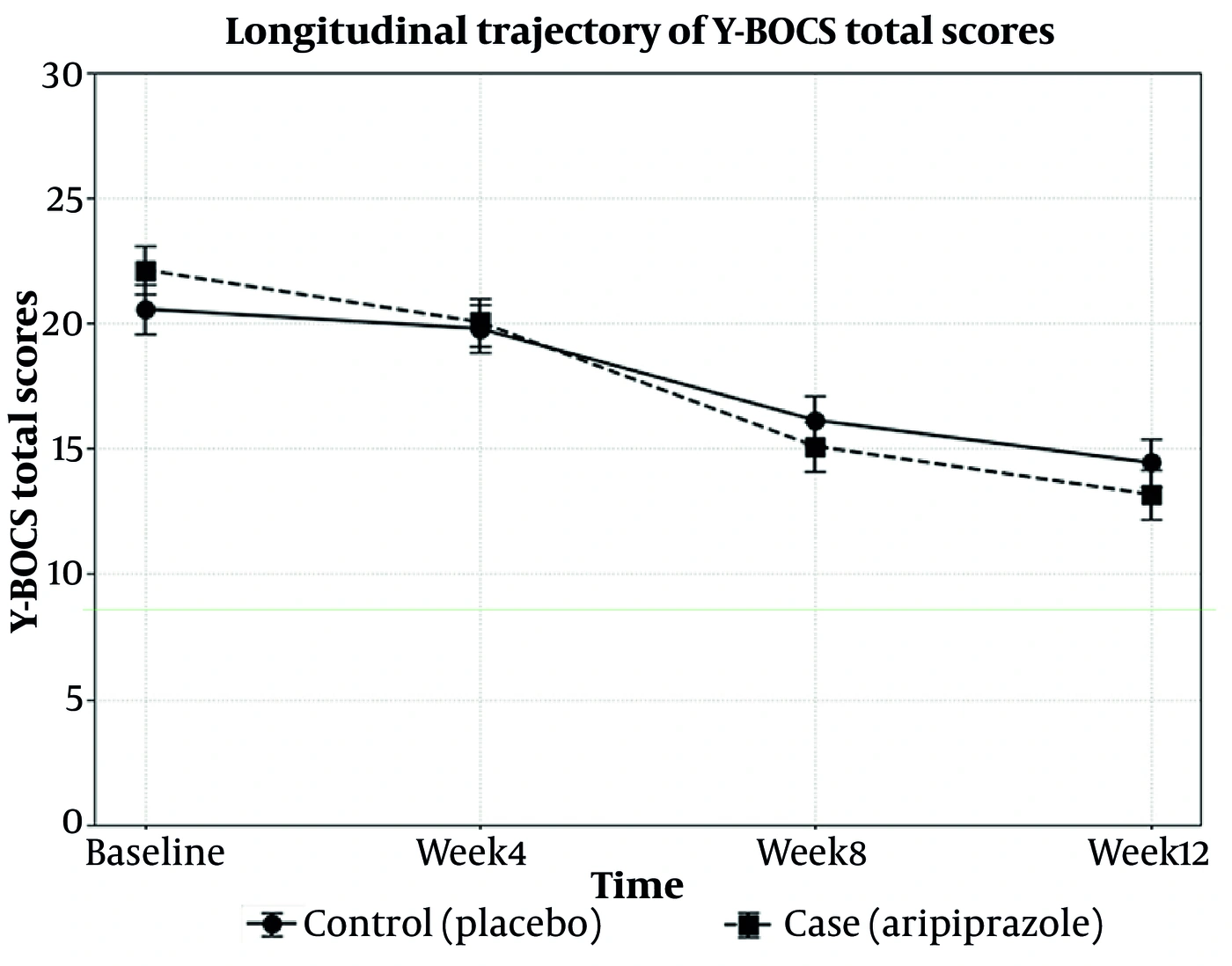
Figure 2.
Longitudinal trajectory of Yale-Brown Obsessive Compulsive Scale (Y-BOCS) total scores over 12 weeks. The graph illustrates the significant group-by-time interaction (P < 0.001) between the adjunctive aripiprazole group (n = 23) and placebo control group (n = 23). Error bars represent the standard error (SE). Active treatment occurred from baseline to week 8, followed by a 4-week off-treatment observation period ending at week 12.
Although the LMM demonstrated a statistically significant trajectory of symptom reduction, categorical clinical outcomes were also evaluated to assess clinically meaningful benefit. At the week-12 endpoint, a clinically significant response, defined as a ≥ 35% reduction in Y-BOCS total score from baseline, was achieved by 17 of 23 patients (73.9%) in the adjunctive aripiprazole group. In contrast, 6 of 23 patients (26.1%) in the placebo group met the clinical response criterion. A Pearson chi-square test showed that the between-group difference in clinical response rates was statistically significant (χ2 = 10.522, P = 0.001), further supporting the therapeutic efficacy of the adjunctive intervention.
5. Discussion
The primary aim of this study was to evaluate the effect of adjunctive aripiprazole on OCD severity in patients with BP-I at Golestan Hospital, Ahvaz. The primary analysis demonstrated a highly significant group-by-time interaction (P < 0.001), indicating a greater rate of symptom reduction in the aripiprazole group than in the placebo group.
Several studies have explored the efficacy of aripiprazole in OCD and bipolar disorder. Di Salvo et al. (17) investigated aripiprazole augmentation with lithium or valproate in 70 patients with BP-I and reported reduced OCD symptoms after 12 weeks. Our findings are generally consistent with this therapeutic effect. Despite our smaller sample size (23 per group vs 70), the highly significant group-by-time interaction suggests that aripiprazole augmentation may be effective in reducing OCD symptoms. Calabrese et al. (18) reported improvements in symptoms and functioning with once-monthly aripiprazole maintenance treatment in BP-I. Our 12-week study similarly identified improvement over follow-up, although the duration and outcomes differed from those of the longer study.
Woo et al. (11) reported outcomes associated with once-monthly aripiprazole in patients with bipolar disorder. Our findings, based on a shorter follow-up period and a smaller sample, are broadly consistent with evidence supporting the use of aripiprazole in bipolar disorder. Other studies have examined aripiprazole augmentation, antipsychotic augmentation, psychopharmacological treatment, and comorbidity in complex OCD populations, emphasizing that treatment response may vary and may require individualized approaches (20-23).
The statistical significance of our findings underscores the value of evaluating complex comorbidities over an extended observation window. In another study, the clinical meaning of obsessive-compulsive symptoms in bipolar disorder and schizophrenia was examined (19). Other work on OCD comorbidity and treatment has similarly emphasized the complexity of treatment response (23). Sayyah et al. (20) investigated aripiprazole augmentation for treatment-resistant OCD, supporting consideration of antipsychotic augmentation while acknowledging the need to balance potential benefits and risks. Our structured 12-week timeline was likely important for detecting the observed therapeutic response. This is consistent with observations by Veale et al. (21) and Del Casale et al. (22), who discussed antipsychotic augmentation and psychopharmacological treatment approaches for OCD.
Clinicians may consider individualized treatment plans, as discussed by Rector et al. (23), and standardized definitions of treatment response and related outcomes, as described by Mataix-Cols et al. (24).
5.1. Limitations
Several limitations should be considered when interpreting the findings. First, the small sample size and single-center design may limit the generalizability of these preliminary results to broader and more diverse psychiatric populations. Second, the absence of routine serum valproate monitoring precludes definitive exclusion of pharmacological confounding. Third, the 4-week off-treatment observational period introduces ambiguity regarding the week-12 endpoint, making it difficult to fully distinguish sustained therapeutic effects from natural symptom fluctuation. In addition, although all clinical outcome assessors underwent joint preparatory training to standardize Y-BOCS administration, formal statistical interrater reliability calibration was not performed, leaving endpoint evaluations potentially vulnerable to rater variability. Future large-scale trials with larger samples, longer follow-up, and biomarker exploration should stratify patient cohorts by care setting to determine whether environmental stability moderates the efficacy of adjunctive aripiprazole.
5.2. Conclusions
This trial, comprising an 8-week active treatment phase and a 4-week off-treatment follow-up, suggests that adjunctive aripiprazole may be a well-tolerated strategy associated with reduced OCD symptom severity in patients with BP-I stabilized on sodium valproate and quetiapine. Although the symptomatic improvement observed during active treatment appeared to persist after discontinuation of the study medication at week 8, these findings should be considered preliminary and hypothesis-generating rather than persuasive evidence for broader clinical use. Given the small sample size and single-center design, large-scale multicenter clinical trials with extended observation periods are required to evaluate the long-term efficacy, safety, and persistence of this adjunctive treatment.