
1. Background
Innovation is essential for gaining a competitive edge and ensuring long-term success. To foster innovation, companies need to move beyond their internal resources and seek out external information, skills, and capabilities (1, 2). As organizations manage the challenges of technological progress and market changes, strategically seeking out and integrating external knowledge has become crucial for driving innovation (3, 4). EKS strategies comprise various activities, including scouting for cutting-edge technologies, engaging with industry experts, forming alliances with academic institutions, and participating in open innovation platforms. These strategies help companies gain and integrate a wide range of knowledge, which is essential for creating new and innovative products, processes, and services. The effect of external knowledge on company innovation is substantial, and companies that actively pursue new knowledge sources often show higher levels of innovation (5, 6).
Historically, the pharmaceutical industry relied on closed innovation, protecting its new discoveries through patents, giving manufacturers exclusive intellectual property rights (IPR). This strategy primarily focused on protecting the company's proprietary knowledge and minimizing external knowledge exchange (7). However, rising R&D costs (now exceeding $2.6 billion per drug), regulatory hurdles, and pressure to accelerate drug development have made this model unsustainable (8-10). Given the many challenges in the political, regulatory, and economic landscape of today, pharmaceutical companies are under pressure to speed up product development, manage costs, enhance design processes, prioritize areas with high medical requirements, and significantly boost productivity without compromising quality. As a result, the sector has increasingly embraced open innovation, forming partnerships with academia, biotech firms, and even competitors to enhance R&D efficiency and speed up patient access to new therapies (11-13).
Although the entire pharmaceutical industry faces innovation challenges, biopharmaceutical companies face even greater ones. Developing biologic drugs is far more complex than traditional medicines. They involve longer R&D cycles, stricter regulations, and a much stronger need for external scientific knowledge (14, 15). In contexts such as Iran, where companies work under specific institutional and resource limitations, relying only on internal R&D is often not enough. This highlights the need to understand how firms can effectively translate external knowledge into innovation outcomes. To address this, our study examines two key mechanisms: first, whether KIC enables the conversion of external knowledge into IP, and second, whether R&D intensity strengthens this relationship.
1.1. Conceptual Framework and Hypotheses
This research is based on a framework grounded in the principles of knowledge-based view (KBV) theory. The theory emphasizes that knowledge is the most important strategic resource for an organization. It stresses the significance of continuous learning and innovation, suggesting that firms that can learn and adapt quickly are better equipped to innovate and respond to market changes. The theory underscores the need for firms to effectively manage and integrate knowledge to maintain a competitive advantage in the modern economy. This involves processes for acquiring, storing, sharing, and using knowledge to achieve organizational goals (16-18). Finally, this article enhances the understanding of the knowledge-based theory by emphasizing the significance of knowledge as a strategic resource and its effect on IP.
1.1.1. External Knowledge Search Strategy
The concept of External knowledge search strategy is crucial in strategic management and innovation literature. It refers to the structured approach companies use to identify, acquire, and leverage knowledge from external sources to boost their innovation potential and remain competitive. This strategy is grounded in the knowledge-based perspective of the firm (6).
In this study, we assessed the EKS strategy through external knowledge search depth. We intend to conduct our evaluation in the biopharmaceutical industry where knowledge depth represents a vertical dimension that reflects the level of collaboration with partners. It also signifies the complexity, uniqueness, and knowledge content within the field (19-21).
1.1.2. Knowledge Integration Capability
A knowledge base by itself may not be enough for effective product development. A company also needs to implement knowledge integration mechanisms to gather, understand, and apply its knowledge resources (22). KIC is the ability of an organization to evaluate and combine knowledge from external sources and its own internal experiences. This ability is essential for organizational learning and the decision-making process, as it allows the organization to create knowledge, which is then retained and integrated into its practices and procedures (23). Ming-Chao Wang defines KIC as a firm's capability to integrate and utilize knowledge and expertise from its operational processes, suppliers, and partners (24). In a different study, KIC was described as a project-oriented firm's capability to intentionally generate new knowledge by combining various knowledge resources, expand this knowledge to activities that create value, and adapt it to meet evolving market conditions (25). Ming-Shun Li describes KIC as the ability to leverage existing knowledge to create new reconfigurations and combinations, which act as a foundation for innovation (26).
The concept of KIC has been interpreted in various ways by scholars from different perspectives. However, the fundamental understanding remains consistent. In essence, this process involves collecting distinct types of knowledge, then reorganizing and innovating based on the members' comprehension and assimilation. The aim is to preserve the organization's core competitiveness.
1.1.3. Innovation Performance
Innovation performance (IP) refers to the ability of companies to use new ideas and technologies to surpass their competitors and gain a competitive edge. It involves assessing an organization's capacity to create and apply innovations, measuring the impact of these efforts on actual innovative outcomes, and determining how they have contributed to the organization's success and expansion (27).
IP can be assessed by the number of sales resulting from new or improved technological products (28), number of new product development and patents (29-31), customer value creation (32), the success ratio of new services or products, cost reductions (31), and access to new markets (30). In essence, IP is a multidimensional concept that measures how effectively organizations can convert their innovation efforts into concrete outcomes that contribute to their strategic goals and market success (33). It is a measure of how effectively an organization can utilize its innovative capabilities to achieve its goals, which was the focus of our study.
1.1.4. External Knowledge Search Strategy and Innovation Performance
IP is crucial for a company's competitive edge and long-term prosperity. Effective innovation relies on various factors, including the strategies used to obtain and apply knowledge. One crucial strategy is EKS, which involves organizations seeking valuable new ideas from external sources such as public and private institutions, competitors, suppliers, and customers. This approach is vital for fostering innovation as it enables firms to access diverse perspectives, new technologies, and market trends that may not be available internally (20). In addition, companies increasingly rely on external knowledge resources to maintain a sustainable competitive advantage in today's markets (6). Recent research has emphasized the beneficial effects of EKS on IP. Segarra-Ciprés and Bou-Llusar (2018) discovered that firms conducting extensive and in-depth EKS are more likely to achieve better innovation outcomes. However, they noted that knowledge search strategies might not always yield the desired results. Therefore, firms should ensure that their search strategies are aligned with their innovation goals and the specific contexts of their industry (34). Zhang et al. (2022) (5) conducted a meta-analysis and concluded that EKS positively correlates with firm IP, particularly in mature enterprises. Wang et al. (2020) highlight the importance of an ambidextrous knowledge search strategy, which seeks to balance the depth and breadth of external knowledge. This strategy enables firms to effectively integrate a broad array of external knowledge sources. As a result, this integration leads to improved innovation performance (35). Recent scientific articles provide strong evidence that searching for external knowledge is a crucial factor for driving IP. The capability to effectively find and incorporate external knowledge into a company's innovation processes is essential for staying competitive in a fast-changing business environment. These studies offer valuable insights into how companies can strategically manage their knowledge search activities to maximize innovation outcomes. Based on the theoretical foundations and empirical evidence, we propose the following hypothesis:
H1: External knowledge search strategy will exert a positive and significant effect on companies’ innovation performance.
1.1.5. External Knowledge Search Strategy, Knowledge Integration Capability, and Innovation Performance
Acquiring external knowledge is essential for organizations to secure a competitive edge and drive product innovation (36, 37). The enterprise should integrate that new external knowledge with existing ones through a knowledge integration mechanism to create innovative knowledge resources (24). Knowledge integration is the ability to efficiently handle and apply both newly acquired and existing knowledge within organizations. It enables enterprises to obtain, distribute, and apply knowledge (6, 38). Integrating knowledge allows businesses to enhance their existing repository of knowledge, speed up the generation of new knowledge, and offer valuable insights for pioneering innovations (39).
Recent research underscores the significance of aligning EKS strategies with the capability to effectively integrate that knowledge. For instance, a study by Zhang, Wang, and Xu (2021) emphasizes that knowledge integration serves as a crucial intermediary between breakthrough innovation and knowledge search in enterprises (39). This implies that simply obtaining external knowledge is not sufficient; to achieve innovation outcomes, companies must also possess the capability to effectively combine this knowledge. Liu's study suggests that the KIC mediates the impact of external search strategies on both incremental and radical IP. This mediation effect underscores the importance of KIC as a critical factor in turning external knowledge into innovative outcomes (40). The literature suggests that taking a strategic approach to seeking external knowledge, along with having a strong ability to integrate that knowledge, is crucial for promoting innovation. Organizations need to concentrate not only on obtaining external knowledge but also on creating the necessary processes and systems to integrate this knowledge effectively. As the business environment continues to change, the capability to integrate external knowledge will continue to be a critical factor for achieving innovation success and organizational sustainability (25).
The review above draws on the latest articles and summarizes the current understanding of the relationship between EKS strategies, KIC, and IP. Based on this, the following hypothesis is proposed: Organizations that actively seek knowledge beyond their borders are more likely to develop advanced capabilities in integrating diverse knowledge sources.
H2: External knowledge search strategy will exert a positive and significant effect on knowledge integration capability.
H3: Knowledge integration capability will exert a positive and significant effect on innovation performance.
Ultimately, the effectiveness of an EKS strategy on IP hinges on the organization's ability to integrate and effectively utilize the acquired knowledge.
H4: External knowledge search strategy will exert a positive and significant effect on innovation performance with the mediating effect of knowledge integration capability.
1.1.6. The Moderating Effect of R&D Intensity on Innovation Performance
IP refers to the results of a company's innovative activities, including the development of new products, the speed of innovation, and the economic gains from these innovations (31). Usai et al. (2021) emphasize that a firm's success is significantly measured by its ability to transform R&D efforts into marketable solutions (41).
Xu, Wang, and Liu (2021) identified a strong positive correlation between IP and R&D investment (42). Similarly, Nooteboom et al. (2007) observed that higher R&D intensity correlates with improved IP, leading to more patents for firms already proficient in this area (43). Zhu et al. (2019) demonstrated that R&D personnel input and R&D investment significantly enhance technological IP in most high-technology based industries in China (44).
A study contends that external knowledge acquisition and internal R&D are complementary activities in the innovation process. The extent of this complementarity is influenced by factors such as the firm's R&D intensity (45). This implies that companies with higher R&D intensity may be better positioned to benefit from EKS strategies. Therefore, we propose the following hypothesis:
H5: External knowledge search strategy will exert a positive and significant effect on innovation performance with the moderating effect of R&D intensity.
1.1.7. Firm Size and Age as Control Variables on the Model
A company's size and age can influence various aspects of its operations. Larger firms typically have more resources to invest in R&D, which can result in greater innovation. A study suggests that larger firms can financially benefit from environmental innovation, especially when driven by regulations or industry codes of conduct (46). Another study discovered that the size of a firm moderates the impact of innovation on its performance, Therefore, firms should consider their size before investing in innovative projects or process management improvements, as it can influence how creativity is perceived within the organization and its overall performance (47).
Another factor that has been linked to IP is firm age. Coad et al. review the literature on this topic, suggesting that older firms might benefit from greater experience and established processes that support innovation. However, the link between a firm's age and its innovation is intricate and not easily defined (48). Some studies suggest that established routines and resistance to change in older firms may lead to less inclination to innovate (49, 50). Conversely, some research suggests that the age of a firm can have a positive impact on innovation by offering a stable foundation for continuous improvement (51).
The literature review indicates that both firm size and age have intricate relationships with IP. Larger firms have more resources for innovation, but the effectiveness of these innovations can be affected by external factors like market demands and regulatory pressures. Similarly, older firms may have more experience, but their established routines can either hinder or facilitate innovation. Drawing from the literature review, we propose the following hypotheses:
H6: Firm size will exert a positive and significant effect on the company's innovation performance.
H7: Firm age will exert a positive and significant effect on the company's innovation performance.
Building on the KBV introduced earlier, our hypotheses are explicitly designed to reflect its core tenets. Specifically, the relationship between EKS and IP (H1) embodies the KBV principle that access to external knowledge is a strategic imperative. The positive effect of EKS on KIC (H2), and of KIC on IP (H3), operationalize the theory’s central claim that value is created not merely by acquiring knowledge, but by effectively internalizing and recombining it. The mediating role of KIC (H4) further captures the KBV insight that competitive advantage stems from how firms process knowledge, not just its collection. Finally, the test of R&D intensity as a moderator (H5) allows us to examine whether structural resources alone can compensate for limited integrative capability. Together, these hypotheses translate the abstract logic of KBV into a testable model of innovation in a resource-constrained biopharmaceutical context.
Figure 1 illustrates the concepts and connections proposed in the hypotheses. The model illustrates EKS as independent variable, with IP as the dependent variable. It also includes the moderating effect of R&D intensity and the mediating effect of KIC components.
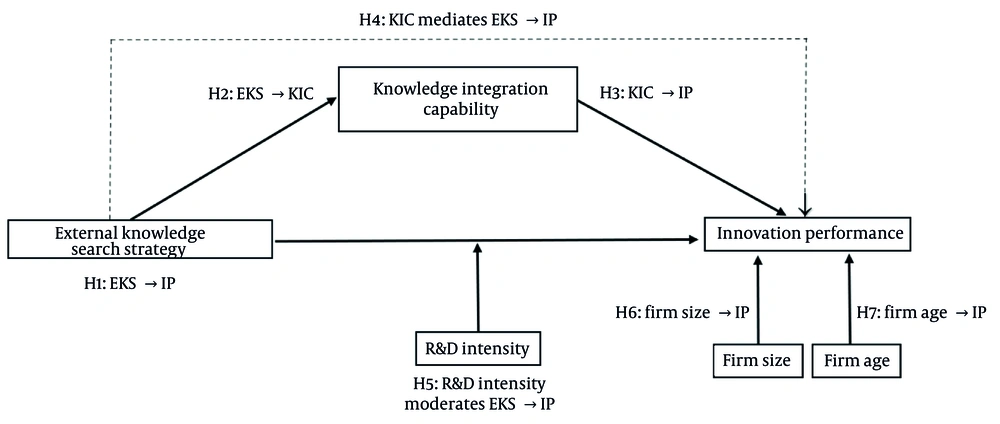
Figure 1.
Conceptual framework of the study model
2. Objectives
This study examined whether KIC enables the conversion of external knowledge into IP and whether R&D intensity strengthens this relationship in Iranian biopharmaceutical firms.
3. Methods
3.1. Population and Sample
In this study, we focused on biopharmaceutical companies in Iran. The list of companies was obtained from the Iranian Food and Drug Administration (IFDA). After excluding companies that had no activity or products in the last 5 years, 47 biopharmaceutical companies were selected as the final sample. To mitigate common method bias, data were gathered from multiple respondents within each company. The questionnaire was distributed to selected companies, requesting input from 3 individuals, including the CEO, R&D manager, and business development managers. Out of 141 distributed questionnaires, 92 were completed and returned by 44 companies.
3.2. Instrument and Data Collection
We developed the questionnaire by adapting items from previous studies (see Section 3.3 for details) and validated it using the Content Validity Index (CVI) and Content Validity Ratio (CVR) methods. The questionnaire was separated into two sections. The first section gathers general information about the respondent, such as their job position and history of his/her activity in that company, along with the company's profile, including its name, year of establishment, total number of employees, and the number of employees in the R&D department. The second section assesses the research variables using a five- or seven-point Likert scale.
Following Armstrong and Overton's (1977) procedure, t-tests were conducted to compare nonresponding and responding firms in terms of size and age to address potential nonresponse bias. The findings revealed no significant differences, suggesting that nonresponse bias was not a concern (52).
3.3. Measures
3.3.1. Dependent Variable
3.3.2. Independent Variables
To measure EKS strategy, we relied on three studies by Laursen and Salter, Guo and Wang, and Kang (20, 57, 58). We asked our respondents which sources of external knowledge and to what extent they use for new product design. This variable was constructed by combining 17 possible sources of knowledge for information obtained from the mentioned sources: (1) Suppliers of materials, equipment, parts, or software (2) Competitors; (3) Customers; (4) Business consultants; (5) Informal communications with employees of other companies; (6) Recruiting experienced employees from other companies; (7) Consulting contract with a foreign party for the technical knowledge transfer or training of manpower; (8) Exhibitions; (9) Patents; (10) Scientific magazines; (11) Technical and commercial press or websites; (12) Specialized and international conferences; (13) National meetings and congresses; (14) Business associations such as chambers of commerce; (15) Commercial laboratories/ R&D companies; (16) Government or private research organizations; and (17) Universities or other higher education institutions. Each of the 17 sources used a 5-point Likert scale to measure the external knowledge depth.
3.3.3. Mediator and Moderator Variables
KIC functioned as a mediator in our model, and we relied on three studies to measure it. All questions were measured using a 7-point Likert scale (25, 39, 59). According to Katila and Ahuja, we calculated R&D intensity (moderator variable) as a firm's R&D expenditures divided by its total sales (60).
3.3.4. Control Variables
Firm size and age are commonly used control variables in innovation research, as they reflect differences in resource availability and organizational experience that may affect IP. We included these two variables because they are standard controls in studies on EKS (20)and are particularly relevant in resource-constrained settings like Iran’s biopharmaceutical sector. Other potential controls, such as market competition or regulatory pressure, were not included because all firms in the sample operate under the same national regulatory authority (IFDA) and face highly similar market conditions, resulting in limited variation that would not meaningfully contribute to the model.
3.4. Statistical Analysis
We utilized partial least squares structural equation modeling (PLS-SEM) with Smart PLS 3.0 to validate our model and hypotheses. PLS, as a multivariate analysis method, allows researchers to simultaneously examine latent and manifest variables (62). PLS-SEM is suitable for this study for several reasons. Firstly, it can handle non-normal data (63). We performed the Kolmogorov-Smirnov test and found that aside from EKS, our other two variables (IP and KIC) were not normally distributed. Additionally, PLS-SEM can handle small sample sizes, making it suitable for our analysis as we had 92 questionnaires (64).
4. Results
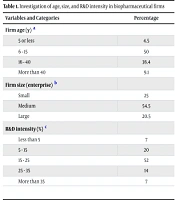
Table 1 provides information on the age and R&D intensity of the companies. The table also shows the distribution of company size based on the number of employees, according to the OECD classification. 55% of the companies in the study were considered medium-sized, with 250 - 499 employees. Additionally, almost half of the companies had an R&D intensity between 15% and 25%.
Table 1.
Investigation of Age, Size, and R&D Intensity in Biopharmaceutical Firms
| Variables and Categories | Percentage |
|---|---|
| Firm age (y) a | |
| 5 or less | 4.5 |
| 6 - 15 | 50 |
| 16 - 40 | 36.4 |
| More than 40 | 9.1 |
| Firm size (enterprise) b | |
| Small | 25 |
| Medium | 54.5 |
| Large | 20.5 |
| R&D intensity (%) c | |
| Less than 5 | 7 |
| 5 - 15 | 20 |
| 15 - 25 | 52 |
| 25 - 35 | 14 |
| More than 35 | 7 |
a Calculated as the natural logarithm of the number of years since the company's establishment.
b Calculated by the logarithm of the number of employees
c Calculated as R&D expenditure/total sales × 100%, based on self-reported financial data.
4.1. Data Validity and Reliability
We began by conducting several tests to confirm the reliability and validity of our measurements. Initially, we demonstrated that all items were appropriately loaded onto their respective hypothetical factors, with all factor loadings exceeding 0.60 (65). We evaluated the construct's reliability, as presented in Table 2. All values for Cronbach's alpha and composite reliability (CR) exceeded 0.7, demonstrating strong measurement reliability (66). Next, we evaluated the construct validity by examining the component items of each scale to establish both convergent and discriminant validity.
To verify convergent validity, we calculated the average variance extracted (AVE). The AVE scores for all three variables surpassed the recommended threshold of 0.5, thereby confirming convergent validity (67). The research constructs were assessed for discriminant validity using the Fornell-Larcker criterion (66). The findings show that each construct's average variance extracted is significantly higher than its highest shared variance with other constructs, offering additional proof of discriminant validity (67). Therefore, it can be inferred that the measures employed in this study demonstrate adequate reliability and validity.
| Constructs and Items | Factor Loading | AVE | Cronbach’s α | CR |
|---|---|---|---|---|
| External knowledge search strategy | 0.549 | 0.736 | 0.829 | |
| Exhibitions | 0.817 | |||
| Press or technical and commercial sites | 0.635 | |||
| Specialized and international conferences | 0.764 | |||
| National meetings and congresses | 0.737 | |||
| Knowledge Integration Capability | 0.584 | 0.860 | 0.894 | |
| Our company can integrate the acquired EK into organizational performance. | 0.782 | |||
| In our company, team meetings involve experts with different skills to generate new ideas. | 0.729 | |||
| Our company shares information from experts in different units with relevant people in the organization. | 0.716 | |||
| Employees in the company have a shared understanding of the processes required to complete projects. | 0.781 | |||
| The company's staff is well-informed about and complies with the necessary rules, responsibilities, and collaboration measures | 0.786 | |||
| All employees in the company can use their expertise and knowledge to bring new ideas to fruition. | 0.789 | |||
| Innovation performance | 0.533 | 0.875 | 0.900 | |
| Our company is seeing an increase in the introduction of new products. | 0.741 | |||
| Our new product development program has met its set objectives. | 0.749 | |||
| Our new products clearly offer more advantages than the previous ones. | 0.712 | |||
| Our overall new product development program is much more successful compared to that of our main competitors. | 0.765 | |||
| We always release new products before our competitors. | 0.640 | |||
| Our new products are gaining more market share. | 0.891 | |||
| Our new products create new markets for themselves. | 0.701 | |||
| After our new products entered the market, they achieved remarkable success in terms of sales. | 0.606 |
a 0.5 ≤ factor loading < 0.7, average variance extracted (AVE) ≥ 0.5, Cronbach’s α (CA) ≥ 0.7, composite reliability (CR) ≥ 0.7.
b All constructs were measured using a 5- or 7-point Likert scale.
4.2. Structural Model Fitness
We assessed the variance inflation factors (VIFs) for all constructs in our model to detect multicollinearity. The VIFs are all below 1.5, significantly lower than the widely accepted threshold of 5 (68). We utilized the R-squared value for the dependent variables to evaluate the structural model; 0.405 for IP, and 0.206 for KIC. The structural model explained (40.5%) variance in IP and (20.6%) variance in KIC.
4.3. Hypothesis Testing and Results
We used bootstrapping to analyze the hypotheses and explore the significance level among all the variables. In line with our first hypothesis, the EKS strategy has a positive effect on IP (β = 0.462, P < 0.001). Our results indicate that EKS also has a significant positive effect on KIC (β = 0.239, P < 0.003), and KIC has a positive significant effect on IP (β = 0.437, P < 0.001). Consistent with H4, KIC mediates the effect of EKS on IP. We perform the Sobel test to obtain the path coefficient of the mediating variable. To determine the level of mediation, we calculated the variance accounted for (VAF) at 0.2, indicating a partial mediation effect. The VAF value of 0.2 indicates that 20% of the total effect of EKS on IP is transmitted through KIC, confirming a partial but meaningful mediating role. Meanwhile, an R² of 0.405 for IP suggests that the model explains over 40% of the variance in IP a substantial level in organizational and innovation research, particularly within the context of emerging biopharmaceutical firms facing resource constraints. In our study, we found that R&D intensity did not have a significant moderating effect on IP (β = 0.198, P = 0.10). Finally, neither firm age nor size had a significant effect on IP (Table 3).
Table 3.
Results of Hypothesis Testing
| Hypothesis | Statement | P-Value | beta | Result |
|---|---|---|---|---|
| H1 | The EKS strategy will exert a positive and significant effect on the company's IP. | < 0.000 a | 0.462 | Supported |
| H2 | EKS strategy will exert a positive and significant effect on KIC. | < 0.003 a | 0.239 | Supported |
| H3 | KIC will exert a positive and significant effect on IP. | < 0.001 a | 0.437 | Supported |
| H4 | EKS strategy will exert a positive and significant effect on IP with the mediating effect of KIC. | 0.02 a | 0.104 | Supported |
| H5 | EKS strategy will exert a positive and significant effect on IP with the moderating effect of R&D intensity. | 0.1 | 0.198 | Not supported |
| H6 | Firm size will exert a positive and significant effect on the company's innovation performance. | 0.924 | 0.009 | Not supported |
| H7 | Firm age will exert a positive and significant effect on the company's innovation performance. | 0.792 | 0.030 | Not supported |
P ≤ 0.05.
5. Discussion
5.1. Confirming the Effect of External Knowledge Search Strategy on Innovation Performance
The relationship between EKS and IP has always been the focus of research in the field of knowledge management and innovation. The findings of this study confirm the positive and significant effect of EKS strategy on IP. This aligns with the results of a meta-analysis conducted by Zhang et al., which demonstrated a significant positive correlation between EKS and IP. The study suggests that companies actively seeking knowledge beyond their borders are more likely to achieve better innovation outcomes (5). Zhengrui Li's study in 2023 pointed out that seeking market information and technical knowledge to understand market needs and trends positively affects the quality and speed of innovation development (69). In our study, we found that biopharmaceutical companies are currently benefiting from 17 different sources of external knowledge, including patents, customer, supplier, and competitor knowledge, and more. Our research showed that companies can improve their IP by leveraging press, technical, and commercial knowledge sources, and by participating in specialized and international conferences, exhibitions, national meetings, and congresses.
The findings from similar studies in this section suggest that organizations should tailor the acquisition of external knowledge to fit the specific industry and market dynamics. Different search patterns may result in different levels of IP. These results emphasize the importance for companies to thoughtfully consider how to search for and integrate external knowledge into their innovation processes while taking into account their unique capabilities and context (6, 34, 69). Our study is the first of its kind in the biopharmaceutical industry in Iran and is expected to create opportunities for companies to improve their IP.
5.2. Investigating the Moderating Effect of R&D Intensity
Our research, along with other studies, suggests that increasing R&D intensity does not always lead to better IP. This aligns with evidence that the quality and strategic alignment of R&D activities may matter more than their scale. For instance, Dong et al. noted a curvilinear relationship between R&D intensity and IP, implying diminishing returns beyond an optimal threshold (70). Similarly, other studies have shown that factors like governance structure (71), commercialization orientation (72), or government subsidies (42) can reshape how R&D translates into innovation conditions that may not fully apply in Iran’s uniformly regulated, resource-constrained environment. Critically, the non-significant moderating role of R&D intensity in our model reflects the structural realities of Iran’s biopharmaceutical sector. Due to technological sanctions, limited access to original cell lines, and intellectual property barriers, firms are largely unable to engage in radical drug discovery. Instead, R&D activities are predominantly oriented toward biosimilar development and process optimization forms of “smart imitation” rather than knowledge-intensive innovation. In such a context, higher R&D spending alone cannot compensate for weak KIC. Without the internal routines to absorb, recombine, and adapt external knowledge, increased budgets risk becoming inefficient or even wasteful. It is also worth noting that the non-significant moderating role of R&D intensity may be partially influenced by social desirability bias, as some managers tended to overreport their R&D expenditures, potentially inflating this metric beyond actual investment levels further weakening its empirical link to innovation outcomes.
5.3. Examining the Role of Company Age and Size as Control Variables in Innovation Performance
Our results show that neither firm size nor age significantly affects IP, a finding that challenges conventional assumptions derived largely from other studies, where scale and experience often translate into innovation advantage (73, 74). In contrast, in Iran’s policy-intensive and resource-constrained biopharmaceutical ecosystem, such advantages are decoupled from demographic traits. In this context, many large and established firms are primarily generic drug manufacturers with minimal R&D investment. Their market position stems not from innovation, but from stable government procurement and regulated pricing. Conversely, smaller, and younger biotech firms despite limited scale often demonstrate higher innovation by actively collaborating with universities and strategically sourcing external knowledge.
Thus, organizational size and age lose their typical predictive power. This reflects a broader insight, in policy-driven, resource-constrained ecosystems, strategic choices and external linkages matter more than demographic traits specially in Iran. As Baláž et al. suggest, innovation strategy can mediate the influence of firm age and size (75), while Adam and Alarifi highlight that external support often drives SME innovation under pressure situations (76).
Our null result, therefore, is not a weakness but a contextual signature of Iran’s unique innovation landscape.
5.4. Investigating the Mediating Role of Knowledge Integration Capability in the Relationship Between External Knowledge Search Strategy and Innovation Performance
An organization's EKS strategy remains incomplete without the capacity to internally communicate and share insights gained from the external environment. The ability to integrate knowledge includes gathering and processing different information within the organization. In our model, we examined KIC as a mediating variable. This indicates that innovation is driven not only by access to external knowledge but also by a firm's ability to acquire and integrate knowledge into its existing operations and R&D processes. This capability enables firms not only to absorb external knowledge but also to combine it with their internal knowledge, thus enhancing their IP. In this regard, Martini's study also showed that EKS practices have a positive effect on IP. This positive effect becomes more pronounced when internal knowledge management methods are used to integrate and manage innovative ideas. It's also noted that an organization's EKS strategies will not be effective without the ability to communicate and share information internally (77). Dong's study emphasized that KIC forms a vital foundation for digital enterprises. It also highlighted the necessity of a strategic approach to knowledge sharing for enhancing IP within these organizations (78). The positive impact of EKS strategies on KIC is supported by the literature, which highlights the essential role of this variable in enhancing IP. For clarification, we can refer to a study by Feng and his colleagues that emphasizes the importance of dynamic knowledge management capabilities in improving IP. The study demonstrates that effective management and the ability to absorb, transfer, and apply knowledge are crucial. These capabilities are not fixed; they evolve with changes in the business environment, allowing companies to adapt and reconfigure their knowledge resources in response to market conditions, technological advancements, and competitive pressures. This adaptability helps companies to maintain or enhance their IP despite external uncertainties and rapid changes (79). The Trantopoulos study investigates how the acquisition and retention of external knowledge, along with the presence of information technology facilities, collectively impact the process IP of Swiss firms in various manufacturing industries. This research offers valuable insights into how companies can strategically utilize information technology to enhance their innovation capabilities by effectively integrating external knowledge into their processes (80).
We found that biopharmaceutical companies can improve their IP by integrating the acquired knowledge into their operations. This is achieved by holding team meetings that involve experts with different skills, which leads to the generation of new ideas. Sharing information from experts in different units with relevant people in the organization further contributes to increased IP. However, for this to be successful, employees in the company need to have a shared understanding of the processes required to complete projects. Additionally, the company's staff must be well-informed about and comply with the necessary rules, responsibilities, and collaboration measures. Ultimately, these conditions will allow employees to utilize their expertise and knowledge to bring new ideas to fruition.
Our study adds to the knowledge of innovation management in the pharmaceutical industry by emphasizing the significance of external knowledge and its integration with internal knowledge. As companies tackle the challenges of developing new medicines and treatments, it is crucial not to underestimate the strategic value of external knowledge and its fusion with internal resources.
5.5. Conclusions
The findings offer an understanding of how EKS enhances IP in Iran’s biopharmaceutical firms. Notably, EKS exerts a strong positive effect on IP (β = 0.462), indicating that firms actively engaging with external sources such as scientific publications, conferences, and collaborative networks achieve substantially higher innovation outcomes. More importantly, KIC emerges as a pivotal mechanism. It not only directly boosts IP (β = 0.437) itself but also partially mediates the EKS-IP link (indirect effect β = 0.104). This implies that about 20% of EKS’s total impact on innovation operates through integration processes, reinforcing that external knowledge alone is insufficient without internal capability to synthesize it.
In contrast, R&D intensity shows no significant moderating role (β = 0.198, P = 0.10), suggesting that higher R&D spending does not amplify the EKS-IP relationship in this context. Furthermore, firm size (β = 0.009) and age (β = 0.03) have negligible effects, confirming that innovation in this emerging ecosystem is driven more by strategic knowledge management than by structural or temporal advantages.
Altogether, these results highlight that KIC is not merely a mediator but a core strategic capability one that biopharmaceutical firms should prioritize to translate external insights into tangible innovation outcomes.
5.6. Managerial and Policy Implications
The findings offer actionable guidance for managers and policymakers in Iran’s biopharmaceutical sector.
Managers should strengthen KIC by holding cross-functional team meetings to interpret external knowledge, using shared platforms to document processes and collaboration rules, training staff to combine diverse knowledge into innovations, and assigning knowledge brokers to facilitate information flow across units. Policymakers can support this shift by promoting university–industry R&D consortia, providing innovation vouchers for SMEs to adopt KIC practices, and incentivizing firms that institutionalize structured knowledge integration.
5.7. Limitations
- The present study was conducted in the population of biopharmaceutical companies (47 companies), which is considered a small target population.
-Moreover, this population operates under a specific set of institutional, regulatory, and resource constraints. As such, the findings may not be generalizable to firms in other countries, particularly those in developed or differently regulated emerging economies.
- Single research method: Relying only on the questionnaire may limit the scope of the study findings. Different research methods can provide diverse insights, and using only one method may limit the depth and richness of the collected data.
- Response bias: The study uses self-reported measures, and there is a risk of social desirability bias, where respondents may answer in a way, they believe is desirable rather than honestly.