


1. Context
Technology is the key to entering today’s business world, and commercialization is the cornerstone of technology. In other words, commercialization serves as the link between technology and the market, focusing on the final stages of the value chain. While many studies in the literature have been conducted on market research and marketing, compared to the commercialization of other products, studies on commercializing new ideas, especially emerging technologies, have received less attention (1). This gap is particularly pronounced in the context of medical technology commercialization, where the intersection of innovation, regulation, and public health creates unique challenges that require specialized research approaches.
Entering international markets involves planning and managing cross-border exchanges to meet the goals of individuals and organizations. Domestic and foreign markets differ in political, economic, and cultural environmental factors. Differences in climate, natural environment, culture, resources, and technology create diverse production and service needs (2, 3). However, the medical technology sector presents unique challenges that transcend typical market entry considerations, including stringent regulatory requirements, complex certification processes, and the critical nature of healthcare products that directly impact patient outcomes.
Currently, many medical achievements depend on advanced medical equipment, and without appropriate equipment, diagnosis, treatment, and monitoring become challenging. Various types of medical equipment have been introduced to facilitate tasks and enable new activities (4, 5). The global medical device market, valued at approximately $432 billion in 2020 and is expected to reach $628 billion by 2028, at a rate of increase of 5.4% from 2021 to 2028. However, developing countries face significant barriers to accessing these technologies, with import dependencies often exceeding 80% for critical medical devices (6).
In the Iranian context, extensive sanctions, resulting inflation, and severe currency market fluctuations in recent years have created substantial challenges regarding the import of medical equipment, highlighting the critical importance of domestic production and localization of these technologies. These constraints have inadvertently created opportunities for indigenous innovation and self-reliance in medical technology, similar to experiences observed in other sanctions-affected economies. The entry of medical equipment manufacturing companies and the establishment of knowledge-based companies in the field of advanced medical technology require a fundamental review of standards, technical requirements, and licensing needs for these products to enter the consumer market. Therefore, the present study aims to investigate and analyze the processes of entering domestically produced medical equipment into the market and propose an appropriate model (4, 6).
Currently, many medical achievements depend on advanced medical equipment, and without appropriate equipment, diagnosis, treatment, and monitoring become challenging. Various types of medical equipment have been introduced to facilitate tasks and enable new activities (4, 5). However, due to extensive sanctions, resulting inflation, and severe currency market fluctuations in recent times, many challenges have arisen regarding the import of medical equipment, highlighting the importance of domestic production and localization of these technologies. The entry of medical equipment manufacturing companies and the establishment of knowledge-based companies in the field of advanced medical technology require a fundamental review of standards, technical requirements, and licensing needs for these products to enter the consumer market. Therefore, this study aims to investigate and analyze the processes of entering domestically produced medical equipment into the market and propose an appropriate model (4, 6).
Identifying and eliminating or reducing strategic barriers to advancing competitive technology production and market entry is an important issue in formulating necessary policies for medical equipment in the Ministry of Health. For example, one of the most significant challenges is the barriers to entering innovative products into the market, the resolution of which plays a crucial role in shaping the market (2, 7, 8).
2. Objectives
Given the importance of the mentioned issues, it can be argued that conducting research to propose a model for developing market strategies for health-related technologies in Iran is essential. This study can serve as a valuable resource for evidence-based policy-making and knowledge enhancement. The present study aims to investigate and analyze the processes and challenges of entering health-related equipment and technologies into the domestic market, with the goal of providing the best evidence for managers and policymakers in this field, informed by international best practices and adapted to local conditions.
3. Evidence Acquisition
This study is a systematic review in which data collection was conducted through searches in international databases such as PubMed, Cochrane, Scopus, and HTA, as well as domestic databases like SID and IranDoc. The search strategy was developed based on English and Persian root keywords under the guidance of relevant experts. Using Mesh terms, Emtree, and appropriate keywords, without restrictions on the publication date or language of the studies, the search was conducted in the mentioned databases. In addition to electronic resources, relevant national and international conferences were also searched. The main roots of the search strategy were based on key terms and phrases in the field, such as "Health Equipment", "Medical Industry", "Medical Equipment", "Medical Device", "Medical Supply", "Laboratory Diagnostic Equipment", "Diagnostic Equipment", "Health Device", "Market", "Commercial", and their English equivalents, which were searched in both international and Iranian databases.
To search for other related documents and reports, organizational data and reports were also pursued. As inclusion criteria, all relevant studies from 2010 onwards, without language restrictions, were considered eligible for the study.
All stages of developing the protocol, conducting the search process, assessing thematic relevance, refining articles, quality assessment, data extraction, and analysis were performed independently by two researchers. In case of discrepancies in the results or outputs at any stage, consensus was reached with the input of the lead researcher.
To assess the quality of the articles, the Critical Appraisal Skills Programme (CASP) tool was used. Two researchers independently carried out all stages of protocol development, search execution, thematic relevance assessment, article selection, quality evaluation, data extraction, and analysis. In cases of discrepancies, consensus was achieved with input from the lead researcher. For quality assessment, the CASP tool was used, though transparency in scoring had been previously lacking. Of the 819 initially retrieved studies, 32 met the inclusion criteria and underwent content analysis. The studies were categorized based on CASP scores: High quality (8 - 10) included 15 studies, moderate quality (5 - 7) included 12 studies, and low quality (≤ 4) included 5 studies. These findings illustrate the overall quality of the included studies.
Finally, through the mentioned processes, out of the 819 initially searched articles, 32 articles met the criteria for data extraction, and their data were extracted and subjected to content analysis. The PRISMA diagram illustrates the process of search, refinement, screening, and analysis (Figure 1).
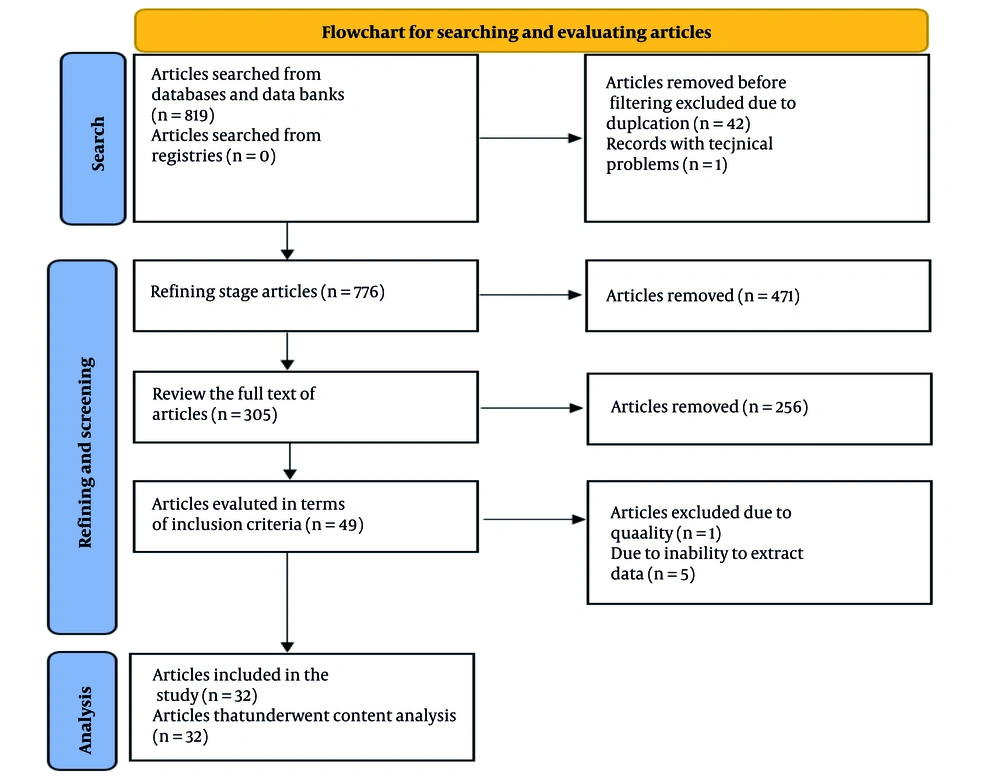
Figure 1.
The PRISMA diagram of search and evaluation
3. Results
The analysis of data extracted from the 32 eligible articles in this study focused on examining the processes of entering medical equipment into the domestic market. This included analyzing the objectives, methods, strengths, weaknesses, and lessons learned from published experiences related to Iran and other countries. One notable finding of this approach was the identification and analysis of strategic barriers to health-related technologies in the competitive domestic production sector and the challenges of market entry. The study results indicate that these barriers can significantly push the market structure toward monopoly, which in turn initiates a cycle of inefficiency. Table 1 outlines the most significant challenges identified in the marketing and commercialization of health-related products and technologies in the domestic market.
Table 1.Challenges Identified in the Processes of Entering Health Technologies into the Domestic Market
| Extracted Concepts (Themes) | Related Studies |
|---|---|
| Insufficient scientific evidence for evidence-based decision-making and policy-making | (1, 6, 7, 9-15, 16, 17) |
| Inconsistency of some standards with existing scientific evidence | (1, 9, 16, 18) |
| Lack of systematic prioritization of health technologies | (1, 6, 9, 10,11, 14-17) |
| Insufficiency of most research and scientific projects in universities and research institutions to meet real needs | (2, 8) |
| Cost-ineffectiveness of research-based production compared to imports | (1, 4, 11, 12, 15, 18) |
| Dependence of domestic production processes on the import of raw materials and basic equipment | (3) |
| Bureaucratic and time-consuming processes for obtaining production and commercialization licenses | (4, 7, 10, 11, 12, 13, 17, 18) |
| Need for greater attention to supporting innovations, inventions, and industrial property rights | (4, 6, 7, 12, 13, 15, 16, 18) |
| Challenges of conflict of interest in the design, implementation, and documentation of related studies | (5, 10) |
| Weakness in processing initial ideas based on current needs | (13) |
| Weak infrastructure for electronic communications and data processing | (6, 7, 10, 11, 15, 17, 19) |
| Need for systematic improvement of research productivity | (19, 20) |
| Alienation of some professors and researchers from the cycle of knowledge production to wealth creation | (21, 22) |
| Weakness in optimal utilization of modern and up-to-date technology | (23) |
| Lack of necessary training in continuous succession planning programs | (1, 4, 6, 9, 10, 13, 16-18) |
| Lack of supportive and incentive measures for attracting and retaining elites and skilled human resources | (13, 24) |
As can be inferred from the findings in Table 1, related studies highlight significant challenges in fragmented approaches to managing and leading the commercialization of health-related products and technologies. At the same time, considering the solutions proposed in some sources, measures can be taken to improve production quality and facilitate commercialization processes.
At the forefront of proposed solutions for the optimal management of domestically produced technology market entry is the production of scientific evidence based on the needs of policymakers and managers, as well as the utilization of such evidence. In this regard, four main steps have been emphasized: Processing the initial idea, research and development, transfer and application of research results, and enhancing the productivity of research findings. Six corresponding strategies include: Management and policy-making, educational and research processes, capacities and infrastructure, scientific communication and networking, alongside the dissemination of applied knowledge and innovation. The outcome of analyzing the obtained results is a list of major strategies for improving the entry of health-related technologies into the domestic market, as outlined in Table 2.
Table 2.Strategies for Improving the Entry of Health-Related Technologies into the Domestic Market
| Extracted Concepts (Themes) | Related Studies |
|---|---|
| Production of scientific evidence based on the needs of policymakers and managers | (3) |
| Attention to cost-effectiveness assessment approaches in processes | (10) |
| Systematization of processes from design to implementation of clinical guidelines | (21, 25) |
| Creation of a healthy and fair competitive environment | (2, 5, 8) |
| Reduction of time-consuming bureaucratic processes in decision-making and licensing | (26) |
| Supportive approaches in the form of funding and stakeholder networking | (1) |
| Attention to evidence-based prioritization | (6, 7) |
| Continuous review and analysis of scientific evidence and successful experiences from Iran and the world | (9, 12, 20, 27) |
| Structuring mechanisms for collecting, analyzing, and utilizing information databases | (3, 4) |
| Enhancing productivity through networking of infrastructure and capacities | (10, 11) |
| Strengthening a healthy and constructive competitive environment and synergy | (19, 28) |
| Synergistic approach to utilizing modern technology | (14, 23, 29, 30) |
| Development and follow-up of guidelines to ensure values and ethics in the health sector | (31) |
| Utilization of diverse perspectives in processing practical ideas | (15, 32) |
Novel and scientific approaches to cost-effectiveness assessment and the feasibility of implementing ideas have proven effective in successful experiences. In addition to utilizing modern planning and execution systems, the supportive role of governments in facilitating and streamlining the requirements for issuing licenses has also been emphasized in related scientific evidence (20, 29).
Attention to societal values and needs, particularly in supporting innovations and inventions, and respecting industrial property rights, along with simultaneous focus on economic, industrial, commercial, and social welfare development, are crucial. Providing economic incentives to encourage innovators to register commercially viable patents is also among the important points emphasized in the literature (16, 21, 31).
In this regard, the importance of government support policies is such that it necessitates senior policymakers and decision-makers to not only review executive and regulatory processes but also seriously consider drafting supportive legislation for the establishment and development of knowledge-based companies. Key areas of focus include incentives, regulations, infrastructure, and equipment. Additionally, both government and non-governmental sectors need to network knowledge-based companies to attract and retain elite and skilled human resources sustainably (11, 30).
The analysis of findings from this study underscores the urgent need for a thorough examination and improvement of processes related to market entry and commercialization of health-related products and technologies. In this regard, leveraging infrastructure for the production and analysis of relevant data to provide evidence-based policy support and document the results of monitoring and evaluating ongoing programs is one of the most critical yet overlooked aspects. Reducing time-consuming bureaucratic processes for evaluation and licensing, creating healthy competitive environments, and providing financial and moral support are among the most important proposed solutions in this study.
Parallel studies confirm that, in addition to accessing domestic markets, preparing infrastructure for the export of health-related technologies is also a driving force and a key to the survival of countries in the competitive global market. Regarding the entry of new products and health-related technologies into the market, strategic management decisions are determining factors (22, 23). These decisions are made based on the macro-policy approaches of the country’s health system, the capabilities of relevant organizations, and the competitive position of the industrial sector (3, 10, 19). In the case of exporting domestically produced technologies to other countries, not only the legal boundaries of countries but also the analysis of the strengths and weaknesses of companies and their capabilities are determining factors. Marketing strategies at national and international levels have their own specific characteristics in the initial stages, but over time, they remain sustainable by considering the two general factors mentioned above, which can strengthen the competitive success of the producing company and become a sustainable competitive advantage (9, 26, 28).
Related studies have shown that strengthening production capacities and facilitating the path of development and export not only ensure investment returns and reduce monopolies but also promote domestic production and revitalize manufacturing enterprises (12, 20). In addition to the mentioned points, creating moral and material incentives to encourage innovators to register efficient patents with commercialization potential and removing inefficient barriers to enhance the monitoring, evaluation, and patent registration system, along with establishing and expanding the industrial property system (focused on inventions and their commercialization), are important issues that have attracted the attention of researchers and experts (14, 15, 24).
In most studies conducted with various approaches, the role of effective and systematic leadership based on scientific evidence and utilizing up-to-date facilitation requirements has been emphasized (13, 25, 32, 33). Researchers, in examining and analyzing the successful experiences of various societies, have emphasized that under comprehensive and goal-oriented management, in the medium term, the performance of specialists in the field of health technologies will primarily focus on technical and innovative aspects. The findings of these studies indicate that policy and managerial outcomes are directly related to the performance of policymakers and managers of knowledge-based companies in the commercialization of advanced health-related technologies (7, 9).
On the other hand, many studies have emphasized the role and importance of health technology assessment, highlighting that, in addition to improving the quality of services in the health sector, planning and management processes are also influenced by these assessments. Among the effective achievements of these assessments are: At the policy level, providing solid evidence for evidence-based decision-making; at the technology level, enabling the production of diagnostic devices, drugs, and advanced equipment; at the individual level, improving clinical interventions; and at the community level, enhancing public health (19, 26, 27).
The main strength of the present study lies in its innovative selection of a practical topic with a problem-solving approach to the challenges of commercializing health-related technological products, conducted through a systematic review that examines and analyzes all relevant data on the subject. However, like other secondary studies, this systematic review is dependent on the accuracy and precision of the data and results presented in the primary studies that met the inclusion criteria. Additionally, limited access to the full text of some articles was another challenge in this study, which was minimized through contact with the corresponding authors.
4. Conclusions
Due to their structural features and technical intricacies, the commercialization of health-related products has become one of the most important priorities for health policymakers and managers, as well as a focus of recent research. Investigating and analyzing the processes related to the marketing and commercialization of health technologies is an effective strategy for identifying and addressing related challenges. The compilation and analysis of published studies highlight the need for serious attention and planning in revising and facilitating executive processes, from licensing to product monitoring. Strengthening evidence-based policy-making approaches, synergistically integrating capacities, and attracting and retaining elite and skilled human resources were identified as the most fundamental solutions to address existing challenges.


