


1. Background
Panoramic images are the most useful radiographs in dentistry that can be used for diagnostic procedures requiring broad coverage of the jaw such as overall evaluation of dentition, maxillofacial trauma and evaluation of the position of impacted teeth.
Nowadays, many surgeries are performed in the anterior part of the mandible (inter-mental area) including dental implants, orthognathic surgeries, and screw fixation. The mandibular inter-mental area is assumed to be safe for these procedures. The problem is the presence of mandibular incisive canal (MIC). The inferior alveolar nerve may extend beyond the mental foramen as an intraosseous anterior loop. The mandibular canal contains the inferior alveolar nerve and blood vessels. It is divided into mental and incisive branches. The incisive branch has a radiographic view in some cases (1).
Studies have shown that panoramic radiography has an almost limited value in positioning these landmarks and the reported cases are variable (2.7 - 50%) (2-7). On the other hand, more advanced radiographies such as cone beam computed tomography (CBCT) show the mandibular canal in 78 to 94 percent of cases (5, 6, 8-10). Using digital panoramic radiographies and software features, some manipulations can be performed on the images to make them useful for diagnosis of the landmarks.
Several manipulation tools are used in digital radiography one of which is inversion filter (IF). It inverts the image gray scale, changing the pixels of low value (dark) to high value (bright) and vice versa (11). Previous studies about application of IF did not demonstrate clear results. Optical contrast adjustment is reported to be better when a dark object is seen on a black background (12). According to Paul et al. application of IF enhanced the contours and made the image more easily recognizable by the human visual system (13). In addition, IF provides a negative image and sometimes reveals pathologies that mental area on panoramic radiographs in conventional mode (3, 4, 8, 9, 14), but so far there is no study about the effect of IF on the visibility of MIC.
2. Objectives
Thus IF was used in this study to assess the improving of visibility of MIC in digital panoramic radiographs.
3. Patients and Methods
3.1. Patients
Out of 3200 digital panoramic radiographs of patients who were referred to a private oral and maxillofacial imaging center in Babol from July 2013 to October 2013, 2580 radiographs were included in the study. All of the patients were older than 18 years, had teeth in the inter-mental area, and had no systemic diseases affecting bone structures. Exclusion criteria of radiographs included artifacts related to the patients and abnormal anatomic variations, fractures or history of surgery, malposed or missing teeth, cysts, tumors or abnormal lesions in the inter-mental area.
3.2. Radiographic Evaluation
All panoramic radiographs were obtained by Cranex D X-ray unit (Soredex, Finland). Digital images were examined one by one in a predetermined random order on a DFX 17-inch LCD monitor (Samsung Sync Master 1793) with high resolution and no time limitation in a semi-dark room. Two oral and maxillofacial radiologists with more than 10 years of experience simultaneously inspected all images. Data were collected after an agreement between them. In case of disagreement between observers, the opinion of a third observer was asked in order to have a majority-coordinated decision. The criteria for detecting MIC were:
- Visible upper and lower MIC borders
- 5-mm extension of the anterior loop of the mental foramen
The extension rate of MIC was determined based on the position of the teeth from 0 to 3 (Figure 1). A line was drawn vertical to mandibular cortex and numbered as shown.
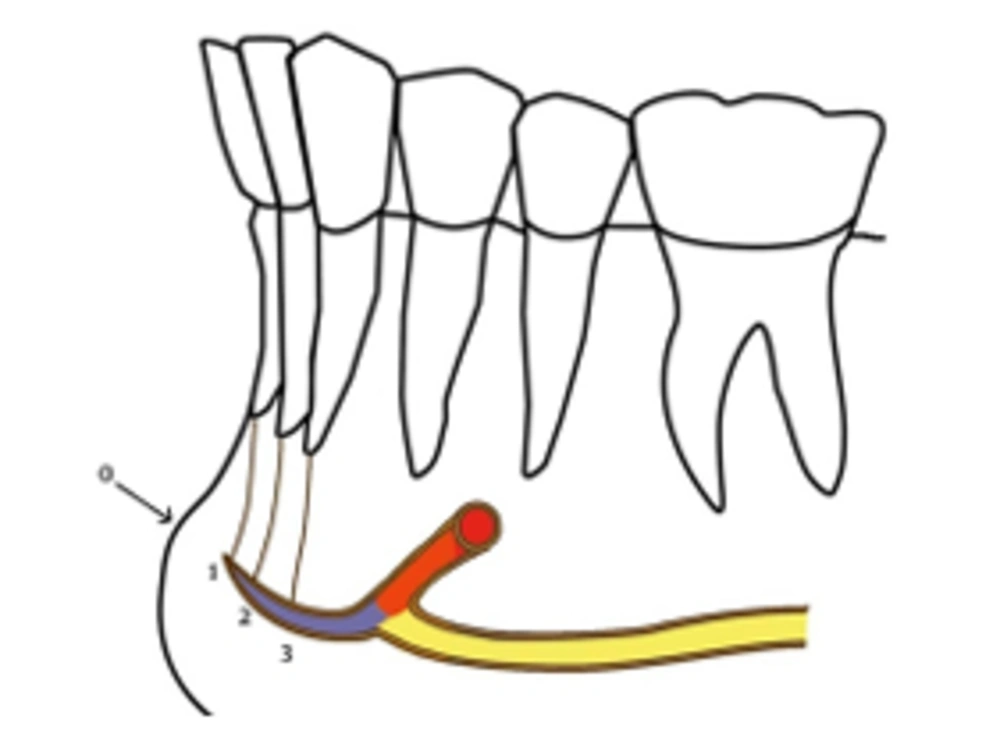
Figure 1.
Extension of the mandibular incisive canal based on tooth position. Blue, MIC, red: mental canal (the anterior opening of the mandibular canal); yellow: mandibular canal. MIC is terminating apically to: 0, midline anastomosis; 1, central incisor area; 2, lateral incisor area; 3, canine area.
All images were adjusted with the same contrast and density and inspected for visibility of MIC in conventional mode and IF mode separately. There was a one-month interval between the two observations (Figure 2).
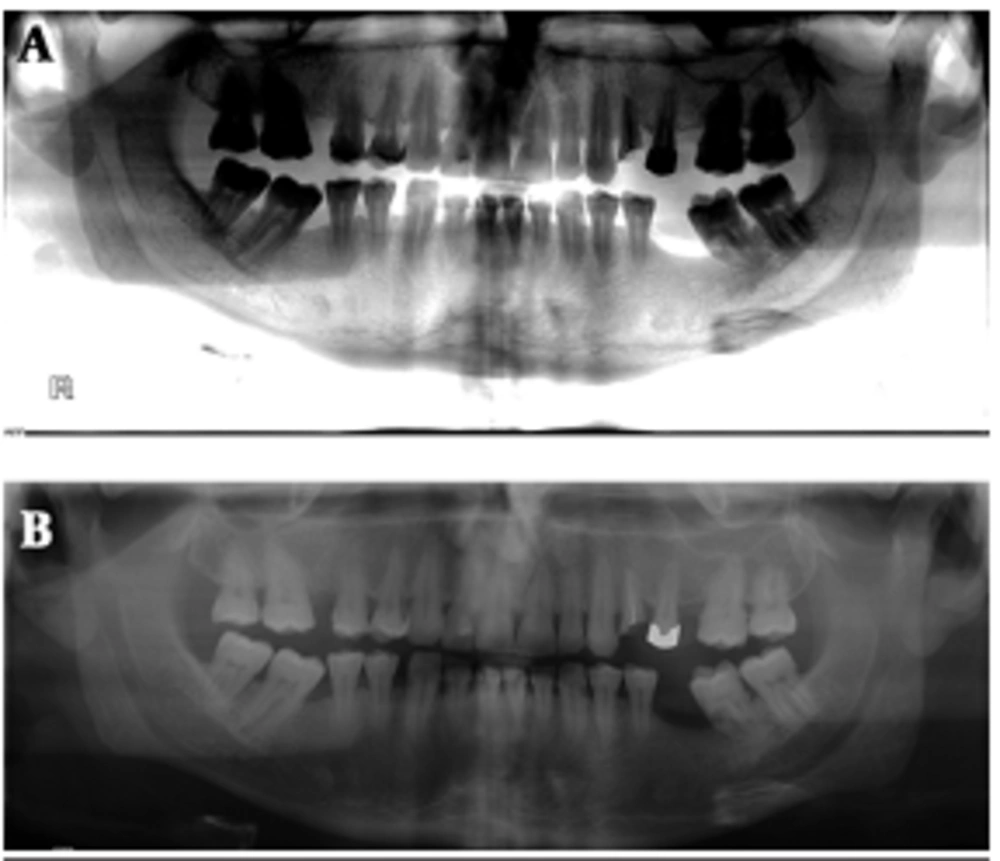
Figure 2.
Digital panoramic view of the mandibular incisive canal. A, by inversion filter; B, in conventional mode.
Inversion filtering was done using manipulation tools of Digora for Windows DWF ver. 2.5 software. In this software, IF tool is named negative.
Data were inserted in a data form and were analyzed by SPSS ver. 20 software (IBM Corp., Released 2011, IBM SPSS Statistics for Windows, Version 20.0. Armonk, NY: IBM Corp.). To compare the tools (IF, and conventional mode) Mc Nemar test was used. P < 0.05 was considered statistically significant.
4. Results
Among 2580 digital panoramic radiographs including 1078 males (41.78%) and 1502 females (58.22%), MIC was visible in 827 (32.1%) cases (331 unilateral, 462 bilateral and 34 in midline, collectively equal to 1289 canals) using IF and 820 (31.8%) cases (347 unilateral, 439 bilateral and 34 in midline, collectively equal to 1259 canals) in conventional mode. Mc Nemar showed no significant difference between the two methods (P > 0.05).
Generally, there was no significant difference in the average extension rate of unilateral and bilateral canals using IF and conventional mode (P > 0.05). Table 1 shows the frequency of the extension rate of MIC using IF and conventional mode.
Table 1. Frequency of Extension Rate of MIC Using IF and Conventional Modea
| Extension rate | Tool | |
|---|---|---|
| Conventional Mode | IF | |
| 0 | 34 (2.7) | 34 (2.6) |
| 1 | 45 (3.6) | 51 (4.0) |
| 2 | 306 (24.3) | 335 (26.0) |
| 3 | 874 (69.4) | 869 (67.4) |
aValues are presented as No. (%).
5. Discussion
Till date, it is not clear whether software application can enhance the diagnostic value of digital imaging. Because of diversity of enhancement modalities, studies assessing their clinical applications are frequently performed. In the present study, visibility and extension rate of mandibular incisive canal using IF and conventional mode were investigated and MIC was visible in 32% of the cases that is in agreement with a study conducted by Raitz et al. (6). In a study performed by Jacobs et al. MIC was visible in only 15% of the panoramic radiographs (8).
Higher visibility of MIC in the present study may be because of the difference in the system of radiography and also racial differences between the studied populations. Again, the study population is lower (about half) than the current study. Another probable reason may be due to the analogue system used in the study carried out by Romano et al. (4) in which no kind of manipulation is possible.
Visibility of MIC in CT scans and CBCT images was reported in the range of 78 to 94.4 percent (5, 6, 8-10). Due to the limitations of panoramic images in showing the anterior region of the mandible and because the panoramic view shows a two-dimensional image of a three-dimensional subject, lower visibility of MIC in the present study can be justified.
Comparing IF and conventional mode, there was no significant difference in the visibility of MIC. This insignificance can be partly attributed to the skilled eyes of the expert observers who were able to detect MIC even in the conventional mode. Visibility of bilateral canals and the extension rate of the canal were slightly higher in IF. This can imply the better optical contrast caused by IF which could be significant if non-professional observers performed the investigation.
Previous studies have used IF in different diagnostic procedures. Kal et al. have shown that using IF cannot increase the accuracy of determination of tooth length (15). Kamburoglu et al. concluded that IF does not help in the diagnosis of vertical root fracture (16). According to Haak et al. IF cannot reveal additional information in the diagnosis of interproximal dental caries (17).
Collectively, according to the results of present and previous studies, IF cannot enhance the diagnostic quality of panoramic radiographs and in case accurate determination of canal position is necessary, CBCT images are recommended.
