


1. Background
2. Objectives
3. Patients and Methods
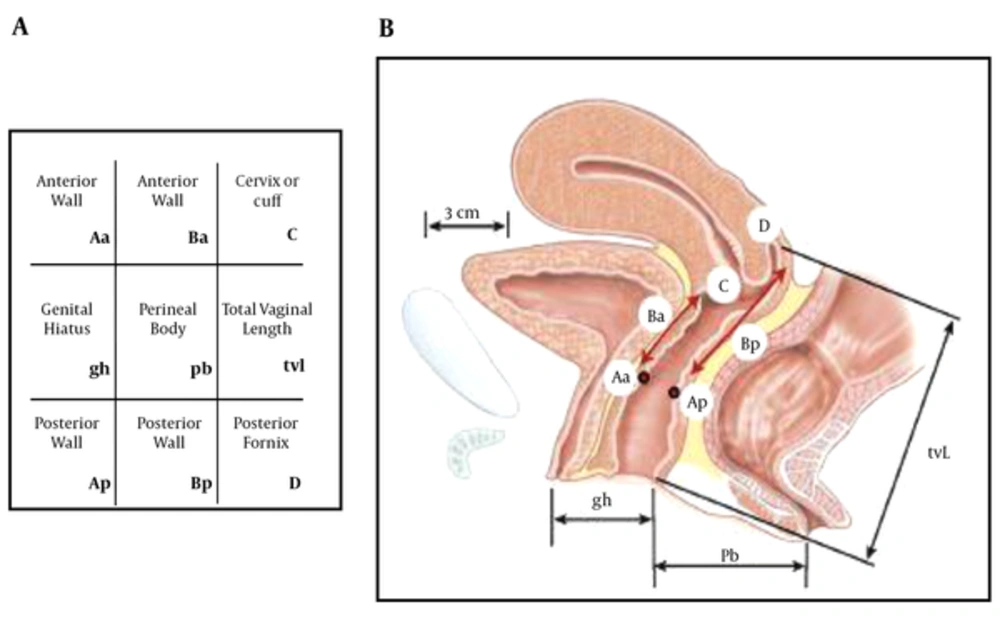
Stages of pelvic organ prolapse. A, Three-by-three grid for recording quantitative description of pelvic organ support. B, Six sites (points Aa - Ba - C - D - Bp - Ap) - genital hiatus (gh) - perineal body (pb) and vaginal length (tvl) used for pelvic organ support quantitation.
| Stage | Description |
|---|---|
| Stage 0 | No prolapse is demonstrated. Points Aa , Ap, Ba, and Bp are all at -3 cm and either point C or D is between -tvl (total vaginal length) cm and - (tvl - 2) cm (i.e., the quantitation value for point C or D is ≤ - (tvl - 2) cm). |
| Stage I | The criteria for stage 0 are not met, but the most distal portion of the prolapse is > 1 cm above the level of the hymen (i.e. its quantitation value is < -1 cm). |
| Stage II | The most distal portion of the prolapse is ≤ 1 cm proximal to or distal to the plane of the hymen (i.e., its quantitation value is ≥ -1 cm but ≤ + 1 cm). |
| Stage Ill | The most distal portion of the prolapse is > 1 cm below the plane of the hymen but protrudes no further than 2 cm less than the total vaginal length in centimeters (i.e. its quantitation value is > + 1 cm but < +( tvl - 2) cm). |
| Stage IV | Essentially, complete eversion of the total length of the lower genital tract is demonstrated. The distal portion of the prolapse protrudes to at least (tvl - 2) cm (i.e., its quantitation value is ≥ + (tvl - 2) cm). In most instances, the leading edge of stage IV prolapse is the cervix or vaginal cuff scar. |
| Grade | Organ Location Relative to PCLa |
|---|---|
| 0 (no prolapse) | Above |
| 1 ( mild or small) | 0 - 3 cm below |
| 2 (moderate) | 3 - 6 cm below |
| 3 (severe or large) | ≥ 6 cm below |
aMeasurement is performed on midsagittal MR images obtained at maximal strain. Severe cystourethroceles are classifid as grade 4 or procidentia.
Abbreviations: PCL, pubococcygeal line
| Grade | Organ Location Relative to H Linea |
|---|---|
| 0 (normal) | Above |
| 1 (mild or small) | 0 - 2 cm below |
| 2 (moderate) | 2 - 4 cm below |
| 3 (severe or large) | ≥ 4 cm below |
aMeasurement is performed on midsagittal MR images obtained at maximal strain. Severe cystourethroceles are classified as grade 4 or procidentia.
3.1. Statistical Analyses
4. Results
| Symptom | Subgroups | No (%) |
|---|---|---|
| Incontinence | Stress | 18 (29.5) |
| Urge | 17 (27.9) | |
| Mix | 1 (1.6) | |
| Fecal complaints | Constipation | 20 (32.8) |
| Splitting | 13 (21.3) | |
| Straining | 8 (13.1) | |
| Gas Incontinence | 6 (9.8) | |
| Sexual Activity | No | 20 (33.9) |
| Normal | 29 (49.2) | |
| Abnormal | 10 (16.9) | |
| Dyspareunia | 6 (9.8) | |
| Incontinence | 2 (2.3) | |
| Partner dissatisfaction | 3 (4.9) | |
| Sign | Subgroups | Abnormal or Positive |
| Urethral Hypermobility | 55 (90.2) | |
| Cough Test | 7 (11.5) | |
| Vaginal Atrophy | 36 (59) | |
| Perineal Defect | 47 (77) | |
| Perineal Descent | 48 (78.8) | |
| Levator Contraction Tone | Good | 19 (31.2) |
| Moderate | 30 (49.2) | |
| Weak | 12 (19.7) | |
| Anal Exam | 7 (11.5) | |
| Anterior Prolapse | No | 9 (14.8) |
| Stage I | 5 (8.2) | |
| Stage II | 28 (45.9) | |
| Stage III | 17 (27.9) | |
| Stage IV | 2 (3.3) |
| Variable | Reference Line | Mean ± SD, mm | Range, mm |
|---|---|---|---|
| Bladder Neck Descent | PCL | 24.2 ± 32.1 | -30 - 110 |
| Bladder Neck Descent | H | 7.3 ± 25.4 | -36 - 84 |
| Urethral Descent | PCL | 12.4 ± 24.1 | -30 - 120 |
| Urethral Descent | H | 0.8 ± 16.2 | -34 - 65 |
Abbreviations: PCL,pubococcygeal line; SD,standard deviation
| MRI Staging Based on PCL | ||||||
|---|---|---|---|---|---|---|
| Normal | Mild | Moderate | Severe | Kappa Coefficient | ||
| POP-Q | Normal | 5 | 4 | 0 | 0 | 0.18 |
| Grade I | 2 | 2 | 1 | 0 | ||
| Grade II | 7 | 12 | 8 | 0 | ||
| Grade III and IV | 1 | 3 | 8 | 7 | ||
| MRI Staging Based on H-Line | ||||||
| POP-Q | Normal | 5 | 3 | 0 | 0 | 0.05 |
| Grade I | 5 | 0 | 0 | 0 | ||
| Grade II | 13 | 12 | 2 | 0 | ||
| Grade III and IV | 5 | 3 | 5 | 6 | ||
Abbreviations: POP-Q, Pelvic organ prolapse quantification
| MRI Staging Based on PCL | ||||||
|---|---|---|---|---|---|---|
| Normal | Mild | Moderate | Severe | Kappa Coefficient | ||
| POP-Q | Normal | 4 | 4 | 0 | 0 | 0.06 |
| Grade I | 2 | 2 | 1 | 0 | ||
| Grade II | 7 | 17 | 3 | 0 | ||
| Grade III and IV | 2 | 14 | 1 | 2 | ||
| MRI Staging Based on H-Line | ||||||
| POP-Q | Normal | 5 | 3 | 0 | 0 | -0.04 |
| Grade I | 5 | 0 | 0 | 0 | ||
| Grade II | 16 | 11 | 0 | 0 | ||
| Grade III and IV | 6 | 9 | 3 | 1 | ||
Abbreviations: POP-Q, Pelvic organ prolapse quantification
| Anatomical Region | Cutoff Point | Reference Line | Both MRI and POP-Q Positive | Both MRI and POP-Q Negative | MRI Negative and POP-Q Positive | MRI Positive and POP-Q Negative | Kappa (95% Confidence Interval) | Concordance Rate, No.(%) |
|---|---|---|---|---|---|---|---|---|
| Bladder Neck | Normal vs. Abnormal | PC Line | 41 (68) | 5 (8) | 10 (17) | 4 (7) | 0.28 (0.004 - 0.56) | 46 (77) |
| (Normal to Moderate) vs. (Severe) | PC Line | 7 (12) | 41 (68) | 12 (20) | 0 | 0.44 (0.21 - 0.68) | 48 (80) | |
| Urethra | Normal vs. Abnormal | PC Line | 40 (68) | 4 (7) | 11 (19) | 4 (7) | 0.21 (0 - 0.48) | 44 (75) |
| (Normal to Moderate) vs. (Severe) | PC Line | 2 (3) | 40 (68) | 17 (29) | 0 | 0.14 (0 - 0.31) | 42 (71) | |
| Bladder Neck | Normal vs. Abnormal | H Line | 28 (47) | 6 (10) | 23 (38) | 3 (5) | 0.09 (0 - 0.3) | 34 (57) |
| (Normal to Moderate) vs. (Severe) | H Line | 6 (10) | 40 (68) | 13 (22) | 0 | 0.39 (0.15 - 0.62) | 46 (78) | |
| Urethra | Normal vs. Abnormal | H Line | 24 (41) | 5 (8) | 27 (46) | 3 (5) | 0.04 (0 - 0.2) | 29 (49) |
| (Normal to Moderate) vs. (Severe) | H Line | 1 (2) | 40 (68) | 18 (31) | 0 | 0.07 (0 - 0.2) | 41 (69) |
Abbreviation: POP-Q, Pelvic organ prolapse quantification
aValues are expressed as NO(%)
5. Discussion
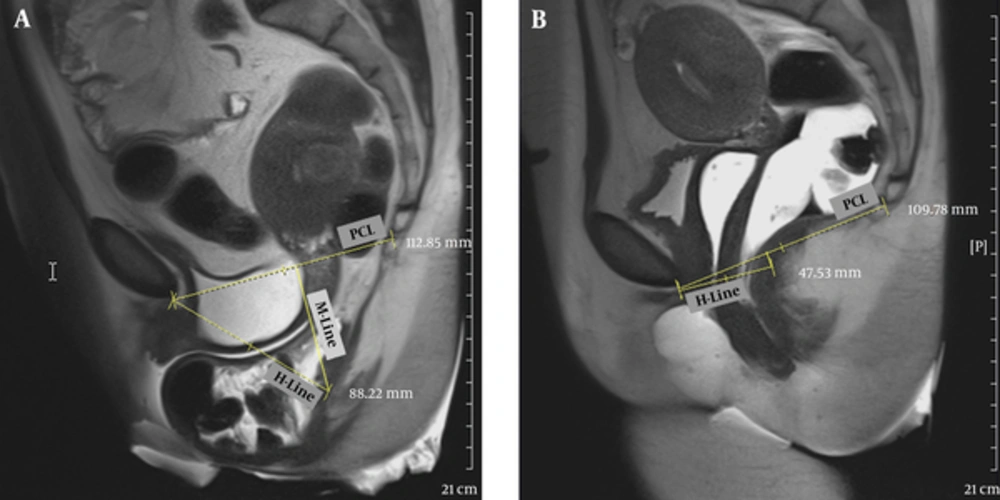
A 44-year-old female with chief complaints of obstructed defecation, frequency and mixed urinary incontinence (urge and stress). A, Midsagittal T2 HASTE during rest shows pubococcygeal line (PCL) between the inferior margin of symphysis pubis and last horizontally oriented coccygeal line. H-line is between the inferior margin of symphysis pubis and posterior aspect of anorectal angle. M-line is between PCL and H-Line; B, Midsagittal T2 HASTE during straining shows small cystocele, moderate apical descent and large rectal descent with anterior rectocele.
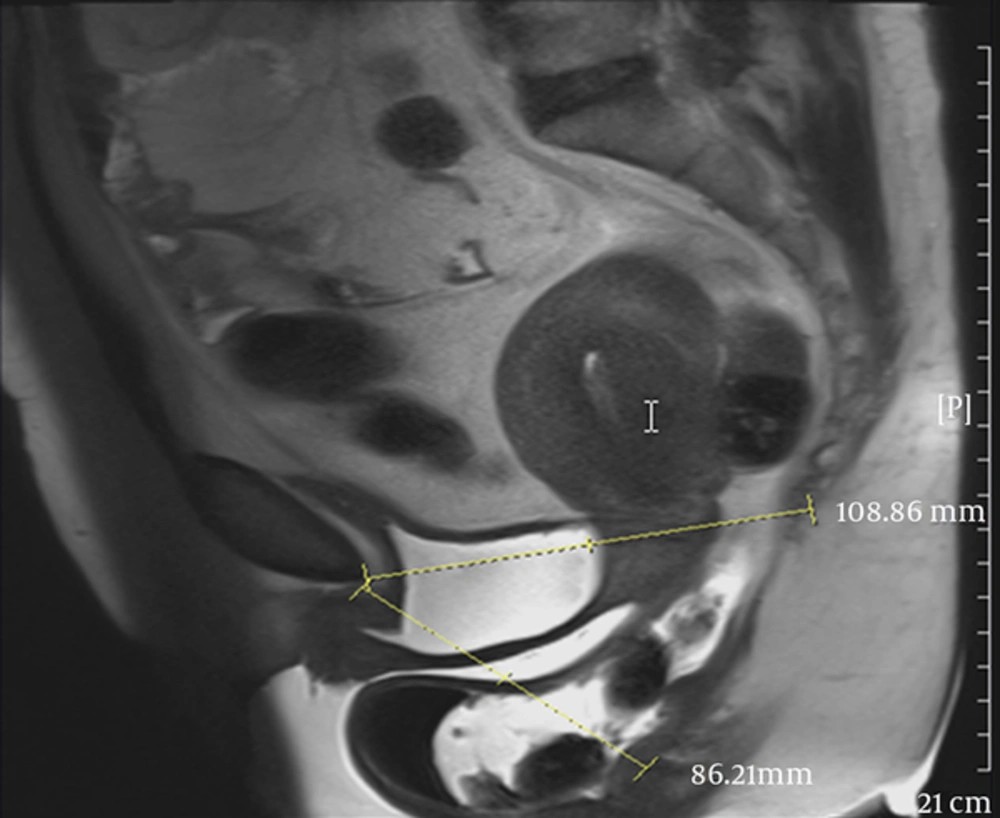
A 33-year-old female with stress urinary incontinence. Image in mid sagittal T2 HASTE during straining shows moderate cystocele, cyctourethrocele, urethral hypermobility, and funneling.
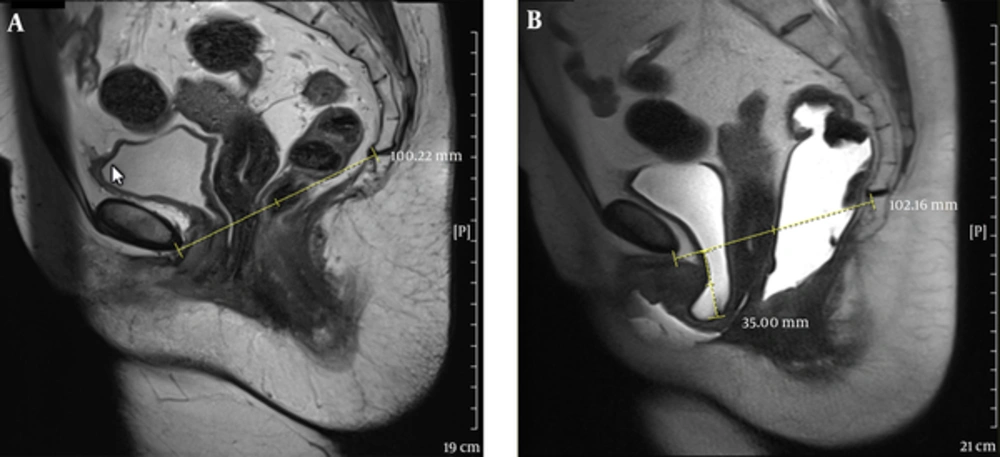
A 50-year-old female with dyspareunia. A, Midsagittal T2 HASTE during rest shows the bladder neck at the level of pubococcygeal line (PCL). B, Midsagittal T2 HASTE during straining shows multi-compartment defect including large cystocele and urethral hypermobility, urethral kink with resultant bladder outlet obstruction and trabeculated bladder, large apical descent and rectal descent.
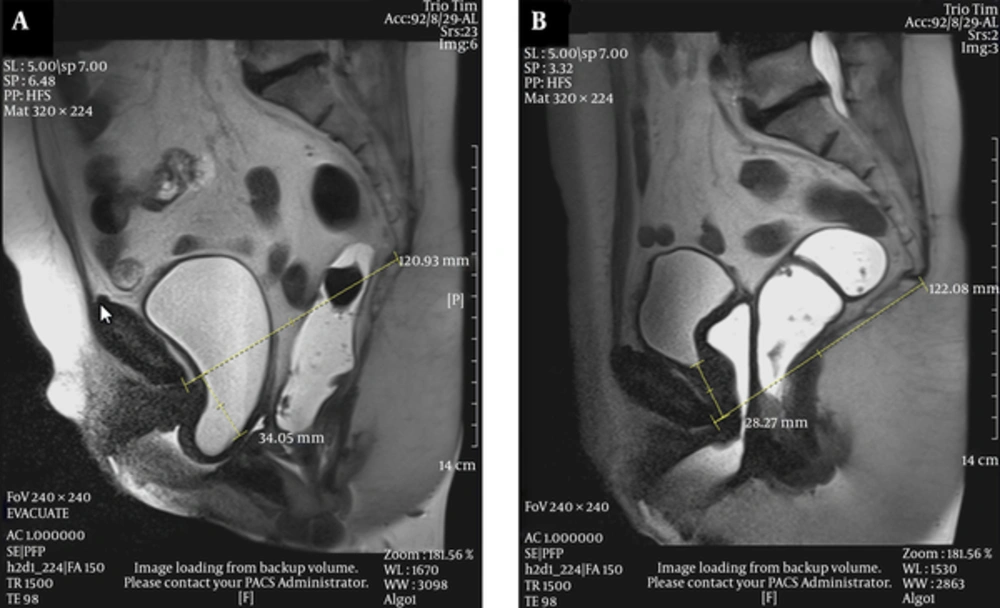
A 67-year-old female with prior history of hysterectomy came with urge urinary incontinence. A, Midsagittal T2 HASTE during rest shows normal position of the bladder neck, vaginal apex and anorectal junction. B, Midsagittal T2 HASTE during straining shows moderate cystocele and urethral hypermobility, large apical prolapse and large rectal descent.
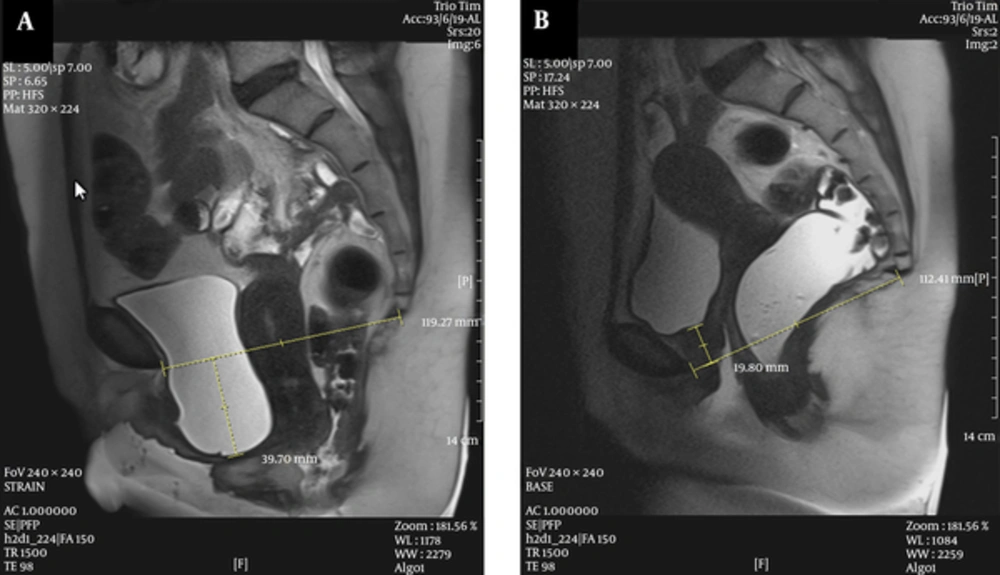
A 48-year-old female with perineal mass protrusion. A, Midsagittal T2 HASTE during rest shows the normal position of the bladder neck, vaginal apex, and mild low anorectal junction; B, Midsagittal T2 HASTE during straining shows large cystocele and urethral hypermobility with kinking and resultant bladder neck obstruction, and trabeculation, large apical prolapse, anterior rectocele, and rectal descent.
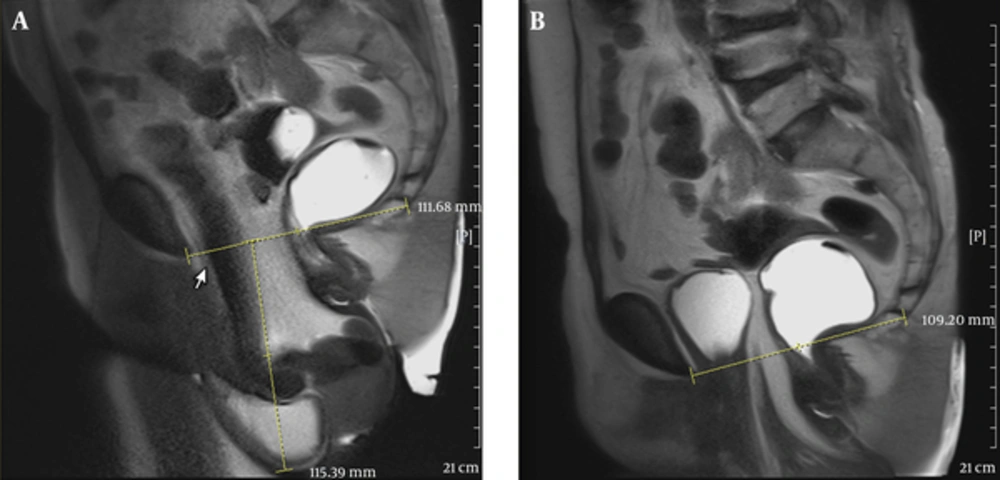
A 54-year-old female with bladder outlet obstruction and perineal mass protrusion. A, Midsagittal T2 HASTE during rest shows the bladder neck at the level of pubococcygeal line (PCL); B, Midsagittal T2 HASTE during straining shows large cystocele, severe apical descent and large enterocele containing illeal loops and mesenteric fat.


