



Full Text
Full text is available in PDF
IJ Radiology
Recently, attempts have been made to quantify the clot burden on the basis of CT angiographic findings. The development of clot burden index [pulmonary arterial obstruction index (PAOI)] may have important prognostic and therapeutic implications and may provide a reproducible standard for measuring response to thrombolytic therapy. The presence of right ventricular dysfunction (RVD) is a marker for adverse clinical outcome in patients with acute pulmonary embolism (PE). The ratio of the right ventricle to left ventricle short axis diameters (RV/LV) has been proposed as an accurate sign for the presence of RVD. Other studies suggested that the quantification of a clot at pulmonary computed tomography (CT) angiography is an important predictor of right heart failure and patients' outcome in the setting of PE. In this study, we assess the measurement of PAOI and RV/LV ratio in pulmonary CT angiography and discuss the significant correlations between them. Patients and Methods: The study population comprised 42 patients (19 women, 23 men; mean age, 52 + 18 years) with the definite diagnosis of PE based on their pulmonary CT angiography. The CT angiographies of patients were reviewed, and PAOI and RV/LV ratio were measured. PAOI was calculated from the size of embolus and the location of thrombus on CT images in accordance with another study by Qanadli et al. The index was defined as the product of N x D, where N was the value of the proximal clot site, equal to the number of segmental bronchial branches, and D was the degree of obstruction, defined as 1 for partial obstruction and 2 for total obstruction. Furthermore, the scans were evaluated by measuring the minor axes of the right and left ventricles of the heart in the transverse plane at their widest points between the inner surface of the free wall and interventricular septum. By using logistic regression, PAOIs were compared with RV/LV ratio. Correlation between PAOI and RV/LV ratio was evaluated by Spearman correlation test, and receiver operating characteristic (ROC) curve was used to determine an optimal cut-off value for PAOI.
Results: In our study group, mean PAOI was 24.3 + 19.2%. Nine cases (21.4%) had a PAOI of more than 40%. The mean RV/LV ratio was 1.03 + 0.25; eighteen patients (43%) had an RV/LV ratio of more than 1; twenty-four patients (57%) had an RV/LV ratio of less than 1. There was a statistically significant correlation between PAOI and RV/LV ratio (P = 0.007; r = 0.4). The mean PAOI of patients with RV/LV ratio of >1 was significantly higher than that of patients with RV/LV ratio of ? 1 (32.6% vs. 18.1%; P = 0.02). However, based on ROC analysis, an ideal cut-off value for PAOI could not be defined. Also, there was no significant difference in PAOIs between different age (P > 0.05) and sex (P > 0.05) groups. Conclusion: Our findings were in agreement with those of Wu et al. and suggested that the quantification of a clot at CT pulmonary angiography is an important predictor of right heart failure and determines patients' outcome in the setting of PE. There was a significant correlation between PAOI and RV/LV ratio in PE. However, there was no ideal PAOI cut-off value for the diagnosis of right ventricular dysfunction (RV/LV ratio > 1). Further studies with a larger study population may be necessary to generalize our findings and to suggest a sensitive and specific cut-off point for ventricular dysfunction in patients with PE. The prognostic role of RV/LV ratio and obstruction index on spiral CT may also warrant further investigation in patients with PE.
© 2014, Author(s). This open-access article is available under the Creative Commons Attribution 4.0 (CC BY 4.0) International License (https://creativecommons.org/licenses/by/4.0/), which allows for unrestricted use, distribution, and reproduction in any medium, provided that the original work is properly cited.
Gungor O, Ciledag N. Pulmonary Obstruction Index in Multidetector Computed Tomographic Imaging for the Risk Assessment of Right Ventricular Dysfunction in Patients with Pulmonary Embolism. I J Radiol. 2019;16(3):e85951. doi: https://doi.org/10.5812/iranjradiol.85951
Karbasi M, Behzadmehr R, Tarzamni MK, Javadrashid R. The Prognostic Significance of Pulmonary CT Angiography in Predicting the Outcomes of Acute Pulmonary Thromboembolism. I J Radiol. 2022;19(3):e121728. doi: https://doi.org/10.5812/iranjradiol-121728
Faghihi Langhroudi T, Borji Esfahani M, Khaheshi I, Naderian M, Zahedi Tajrishi F, et al. Correlation of Hematologic Indices with CT-pulmonary Arterial Obstruction Index in Patients with Acute Pulmonary Emboli. Int J Cardiovasc Pract. 2019;4(3):e130555. doi: https://doi.org/10.29252/ijcp-27078
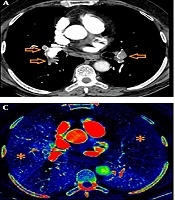
Bayraktaroglu S, Cinkooglu A, Savas R, Ceylan N, Bozdağ M, et al. Dual Energy CT Evaluation of the Severity of Pulmonary Thromboembolism: Correlation of Pulmonary Perfusion Score with CT. I J Radiol. 2020;17(3):e92990. doi: https://doi.org/10.5812/iranjradiol.92990
Sanei Taheri M, Derakhshandi H, Helmi-Khomeirani M. Correlation of the Wells and Simplified Revised Geneva Scores with CT Pulmonary Artery Obstruction Index in Pulmonary Embolism. I J Radiol. 2017;14(3):e58632. doi: https://doi.org/10.5812/iranjradiol.58632

Checking
Last Update: 2 weeks ago
Last Update: 2 weeks ago
Last Update: 2 weeks ago
Last Update: 4 days ago
Ordering Reprints
Articles are published under the Creative Commons license stated on each article. No permission or royalty fee is required for uses permitted by that license. CCC handles optional bulk and customized reprint orders. Any quotation covers production and delivery services only, not copyright permission. > Request Reprints from CCC
Author(s):