
1. Background
Bladder cancer is one of the most common urological malignancies worldwide (1, 2) and has a substantial global annual incidence (3). Transurethral resection of bladder tumor (TURBT) is a standard endoscopic procedure for the diagnosis and treatment of bladder tumors (4, 5). Although minimally invasive, TURBT may be challenging when tumors are located on the lateral or inferolateral bladder wall because of the proximity of the obturator nerve to the surgical field.
The obturator nerve arises from the lumbar plexus (L2–L4), contains motor and sensory fibers, and primarily innervates the thigh adductor muscles. Within the pelvis, it courses close to the lateral and inferolateral bladder wall; consequently, electrical stimulation during resection of tumors in these regions may activate the nerve and trigger involuntary adductor contraction (4, 6). This phenomenon, known as the obturator reflex or obturator jerk, may cause sudden thigh adduction during TURBT (7, 8).
The obturator reflex may occur despite spinal anesthesia because the anesthetic level required for TURBT does not necessarily provide complete blockade of the obturator nerve. Sudden adductor contraction can cause abrupt patient movement, interfere with tumor resection, and, in severe cases, increase the risk of incomplete resection, bladder perforation, bleeding, vascular injury, or other procedure-related complications (4, 9). Therefore, prevention of obturator-related adductor spasm is an important consideration during TURBT, particularly for lateral bladder tumors.
Several strategies have been proposed to prevent or reduce adductor spasm, including avoiding excessive bladder distension, reducing electrocautery intensity, using laser resection, general anesthesia with neuromuscular blockade, and obturator nerve block (ONB) combined with spinal anesthesia (9-11). ONB directly targets the neural pathway responsible for the adductor reflex and may reduce muscle contraction while allowing TURBT to be performed under spinal anesthesia (12-14). However, the obturator nerve is relatively deep, making the block technically challenging, particularly with conventional landmark-based techniques (9).
Ultrasound guidance may facilitate identification of relevant anatomical structures and enable a more targeted ONB. Nevertheless, previous reports indicate variability in the use of ONB during TURBT. Some studies have reported that ONB is selected less frequently than general anesthesia with neuromuscular blockade, partly because of technical difficulty and operator experience (15, 16). Conversely, other studies have shown that ONB combined with spinal anesthesia reduces adductor spasm compared with spinal anesthesia alone and can provide adequate surgical conditions (6, 17-19).
Despite these findings, the comparative effectiveness of ONB combined with spinal anesthesia versus general anesthesia remains insufficiently established. Only a limited number of studies have directly compared these approaches during TURBT (4, 12, 20). One study reported a higher incidence of adductor spasm with general anesthesia than with spinal anesthesia plus ONB (20), whereas another found no significant difference when ONB was combined with either anesthetic technique (4). These inconsistent findings leave uncertainty as to whether the primary anesthetic technique influences obturator-related adductor spasm when ONB is used.
This question is clinically relevant because TURBT is frequently performed in older patients, many of whom have comorbidities that may influence anesthetic selection. Although spinal anesthesia can avoid airway instrumentation and mechanical ventilation in appropriately selected patients, adequate prevention of obturator-induced spasm and satisfactory surgical conditions remain essential.
2. Objectives
Accordingly, this randomized clinical trial aimed to compare the incidence and severity of adductor muscle spasm during TURBT between patients receiving ultrasound-guided ONB combined with spinal anesthesia and those receiving ultrasound-guided ONB combined with general anesthesia. Secondary outcomes included intraoperative heart rate and mean arterial pressure, surgical duration, and surgeon satisfaction.
The primary objective was to compare the incidence and severity of adductor muscle spasm during TURBT between spinal and general anesthesia, with ultrasound-guided ONB performed in both groups.
3. Methods
3.1. Study Design and Setting
This prospective, open-label, parallel-group randomized clinical trial was conducted at Imam Khomeini Hospital, Urmia, Iran. The trial was designed as a superiority trial.
3.2. Trial Registration, Protocol, and Ethics
The trial was registered in the Iranian Registry of Clinical Trials (IRCT) under registration number IRCT20170516033992N16 on November 14, 2024. The publicly accessible trial registration record is available at https://fa.irct.ir/trial/80054.
The study protocol was finalized before trial initiation, and no important changes were made after trial commencement. The full protocol and statistical analysis plan are not publicly available. The study was approved by the Ethics Committee of Imam Khomeini Hospital, Urmia, Iran (approval ID: IR.UMSU.HIMAM.REC.1403.033). Written informed consent was obtained from all participants before enrollment.
3.3. Participant Recruitment and Study Setting
Eligible patients scheduled to undergo transurethral resection of bladder tumor (TURBT) were recruited from the hospital’s urology service. A total of 72 eligible patients were identified. Two patients were excluded before randomization because their scheduled surgery was cancelled. The remaining 70 participants were randomized in a 1:1 ratio to receive either spinal anesthesia combined with ultrasound-guided obturator nerve block (SA+ONB) or general anesthesia combined with ultrasound-guided obturator nerve block (GA+ONB), with 35 participants allocated to each group. The study was conducted between 30 December 2024 and 22 July 2025.
3.4. Participants and Eligibility Criteria
Patients scheduled to undergo TURBT at Imam Khomeini Hospital, Urmia, Iran, were assessed for eligibility. Eligible participants were adults aged > 40 years with bladder cancer diagnosed by a urologist and considered suitable for TURBT based on urological evaluation.
Patients were excluded if they had advanced respiratory disease, cardiovascular disease, an allergy to local anesthetic agents, diabetes mellitus, peripheral neuropathy, substance abuse, psychological disorders, a history of pelvic or inguinal surgery, hematological disorders, obturator neuropathy, inguinal lymphadenopathy, infection or hematoma at the intended injection site, or any contraindication to spinal anesthesia.
Patients and members of the public were not involved in the design, conduct, or reporting of the trial.
3.5. Tumor Characteristics
Tumor characteristics were recorded based on preoperative urological evaluation and intraoperative surgical findings. In all patients, the tumor was located on the lateral wall of the urinary bladder. Tumor laterality (right or left) was recorded based on surgical findings. Because all tumors were located on the lateral bladder wall, the investigator performed a unilateral ultrasound-guided obturator nerve block (ONB) on the side corresponding to the tumor location.
3.6. Randomization and Allocation
After eligibility and enrollment were confirmed, participants were randomly assigned in a 1:1 ratio to either the spinal anesthesia combined with ONB group (SA+ONB) or the general anesthesia combined with ONB group (GA+ONB). The random allocation sequence was generated using Random Allocation Software. Block randomization was performed with a block size of four.
The allocation was disclosed to the anesthesiologist only after the patient’s eligibility and enrollment had been confirmed. Therefore, the anesthesiologist was unaware of the group assignment before the patient was enrolled. Following randomization, all participants received an ultrasound-guided obturator nerve block, and the assigned anesthetic technique was administered according to the randomization result.
3.7. Blinding
This was an open-label trial. Blinding of the anesthesiologist and surgeon to treatment allocation was not feasible because the anesthetic techniques differed and were apparent during the procedure. The anesthesiologist administered the assigned anesthetic technique, and the surgeon assessed the occurrence and severity of adductor muscle spasm during TURBT. The surgeon was aware of the assigned anesthetic technique. Participants were not informed of their assigned anesthetic group.
3.8. Intervention and Comparator
Following randomization, all participants received an ultrasound-guided obturator nerve block (ONB). The block was performed by the investigator on the side of the tumor (right or left). Participants were positioned supine with 30° abduction of the legs, and the inguinal region was prepared with povidone-iodine. After local infiltration with 2 mL of 2% lidocaine at the injection site, a high-frequency linear ultrasound probe (SonoSite, USA) was used with an interadductor approach. The probe was positioned approximately 2 cm caudal and medial to the femoral artery. Using an in-plane technique, the needle was advanced between the fasciae of the adductor longus and adductor brevis until the anterior branch of the obturator nerve was identified. Subsequently, 10 mL of 1.5% lidocaine was injected (21).
Participants assigned to the general anesthesia group received general anesthesia without neuromuscular blocking agents, as prespecified in the registered study protocol, induced with fentanyl (1 - 2 μg/kg) and propofol (2 mg/kg). Participants assigned to the spinal anesthesia group received spinal anesthesia in the sitting position, with 12.5 mg of 0.5% hyperbaric bupivacaine administered through a 25-gauge spinal needle at the L3–L4 or L4–L5 intervertebral space. After administration of the spinal anesthetic, participants were placed in the supine position.
Thus, both groups received the same ultrasound-guided ONB, whereas the randomized intervention was the primary anesthetic technique: spinal anesthesia versus general anesthesia without neuromuscular blockade.
3.9. Outcome Definitions
The primary outcome was the occurrence of adductor muscle spasm during TURBT and its severity. Adductor spasm was defined as an involuntary contraction of the adductor muscle group occurring during tumor resection in response to obturator nerve stimulation. The severity of adductor spasm was categorized into three grades: mild, defined as adductor muscle contraction without visible movement of the leg; moderate, defined as adductor muscle contraction accompanied by visible movement of the leg; and severe, defined as adductor muscle spasm that interfered with the surgical procedure or necessitated temporary or complete cessation of TURBT.
Secondary outcomes included surgeon satisfaction with the adductor muscle response during TURBT, duration of surgery, and intraoperative hemodynamic parameters, including mean arterial pressure (MAP) and heart rate (HR). Surgeon satisfaction was categorized as excellent, good, moderate, or poor according to the surgeon’s assessment of the adequacy of the adductor muscle response for performing the resection. Duration of surgery was defined as the operative time in minutes. Hemodynamic parameters were recorded during the procedure as mean arterial pressure and heart rate. All outcomes were assessed during the surgical procedure.
3.10. Harms
Safety-related outcomes included intraoperative mean arterial pressure and heart rate. The occurrence and severity of adductor muscle spasm were also recorded because of their potential to interfere with TURBT. No separate systematic adverse-event surveillance beyond these prespecified safety-related assessments was performed.
3.11. Sample-Size Calculation
The sample size was calculated using a formula for comparing two independent proportions. The calculation was based on the expected frequency of adductor muscle spasm reported in a previous randomized study, namely 40% in patients receiving spinal anesthesia alone and 11.4% in patients receiving spinal anesthesia combined with obturator nerve block. A two-sided significance level of 0.05 (α = 0.05; Z1−α/2 = 1.96) and a statistical power of 80% (β = 0.20; Z1−β = 0.84) were assumed. Based on these parameters, the required sample size was estimated to be 72 participants, with 36 participants allocated to each group.
It should be acknowledged that the assumptions used for this calculation were derived from a previous comparison of spinal anesthesia alone versus spinal anesthesia combined with obturator nerve block and therefore did not directly correspond to the randomized comparison in the present study, which was spinal anesthesia plus ONB versus general anesthesia plus ONB. Consequently, the calculated sample size may not have provided adequate statistical power to detect a difference between the two groups in the present trial.
A total of 72 participants were initially planned for enrollment. Two participants were excluded before randomization because their scheduled surgery was cancelled. The remaining 70 participants were randomized, with 35 participants allocated to each group. All randomized participants received their assigned intervention and were included in the final analysis. No missing outcome data occurred.
3.12. Statistical Analysis
Data were analyzed using appropriate statistical methods according to the type and distribution of the variables. Continuous variables were summarized as the mean and standard deviation or median and interquartile range, as appropriate, whereas categorical variables were presented as frequencies and percentages. The distribution of continuous variables was assessed before selecting the appropriate statistical test. Comparisons between the two study groups (SA+ONB and GA+ONB) were performed using the independent-samples t-test for continuous variables and the chi-square test or Fisher's exact test for categorical variables, as appropriate. All randomized participants were included in the primary analysis according to their assigned groups. No missing outcome data were present; therefore, no imputation was performed. No subgroup or sensitivity analyses were prespecified or performed. All statistical tests were two-sided, and a P value < 0.05 was considered statistically significant.
4. Results
4.1. Participant Flow and Group Allocation
A total of 70 participants were included in the final analysis: 35 in the SA+ONB group and 35 in the GA+ONB group (Figure 1).
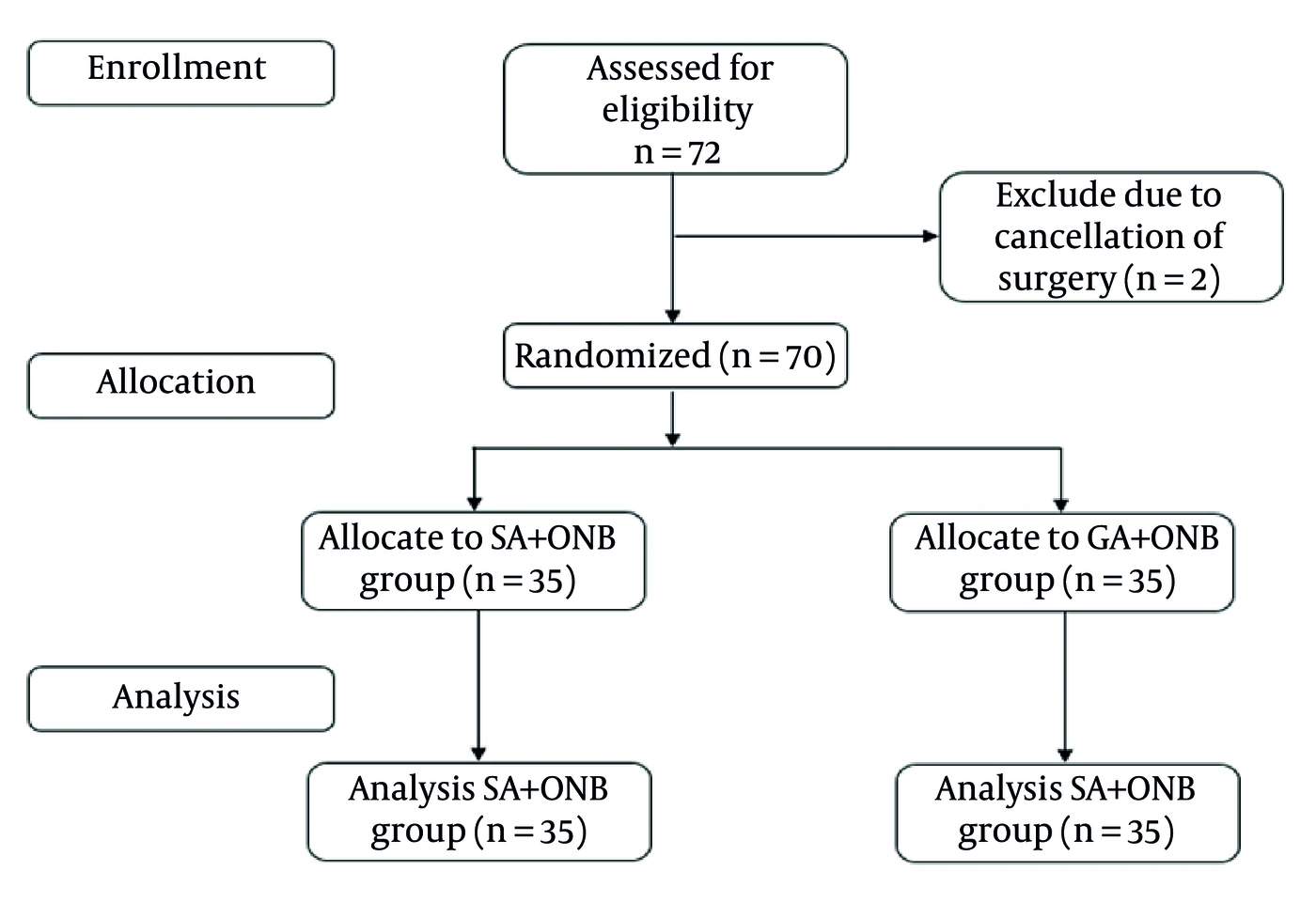
Figure 1.
The study process according to the CONSORT flow diagram
4.2. Demographic and Baseline Characteristics
The mean age was 70.51 ± 13.18 years in the SA+ONB group and 65.42 ± 13.45 years in the GA+ONB group. Sex distribution was comparable, with males comprising 85.7% and 80.0% of participants in the SA+ONB and GA+ONB groups, respectively. Tumor laterality was also similar between groups, with right-sided tumors in 51.4% of participants in each group (Table 1).
Table 1.
Comparison of Demographic Characteristics Between the SA+ONB and GA+ONB Groups a
| Variables | SA Group (n = 35) | GA Group (n = 35) | P-Value |
|---|---|---|---|
| Age (y) | 70.51 ± 13.18 | 65.42 ± 13.45 | 0.11 b |
| Sex | 0.53 | ||
| Male | 30 (85.7) | 28 (80.0) | |
| Female | 5 (14.3) | 7 (20.0) | |
| Tumor location | 1.00 | ||
| Right | 18 (51.4) | 18 (51.4) | |
| Left | 17 (48.6) | 17 (48.6) |
a Values are expressed as mean ± SD or No. (%). Chi-square test.
b Independent t-test.
4.3. Intraoperative Hemodynamic Outcomes
The mean heart rate was 67.26 ± 12.22 beats/min in the SA+ONB group and 69.20 ± 11.53 beats/min in the GA+ONB group, with no statistically significant between-group difference (P = 0.496). The mean arterial pressure was 86.54 ± 10.68 mm Hg in the SA+ONB group and 87.17 ± 12.20 mm Hg in the GA+ONB group (P = 0.819). Thus, no statistically significant between-group differences were observed in the assessed intraoperative hemodynamic variables (Table 2) (Figure 2).
Table 2.
Comparison of Intraoperative Hemodynamic Variables Between the SA+ONB and GA+ONB Groups a
| Hemodynamic Variable | SA Group (n = 35) | GA Group (n = 35) | P-Value b |
|---|---|---|---|
| HR (bpm) | 67.26 ± 12.22 | 69.20 ± 11.53 | 0.496 |
| MAP (mm Hg) | 86.54 ± 10.68 | 87.17 ± 12.20 | 0.819 |
a Values are expressed as mean ± SD.
b Independent t-test.
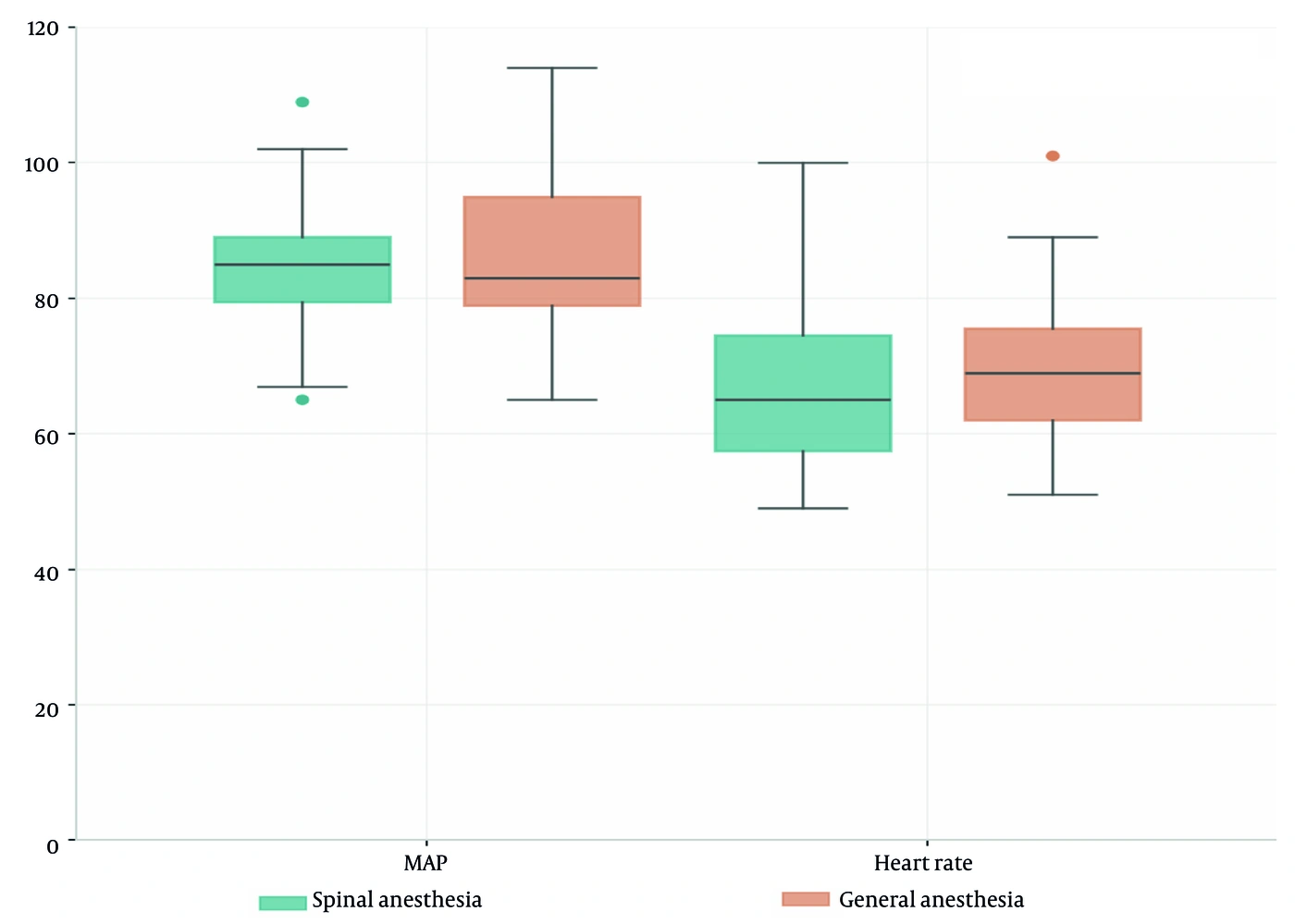
Figure 2.
Box plot of heart rate and MAP between two types of anesthesia technique
4.4. Adductor Muscle Spasm
Adductor muscle spasm occurred in 2 of 35 patients (5.7%) in the SA+ONB group and 3 of 35 patients (8.6%) in the GA+ONB group. The risk difference was −2.9 percentage points (95% CI, −15.3 to 9.6), with no statistically significant between-group difference (Fisher’s exact test, P = 1.00). The corresponding risk ratio (RR) was 0.67 (95% CI, 0.12 - 3.75).
Regarding severity, in the SA+ONB group, 1 patient (2.9%) experienced mild spasm and 1 patient (2.9%) experienced moderate spasm. In the GA+ONB group, 2 patients (5.7%) experienced mild spasm and 1 patient (2.9%) experienced moderate spasm. No severe spasms were observed in either group (Table 3).
Table 3.
Comparison of the Frequency/Severity of Adductor Spasm Between the SA+ONB and GA+ONB Groups a
| Variables | SA Group (n = 35) | GA Group (n = 35) | P-Value | RR (95% CI) |
|---|---|---|---|---|
| Adductor muscle spasm | 2 (5.7) | 3 (8.6) | 1.00 | 0.67 (0.12 - 3.75) |
| Severity | ||||
| Mild | 1 (2.9) | 2 (5.7) | - | - |
| Moderate | 1 (2.9) | 1 (2.9) | - | - |
| Severe | 0 | 0 | - | - |
a Values are expressed as No. (%). Fisher's exact test.
4.5. Surgical Duration and Surgeon Satisfaction
The mean surgical duration was 80.17 ± 23.55 minutes in the SA+ONB group and 77.97 ± 19.52 minutes in the GA+ONB group, with no statistically significant between-group difference (P = 0.67).
Surgeon satisfaction was rated as excellent in 33 patients (94.3%) in the SA+ONB group and 32 patients (91.4%) in the GA+ONB group. Good satisfaction was reported in 1 patient (2.9%) in the SA+ONB group and 2 patients (5.7%) in the GA+ONB group, whereas moderate satisfaction was reported in 1 patient (2.9%) in each group. No cases were rated as having poor surgical conditions. The distribution of surgeon satisfaction did not differ significantly between the two groups (P = 0.81) (Table 4).
Table 4.
Comparison of Surgical Duration and Surgeon Satisfaction Between the SA+ONB and GA+ONB Groups a
| Variables | SA Group (n = 35) | GA Group (n = 35) | P-Value |
|---|---|---|---|
| Surgeon satisfaction | 0.81 | ||
| Moderate | 1 (2.9) | 1 (2.9) | |
| Good | 1 (2.9) | 2 (5.7) | |
| Excellent | 33 (94.3) | 32 (91.4) | |
| Poor | 0 | 0 | |
| Surgical duration (min) | 80.17 ± 23.55 | 77.97 ± 19.52 | 0.67 b |
a Values are expressed as No. (%) or mean ± SD. Chi-square test.
b Independent t-test.
5. Discussion
This randomized clinical trial compared adductor muscle spasm during transurethral resection of bladder tumor (TURBT) between spinal anesthesia (SA) and general anesthesia (GA), with ultrasound-guided obturator nerve block (ONB) in both groups. Adductor muscle spasm occurred infrequently, with no statistically significant difference between the SA+ONB and GA+ONB groups. Similarly, no significant between-group differences were observed in spasm severity, intraoperative hemodynamic variables, surgical duration, or surgeon satisfaction. These findings suggest that the anesthetic technique did not materially affect the ability of ONB to prevent adductor spasm.
Spasm occurred in 2 of 35 patients (5.7%) in the SA+ONB group and 3 of 35 (8.6%) in the GA+ONB group, with an overall incidence of 7.1% (5/70). The risk difference was −2.9 percentage points (95% CI, −15.3 to 9.6), and the risk ratio was 0.67 (95% CI, 0.12 - 3.75), with no significant between-group difference (Fisher’s exact test, P = 1.00). Because only five episodes occurred, these findings should be interpreted cautiously. The wide confidence interval indicates substantial uncertainty regarding the magnitude and direction of any potential difference. Thus, the study demonstrates no statistically significant difference, rather than equivalence, between the anesthetic techniques.
Spasm severity was also similar. In the SA+ONB group, one patient experienced mild spasm and one experienced moderate spasm; in the GA+ONB group, two experienced mild spasm and one experienced moderate spasm. No severe spasms occurred. Although the small number of events limits inference regarding severity, the low frequency of clinically relevant spasms and the absence of severe spasms are consistent with effective ONB in the study setting. However, because no non-ONB control group was included, the independent contribution of ONB to the low incidence of spasm cannot be determined.
Only a limited number of studies have evaluated ONB combined with spinal anesthesia, compared with general anesthesia, for the prevention of adductor muscle contraction during TURBT. Our findings are broadly consistent with previous comparative studies reporting no statistically significant difference in the incidence of adductor spasm between anesthetic techniques. Guney et al. reported adductor spasm rates of 13.7% and 6.4% in the two anesthesia groups, respectively, without a statistically significant difference (4). Similarly, Rychkov et al. reported spasm rates of 25% and 12%, with no statistically significant difference between the groups (20). Although the absolute incidence of spasm was higher in these studies than in the present study, the overall direction of the findings suggests that, when an effective ONB is performed, the primary anesthetic technique may have limited influence on the occurrence of adductor spasm resulting from obturator nerve stimulation. Shubhankar et al. reported that a regional anesthesia technique involving bilateral blockade combined with proximal ONB significantly reduced obturator jerks compared with unilateral proximal ONB and demonstrated comparable safety and efficacy to GA, suggesting that it may be a viable regional anesthesia option for patients who are unsuitable for general anesthesia (22).
Several studies have also specifically evaluated ONB combined with spinal anesthesia during TURBT (7, 9, 10, 17, 19, 23, 24). Alavi et al. reported that ONB combined with spinal anesthesia was effective in preventing adductor muscle spasm during TURBT (7). Furthermore, a meta-analysis reported that the combination of spinal anesthesia and ONB was associated with a reduced incidence of obturator jerks compared with spinal anesthesia alone (19). Taken together with the findings of the present study, these data support the clinical use of ONB as part of the anesthetic strategy for TURBT, particularly when spinal anesthesia is selected.
An important clinical consideration is the selection of the primary anesthetic technique in older patients undergoing TURBT. The mean age of participants in the present study was approximately 68 years, consistent with the older age distribution commonly observed among patients with bladder cancer. Older adults may be more susceptible to adverse effects associated with general anesthesia, including postoperative delirium, cognitive complications, hemodynamic instability, and cardiopulmonary stress (25, 26). Avoiding airway instrumentation and reducing exposure to systemic general anesthetic agents may offer potential advantages in selected older or medically vulnerable patients. However, these potential advantages should not be interpreted as evidence from the present study that spinal anesthesia is universally safer than general anesthesia, because postoperative complications and other longer-term safety outcomes were not systematically evaluated.
In the present study, the absence of statistically significant differences in intraoperative heart rate and mean arterial pressure, together with similar surgical duration and surgeon satisfaction, suggests that both anesthetic approaches provided comparable intraoperative surgical conditions when combined with ultrasound-guided ONB. Surgeon satisfaction was rated as excellent in more than 90% of patients in both groups, and mean surgical duration differed by only approximately two minutes. These findings provide additional clinical evidence supporting the feasibility of either anesthetic approach when adequate ONB is performed.
5.1. Study Limitations
This study has several limitations. First, the small sample size and the occurrence of only five adductor spasm events limited statistical power and precision. Importantly, sample-size assumptions were based on comparing spinal anesthesia alone with spinal anesthesia combined with obturator nerve block, rather than spinal anesthesia plus ONB versus general anesthesia plus ONB. Therefore, the sample size may not have been sufficient to detect between-group differences, and the findings should be interpreted cautiously. Second, the absence of a non-ONB control group limits the ability to determine the absolute effectiveness of ultrasound-guided ONB and its incremental benefit compared with either anesthetic technique alone. Third, the technical success of ONB was not independently assessed using a standardized objective measure. Fourth, surgeon satisfaction may have been affected by observer bias and subjectivity. Fifth, the study was not powered to evaluate postoperative complications, recovery, or long-term outcomes. Finally, the single-center setting may limit generalizability to other populations, settings, and ONB techniques.
5.2. Conclusions
In patients undergoing TURBT with ultrasound-guided ONB, adductor spasm was infrequent, with no significant difference between spinal and general anesthesia. No significant differences were observed in spasm severity, hemodynamic variables, surgical duration, or surgeon satisfaction. These findings suggest similar outcomes between the anesthetic strategies without neuromuscular blockade. However, the number of primary-outcome events and sample-size assumptions based on a different comparison limit statistical power and precision. The absence of a non-ONB control group limits conclusions regarding ONB’s independent efficacy. Thus, the findings are exploratory, and powered randomized trials are needed.