1. Background
Cardiovascular diseases, particularly coronary heart disease (CHD), remain among the leading causes of death and disability worldwide (1). According to the Global Burden of Disease report, an estimated 19.41 million deaths worldwide were attributed to cardiovascular diseases in 2021, with a prevalence exceeding 612 million. The age-standardized mortality rate was reported as 235 deaths per 100,000 population. These statistics indicate that cardiovascular diseases continue to impose a substantial global public health burden, with the highest mortality rates observed in Central Asia, Eastern Europe, North Africa, and the Middle East (2, 3).
A similar trend has been observed in Iran. According to the Global Burden of Disease Study, cardiovascular diseases have been the leading cause of death in the country over the past 3 decades, accounting for a substantial proportion of years of life lost and years lived with disability (4). National and regional cohort studies, including the Kharameh cohort in southern Iran, have also shown an increasing prevalence of cardiovascular diseases, with classic risk factors such as diabetes, hypertension, obesity, and dyslipidemia contributing substantially to this trend (5).
Among these factors, lipid disorders are particularly important because changes in blood cholesterol levels are directly related to atherosclerosis (6). Low-density lipoprotein (LDL) cholesterol is considered atherogenic, and elevated levels are associated with lipid deposition in the vascular wall and the formation of atherosclerotic plaques (7). In contrast, high-density lipoprotein (HDL) cholesterol plays a protective role by removing cholesterol from the vascular wall and transporting it to the liver for excretion (8, 9). Recent studies have shown that the LDL/HDL ratio may be a more accurate indicator of coronary artery disease risk because it simultaneously accounts for the atherogenic effects of LDL and the protective effects of HDL (6).
Epidemiological evidence suggests that a higher LDL/HDL ratio is associated with greater coronary disease severity and unfavorable cardiometabolic profiles. For example, a study in China of patients with myocardial ischemia reported that the LDL/HDL ratio was more strongly associated with the severity of coronary atherosclerosis than LDL cholesterol or HDL cholesterol alone (10). Recent evidence indicates that lipid ratios such as LDL/HDL may provide better discrimination of CHD than isolated lipid parameters because they integrate atherogenic and protective lipid components (1). European studies have also reported significant cross-sectional associations between this ratio and the burden of cardiovascular disease (11).
2. Objectives
Given the potential relevance of this index, examining the association between the LDL/HDL ratio and prevalent CHD in different populations may help characterize cardiometabolic risk profiles. In Iran, data on this ratio among academic staff and working populations are limited. Therefore, this study aimed to investigate the association and discriminatory ability of the LDL/HDL ratio in relation to prevalent CHD among employees of Shiraz University of Medical Sciences.
3. Methods
3.1. Study Design and Participants
This cross-sectional study was conducted as part of the first phase of the Center for Monitoring and Promoting Employee Health at Shiraz University of Medical Sciences. The study included 7,100 employees aged 20 - 70 years, of whom 332 had prevalent CHD. Coronary heart disease status was defined based on either physician-documented diagnoses in medical records or participant self-report of a previous physician diagnosis. This cohort is part of the Persian National Cohort (12) and represents one of the first 3 centers established for employee health monitoring in Iran. Inclusion criteria included official, contract, and temporary employees. Exclusion criteria were unwillingness to participate or inability to understand the questionnaire.
3.2. Data Collection
Data were collected using a demographic questionnaire that recorded age, sex, marital status, educational level, weight, and height. Laboratory data, including LDL, HDL, total cholesterol (TC), triglycerides (TG), blood urea nitrogen (BUN), creatinine (Cr), glucose (GLU), and lipid ratios such as LDL/HDL, were extracted from the medical records.
3.3. Statistical Analysis
Statistical analyses were conducted using SPSS version 26. Continuous variables were reported as mean ± standard deviation, and groups were compared using independent-samples t-tests or nonparametric equivalents. Categorical variables were reported as percentages and compared using the chi-square test. Pearson correlation analysis was used to assess associations between continuous variables. Simple and multiple logistic regression models were used to evaluate associations between prevalent CHD and lipid profiles (TC, LDL, TG, HDL, GLU, BUN, and Cr), as well as the LDL/HDL ratio, after adjustment for major confounders. The discriminatory ability of lipid indices in relation to prevalent CHD was assessed using ROC curve analysis, and the optimal cutoff was determined using the Youden Index. Receiver operating characteristic curves were generated in Python using the scikit-learn library, which provided AUC calculations and graphical visualization of the diagnostic performance of each lipid marker. A P value < 0.05 was considered statistically significant.
4. Results
4.1. Participant Characteristics
The study included 7,100 participants (3,035 men and 4,047 women; mean age, 40.7 ± 7.2 years). No significant differences were observed between participants with and without prevalent CHD with respect to sex, use of lipid-lowering medications, LDL, HDL, TC, or BUN (Table 1). In contrast, older age, lower educational attainment, smoking, hypertension, obesity, elevated TG, increased Cr, and higher blood glucose were associated with a higher prevalence of CHD (Table 1).
Table 1.
Comparison of Demographic and Clinical Variables Between the CHD and Non-CHD Groups a
| Variables | CHD: Yes (n = 332) | CHD: No (n = 6754) | P Value |
|---|---|---|---|
| Age | 45.29 ± 7.50 | 40.53 ± 7.12 | < 0.001 |
| Gender | 0.06 | ||
| Male | 159 (47.9) | 2886 (42.7) | |
| Female | 173 (52.1) | 3868 (57.3) | |
| Marital status | 0.001 | ||
| Single | 45 (13.6) | 1402 (20.8) | |
| Married | 287 (86.4) | 5352 (79.2) | |
| Educational level | < 0.001 | ||
| Low (≤ high school diploma) | 119 (35.8) | 1766 (26.2) | |
| Intermediate (associate or bachelor’s degree) | 154 (46.4) | 3740 (55.4) | |
| High (≥ master’s degree) | 59 (17.8) | 1247 (18.5) | |
| Smoking status | 0.04 | ||
| No | 302 (91) | 6331 (93.7) | |
| Yes | 30 (9) | 423 (6.3) | |
| Hypertension | < 0.001 | ||
| Yes | 68 (20.5) | 377 (5.6) | |
| No | 264 (79.5) | 6377 (94.4) | |
| Hypolipidemic drug use | 0.81 | ||
| No | 319 (96.1) | 6457 (95.6) | |
| Yes | 13 (3.9) | 297 (4.4) | |
| Body Mass Index (kg/m2) | 0.02 | ||
| Underweight (BMI < 18.5) | 2 (0.6) | 79 (1.2) | |
| Normal (18.5 ≤ BMI < 23.9) | 49 (14.8) | 1335 (19.8) | |
| Overweight (24 ≤ BMI < 27.9) | 130 (39.2) | 2755 (40.8) | |
| Obese (BMI ≥ 28.0) | 151 (45.5) | 2585 (38.3) | |
| LDL/HDL | 2.24 ± 0.66 | 2.27 ± 0.70 | 0.55 |
| LDL-C | 100.67 ± 25.25 | 100.46 ± 24.70 | 0.88 |
| HDL-C | 46.30 ± 10.01 | 46.11 ± 10.16 | 0.73 |
| TC | 175.19 ± 35.58 | 173.46 ± 34.10 | 0.36 |
| TG | 150.88 ± 90.37 | 135.18 ± 83.74 | < 0.001 |
| Cr | 1.006 ± 0.20 | 0.97 ± 0.18 | < 0.001 |
| GLU | 99.54 ± 34.98 | 92.26 ± 19.11 | < 0.001 |
| BUN | 13.27 ± 3.55 | 13.24 ± 3.27 | 0.84 |
a Values are expressed as mean ± SD or No. (%). Abbreviations: BMI, Body Mass Index; BUN, blood urea nitrogen; CHD, coronary heart disease; Cr, creatinine; GLU, glucose; HDL-C, high-density lipoprotein cholesterol; LDL-C, low-density lipoprotein cholesterol; TC, total cholesterol; TG, triglycerides.
4.2. Logistic Regression Analysis
In both univariate and multivariate analyses, age (OR = 1.07), hypertension (OR = 2.50), and blood glucose (OR = 1.004) remained independently associated with prevalent CHD. Owing to multicollinearity among LDL-C, HDL-C, and the LDL/HDL ratio, separate multivariate models were constructed. Although the crude comparison in Table 1 showed no significant difference in the mean LDL/HDL ratio between the CHD and non-CHD groups (P = 0.55), the ratio was significantly associated with prevalent CHD after adjustment in separate models. This finding likely reflects confounding and multicollinearity among lipid variables; adjustment for major cardiometabolic factors and isolation of the ratio from its individual components revealed its independent association with CHD. In the model that included only the LDL/HDL ratio, a higher ratio was positively associated with CHD, whereas LDL-C and HDL-C showed no significant independent associations when modeled separately. Other variables, including sex, marital status, educational level, smoking status, lipid-lowering medication use, BMI, TC, TG, Cr, and BUN, also showed no independent associations in their respective models (Table 2).
Table 2.
Logistic Regression Results for Demographic, Clinical, and Biochemical Variables in Relation to CHD a
| Variables | Univariate OR (95% CI) | P-Value | Multivariate OR (95% CI) | P-Value |
|---|---|---|---|---|
| Age | 1.09 (1.07 - 1.10) | < 0.001 | 1.07 (1.05 - 1.09) | < 0.001 |
| Gender | ||||
| Female | 0.81 (0.65 - 1.01) | 0.06 | 1.09 (0.81 - 1.45) | 0.55 |
| Marital status | ||||
| Married | 1.67 (1.21 - 2.30) | 0.001 | 1.24 (0.89 - 1.75) | 0.19 |
| Educational level | ||||
| Intermediate (associate or bachelor’s degree) | 0.61 (0.47 - 0.78) | < 0.001 | 0.83 (0.64 - 1.09) | 0.19 |
| High (≥ master’s degree) | 0.70 (0.50 - 0.96) | 0.83 (0.59 - 1.16) | 0.29 | |
| Smoking status | ||||
| Yes | 1.48 (1.008 - 2.19) | 0.04 | 1.28 (0.84 - 1.97) | 0.24 |
| Hypertension | ||||
| Yes | 4.36 (3.27 - 5.80) | < 0.001 | 2.50 (1.87 - 3.50) | < 0.001 |
| Hypolipidemic drug use | ||||
| Yes | 0.88 (0.50 - 1.58) | 0.81 | 0.96 (0.53 - 1.71) | 0.89 |
| BMI (kg/m2) | 1.04 (1.01 - 1.07) | 0.02 | 1.01 (0.98 - 1.04) | 0.35 |
| LDL/HDL | 0.95 (0.81 - 1.11) | 0.55 | 1.35 (1.10 - 1.65) | 0.004 |
| LDL-C | 1.00 (0.99 - 1.005) | 0.88 | 1.01 (0.98 - 1.03) | 0.36 |
| HDL-C | 1.002 (0.99 - 1.01) | 0.73 | 0.97 (0.93 - 1.01) | 0.12 |
| TC | 1.001 (0.99 - 1.005) | 0.36 | 0.99 (0.98 - 1.01) | 0.92 |
| TG | 1.002 (1.001 - 1.003) | < 0.001 | 1.001 (0.99 - 1.003) | 0.32 |
| Cr | 2.01 (1.23 - 3.27) | < 0.001 | 1.46 (0.88 - 2.41) | 0.13 |
| GLU | 1.01 (1.007 - 1.01) | < 0.001 | 1.004 (1.001 - 1.008) | 0.02 |
| BUN | 1.003 (0.97 - 1.03) | 0.84 | 0.98 (0.95 - 1.02) | 0.49 |
a Values are expressed as 95% CI. Abbreviations: BMI, Body Mass Index; BUN, blood urea nitrogen; CHD, coronary heart disease; CI, confidence interval; Cr, creatinine; GLU, glucose; HDL-C, high-density lipoprotein cholesterol; LDL-C, low-density lipoprotein cholesterol; OR, odds ratio; TC, total cholesterol; TG, triglycerides.
4.3. Correlation and Discriminatory Analyses
As shown in Figure 1, the LDL/HDL ratio demonstrated statistically significant correlations with several metabolic indices, including LDL, TC, TG, and HDL. Its strong positive correlation with LDL and negative correlation with HDL highlight the descriptive value of this ratio for summarizing participants’ lipid status.
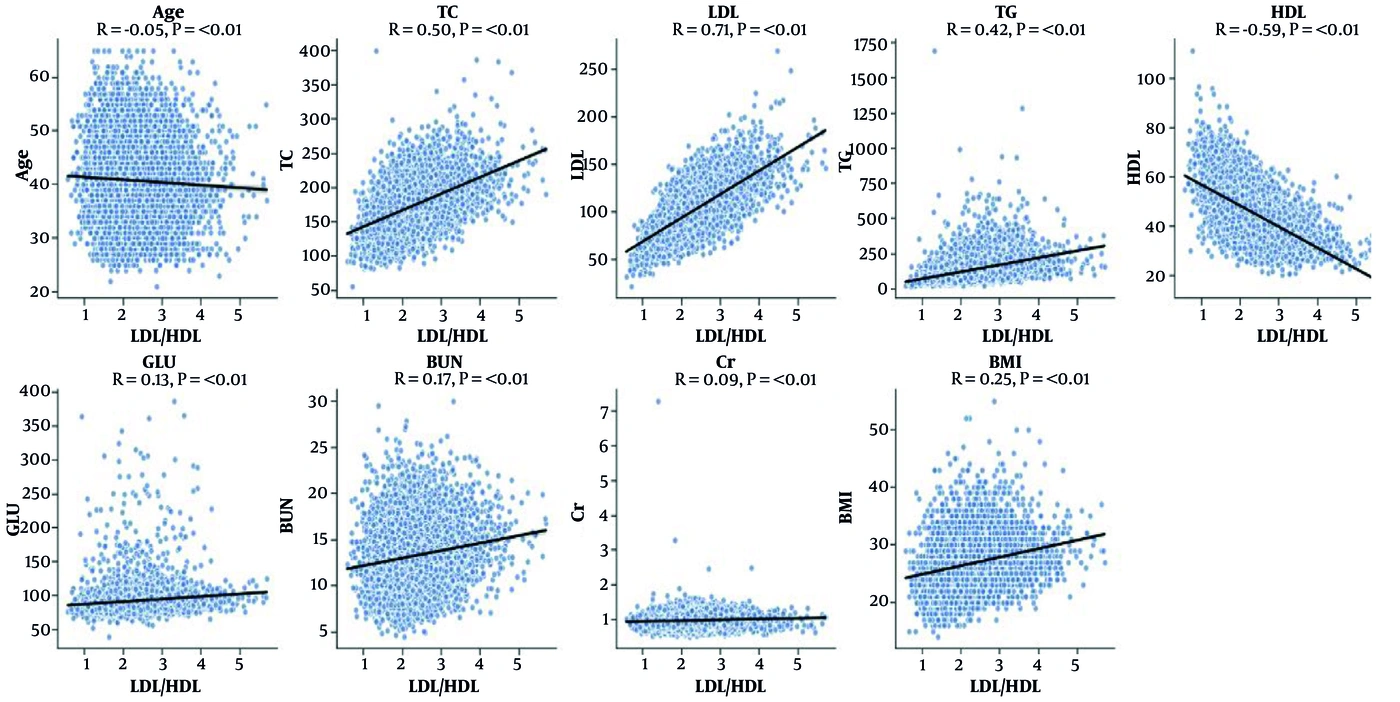
Figure 1.
Correlation Between the LDL/HDL Ratio and Metabolic Health Indicators
The ROC analysis of LDL-C, HDL-C, and the LDL/HDL ratio is presented in Figure 2. The LDL/HDL ratio showed greater discriminatory ability than LDL-C or HDL-C alone. The AUC for the LDL/HDL ratio was 0.677 (95% CI, 0.644 - 0.710), representing the highest discriminatory performance among the indices. The optimal cutoff was 2.19, yielding 63% sensitivity and 61% specificity. For LDL-C, the AUC was 0.576 (95% CI, 0.541 - 0.611), with an optimal cutoff of 105.52 mg/dL (58% sensitivity and 58% specificity). For HDL-C, the AUC was 0.591 (95% CI, 0.556 - 0.626), with an optimal cutoff of 46.24 mg/dL (59% sensitivity and 60% specificity).
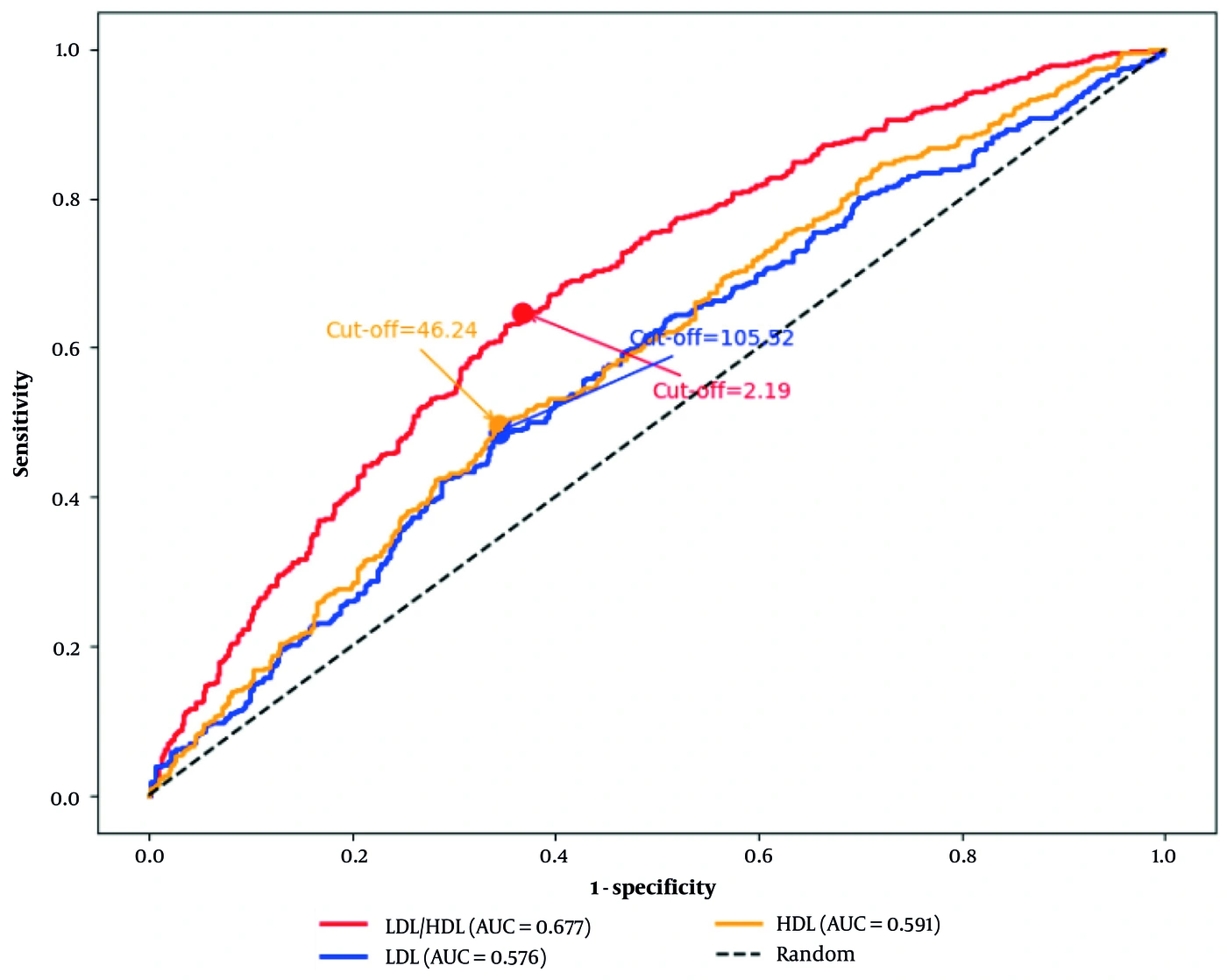
Figure 2.
Comparative ROC Analysis of LDL, HDL, and the LDL/HDL Ratio for CHD Diagnosis
4.4. Clinical and Metabolic Differences by LDL/HDL Cutoff
Participants were divided into 2 groups based on the LDL/HDL cutoff of 2.19. The prevalence of CHD and associated cardiometabolic factors was compared between the groups (Table 3). Participants with LDL/HDL ≥ 2.19 had a higher prevalence of CHD and were more likely to be male, married, and smokers. This group also included a higher proportion of participants with lower educational attainment. BMI distributions differed significantly, with more participants classified as overweight or obese in the group with LDL/HDL ≥ 2.19 than in the group with LDL/HDL < 2.19. The group with LDL/HDL ≥ 2.19 also had higher LDL-C, TC, TG, Cr, GLU, and BUN levels and lower HDL-C levels.
Table 3.
Clinical and Metabolic Differences Between Participants Above and Below the Optimal LDL/HDL Cutoff a
| Variables | LDL/HDL < 2.19 (n = 1901) | LDL/HDL ≥ 2.19 (n = 5199) | P-Value |
|---|---|---|---|
| Age | 40.46 ± 7.25 | 41.05 ± 7.17 | 0.002 |
| Gender | < 0.001 | ||
| Male | 470 (24.7) | 2583 (49.7) | |
| Female | 1431 (75.3) | 2616 (50.3) | |
| Marital status | < 0.001 | ||
| Single | 828 (23.5) | 624 (17.4) | |
| Married | 2695 (76.5) | 2953 (82.6) | |
| Educational level | < 0.001 | ||
| Low (≤ high school diploma) | 830 (23.6) | 1060 (29.6) | |
| Intermediate (associate or bachelor’s degree) | 2007 (57.0) | 1892 (52.9) | |
| High (≥ master’s degree) | 686 (19.5) | 624 (17.4) | |
| Smoking status | < 0.001 | ||
| No | 1824 (95.9) | 4822 (92.7) | |
| Yes | 77 (4.1) | 377 (7.3) | |
| Hypertension | 0.04 | ||
| Yes | 200 (5.7) | 245 (6.9) | |
| No | 3320 (94.3) | 3326 (93.1) | |
| Hypolipidemic drug use | 0.20 | ||
| No | 3380 (95.9) | 3410 (95.3) | |
| Yes | 143 (4.1) | 167 (4.7) | |
| Body Mass Index (kg/m2) | < 0.001 | ||
| Underweight (BMI < 18.5) | 74 (2.1) | 7 (0.2) | |
| Normal (18.5 ≤ BMI < 23.9) | 934 (26.5) | 452 (12.6) | |
| Overweight (24 ≤ BMI < 27.9) | 1439 (40.8) | 1455 (40.7) | |
| Obese (BMI ≥ 28.0) | 1076 (30.5) | 1663 (46.5) | |
| LDL/HDL | |||
| LDL-C | 86.48 ± 18.16 | 114.28 ± 22.52 | < 0.001 |
| HDL-C | 51.21 ± 9.94 | 41.10 ± 7.53 | < 0.001 |
| TC | 159.97 ± 29.46 | 186.94 ± 33.25 | < 0.001 |
| TG | 105.57 ± 66.33 | 165.87 ± 88.95 | < 0.001 |
| Cr | 0.95 ± 0.19 | 0.99 ± 0.17 | < 0.001 |
| GLU | 90.40 ± 17.96 | 94.79 ± 21.95 | < 0.001 |
| BUN | 12.78 ± 3.27 | 13.70 ± 3.24 | < 0.001 |
a Values are expressed as mean ± SD or No. (%). Abbreviations: BMI, Body Mass Index; BUN, blood urea nitrogen; Cr, creatinine; GLU, glucose; HDL-C, high-density lipoprotein cholesterol; LDL-C, low-density lipoprotein cholesterol; TC, total cholesterol; TG, triglycerides.
5. Discussion
This study evaluated the association between the LDL/HDL ratio and prevalent CHD in an occupational cohort with relatively favorable health profiles. Although dyslipidemia is a well-established contributor to cardiovascular disease (6, 13, 14), our findings indicate a more nuanced pattern in this population. The LDL/HDL ratio was positively associated with CHD when modeled independently to address multicollinearity (OR = 1.35; 95% CI, 1.10 - 1.65), but its relative contribution was weaker than those of age, hypertension, and fasting glucose. This pattern is biologically plausible given the close interrelationship among lipid metabolism, glucose homeostasis (15, 16), and blood pressure regulation (17).
This finding contrasts with several previous reports identifying the LDL/HDL ratio as a strong independent marker associated with CHD, often retaining high statistical significance after extensive adjustment for multiple risk factors (6, 18, 19). For example, studies in general populations or high-risk clinical settings have frequently reported that the LDL/HDL ratio demonstrates better discriminatory ability and stronger associations with CHD than isolated lipid parameters (20, 21). The more limited effect observed in the present cohort may be explained by the relatively healthy worker population and restricted variability in cardiometabolic risk factors, consistent with the healthy worker effect (22-24). In such settings, reduced exposure variability can attenuate observed associations between lipid indices and disease outcomes.
Among all lipid measures, the LDL/HDL ratio showed the highest discriminatory capacity, although its discriminatory ability was modest (AUC = 0.677) (25). Rather than indicating strong diagnostic utility, this result suggests that the ratio reflects the clustering of cardiometabolic abnormalities rather than acting as an isolated disease discriminator. Participants with an LDL/HDL ratio ≥ 2.19 had a higher burden of adverse metabolic traits, including obesity, smoking, and hypertension, supporting its role as an integrated marker of metabolic dysregulation rather than a stand-alone predictor (26).
Current clinical guidelines emphasize non-HDL cholesterol and apolipoprotein B as more robust risk markers (27, 28), limiting the clinical applicability of the LDL/HDL ratio in routine practice. In this study, multivariable models confirmed an independent association between the LDL/HDL ratio and prevalent CHD after adjustment; however, this association remained secondary to traditional risk factors, particularly age, hypertension, and glycemic status.
After multicollinearity was addressed by modeling the LDL/HDL ratio independently of LDL-C and HDL-C, the ratio was positively associated with prevalent CHD. Although this finding may appear inconsistent with the crude comparison in Table 1, in which no significant difference was observed between groups, the discrepancy is expected because unadjusted comparisons do not account for confounding or intercorrelations among lipid variables. After adjustment for major cardiometabolic factors, the LDL/HDL ratio remained independently associated with prevalent CHD; however, its effect size was weaker than those of age, hypertension, and fasting glucose.
The observed pattern suggests that the LDL/HDL ratio primarily reflects underlying metabolic dysregulation rather than acting as a dominant independent determinant of CHD in this cohort. This interpretation is consistent with its biological role as an integrated indicator of opposing atherogenic and antiatherogenic lipid effects (6) and with previous studies reporting associations between the LDL/HDL ratio and CHD severity, plaque characteristics, and stenosis burden (19, 20, 29, 30).
The relatively modest discriminatory performance observed in the ROC analysis (31), compared with the regression results, likely reflects methodological differences because ROC curves evaluate discrimination without adjustment, whereas multivariable models estimate independent associations (23). In this occupational cohort, the influence of lipid indices appears attenuated, likely because of limited variability in risk-factor distribution and the healthy worker effect (24), resulting in a stronger apparent contribution of traditional factors such as hypertension and glycemic status.
CHD classification based on medical records or self-report may have introduced misclassification bias, and the absence of apolipoprotein-based markers limited comparisons with more contemporary lipid indices (32). Overall, these findings support interpreting the LDL/HDL ratio as a marker of metabolic risk clustering rather than as a primary independent predictor of prevalent CHD in this population.
5.1. Strengths and Limitations
This study has several strengths. First, the relatively large sample of 7,100 participants increased statistical power and improved the precision of the estimated associations. The use of data from an established cohort within the PERSIAN Cohort framework also enhanced methodological rigor because data collection followed standardized protocols and validated procedures. Second, the study incorporated a comprehensive set of demographic, anthropometric, and biochemical variables, allowing adjustment for important cardiometabolic confounders such as age, hypertension, blood glucose, BMI, and smoking. Third, the analysis combined logistic regression, correlation analysis, and ROC curve analysis. Receiver operating characteristic analysis enabled evaluation of the discriminatory ability of the LDL/HDL ratio compared with individual lipid parameters, providing additional insight into its potential utility as a risk-stratification marker. Another strength was the evaluation of the LDL/HDL ratio in a working population. Occupational cohorts are relatively understudied in cardiovascular epidemiology in Iran, and this study contributes evidence regarding cardiometabolic risk patterns among university employees. Finally, identifying a data-driven optimal LDL/HDL cutoff of 2.19 provides a useful reference point for future epidemiological and workplace health-monitoring studies.
Several limitations should be considered. First, the cross-sectional design precludes causal inference because exposure and outcome were assessed simultaneously; therefore, it is not possible to determine whether the observed lipid profiles preceded CHD. Second, CHD status was partly based on self-reported physician diagnoses, which may have introduced recall bias or misclassification. Although medical records were used when available, some reporting error cannot be excluded. Third, the study population consisted exclusively of employees of a single university medical system. This relatively homogeneous occupational group may not represent the general population, and the healthy worker effect could have led to underestimation of associations between lipid abnormalities and cardiovascular disease. Finally, residual confounding cannot be excluded. Information on certain lifestyle and clinical factors, such as diet, physical activity, medication adherence, and duration of lipid-lowering therapy, was unavailable or incompletely captured and may have influenced the observed associations.
5.2. Conclusions
In this relatively healthy and homogeneous occupational cohort, the LDL/HDL ratio primarily reflected the clustering of adverse cardiometabolic traits rather than serving as a strong independent marker of prevalent CHD. Its moderate discriminatory ability suggests potential utility for identifying higher-risk subgroups in research or occupational settings, but it should not replace guideline-endorsed lipid markers in clinical practice. These findings emphasize the importance of considering population characteristics and underlying metabolic factors when interpreting lipid ratios and highlight the need for studies in more diverse populations to clarify their association with cardiometabolic outcomes.
Given the cross-sectional design, the absence of apolipoprotein-based markers, and the possibility of residual confounding, these results should be interpreted cautiously and viewed as descriptive rather than inferential. Future longitudinal studies in more heterogeneous populations incorporating broader lipid and metabolic profiling may further clarify how this ratio fits within the overall cardiometabolic risk landscape.