Fulltext
The full text is available in PDF.
International Cardiovascular Research Journal
An annual journal in scientific affiliation with the Cardiovascular Research Center, Shiraz University of Medical Sciences
Image Credit:Int Cardiovasc Res J
Authors
Background:
Cardiovascular Diseases (CVDs) are the major cause of mortality around the world. Knowledge about CVDs is an important subject in encouraging Cardiac Rehabilitation (CR) patients to make health changes related to their condition. However, it is still not clear how much knowledge Iranian patients have about such diseases.
Objectives:
This study aimed to investigate CR patients’ knowledge of CVDs in East of Iran.
Patients and Methods:
This cross-sectional study was carried out on CR patients who had referred to a CR center in Mashhad, Iran between November 2016 and May 2017. A total of 161 patients were recruited using convenience sampling method. A reliable and valid questionnaire was used to assess the patients’ knowledge. The data were entered into the SPSS statistical software, version 16 and were analyzed using descriptive and analytical statistics. P < 0.05 was considered to be statistically significant.
Results:
The mean age of the patients was 54.12 ± 14.57 years (range: 19 to 74 years). Mean score of knowledge about CVDs was 40.66 ± 17.19. Most of the participants had a low level of knowledge about CVDs (52.8%). The results showed a significant difference between the mean scores of knowledge in different age groups (P = 0.008) and education levels (P = 0.001). Indeed, men had a higher level of knowledge in exercise (P = 0.009) and psychosocial risk subscales (P = 0.012).
Conclusions:
The participants showed an insufficient level of knowledge about CVDs. Thus, appropriate training programs are recommended to improve such patients’ knowledge of CVDs. The research findings also provided a sound and fundamental basis for future studies in this field.
© 2018, Author(s). This open-access article is available under the Creative Commons Attribution 4.0 (CC BY 4.0) International License (https://creativecommons.org/licenses/by/4.0/), which allows for unrestricted use, distribution, and reproduction in any medium, provided that the original work is properly cited.
Saeidi M, Soroush A, Komasi S, Moemeni K, Heydarpour B. Attitudes Toward Cardiovascular Disease Risk Factors Among Patients Referred to a Cardiac Rehabilitation Center: Importance of Psychological Attitudes. Shiraz E-Med J. 2015;16(7):e22281. doi: https://doi.org/10.17795/semj22281
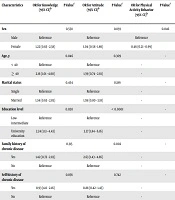
Koohi F, Khalili D. Knowledge, Attitude, and Practice Regarding Cardiovascular Diseases in Adults Attending Health Care Centers in Tehran, Iran. Int J Endocrinol Metab. 2020;18(3):e101612. doi: https://doi.org/10.5812/ijem.101612
Komasi S, Saeidi M. Aging is an Important Cause for a Lack of Understanding of the Main Risk Factor in Cardiac Rehabilitation Patients. Thrita J Neu. 2015;4(4):e32751. doi: https://doi.org/10.5812/thrita.32751
Ezzati P, Salehi S. Correlation of Heart Knowledge and Cardiac Risk Factors with Readiness for Lifestyle Modification in Companions of Patients with Cardiovascular Diseases in the West of Iran. Middle East J Rehabil Health Stud. 2019;6(2):e88622. doi: https://doi.org/10.5812/mejrh.88622
Nosratabadi M, halvaiepour Z. The mediating role of social support on the relation between social capital and satisfaction with self-care program in patients referring to cardiac rehabilitation centers. koomesh. 2018;20(2):e152962. doi:
More by these authors
Last Update: 1 month ago
Last Update: 1 month ago
Last Update: 1 month ago
Last Update: 4 hours ago
Last Update: 8 hours ago
Last Update: 4 days ago

