Fulltext
The full text is available in PDF.
International Cardiovascular Research Journal
An annual journal in scientific affiliation with the Cardiovascular Research Center, Shiraz University of Medical Sciences
Image Credit:Int Cardiovasc Res J
Authors
Background: Percutaneous coronary intervention (PCI) in ostial coronary artery lesions has been technically
difficult because it should be done with precise stent placement in ostium and absence of side branch compromise.
The Szabo technique consists of side branch wiring through most proximal stent strut as well as main
branch wiring through stent lumen. The side branch wire or anchor wire prevents stent advancement beyond ostial
segment and makes possible the accurate stent implantation in ostium. The purpose of this study is to evaluate
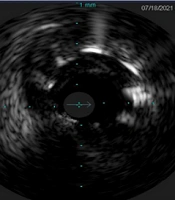
the feasibility and success rate of Szabo technique analysing technical, angiographic and IVUS(Intravascular
Ultrasonography) findings success rate.
Methods: We analysed retrospectively in our cath lab, 13 PCIs in 13 patients with a significant lesion at a
coronary artery ostium which was treated percutaneously using Szabo technique. The procedure was defined as
technically successful if there was neither stent loss nor second guide wire pull back during stent advancement.
A successful procedure from angiographic point of view was defined as a precise stent implantation at ostium
without side branch compromise. We defined also successful procedure from IVUS point of view consisting of
accurate stent placement in ostium without proximal protrusion and without any stent uncovered area.
Results: Of a total of 13 patients with 10 (76.9%) males, 46.2% had diabetes, 69.2% hypertension, 53.8% hypercholesterolemia
and 23.1 % were smoker or former smoker. They aged from 37-81 years with a mean age of
63±11 years. In 11 (84.6%) patients 6F and in 2 (15.4%) patients 7F sheathless guiding catheter (Asahi Intecc
Co; LTD. Japan) were used. The access was radial in 12 (92.3%) and femoral in 1 (7.7%). The culprit vessel was
left anterior descending (LAD) in 9 (69.2%), right coronary artery (RCA) 2 (15.4%), circumflex- obtuse marginal
(LCX-OM) 1(7.7%), and posterior descending (PDA) 1(7.7%). In 9 (69.2%) IVUS was performed through
culprit vessel and in 2 (15.4%) IVUS was done also in side branch after stent implantation. In 11 (84.6%) the
procedure was technically successful. Among technically successful patients all (100%) had angiographic success.
IVUS examination of culprit vessel showed accurate stent placement in ostium 7 (77.8%) and slight stent
proximal protrusion in 2 patients (22.2%).
Conclusions: This study shows that Szabo technique is safe and feasible for PCI in ostial coronary artery lesions
with a high angiographic success rate. In a high percentage of cases the accurate position of stent in ostium can
be confirmed by IVUS.
© 2009, Author(s). This open-access article is available under the Creative Commons Attribution 4.0 (CC BY 4.0) International License (https://creativecommons.org/licenses/by/4.0/), which allows for unrestricted use, distribution, and reproduction in any medium, provided that the original work is properly cited.
Mansouri P, Mansouri MH, Kazemian A, Hashemi SM, Khalilpour E, et al. Modified Floating Wire: A Novel Aorto-Ostial Coronary Stenting Technique. Multidiscip Cardio Annal. 2024;15(1):e146780. doi: https://doi.org/10.5812/mca-146780
babazadeh K. Coronary-Artery Stent. Multidiscip Cardio Annal. 2007;1(3):e8679. doi:
Safi M, Namazi MH, Sadeghi H, Saadat H, Vakili H, et al. Chronic Total Occlusion-Angioplasty with Antegrade Approach: A two-Year Experience in “Modarres Hospital”, A Tertiary University Hospital, Tehran, Iran. Int J Cardiovasc Pract. 2016;1(3):e130047. doi: https://doi.org/10.21859/ijcp-010307
Mohandes M, Guarinos J, Sans J. Intravascular Ultrasound in Percutaneous Coronary Intervention for Chronic Total Occlusion. Int Cardiovasc Res J. 2010;4(3):e62940. doi:
Edraki M, Ataei Z, Mehdizadegan N, Amoozgar H, Mohammadi H, et al. Results of Transcatheter Therapy with Balloon Versus Stent for Treating Isolated Branch Pulmonary Artery Stenosis in Children and Adolescents: A Midterm Study. Inn J Pediatr. 2023;33(6):e137593. doi: https://doi.org/10.5812/ijp-137593
Last Update: 3 weeks ago
Last Update: 3 weeks ago
Last Update: 3 weeks ago
Last Update: 5 hours ago
Last Update: 1 day ago
Last Update: 4 days ago
