
Targeted Biologic and Cellular Therapies for Systemic Lupus Erythematosus: Current Evidence and Future Perspectives

Authors

Reyhaneh Taheri1, Cobra MoradianCobra Moradian ORCID1,*
1Department of Chemical and Biological Technologies, CT.C, Islamic Azad University, Tehran, Iran
*Corresponding Author: Department of Chemical and Biological Technologies, CT.C, Islamic Azad University, Tehran, Iran. Email: [email protected]

Journal of Advanced Immunopharmacology:Vol. 6, issue 2; e173131
Published online:Jun 30, 2026
Article type:Review Article
Received:May 28, 2026
Accepted:Jun 17, 2026
How to Cite:Taheri R, Moradian C. Targeted Biologic and Cellular Therapies for Systemic Lupus Erythematosus: Current Evidence and Future Perspectives. J Adv Immunopharmacol. 2026;6(2):e173131. doi: https://doi.org/10.69107/jai-173131

Abstract

Context:

Systemic lupus erythematosus (SLE) is a multisystem autoimmune disease characterized by heterogeneous clinical manifestations and dysregulated innate and adaptive immune responses. Conventional management relies largely on immunosuppressants, which pose challenges for long-term efficacy and sustained disease control. Recent therapeutic advances have introduced monoclonal antibodies as a more targeted approach to disease control.

Evidence Acquisition:

A comprehensive literature search was conducted in PubMed, Scopus, Web of Science, and Embase from database inception to early 2026. The review included randomized controlled trials, pivotal phase II/III trials, long-term extension trials, observational cohort studies, systematic reviews and meta-analyses, and regulatory documents from the FDA and the EMA.

Results:

Anifrolumab, a monoclonal antibody that inhibits the type I interferon pathway, appears to improve SLE manifestations and to enable sustained reductions in the corticosteroid dose. B-cell-targeted therapies, including belimumab, rituximab, and obinutuzumab, together with novel agents targeting other immune pathways, offer promising therapeutic alternatives. Although several novel therapies have demonstrated clinical benefit in SLE, other experimental approaches, such as ustekinumab, have failed to show significant efficacy. Cell-based therapies, including anti-CD19 chimeric antigen receptor T-cell therapy, are emerging as investigational options for refractory disease.

Conclusions:

Emerging targeted and cell-based therapies represent a promising direction in SLE management by enabling more precise strategies for treatment-resistant disease; however, careful evaluation of their long-term safety, effectiveness, and accessibility is required.

1. Context

1.1. Introduction

Systemic lupus erythematosus (SLE) is a chronic autoimmune disease in which loss of immune tolerance leads to the production of autoantibodies against nuclear antigens, resulting in immune-complex deposition and multiorgan inflammation (1, 2). The clinical spectrum ranges from mild mucocutaneous involvement to life-threatening nephritis, neuropsychiatric syndromes, and hematologic cytopenias. Despite improvements in survival, many patients continue to experience disease flares and treatment-related morbidity.
Conventional lupus management primarily involves antimalarial agents, particularly hydroxychloroquine, together with immunosuppressive or immunomodulatory therapies, including glucocorticoids, cyclophosphamide, mycophenolate mofetil, methotrexate, and azathioprine (1, 3). These drugs have substantial adverse effects, including increased infection risk, hepatic and renal toxicity, osteoporosis, and metabolic complications. They also lack specificity and may affect normal immune pathways and healthy cells. Recent advances in biotechnology and immunology have led to the development of targeted therapies (4). This therapeutic gap has driven the development of biologics that selectively interfere with key pathogenic pathways.
Several studies have shown that monoclonal antibodies can target specific pathogenic mechanisms in SLE. Monoclonal antibodies, generated from clonal B-cell lines, recognize and neutralize specific molecular targets. In SLE, they can deplete B cells, block cytokines or costimulatory signals, or interfere with interferon signaling. Since the approval of belimumab (anti-BAFF) and, more recently, anifrolumab (anti-IFNAR1) and obinutuzumab (anti-CD20 for lupus nephritis), the biologic armamentarium for SLE has expanded substantially (1, 4-6).
This review aims to 1) provide a structured narrative review methodology for evidence synthesis; 2) critically evaluate the current evidence for monoclonal antibody-based therapies in SLE and lupus nephritis; 3) compare their efficacy and safety with conventional immunosuppressants; and 4) discuss emerging cellular strategies, including CAR-T therapy, that may redefine treatment goals in refractory disease.

1.2. Systemic Lupus Erythematosus and Lupus Nephritis: Pathogenic Overview

SLE is a polygenic autoimmune disorder characterized by substantial heterogeneity arising from dysregulation of innate and adaptive immunity. Consequently, the body produces antibodies against nuclear antigens such as double-stranded DNA (dsDNA). The appearance of autoantibodies triggers immune-complex formation and inflammation in several target organs (1, 2).
The clinical manifestations of SLE vary substantially among patients. Some patients have mild manifestations confined to the skin and joints, whereas others develop severe organ damage. Recurrent inflammation, photosensitivity, skin changes, anemia, cardiovascular disease, and nephropathy are common clinical manifestations. Photosensitivity is a frequent cutaneous feature and may induce skin erythema or cutaneous vasculitis. In addition, atypical overlapping autoimmune presentations, such as bullous lupus erythematosus, contribute to the diagnostic and pathogenic complexity of the disease (1, 7).
Lupus nephritis (LN) occurs in approximately 40 - 70% of patients and is a major determinant of long-term prognosis. Histologically, LN is classified into 6 classes (I-VI), with proliferative forms (classes III and IV) carrying the highest risk of progression to end-stage kidney disease. The pathogenesis of LN involves glomerular immune-complex deposition, complement activation, and local inflammation mediated by type I interferons and infiltrating immune cells (1, 8).
The condition is more common in women in their third and fourth decades of life; however, it may develop at any age. SLE is more commonly observed among individuals from Afro-Caribbean, African American, and Asian populations. Increasing global awareness and addressing diagnostic disparities in developing health care systems remain important for improving patient outcomes. Although survival among patients with lupus has improved, disease management remains challenging because of the heterogeneous nature of SLE, recurrent flares, and adverse effects associated with prolonged immunosuppressive treatment (1, 5, 6, 8-11).
The heterogeneous nature of the disease, recurrent flares, and cumulative organ damage caused by both disease activity and long-term immunosuppression remain major clinical challenges.

2. Evidence Acquisition

2.1. Literature Search and Methodology

To ensure transparency, a comprehensive literature search was conducted in PubMed, Scopus, Web of Science, and Embase from the inception of each database through early 2026. The search strategy used Boolean operators to identify relevant publications: ("Systemic Lupus Erythematosus" OR "Lupus Nephritis") AND ("Monoclonal Antibody" OR "Belimumab" OR "Anifrolumab" OR "Rituximab" OR "Obinutuzumab" OR "Dapirolizumab" OR "Litifilimab" OR "Ustekinumab" OR "CAR-T") (1, 4).
This review included randomized controlled trials (RCTs), pivotal phase II/III trials, long-term extension trials, observational cohort studies, systematic reviews and meta-analyses, and regulatory documents from the FDA and EMA. Eligible references were independently screened by the authors, and regulatory approval status was updated as of the manuscript revision date (3, 6).

3. Results

3.1. Targeted Biological Therapies in Systemic Lupus Erythematosus

Monoclonal antibodies are a form of biologic therapy produced in vitro through the fusion of B lymphocytes and myeloma cells. These antibodies have an affinity for specific target antigens in the immune system, enabling selective modulation of immune responses and disease activity. Compared with standard immunosuppressive medications, monoclonal antibodies provide a more targeted mechanism of action; however, they carry specific risks, including serious infections, infusion reactions, and hypogammaglobulinemia (1, 4-6).

3.2. Comparison of Conventional Treatments and Monoclonal Antibody Therapies

Hydroxychloroquine (HCQ) is a cornerstone therapy for patients with SLE. Many patients also require glucocorticoids for acute disease control; however, long-term use is limited by cumulative toxicity, including osteoporosis, avascular necrosis, metabolic syndrome, and irreversible organ damage (12, 13). For patients with inadequate responses or major organ involvement, immunosuppressants such as mycophenolate mofetil, cyclophosphamide, and azathioprine are added. However, these agents are nonspecific and may predispose patients to opportunistic infections, malignancies, and infertility (1, 3, 14).
Biologic therapies offer distinct advantages:
- Steroid-sparing effect: Anifrolumab and belimumab have both demonstrated significant glucocorticoid dose reductions in clinical trials.
- Targeted pathway inhibition: These therapies intervene in defined pathogenic pathways, such as IFN-I, BAFF, and CD20, rather than broadly suppressing the immune system.
In line with current EULAR guidelines, biologic drugs may be considered in patients with persistent disease activity and frequent relapses who do not respond adequately to existing treatments. Belimumab (anti-BAFF) and anifrolumab (anti-IFNAR1) are approved add-on options, while obinutuzumab has recently been approved for active LN.
Compared with conventional immunosuppressive drugs, monoclonal antibodies provide a more targeted approach that may improve treatment outcomes while reducing toxicity. Nevertheless, monoclonal antibodies are not without drawbacks, including high cost, the need for parenteral administration, infusion reactions, and, in some cases, increased infection risk. Moreover, not all patients respond, reflecting the biological heterogeneity of SLE (1, 3, 12).
Figure 1 illustrates the historical evolution of SLE therapies from nonspecific immunosuppression to targeted biologics.
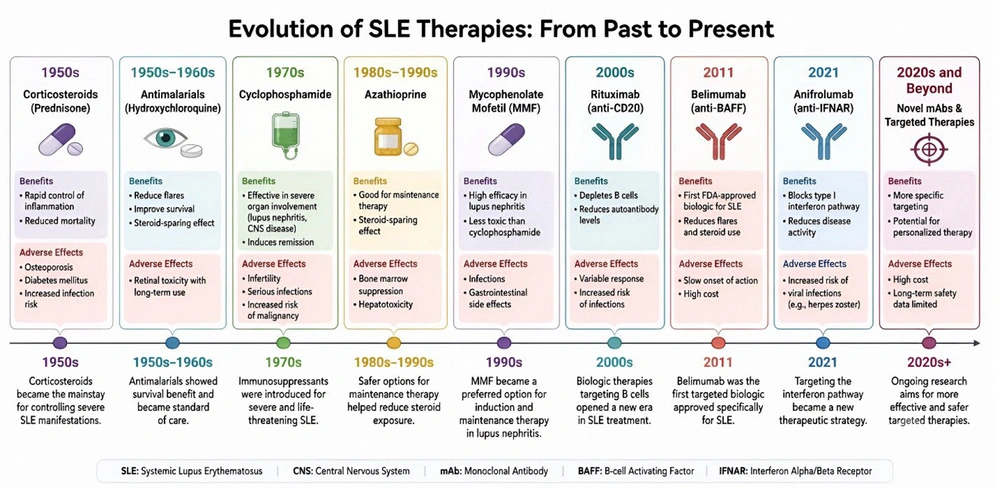
Timeline of therapeutic advances in SLE, illustrating the progression from conventional immunosuppressive agents to targeted biologic therapies.
Figure 1.
Timeline of therapeutic advances in SLE, illustrating the progression from conventional immunosuppressive agents to targeted biologic therapies.

3.3. Mechanisms of Action: Conventional Drugs Versus Monoclonal Therapies

Therapeutic intervention in SLE increasingly focuses on targeted inhibition of specific immunopathologic pathways involved in disease development. SLE develops because of abnormalities in cell death and failure to clear cellular degradation products, resulting in exposure to nuclear and cytoplasmic autoantigens. These antigens activate B and T cells, leading to autoantibody production, immune-complex formation, and complement activation (15, 16). In addition, they promote the activation of type I interferon (IFN), which contributes to inflammation and tissue damage (17).
Conventional immunosuppressants broadly inhibit lymphocyte activity, whereas monoclonal antibodies interfere with discrete immune checkpoints:
- Anifrolumab blocks the IFNAR1 subunit, suppressing the type I interferon signature.
- Anti-CD20 antibodies, including rituximab and obinutuzumab, deplete mature B lymphocytes and reduce autoantibody production.
- Belimumab neutralizes soluble BAFF/BLyS, thereby inhibiting B-cell survival and differentiation.
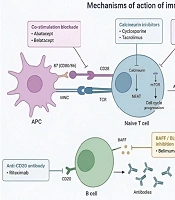
Figure 2 contrasts the broad effects of immunosuppressants with the focused actions of monoclonal antibodies on key SLE pathways.
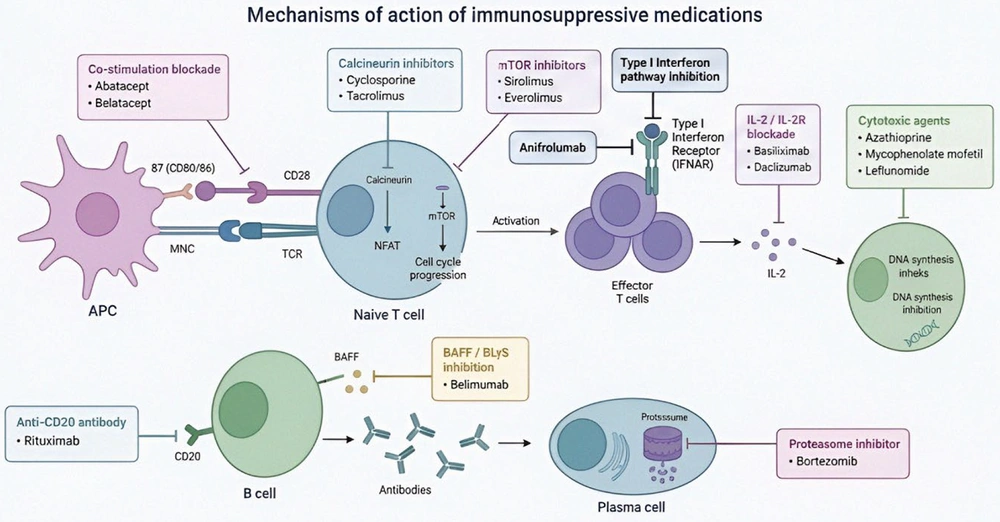
Mechanisms of action of immunosuppressive medications and targeted therapies in SLE. Belimumab: BAFF (BLyS); inhibits B-cell survival and differentiation; FDA/EMA approved. Anifrolumab: IFNAR1; blocks type I interferon signaling; FDA/EMA approved. Rituximab: CD20; depletes B lymphocytes; off-label use with mixed RCT results. Obinutuzumab: CD20 (type II); enhanced B-cell depletion/ADCC; phase II/III (LN). Dapirolizumab pegol: CD40 L; inhibits T-B cell costimulation; phase III ongoing. Litifilimab: BDCA2; suppresses pDC-derived IFN-I; phase III ongoing.
Figure 2.
Mechanisms of action of immunosuppressive medications and targeted therapies in SLE. Belimumab: BAFF (BLyS); inhibits B-cell survival and differentiation; FDA/EMA approved. Anifrolumab: IFNAR1; blocks type I interferon signaling; FDA/EMA approved. Rituximab: CD20; depletes B lymphocytes; off-label use with mixed RCT results. Obinutuzumab: CD20 (type II); enhanced B-cell depletion/ADCC; phase II/III (LN). Dapirolizumab pegol: CD40 L; inhibits T-B cell costimulation; phase III ongoing. Litifilimab: BDCA2; suppresses pDC-derived IFN-I; phase III ongoing.

3.4. Approved and Late-Stage Monoclonal Antibody Therapies

3.4.1. Belimumab: Foundational BAFF Blockade

Belimumab is a monoclonal antibody that inhibits BLyS and soluble BAFF. In the BLISS trials conducted in patients with nonrenal SLE, belimumab improved SRI-4 response rates and reduced disease flares. In active lupus nephritis, the phase III BLISS-LN trial showed increased complete renal response (CRR) and primary efficacy renal response (PERR) rates in patients receiving belimumab compared with standard treatment after 104 weeks of therapy. Belimumab has been approved for use in SLE and lupus nephritis by both the EMA and FDA (18, 19).

3.4.2. Anifrolumab: Targeting the Interferon Pathway

Anifrolumab is a fully human IgG1 monoclonal antibody that targets the IFNAR1 subunit of the type I interferon receptor. Binding to IFNAR1 blocks type I interferon signaling. In the TULIP-2 trial, anifrolumab improved BICLA response rates (47.8% vs 31.5%) and allowed corticosteroid dose reduction compared with placebo. The TULIP-1 trial did not achieve its primary SRI-4 endpoint, although post hoc analysis supported efficacy according to BICLA. Anifrolumab is authorized for the treatment of active nonrenal SLE. Herpes zoster infection rates were higher in the anifrolumab group. These studies did not include patients with severe active lupus nephritis (15, 20, 21).

3.4.3. Enhanced B-Cell Depletion: Obinutuzumab

In the EXPLORER and LUNAR studies, rituximab produced inconclusive primary outcomes. Nevertheless, observational registries support its off-label use in refractory disease. Obinutuzumab was developed to achieve deeper tissue B-cell depletion. It is a type II humanized anti-CD20 monoclonal antibody with enhanced antibody-dependent cell-mediated cytotoxicity. Results from a phase III regimen showed that the combination of obinutuzumab with glucocorticoids increased total renal response rates from 33.1% to 46.4% at 76 weeks in proliferative lupus nephritis (P = 0.007). FDA approval was granted in October 2025 (17, 22, 23).

3.4.4. Costimulation Blockade: Dapirolizumab

Dapirolizumab pegol is a PEGylated Fab' fragment targeting CD40 L. Because it lacks an Fc region, it avoids the thromboembolic adverse effects associated with earlier anti-CD40 L antibodies. In the phase III PHOENYCS DO trial, dapirolizumab pegol met its primary endpoint, achieving a 500% BICLA response rate at week 48 compared with 35.4% with placebo (P = 0.011) (24).

3.4.5. Targeting Plasmacytoid Dendritic Cells: Litifilimab

Litifilimab (BIIB059) is a humanized monoclonal antibody targeting blood dendritic cell antigen 2 (BDCA2) on plasmacytoid dendritic cells (pDCs). In the phase II LILAC study, litifilimab significantly reduced cutaneous disease activity and produced a modest reduction in active swollen or tender joints. Phase III trials in the TOPAZ program are currently ongoing (25).

3.5. Lessons From Unsuccessful Programs: Ustekinumab

Ustekinumab is a monoclonal antibody targeting the receptor complex shared by interleukin (IL)-12 and IL-23 and initially showed promising results. However, an important phase III global trial was stopped prematurely after an interim analysis showed no significant difference in SRI-4 response rates compared with placebo (1, 26).

3.6. Emerging Cellular Therapies: CAR-T

Beyond monoclonal antibodies, adoptive cellular therapy with anti-CD19 chimeric antigen receptor (CAR) T cells represents an innovative investigational strategy. By targeting CD19, CAR T cells deeply deplete B-cell lineages across lymphoid tissue. Early cohort studies and pooled analyses, including 47 patients across 10 studies, reported high rates of drug-free remission according to LLDAS/DORIS criteria in highly refractory SLE (1).
Nevertheless, promotional terms such as "revolution" should be used cautiously because CAR-T therapy is associated with serious adverse effects, including cytokine release syndrome, most commonly grades 1 - 2, neurotoxicity, prolonged cytopenias, and hypogammaglobulinemia. Manufacturing challenges, high costs, and risks associated with conditioning regimens require careful evaluation in future research (27, 28).

4. Conclusions

4.1. Discussion and Future Perspectives

The treatment landscape for SLE is evolving. The approval of belimumab, anifrolumab, and obinutuzumab, together with promising late-stage data for dapirolizumab and litifilimab, indicates that targeted therapies are now an established component of SLE management (18, 20, 22, 24, 25). However, several challenges remain:
- Patient heterogeneity: Validated biomarkers, including interferon gene signatures and baseline BAFF levels, are needed to guide precision treatment selection (1, 29, 30).
- Safety monitoring: Long-term surveillance is required for serious infections, hypogammaglobulinemia, and viral reactivation (4, 15).
- Access and cost: The high acquisition costs of biologic and cellular therapies remain barriers in health care systems worldwide (16, 17).

4.2. Conclusions

Overall, SLE management has shifted in recent years from relatively nonspecific broad immunomodulation toward highly targeted immune modulation with monoclonal antibodies and emerging cellular therapies (1, 3). Anifrolumab notably reduces disease activity and enables steroid dose reduction in patients with nonrenal SLE, whereas belimumab remains an important therapeutic option for both SLE and lupus nephritis, and obinutuzumab has shown substantial benefit in proliferative lupus nephritis (18, 20, 21). Investigational agents such as dapirolizumab pegol have demonstrated efficacy (24); however, unsuccessful studies of ustekinumab suggest that this pathway may be redundant (26). Finally, anti-CD19 CAR T-cell therapy has shown promising preliminary results in patients with refractory disease, although its long-term efficacy and safety require further investigation (27).
Footnotes

  • AI Use Disclosure:For the purpose of Figure Design, the Chatgpt was used Substantial in the All Images section.

  • Authors' Contribution:R. T.: Study concept and design, acquisition of data, and drafting of the manuscript; C. M.: Analysis and interpretation of data and critical revision of the manuscript.

  • Conflict of Interests Statement:The authors declare no conflict of interest

  • Data Availability:The dataset presented in the study is available on request from the corresponding author during submission or after publication.

  • Funding/Support:The authors received no financial support for the research, authorship, or publication of this article.

References

  • 1.
    Fasano S, Milone A, Nicoletti GF, Isenberg DA, Cicca F. Precision medicine in systemic lupus erythematosus. Nat Rev Rheumatol. 2023;19(6):331-342. [PubMed ID: 37041269]. https://doi.org/10.1038/s41584-023-00948-y.
  • 2.
    Ghodke-Puranik Y, Olferiev M, Crow MK. Systemic lupus erythematosus genetics: insights into pathogenesis and implications for therapy. Nat Rev Rheumatol. 2024;20:635-648. [PubMed ID: 39232240]. https://doi.org/10.1038/s41584-024-01152-2.
  • 3.
    Fanouriakis A, Kostopoulou M, Andersen J, et al. EULAR recommendations for the management of systemic lupus erythematosus: 2023 update. Ann Rheum Dis. 2024;83(1):15-29. [PubMed ID: 37827694]. [PubMed Central ID: PMC12439377]. https://doi.org/10.1136/ard-2023-224762.
  • 4.
    Chan J, Walters GD, Puri P, Jiang SH, et al. Safety and efficacy of biological agents in the treatment of systemic lupus erythematosus (SLE). BMC Rheumatol. 2023;7:37. [PubMed ID: 37807057]. [PubMed Central ID: PMC10561476]. https://doi.org/10.1186/s41927-023-00358-3.
  • 5.
    García-Carrasco M, Mendoza Pinto C, Solís Poblano JC, et al. National Institutes of Health. El Rosario University Press; 2013, [cited 2026 Aug 19]. Systemic lupus erythematosus. Available from: https://www.ncbi.nlm.nih.gov/books/NBK459474/.
  • 6.
    Zavaleta-Monestel E, Arrieta-Vega D, Rojas-Chinchilla C, et al. Advances in systemic lupus erythematosus treatment with monoclonal antibodies. Cureus. 2024;16(7). e64090. https://doi.org/10.7759/cureus.64090.
  • 7.
    Miner JJ, Kim AH. Cardiac manifestations of systemic lupus erythematosus. Rheum Dis Clin North Am. 2014;40:51-60. [PubMed ID: 24268009]. https://doi.org/10.1016/j.rdc.2013.10.003.
  • 8.
    Ding Z, Zhang H, Huang F, et al. Efficacy and safety of biologics for systemic lupus erythematosus (SLE): a systematic review and network meta-analysis. Clin Rev Allergy Immunol. 2025;68:70. [PubMed ID: 40699272]. [PubMed Central ID: PMC12287134]. https://doi.org/10.1007/s12016-025-09082-x.
  • 9.
    Tian XP, Zhang X. Gastrointestinal involvement in systemic lupus erythematosus: insight into pathogenesis, diagnosis and treatment. World J Gastroenterol. 2010;16:2971-2977. [PubMed ID: 20572299]. [PubMed Central ID: PMC2890936]. https://doi.org/10.3748/wjg.v16.i24.2971.
  • 10.
    Florez Suarez J, Quintana G. Factors associated with the development of target organ damage in patients with systemic lupus erythematosus. Rev Colomb Reumatol. 2018;25:75-78. https://doi.org/10.1016/j.rcreue.2018.12.004.
  • 11.
    Valenzuela P, Ladino M, Vargas N. Childhood-onset systemic lupus erythematosus: patients features and their transition into adulthood. Andes Pediatr. 2021;92:375-381. [PubMed ID: 34479243]. https://doi.org/10.32641/andespediatr.v92i3.1653.
  • 12.
    Plüß M, Piantoni S, Tampe B, Kim AHJ, Korsten P. Belimumab for systemic lupus erythematosus - focus on lupus nephritis. Hum Vaccin Immunother. 2022;18(5):2072143. [PubMed ID: 35588699]. [PubMed Central ID: PMC9359396]. https://doi.org/10.1080/21645515.2022.2072143.
  • 13.
    Tanaka Y. State-of-the-art treatment of systemic lupus erythematosus. Int J Rheum Dis. 2020;23(3):285-291. [PubMed ID: 32134201]. [PubMed Central ID: PMC7187183]. https://doi.org/10.1111/1756-185X.13817.
  • 14.
    Manjón-Rodríguez M, Borrego-Utiel FJ, Merino-García E, et al. Concurrent use of anifrolumab and belimumab in a patient with systemic lupus erythematosus presenting with recurrent severe cutaneous involvement and lupus nephritis. Cureus. 2025;17(11). e97252. [PubMed ID: 41426928]. [PubMed Central ID: PMC12716614]. https://doi.org/10.7759/cureus.97252.
  • 15.
    Tipton CM, Fucile CF, Darce J, et al. Diversity, cellular origin and autoreactivity of antibody-secreting cell population expansions in acute systemic lupus erythematosus. Nat Immunol. 2015;16(7):755-765. [PubMed ID: 26006014]. [PubMed Central ID: PMC4512288]. https://doi.org/10.1038/ni.3175.
  • 16.
    Leonard D, Eloranta ML, Hagberg N, et al. Activated T cells enhance interferon-α production by plasmacytoid dendritic cells stimulated with RNA-containing immune complexes. Ann Rheum Dis. 2016;75(9):1728-1734. [PubMed ID: 26493814]. https://doi.org/10.1136/annrheumdis-2015-208055.
  • 17.
    Doria A, Gatto M, Zen M, et al. Optimizing outcome in SLE: treating-to-target and definition of treatment goals. Autoimmun Rev. 2014;13(7):770-777. [PubMed ID: 24480071]. https://doi.org/10.1016/j.autrev.2014.01.055.
  • 18.
    Borchers AT, Leibushor N, Naguwa SM, Cheema GS, Shoenfeld Y, Gershwin ME. Lupus nephritis: a critical review. Autoimmun Rev. 2012;12(2):174-194. [PubMed ID: 22982174]. https://doi.org/10.1016/j.autrev.2012.08.018.
  • 19.
    Ugarte-Gil MF, Mak A, Leong J, et al. Impact of glucocorticoids on the incidence of lupus-related major organ damage: a systematic literature review and meta-regression analysis. Lupus Sci Med. 2021;8(1). e000590. [PubMed ID: 34930819]. [PubMed Central ID: PMC8689160]. https://doi.org/10.1136/lupus-2021-000590.
  • 20.
    Albert D, Dunham J, Khan S, et al. Variability in the biological response to anti-CD20 B cell depletion in systemic lupus erythematosus. Ann Rheum Dis. 2008;67(12):1724-1731. [PubMed ID: 18250115]. https://doi.org/10.1136/ard.2007.083162.
  • 21.
    Lu TYT, Ng KP, Cambridge G, et al. A retrospective seven-year analysis of the use of B cell depletion therapy in systemic lupus erythematosus at University College London Hospital. Arthritis Rheum. 2009;61(4):482-487. [PubMed ID: 19333973]. https://doi.org/10.1002/art.24341.
  • 22.
    Pepper R, Griffith M, Kirwan C, et al. Rituximab is an effective treatment for lupus nephritis and allows a reduction in maintenance steroids. Nephrol Dial Transplant. 2009;24(12):3717-3723. [PubMed ID: 19617257]. https://doi.org/10.1093/ndt/gfp336.
  • 23.
    Terrier B, Amoura Z, Ravaud P, et al. Safety and efficacy of rituximab in systemic lupus erythematosus: results from 136 patients from the French AutoImmunity and Rituximab registry. Arthritis Rheum. 2010;62(8):2458-2466. [PubMed ID: 20506527]. https://doi.org/10.1002/art.27541.
  • 24.
    Vital EM, Dass S, Buch MH, et al. B cell biomarkers of rituximab responses in systemic lupus erythematosus. Arthritis Rheum. 2011;63(10):3038-3047. [PubMed ID: 21618204]. https://doi.org/10.1002/art.30466.
  • 25.
    Condon MB, Ashby D, Pepper RJ, et al. Prospective observational single-centre cohort study to evaluate the effectiveness of treating lupus nephritis with rituximab and mycophenolate mofetil but no oral steroids. Ann Rheum Dis. 2013;72(8):1280-1286. [PubMed ID: 23740227]. https://doi.org/10.1136/annrheumdis-2012-202844.
  • 26.
    Witt M, Grunke M, Proft F, et al. Clinical outcomes and safety of rituximab treatment for patients with systemic lupus erythematosus (SLE) - results from a nationwide cohort in Germany (GRAID). Lupus. 2013;22(11):1142-1149. [PubMed ID: 24057058]. https://doi.org/10.1177/0961203313503912.
  • 27.
    Insfrán CE, Aikawa NE, Pasoto SG, et al. 2019-EULAR/ACR classification criteria domains at diagnosis: predictive factors of long-term damage in systemic lupus erythematosus. Clin Rheumatol. 2022;41(4):1079-1085. [PubMed ID: 34782939]. https://doi.org/10.1007/s10067-021-05989-w.
  • 28.
    Cheng Y, Ma J, Niu J. Post-marketing safety signals of anifrolumab in systemic lupus erythematosus: a pharmacovigilance study based on FAERS. BMC Rheumatol. 2025;9:90. [PubMed ID: 40691805]. [PubMed Central ID: PMC12278508]. https://doi.org/10.1186/s41927-025-00545-4.
  • 29.
    Iwata S, Saito K, Hirata S, et al. Efficacy and safety of anti-CD20 antibody rituximab for patients with refractory systemic lupus erythematosus. Lupus. 2018;27:802-811. [PubMed ID: 29308726]. https://doi.org/10.1177/0961203317749047.
  • 30.
    Tokunaga M, Saito K, Kawabata D, et al. Efficacy of rituximab (anti-CD20) for refractory systemic lupus erythematosus involving the central nervous system. Ann Rheum Dis. 2007;66:470-475. [PubMed ID: 17107983]. [PubMed Central ID: PMC1856059]. https://doi.org/10.1136/ard.2006.057885.

Copyright

Copyright © 2026, Journal of Advanced Immunopharmacology. This open-access article is available under the Creative Commons Attribution-NonCommercial 4.0 (CC BY-NC 4.0) International License (https://creativecommons.org/licenses/by-nc/4.0/), which allows for the copying and redistribution of the material only for noncommercial purposes, provided that the original work is properly cited.

Similar Articles

31
Mar
2026
Systemic Lupus Erythematosus: Current Management Strategies and Emerging Therapeutic Advances - A Narrative Review

Systemic Lupus Erythematosus: Current Management Strategies and Emerging Therapeutic Advances - A Narrative Review

Nauman Ismat Butt,
Hafiz Zaki Naeem,
Muhammad Matee Ullah,
Nubera Ahmed

Butt NI, Naeem HZ, Ullah MM, Ahmed N. Systemic Lupus Erythematosus: Current Management Strategies and Emerging Therapeutic Advances - A Narrative Review. J Inflamm Dis. 2026;30(1):e172006. doi: https://doi.org/10.69107/jid-172006

7
Oct
2024
The Effectiveness of Rituximab in the Treatment of Refractory Manifestations of Patients with Systematic Lupus Erythematous: A Retrospective Study

The Effectiveness of Rituximab in the Treatment of Refractory Manifestations of Patients with Systematic Lupus Erythematous: A Retrospective Study

Maryam Sahebari,
Sajjad Abbasi,
Farhang Soltani Bajestani,
Davoud Salarbashi,
Zahra Mirfeizi

Sahebari M, Abbasi S, Soltani Bajestani F, Salarbashi D, Mirfeizi Z. The Effectiveness of Rituximab in the Treatment of Refractory Manifestations of Patients with Systematic Lupus Erythematous: A Retrospective Study. J Kermanshah Univ Med Sci. 2024;28(4):e142432. doi: https://doi.org/10.5812/jkums-142432

2
Dec
2025
Secondary Autoimmune Dermatological Disorders Induced by Multiple Sclerosis Biological Immunotherapy Agents: A Systematic Review of Case Reports

Secondary Autoimmune Dermatological Disorders Induced by Multiple Sclerosis Biological Immunotherapy Agents: A Systematic Review of Case Reports

Mohammad Ali Sahraian,
Shahboddin Emami,
Sara Ataei,
Fahime Nasr Esfahani,
Nasibeh Ghalandari

Sahraian MA, Emami S, Ataei S, Nasr Esfahani F, Ghalandari N. Secondary Autoimmune Dermatological Disorders Induced by Multiple Sclerosis Biological Immunotherapy Agents: A Systematic Review of Case Reports. Iran J Pharm Res. 2025;24(1):e166426. doi: https://doi.org/10.5812/ijpr-166426

30
Sep
2025
Baricitinib in Dermatology: Expanding Therapeutic Horizons Beyond Alopecia Areata

Baricitinib in Dermatology: Expanding Therapeutic Horizons Beyond Alopecia Areata

Prateek Nayak,
Priyanka Kowe,
Nandhetha Sreenivaasan

Nayak P, Kowe P, Sreenivaasan N. Baricitinib in Dermatology: Expanding Therapeutic Horizons Beyond Alopecia Areata. J Skin Stem Cell. 2025;12(3):e166700. doi: https://doi.org/10.5812/jssc-166700

31
Jan
2018
Effects of Interleukin Families Polymorphisms on Systemic Lupus Erythematosus: Focus on Interleukin-1

Effects of Interleukin Families Polymorphisms on Systemic Lupus Erythematosus: Focus on Interleukin-1

Maryam Moossavi,
Maryam Shojaee,
Arezoo Mollashahi,
Jafar Poodineh,
Seyedeh Zahra Moossavi,
Maryam Alaei
,et al.

Moossavi M, Shojaee M, Mollashahi A, Poodineh J, Moossavi SZ, et al. Effects of Interleukin Families Polymorphisms on Systemic Lupus Erythematosus: Focus on Interleukin-1. Gene Cell Tissue. 2018;5(1):e69365. doi: https://doi.org/10.5812/gct.69365

More by these authors

Reyhaneh TaheriPubMedScholar
Cobra MoradianPubMedScholar
Share
Cited by
Metrics