
1. Introduction
Zoonotic viral diseases are among the most significant challenges to global health in the 21st century. These diseases, transmitted from vertebrate animals to humans, have emerged with increasing frequency and severity over the past two decades (1). From the Ebola epidemic in West Africa and Nipah outbreaks in Southeast Asia to the COVID-19 pandemic, these events demonstrate the vulnerability of species barriers to viral mutation and adaptation (2-4). According to the World Health Organization (WHO), more than 60% of emerging human diseases are of animal origin, highlighting the need for substantial investment in prevention and control tools. Diseases such as rabies (5) and Crimean-Congo hemorrhagic fever (CCHF) (6) further underscore this need (7).
Vaccination, the most effective intervention for controlling epidemics, has saved millions of lives throughout history (8). However, conventional vaccines based on inactivated or attenuated viruses or protein subunits have important limitations for zoonotic viruses (9). These include weak or short-lived immune responses; insufficient mucosal immunity in the respiratory and digestive tracts, which are major entry sites for these viruses; dependence on the cold chain, which complicates distribution in underserved areas; and the risk of reversion to a pathogenic form with live attenuated vaccines (10). Genetic recombination, as observed in dengue fever (11), and the capacity of viruses shared by humans and animals to evade the immune system further increase the need for smart, multipotent vaccines that can be rapidly updated.
Nanotechnology, a transformative interdisciplinary field, has opened new avenues in vaccine engineering. Nanomaterials measuring 1 - 100 nm have distinctive physicochemical properties, including high surface-to-volume ratios, surfaces that can be functionalized with targeting ligands, tunable surface charge, and specific colloidal behaviors, making them suitable platforms for antigen and adjuvant delivery (12, 13). A wide range of nanocarriers, including lipid nanoparticles (LNPs), such as liposomes and solid lipid nanoparticles; biodegradable polymeric nanoparticles, such as poly(lactic-co-glycolic acid) (PLGA) and chitosan; metallic nanoparticles, including gold; virus-like protein nanostructures; and graphene oxide nanoparticles, have been evaluated for the encapsulation, protection, and targeted delivery of viral antigens (14-16). The success of mRNA vaccines using LNP delivery systems has demonstrated the translational potential of this technology and has ushered in a new era of vaccination (17). However, the clinical translation achieved with LNPs should not be generalized to all nanomaterial platforms. Although LNP-based vaccine systems have demonstrated clinical feasibility, many polymeric, metallic, protein-based, and hybrid nanoplatforms remain under preclinical evaluation, and their safety, scalability, and regulatory pathways require further investigation.
The efficacy of a nanostructured vaccine depends not only on the physical properties of its nanoparticles but also on their interactions with the immune system. Nanoparticles can modulate immune responses through several mechanisms: efficient uptake by antigen-presenting cells, such as dendritic cells and macrophages, via receptor-mediated endocytosis; activation of intracellular signaling cascades, including the NF-κB and interferon regulatory factor (IRF) pathways, through stimulation of pattern recognition receptors, such as Toll-like receptors (TLRs) and NOD-like receptors (NLRs); modulation of T helper cell differentiation toward Th1 or Th2 subtypes; induction of antigen-specific cytotoxic T cells; and stimulation of mucosal immunity through secretory IgA production (18, 19).
These interactions remain incompletely understood. Factors such as nanoparticle size, shape, surface charge, hydrophobicity, and antigen-release pattern can substantially alter the immune response. The lack of a unified, systematic framework for comparing these variables and their relationships with immunological outcomes remains a major obstacle to the rational design of nanovaccines. This review compiles and critically evaluates available experimental evidence on nanomaterials in the development of novel vaccines against zoonotic viruses, emphasizing the cellular and molecular mechanisms underlying the elicited immune responses. It aims to provide a conceptual roadmap linking nanoparticle characteristics, activated immune signaling pathways, and the type and extent of protective immunity, thereby guiding future research and the clinical design of more effective nanovaccines.
2. Methods
2.1. Search Strategy and Databases
A narrative literature search was conducted in PubMed, Web of Science, Scopus, and Google Scholar for articles published between January 2020 and June 2026. Boolean operators (AND, OR, NOT) and combinations of standard Medical Subject Headings (MeSH) terms were used to improve search sensitivity and precision. These included "Nanoparticles", "Nanotechnology", "Vaccines", "Zoonotic Viruses", "Viral Zoonoses", "Drug Delivery Systems", "Immunologic Mechanisms", "Adjuvants, Immunologic", and "Adaptive Immunity".
2.2. Inclusion and Exclusion Criteria
Articles were screened using predefined criteria. Original studies, reviews, and systematic reviews with meta-analyses were eligible if they were written in English and available in full text. The exclusion criteria were: 1) studies limited to in silico approaches or computer modeling without experimental validation; 2) letters to the editor, case reports, and conference abstracts without full text; and 3) studies addressing only nanoparticle synthesis without immunological evaluation.
2.3. Screening and Data Extraction
The initial search identified 547 articles. After duplicates were removed, 316 articles underwent title and abstract screening. At this stage, 189 articles were excluded because they were unrelated to the main topic or did not meet the inclusion criteria. The full texts of the remaining 127 articles were evaluated, and 22 eligible articles were selected for the final analysis. Data were extracted using standard forms. The recorded information included the nanomaterial type, target virus, animal model, vaccine dose, route of administration, immunological markers measured, and main findings. The 22 selected articles formed the core evidence base for evaluating nanomaterial-based vaccine platforms against zoonotic viruses. Additional references provided supporting literature on biological mechanisms, background context, and broader advances in the field. Although structured screening was used to improve transparency and identify relevant literature, this review was conducted as a narrative review rather than a systematic review. The selected studies constituted the core evidence base for discussion, while additional publications provided broader context and supported interpretation of the findings.
3. Results
3.1. Nanoplatforms Enhance Antigen Uptake and Presentation
Nanomaterials with diverse compositions, including LNPs, biodegradable polymers, metallic nanoparticles, and protein nanostructures, have served as effective platforms for delivering zoonotic viral antigens (20-22). Several studies have reported greater antigen uptake by immune cells than that achieved with free antigens, suggesting that nanocarriers may improve antigen delivery and presentation efficiency (23-25). Nanocarriers enhance antigen uptake by antigen-presenting cells, such as dendritic cells and macrophages, thereby facilitating more effective antigen processing and presentation on major histocompatibility complex (MHC) molecules (23, 26-28).
3.2. Humoral and Mucosal Immune Responses Induced by Nanovaccines
Many of the reviewed studies reported increased levels of antigen-specific antibodies, including IgG, in animal models immunized with nanostructured vaccines (25, 29). An important potential advantage of nanovaccines is their ability to promote mucosal immune responses, particularly secretory IgA production, which is considered a first line of defense against zoonotic viruses (30-32). This feature distinguishes nanovaccines from conventional injectable vaccines, which often fail to induce effective mucosal immunity (22, 33, 34).
3.3. Cellular Immunity and Th1/Th2 Polarization
Evidence suggests that nanomaterials can direct T helper lymphocyte differentiation toward both Th1 subtypes, which mediate cellular immunity and cytotoxic responses, and Th2 subtypes, which support antibody production by B cells (32, 35). Many studies highlight the ability of nanoparticles to strongly stimulate Th1 responses and subsequently activate cytotoxic T lymphocytes (CTLs), which are crucial for clearing viral infections and killing infected cells (18, 36-38). Reports of the induction of key proinflammatory cytokines and increases in immune memory cell populations also indicate the potential of nanovaccines to provide durable immunity (9, 39).
3.4. Role of Physicochemical Properties in Immunomodulation
Previous studies emphasize that nanoparticle physicochemical properties, such as size, surface charge, hydrophobicity, and antigen-release patterns, play a decisive role in the quality and magnitude of immune responses (40-43). Multiple physicochemical parameters, including particle size, shape, surface charge, hydrophobicity, and antigen-release kinetics, influence nanoparticle-mediated immune responses. Although smaller nanoparticles and optimized surface characteristics may enhance cellular uptake in some contexts, these effects depend strongly on nanoparticle composition, formulation, and the biological environment (44, 45). Lipid nanoparticle-based mRNA vaccines and polymeric nanoparticles with sustained release have been among the most common platforms in successful studies and are considered promising approaches for future viral outbreaks (46-50) (Table 1).
Table 1.
Summary of Main Findings: Nanomaterial-Based Vaccines Against Zoonotic Viruses
| Nanomaterial Category | Key Immunological Outcomes | Protection and Efficacy | Notable Features |
|---|---|---|---|
| Lipid Nanoparticles (LNPs), Liposomes, and Nanostructured Lipid Carriers (NLCs) | Strong neutralizing IgG; Th1-biased CD4+/CD8+ responses; germinal center activation; mucosal IgA (via intranasal administration) | High survival rates; reduced viral load in lungs/tissues; protection against lethal challenge | Clinically validated (mRNA platforms); excellent cellular uptake; versatile for nucleic acids and proteins |
| Polymeric Nanoparticles [Poly(lactic-co-glycolic acid) (PLGA), Chitosan, Alginate] | Balanced Th1/Th2 responses; strong mucosal IgA; sustained antigen release; enhanced dendritic cell (DC) maturation | Reduced viral shedding; partial to full protection; effective against respiratory and enteric viruses | Biodegradable; suitable for oral/nasal delivery; good stability and controlled release |
| Metallic Nanoparticles (Gold, Iron Oxide) | Toll-like receptor (TLR) activation; Th1-skewed immunity; high IFN-γ and IL-12; enhanced cytotoxic T lymphocyte (CTL) responses | Complete survival in some models; reduced viremia; effective as both carrier and adjuvant | Immunostimulatory; multivalent antigen display; potential for imaging and theranostics |
| Protein-Based Nanostructures [Ferritin, Virus-Like Particles (VLPs), Self-Assembling Proteins] | Broadly neutralizing antibodies; strong germinal center and T follicular helper cell (Tfh) responses; long-lived memory B and T cells | Sterilizing immunity; cross-protection against variants; complete protection in challenge models | Highly immunogenic; precise antigen orientation; scalable and biocompatible |
| Hybrid Platforms (PLGA-Chitosan, Lipopolyplex, Silica-Based) | Combined advantages of multiple systems; enhanced mucosal and systemic immunity; improved stability | Strong protection; reduced clinical signs; prolonged immune memory | Multifunctional; customizable; improved delivery and adjuvanticity |
| Mucosal-Targeted Systems (Chitosan, Alginate, Lipid-Based) | Secretory IgA in respiratory and gastrointestinal (GI) tracts; local tissue-resident memory T cells; Th17 responses | First-line defense at entry sites; reduced shedding and transmission | Ideal for oral/inhalable vaccines; needle-free administration; improved compliance |
3.5. Toxicity and Biocompatibility Concerns
Despite notable preclinical successes, translating nanovaccines into marketable products involves numerous, sometimes complex, challenges (51, 52). A major obstacle is the long-term toxicity and biocompatibility of nanomaterials. Many nanoparticles, particularly metallic and nondegradable types, tend to accumulate in tissues such as the liver, spleen, and bone marrow. They may compromise host safety by inducing oxidative stress, chronic inflammation, or immune responses against the nanoparticles themselves (anti-nanoparticle reactions) (53-55). Although preclinical studies have raised concerns regarding the accumulation, oxidative stress, and inflammatory effects of some nanomaterials, particularly metallic and nondegradable nanoparticles, long-term clinical safety data in humans remain limited. Further well-designed clinical studies and long-term monitoring are therefore needed before widespread application (Figure 1) (56-58).
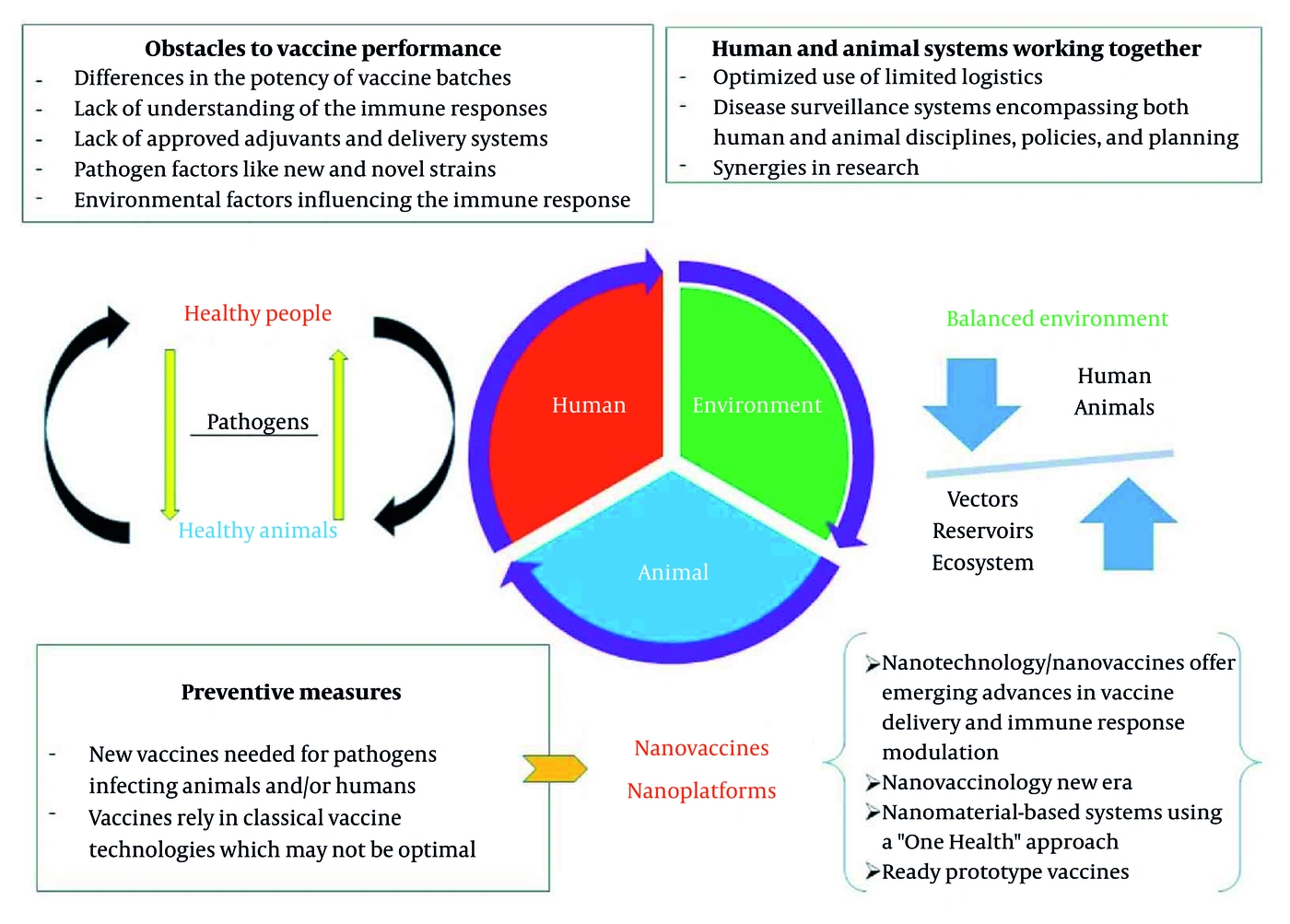
Figure 1.
Nanovaccines as key elements of a One Health approach in preparation for future threats (MDPI Copyright, 2021) (22).
3.6. Manufacturing Challenges and Scalability
Another major challenge is the complexity of large-scale industrial production while maintaining consistent quality. Nanoparticle synthesis, particularly of lipid and multilayer polymeric nanoparticles, depends strongly on environmental conditions, including temperature, pH, pressure, and agitation speed. Even small deviations can alter the size distribution and surface charge and, consequently, the immunological efficacy of the vaccine (59). High production costs and the need for advanced equipment and skilled personnel severely limit access in low-income and developing countries, which bear the greatest burden of zoonotic diseases (60). Many nanovaccines also depend on the cold chain and have limited stability at ambient temperatures. These requirements add to the challenge of equitable distribution in tropical and underserved areas and diminish the practical advantages of nanotechnology (61).
3.7. Future Directions: Smart, Biodegradable, and Thermostable Nanomaterials
Future research should focus on smart, multifunctional nanomaterials that combine high immunological efficacy with biodegradability, thermal stability, and cost-effective production. Nanomaterials derived from natural sources, such as chitosan, agarose, and self-assembled nucleic acids, together with green approaches to nanoparticle synthesis, offer promising strategies to reduce toxicity and costs (62, 63). The development of multivalent nanovaccines that simultaneously induce immunity against multiple serotypes or strains of zoonotic viruses, particularly through mRNA-based platforms or nanostructured virus-like particles (VLPs), is a research priority for addressing rapid viral mutation (64).
3.8. Regulatory Frameworks
From a clinical and regulatory perspective, comprehensive databases and open repositories of nanovaccine clinical trial results are essential, as are standardized international guidelines, including those developed by the WHO, for evaluating product safety and efficacy. Interdisciplinary collaboration among nanotechnology scientists, immunologists, virologists, and clinicians will be key to translating this technology from the laboratory to clinical care (31). Advances in artificial intelligence and machine learning also make it possible to predict optimal nanocarrier physicochemical characteristics for individual viral antigens by modeling nanoparticle-immune system interactions before animal experiments (65). These computational approaches, together with oral or inhaled nanostructured vaccines that eliminate the need for injections and trained personnel (66), offer promising prospects for a comprehensive and equitable response to future zoonotic viral threats (Table 2) (67, 68).
Table 2.
Major Challenges to the Clinical Translation and Widespread Deployment of Nanotechnology-Based Vaccines Against Zoonotic Viral Diseases, with Future Perspectives and Proposed Solutions
| Challenge | Brief Description | Future Perspective |
|---|---|---|
| Long-term toxicity | Accumulation in liver, spleen, bone marrow; oxidative stress and chronic inflammation | Biodegradable nanomaterials (chitosan, green synthesis, self-assembled nucleic acids) |
| Scale-up and cost issues | Batch-to-batch inconsistency; high production costs; need for advanced equipment | Continuous manufacturing; automated quality control; natural and low-cost raw materials |
| Cold chain dependency | Strict storage at 2 - 8 °C or freezing; limited distribution in tropical regions | Thermostable formulations (lyophilization, cryoprotectants, hybrid nanostructures) |
| Regulatory gaps | No unified global guidelines for safety and efficacy assessment | WHO-led standardization and harmonization between regulatory agencies |
| Viral mutation escape | Single-target vaccines lose efficacy against emerging variants | Multivalent nanovaccines targeting conserved epitopes (mRNA, virus-like particle [VLP] platforms) |
| Weak mucosal immunity | Parenteral routes fail to induce strong secretory IgA at entry sites | Mucosal-targeted nanocarriers for oral, intranasal, or inhalable delivery |
| Limited clinical data | Most studies are preclinical; few human trials have short follow-up | Large-scale phase III/IV trials with long-term monitoring |
| Poor accessibility | High cost and technology gap limit use in developing countries | Technology transfer, public-private partnerships, tiered pricing strategies |
4. Discussion
Nanotechnology has provided valuable platforms for next-generation vaccine design. However, clinical maturity varies considerably among nanoplatforms, with LNPs currently representing the most clinically validated approach. Findings from multiple experimental studies indicate that lipid, polymeric, and metallic nanoparticles significantly enhance vaccine efficacy in animal models by optimizing antigen uptake by antigen-presenting cells, activating innate immune signaling pathways through TLRs, directing cellular and humoral responses toward protective phenotypes, particularly Th1 and cytotoxic immunity, and inducing sustained mucosal immunity. Nevertheless, clinical translation faces serious challenges, including long-term toxicity, high production costs, cold-chain dependence, and the lack of unified regulatory standards. Addressing these challenges requires interdisciplinary collaboration and targeted investment in future research. Integrating nanotechnology with artificial intelligence-based computational approaches and designing heat-resistant, mucosa-compatible, multipotent nanovaccines offer promising prospects for effective, equitable, and rapid responses to the growing threats posed by zoonotic viruses in the coming decades. Strengthening research infrastructure and streamlining regulatory processes for market entry are therefore strategic priorities in global health.