
1. Background
Lower limb amputation is a serious complication of war and traumatic accidents (1). This condition not only causes physical injury but also presents significant psychological, social, and functional challenges for patients (2). Post-amputation pain is a common and chronic problem reported in patients with lower limb amputations (3). Numerous studies have demonstrated that pain in amputee patients has various types, each with its own specific characteristics and outcomes, directly impacting patients' quality of life and daily function (4, 5). Phantom limb pain (PLP) is one of the most common types of post-amputation pain, in which an individual feels pain in the amputated limb (6). The overall prevalence of this pain is very high in amputee patients, ranging from 45% to 83% (7, 8). Research shows that approximately 77.6% of Iranian veterans suffer from PLP (9). Residual limb pain (RLP), also known as stump pain, is also regarded as a common complication of amputation and is felt at the site of the remaining limb. This type of pain typically begins in the initial weeks following surgery and can persist for years (10). Recent meta-analyses have shown that the prevalence of RLP in military patients varies between 50% and 71% (11). The prevalence of low back pain in individuals with lower limb amputation is also high, reported at 60.9% in one study (12). Other chronic pains, including neuropathic pain, low back pain, and musculoskeletal pain, are also common among these patients (13). Various risk factors contribute to the onset and persistence of these types of pain. Preoperative pain, the amputation level, the presence of RLP, depression and anxiety, the level of social support, and the use of prostheses are among the factors influencing the post-amputation pain intensity and persistence (14, 15). Post-amputation pain not only impacts patients’ physical function but also has negative effects on their psychological, social, and overall quality of life, significantly influencing their total adaptation (16). Adapting to the new condition following an amputation is a complex and multidimensional process that requires considering various physiological, psychological, social, and spiritual aspects (17). Post-amputation pain management also requires a multifaceted approach, including pharmacological and non-pharmacological interventions, physiotherapy, psychological counseling, and patient education (18). In this regard, nursing models can provide an appropriate framework for assessing and improving patients' adaptation. The Roy Adaptation Model (RAM) is one such nursing model that specifically focuses on adaptation and is extensively used in the care of patients with chronic conditions. This model includes four modes of adaptation: The physiological mode, the self-concept mode, the role function mode, and the interdependence mode. These modes each cover various aspects of a person's life and play a role in evaluating the patient’s total adaptation (19). Studies conducted in Iran have suggested that applying the RAM to the care of veterans with lower limb amputations has positive effects on their adaptation (20). While phantom limb pain, residual limb pain, and other chronic pains have been studied in different groups, there is still a shortage of research that looks at both the range of pain experiences and how they affect a person’s ability to adapt, especially among veterans. Veterans represent a unique group who often live with the consequences of amputation for decades, facing not only physical pain but also psychological and social challenges. Exploring how pain and adaptation are connected is important — not only to expand our understanding, but also to provide practical guidance for developing more effective, holistic rehabilitation and nursing care that truly addresses their long-term needs.
2. Objectives
Veterans of the Iran-Iraq imposed war are among the groups who are exposed to post-amputation complications and require specialized and comprehensive care. Therefore, the present study was conducted to investigate the prevalence of various types of pain and the adaptation level, based on the RAM, in veterans with lower limb amputations.
3. Methods
This descriptive-analytical study was conducted in 2025 among all veterans covered by the Martyrs and Veterans Affairs Foundation in Abadan, Iran. Sampling was carried out using a purposive method. Inclusion criteria were lower limb amputation, the ability to respond to questions, and willingness to participate in the study. Exclusion criteria included severe mental illness and abuse of stimulants or narcotics. Based on these criteria, 76 veterans with lower limb amputations, identified through the Veterans’ Health Monitoring Program, voluntarily participated in the research. Data collection tools encompassed demographic questions, the McGill Pain Questionnaire (MPQ), and the RAM questionnaire for veterans with lower limb amputations. The MPQ is the most extensively used standardized tool for chronic pain assessment, which was first used by Melzack on 297 patients (21). This questionnaire consists of 4 main dimensions, 20 sub-groups, and a total of 78 words designed to describe the quality of pain to measure an individual’s various pain perception dimensions, including the following four dimensions: Sensory perception (sets 1 - 10), affective perception (sets 11 - 15), evaluative perception (set 16), and miscellaneous pain (sets 17 - 20). In each set, a variable number of phrases, between a minimum of two and a maximum of six, are provided to describe pain. These phrases are arranged in each set from mild to severe, with each phrase assigned a score from 1 to 6. If a respondent does not find any of the phrases to be an accurate description of their pain, that set is assigned a score of zero. The score pertaining to each dimension is obtained by summing the scores of all sets within that dimension. The questionnaire total score is also calculated by summing the scores of all sets, with a maximum possible score of 78. Khosravi et al. translated and adapted the MPQ into Persian. In their study, the questionnaire’s Cronbach’s alpha was calculated to be 0.85, and the reliability coefficient for all dimensions was above 0.8 (22). The RAM questionnaire for veterans with lower limb amputations consists of 20 questions to examine the adaptation level in 4 dimensions: Physiological, self-concept, interdependence, and role function. The scoring method is based on a five-point Likert scale, ranging from “never” to “always.” To obtain the score for each dimension, the sum of the scores for the questions related to that dimension is used, and to obtain the questionnaire total score, the sum of the scores for all individual questions is considered. Higher scores denote respondent’s greater adaptability, and vice versa. In a study by Azarmi et al., the validity and reliability of this questionnaire were examined. For reliability, the test-retest agreement, measured by the intraclass correlation coefficient (ICC), was 0.911 for the total scale. The Cronbach’s alpha for the questionnaire was calculated to be 0.876 (23). To collect data, the researchers, after obtaining the necessary permissions from Abadan University of Medical Sciences, went to the Martyrs and Veterans Affairs Foundation in Abadan, Iran, to sample amputee veterans. During the study, participants were given full information regarding confidentiality, the research methodology, and the results, and informed consent was obtained from them. For this purpose, first participants were provided with the necessary explanations about the study, after which the questionnaires were completed by trained interviewers. The data collection was carried out based on medical records and evidence in the veterans’ files. Afterward, the collected data were analyzed using SPSS software version 26. For descriptive analysis, frequency percentages, means, and standard deviations were calculated. Pearson’s correlation coefficient was employed to examine the relationships among the questionnaires’ dimensions, and the Kolmogorov-Smirnov test was utilized to check the normality of the data.
4. Results
A total of 76 veterans with lower limb amputations (mean age = 58.6 ± 2.9 years), supported by the Martyrs and Veterans Affairs Foundation in Abadan, Iran, were examined in this study. The mean amputation duration was reported to be 30.1 ± 5.4 years. In terms of the type of amputation, 55 individuals (72.4%) had unilateral amputations and 21 (27.6%) had bilateral amputations. Concerning marital status, 70 individuals (92.1%) were married, and 6 (7.9%) were single. Additionally, regarding education level, 27 individuals (35.5%) had a diploma, 31 (40.8%) had a bachelor’s degree, and 18 (23.7%) had a master’s degree or higher. In terms of employment status, 43 individuals (56.6%) were unemployed, and 33 (43.4%) were employed. In a review of pain intensity measured on a scale from 0 to 10, the highest mean pain intensity was reported in the low back region (6.4 ± 2.1). The thigh (4.9 ± 2.2) and the sole (4.2 ± 2.4) were in the moderate pain intensity range. The toes showed the lowest pain intensity (1.9 ± 1.7). Figure 1 illustrates pain intensity in various lower limbs.
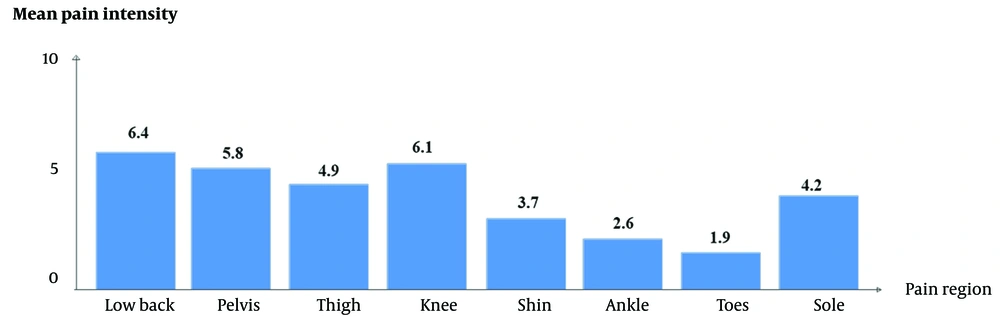
Figure 1.
Pain intensity in various lower limbs
Analyzing the frequency of pain-describing words revealed that in the sensory perception dimension, the most frequent words were “shooting” (26.3%) and “throbbing” (23.7%). In the affective perception dimension, the highest frequencies belonged to the words “tiring” (23.7%) and “aversive” (21.1%). In the evaluative perception dimension, the word “agonizing” was reported with the highest frequency (17.1%). Ultimately, in the miscellaneous pain dimension, the words “spreading” (23.7%) and “vague” (22.4%) had the highest frequencies. Table 1 presents the most common pain-describing words based on the MPQ.
Table 1.
The Frequency of Pain-Describing Words
| Pain Dimension | Sets | The Most Frequent Word | No. (%) |
|---|---|---|---|
| Sensory perception (sets 1 - 10) | 1 | Throbbing | 18 (23.7) |
| 2 | Shooting | 20 (26.3) | |
| 3 | Puncturing | 13 (17.1) | |
| 4 | Cutting | 10 (13.2) | |
| 5 | Pinching | 9 (11.8) | |
| 6 | Painful strain | 7 (9.2) | |
| 7 | Flushing | 6 (7.9) | |
| 8 | Burning | 5 (6.6) | |
| 9 | Painful | 4 (5.3) | |
| 10 | Tightness | 4 (5.3) | |
| Affective perception (sets 11 - 15) | 11 | Tiring | 18 (23.7) |
| 12 | Aversive | 16 (21.1) | |
| 13 | Terrifying | 10 (13.2) | |
| 14 | Debilitating | 9 (11.8) | |
| 15 | Wretched | 7 (9.2) | |
| Evaluative perception (set 16) | 16 | Agonizing | 13 (17.1) |
| Miscellaneous pains (sets 17 - 20) | 17 | Spreading | 18 (23.7) |
| 18 | Vague | 17 (22.4) | |
| 19 | Freezing | 10 (13.2) | |
| 20 | Distressing | 8 (10.5) |
The mean total pain score based on the MPQ in the study population was 40.8 ± 12.7, indicating moderate to high intensity. The highest mean score belonged to the sensory perception dimension (22.1 ± 8.7), followed by the miscellaneous pain dimension (9.1 ± 3.4). The lowest score belonged to the evaluative perception dimension (2.4 ± 1.1). Based on the RAM questionnaire, the participants’ mean total adaptation score was 63.5 ± 11.2, indicating a moderate adaptation level. The highest adaptation level was observed in the physiological mode (23.4 ± 4.9), and the lowest was in the interdependence dimension (10.1 ± 2.9). These findings are reported in Table 2.
Table 2.
The Scores of Pain and Adaptation Dimensions
| Variables and Dimensions | Score Range | Mean ± SD | Minimum - Maximum |
|---|---|---|---|
| Pain | |||
| Sensory perception | 0 - 42 | 22.1 ± 8.7 | 5 - 40 |
| Affective perception | 0 - 14 | 7.2 ± 2.9 | 1 - 13 |
| Evaluative perception | 0 - 5 | 2.4 ± 1.1 | 0 - 5 |
| Miscellaneous pains | 0 - 17 | 9.1 ± 3.4 | 2 - 16 |
| Total pain score | 0 - 78 | 40.8 ± 12.7 | 15 - 71 |
| Adaptation | |||
| Physiological | 8 - 40 | 23.4 ± 4.9 | 13 - 38 |
| Self-concept | 6 - 30 | 18.8 ± 3.6 | 10 - 28 |
| Role function | 3 - 15 | 11.2 ± 2.5 | 5 - 15 |
| Interdependence | 3 - 15 | 10.1 ± 2.9 | 4 - 15 |
| Total adaptation score | 20 - 100 | 63.5 ± 11.2 | 35 - 92 |
Pearson’s correlation analysis demonstrated a significant inverse relationship between various pain and adaptation dimensions. Specifically, the sensory perception dimension was significantly and negatively correlated with all adaptation dimensions and the total adaptation score (R = -0.45, P < 0.001). Similarly, the affective perception dimension showed a significant inverse relationship with all adaptation dimensions and the total adaptation score (R = -0.42, P < 0.001). In contrast, the evaluative perception dimension was not significantly correlated with any adaptation dimension (0.060 ≤ P ≤ 0.14), although poor negative correlations were observed. Miscellaneous pains also demonstrated a significant negative correlation with all adaptation dimensions and the total adaptation score (R = -0.40, P = 0.001). Finally, the total pain score, as a composite index, had the strongest negative correlations with all adaptation dimensions and the total adaptation score (R = -0.51, P < 0.001), all of which were confirmed at a very high significance level. These findings generally suggest that as the pain perception increases, the adaptation level significantly decreases in various dimensions. Detailed information is provided in Table 3.
Table 3.
Pearson’s Correlation Coefficients (R) and Significance Levels (P) Between Pain Dimensions and Adaptation Dimensions
| Pain Dimension / Adaptation Dimensions | Physiological | Self-concept | Role Function | Interdependence | Total Adaptation Score | |||||
|---|---|---|---|---|---|---|---|---|---|---|
| P | R | P | R | P | R | P | R | P | R | |
| Sensory perception | 0.000 | -0.43 | 0.002 | -0.35 | 0.001 | -0.39 | 0.015 | -0.28 | 0.000 | -0.45 |
| Affective perception | 0.001 | -0.37 | 0.000 | -0.41 | 0.005 | -0.32 | 0.021 | -0.26 | 0.000 | -0.42 |
| Evaluative perception | 0.090 | -0.19 | 0.080 | -0.20 | 0.100 | -0.18 | 0.140 | -0.15 | 0.060 | -0.21 |
| Miscellaneous pains | 0.003 | -0.34 | 0.001 | -0.38 | 0.007 | -0.31 | 0.012 | -0.29 | 0.001 | -0.40 |
| Total pain score | 0.000 | -0.47 | 0.000 | -0.44 | 0.000 | -0.43 | 0.005 | -0.33 | 0.000 | -0.51 |
The results of analyzing Pearson’s correlation coefficients between pain dimensions and adaptation dimensions with age and amputation duration revealed significant patterns. As indicated by the results, age has a positive significant correlation with the affective perception dimension (R = 0.24, P = 0.04) and total pain score (R = 0.23, P = 0.03), meaning that aging leads to increasing the affective pain intensity and the total pain score. The sensory perception dimension also demonstrated a tendency for a positive correlation with amputation duration (R = 0.22, P = 0.05). More importantly, amputation duration showed a positive significant relationship with affective perception (R = 0.29, P = 0.01) and the total pain score (R = 0.26, P = 0.02). This means that as time passes since the amputation, affective perception and the total pain experience increase. In contrast, investigating the relationships between age and adaptation dimensions revealed that age was significantly and negatively correlated with the physiological mode (R = -0.25, P = 0.03), the self-concept mode (R = -0.22, P = 0.05), the role function mode (R = -0.31, P = 0.01), and the total adaptation score (R = -0.29, P = 0.01). This indicates that as age increases, the adaptation level decreases, particularly in role function and overall status. Amputation duration also was significantly and negatively correlated with role function (R = -0.26, P = 0.03) and the total adaptation score (R = -0.23, P = 0.04), suggesting that individuals with a longer history of amputation reported lower levels of total adaptation and role function. Table 4 shows the correlations of pain dimensions and adaptation dimensions with age and amputation duration.
Table 4.
Pearson’s Correlation Coefficients Between Pain Dimensions and Adaptation Dimensions with Age and Amputation Duration
| Variables and Dimensions | Age | Amputation Duration | ||
|---|---|---|---|---|
| P | R | P | R | |
| Pain | ||||
| Sensory perception | 0.12 | 0.18 | 0.05 | 0.22 |
| Affective perception | 0.04 | 0.24 | 0.01 | 0.29 |
| Evaluative perception | 0.41 | 0.09 | 0.22 | 0.13 |
| Miscellaneous pains | 0.19 | 0.15 | 0.07 | 0.20 |
| Total pain score | 0.03 | 0.23 | 0.02 | 0.26 |
| Adaptation | ||||
| Physiological | 0.03 | -0.25 | 0.08 | -0.19 |
| Self-concept | 0.05 | -0.22 | 0.18 | -0.15 |
| Role function | 0.01 | -0.31 | 0.03 | -0.26 |
| Interdependence | 0.11 | -0.18 | 0.12 | -0.17 |
| Total adaptation score | 0.01 | -0.29 | 0.04 | -0.23 |
5. Discussion
Phantom limb pain (PLP) is a common and often debilitating condition among amputees that significantly impacts their quality of life and mental well-being (24). Based on reports, many participants still experience PLP for years after amputation, suggesting the persistent nature of this condition (25). As indicated by the findings of this study, the highest pain intensity was reported in the low back region. This finding aligns with previous studies in the veteran population. Erbes et al. showed that the low back was the most common region of pain among veterans (26). Resnik et al., as well as Rahimi et al., have also confirmed the high prevalence of low back pain in veterans with amputation (27, 28). The results of this study demonstrated that the mean total pain score in veterans with lower limb amputations was moderate to high. This finding is consistent with previous studies showing that PLP is regarded as one of the most common post-amputation complications (29, 30), and that moderate-to-high pain intensity has been reported in veteran and amputee populations (25, 31, 32). The highest mean pain score belonged to the sensory perception dimension, followed by miscellaneous pains, and the lowest score belonged to the evaluative perception dimension. This pattern highlights the predominance of somatosensory disturbances as a critical component of PLP in this population, suggesting that PLP is a multidimensional experience primarily defined by its sensory components (33). Other studies have also supported that sensory and mixed pains are the primary components of PLP, while the evaluative perception dimensions are of relatively lower intensity (25). The participants’ mean total adaptation scores indicated a moderate adaptation level. This finding aligns with studies conducted on Iranian veterans (34). The results of the present study also revealed that the highest adaptation level was observed in the physiological mode, while the lowest was in the interdependence mode. Previous studies have shown that RAM-based interventions can improve coping strategies and adaptation in veterans, particularly in the physiological and self-concept modes, but interdependence remains a vulnerable area (35). These findings emphasize that comprehensive adaptation to amputation extends beyond physical rehabilitation and requires extensive psychosocial support (36). The present research revealed a significant negative correlation between total pain and adaptation scores. This finding demonstrates that as the PLP intensity increases, the veterans’ adaptation level decreases. This negative correlation aligns with previous studies that highlight the detrimental impact of chronic PLP on individuals’ adaptation function, including veterans (37, 38). Moreover, a significant negative correlation was observed between pain and adaptation scores across all adaptation dimensions except for the evaluative perception dimension. The strongest negative correlation was observed between the sensory perception dimension and the total adaptation score, indicating that sensory disturbances due to PLP significantly impact overall adaptation capacity. Similarly, a strong negative correlation was found between the affective perception dimension and self-concept. This finding confirms that the emotional burden stemming from PLP substantially and negatively affects an individual’s self-concept and body image (39). These results underscore the deep connection between the pain experience and adaptive psychosocial processes, demonstrating the need for comprehensive interventions (39, 40). Correlation analysis revealed that age was significantly and positively correlated with the affective perception dimension and the total pain score. This means that older veterans may experience more intense affective suffering related to PLP and gain higher total pain scores (41). This finding is consistent with studies suggesting that older individuals may have a lower capacity for pain tolerance and are more prone to pain-related emotional experiences (25). In contrast, age had a significant negative relationship with the physiological, self-concept, and role function modes, as well as the total adaptation scores. These results reveal that as age increases, the adaptation level decreases, particularly in role function and overall status. This could suggest a reduction in adaptation resources among older individuals and highlights the need for targeted support in this age group (41). The results of the current research also revealed a positive correlation between the sensory perception dimension and amputation duration. More importantly, amputation duration showed a positive significant relationship with affective perception and the total pain score. In line with previous studies, these findings suggest that as time passes since the amputation, affective perception and the total pain experience increase (31, 41). In this study, amputation duration was found to have a significant negative correlation with both role function and the total adaptation score. This means that individuals with a longer history of amputation reported lower levels of total adaptation and role function. This pattern underscores the long-term psychosocial challenges that veterans face in adapting to amputation, suggesting that adaptation resources may diminish over time (31, 35).
5.1. Conclusions
This study confirms that the pain experienced by veterans with lower limb amputations encompasses not only physical dimensions but also emotional, cognitive, and psychological components, significantly impacting an individual’s adaptation level in various life aspects. The significant inverse correlation of sensory and affective perception dimension and miscellaneous pains with various adaptation dimensions, including physiological, self-concept, role function, and interdependence modes, indicates that an increase in pain perception directly accompanies a decrease in psychosocial abilities and functional adaptation. Moreover, the findings on the correlation of demographic variables — such as age and the time passed since amputation — with increased pain intensity and reduced adaptation underscore the necessity of considering temporal and age-related factors when designing rehabilitation interventions. The design of educational programs, pain management interventions, continuous follow-ups, enhancement of vocational rehabilitation programs, and increased social participation can effectively improve adaptation and alleviate chronic pain in veterans. Based on the research findings, it is suggested that future studies investigate the changes in pain experience and adaptation over time at different stages of life for veterans. The results of such studies could considerably help formulate more effective and sustainable intervention policies, enhancing the quality of nursing care, and improving health outcomes in this group of patients.