
1. Background
Law enforcement is widely recognized as one of the most demanding and hazardous professions, characterized by chronic exposure to high-stress situations, critical incidents, and life-threatening emergencies (1). Police personnel work within a rigid organizational hierarchy and face persistent occupational demands, including irregular shift work, direct exposure to violence, and responsibility for public safety (2). Consequently, officers are particularly vulnerable to adverse psychological outcomes, including severe burnout, post-traumatic stress, and emotional exhaustion (3). The continuous suppression of emotional responses, which is often culturally expected in military and police environments, may further exacerbate psychological distress (4). When officers are repeatedly exposed to traumatic events without adequate psychological processing or recovery, their internal coping mechanisms may become severely compromised (5). This occupational environment may impair overall well-being and is associated with an elevated risk of mental health crises (6).
A critical consequence of chronic occupational strain is the elevated rate of suicidal ideation among police personnel. In this population, suicidal ideation has been associated with a profound sense of frustration, conceptualized as an intense feeling of defeat and entrapment arising from the inability to achieve desired goals or escape aversive situations (7). According to psychological models of defeat and entrapment, frustration has 2 primary dimensions: internal frustration, characterized by feelings of personal inadequacy and self-blame, and external frustration, characterized by the perception of being blocked or defeated by external forces (8). Chronic exposure to systemic barriers, public scrutiny, and unavoidable traumatic events may be associated with elevated levels of both internal and external frustration among police officers (9). Previous research has shown a strong positive correlation between prolonged frustration and suicidal ideation (10).
When officers perceive repeated failures to manage occupational stressors as inescapable, intense frustration may be associated with heightened suicidal ideation, underscoring its importance for suicide prevention research (11).
Psychological capital (PsyCap) has emerged as a potentially important protective construct in positive organizational psychology for countering the adverse effects of occupational stress and frustration (12). PsyCap is defined as an individual's positive psychological state of development and comprises 4 synergistic components: self-efficacy, optimism, hope, and resilience (13). Theoretically, individuals with high PsyCap may navigate workplace adversity more effectively because they possess internal resources that help them reframe failures, maintain goal-directed energy, and recover from setbacks (14). In law enforcement, PsyCap has been hypothesized to act as a psychological buffer or moderator (15). Previous research suggests that high PsyCap may attenuate the association between occupational stressors and adverse mental health outcomes (16). However, its ability to moderate the association between deep-seated frustration and suicidal ideation in specialized populations such as police personnel requires rigorous empirical investigation (17).
Despite the growing literature on police mental health, an important research gap remains regarding the complex interplay among intense psychological frustration, suicidal ideation, and positive internal resources. Determining whether PsyCap can buffer the association between frustration and suicidal ideation is important for developing targeted, evidence-based interventions (18).
2. Objectives
This cross-sectional study aimed to investigate the association between frustration and suicidal ideation among police personnel and to examine the moderating role of psychological capital (PsyCap).
3. Methods
3.1. Study Design and Participants
This cross-sectional, descriptive-correlational study targeted all police personnel in Ahvaz, Iran, in 2025. Using convenience sampling, 180 active-duty officers in administrative and operational roles were invited to participate. Of these, 145 provided consent, yielding a response rate of 80.6%. Fifteen questionnaires were excluded because they were substantially incomplete, resulting in a final sample of 130 participants. Eligible participants were active-duty officers who provided written informed consent. Officers with incomplete questionnaires or a known history of severe psychotic illness that could compromise self-reporting were excluded. Approximately 65% of the final sample served in patrol or operational roles, and 35% served in administrative or mixed roles. Confidentiality was maintained, and a safety protocol was implemented for participants with elevated suicidal ideation scores, including referral to professional mental health services within the police organization.
3.2. Procedure
Data collection began after the necessary permissions were obtained from the relevant law enforcement authorities. The research team conducted briefing sessions to explain the importance of the study and the voluntary nature of participation. Survey packages containing 3 standardized psychological scales and a demographic information form were distributed to officers during their shifts. To minimize social desirability bias, particularly given the sensitive nature of suicidal ideation, participants completed the questionnaires individually in a private setting and returned them in sealed envelopes.
A suicide risk management protocol was implemented to protect participants. Participants who scored above the clinical threshold on the Beck Scale for Suicide Ideation were identified. Because the procedure was confidential rather than fully anonymous, the research team coordinated with the police organization's mental health officer to provide immediate referral to the occupational mental health unit or local crisis intervention services. A crisis-referral pathway and emergency mental health support were available throughout data collection. Data collection was completed over 4 weeks to reach personnel across different units.
3.3. Instruments
3.3.1. Suicidal Ideation Questionnaire
The Beck Scale for Suicide Ideation (BSSI), developed by Beck and Steer (19), was used to measure the severity of participants' suicidal plans and thoughts. The BSSI consists of 19 self-report items rated on a 3-point Likert scale ranging from 0 to 2. Total scores range from 0 to 38, with higher scores indicating more severe suicidal ideation. Scores were treated as a continuous variable in the analyses. Previous studies in Iran have reported strong reliability for this instrument, with a Cronbach alpha of 0.79. In the present study, the Cronbach alpha was 0.81.
3.3.2. Feeling of Failure/Frustration Questionnaire
The Defeat Scale, developed by Gilbert and Allan (20), was used to assess feelings of frustration and defeat. The instrument contains 16 items divided into 2 subscales: internal frustration, which addresses personal shortcomings and self-evaluation, and external frustration, which concerns feelings of entrapment and external obstacles. Responses are scored on a 5-point Likert scale from 0 (never) to 4 (always). Total scores range from 0 to 64, with higher scores indicating more profound feelings of entrapment and failure. Previous Iranian research reported an alpha coefficient of 0.91. In the present study, the Cronbach alpha was 0.88.
3.3.3. Psychological Capital Questionnaire
The Psychological Capital Questionnaire (PCQ), developed by Luthans et al. (21), was used to assess PsyCap. The instrument contains 24 items divided equally among 4 domains: resilience, hope, optimism, and self-efficacy, with 6 items per domain. Responses are measured on a 6-point Likert scale ranging from 1 (strongly disagree) to 6 (strongly agree). Higher total scores indicate greater psychological capital. Previous Iranian studies reported alpha coefficients greater than 0.89 (22), whereas the Cronbach alpha in the present study was 0.90. The Persian versions of these instruments have been validated previously in Iranian populations, including military groups.
3.4. Statistical Analysis
Data were analyzed using SPSS version 26. Descriptive statistics, including means and standard deviations, were calculated to summarize the data. Pearson correlation coefficients were used to evaluate the primary associations among the variables. Moderated multiple regression analysis was conducted to examine the moderating role of PsyCap. Frustration, calculated as the combined score for the internal and external dimensions, and PsyCap scores were mean-centered before the interaction term was created. The hierarchical model included the main effects in the first step and the interaction term in the second step. The assumptions of normality, multicollinearity, linearity, and homoscedasticity were examined and met.
3.5. Ethical Considerations
Ethical approval for this study was granted by the Ethics Committee at the Ahvaz Branch of Islamic Azad University under approval code IR.IAU.AHVAZ.REC.1404.281. All participants provided written informed consent. Confidentiality and the safety referral protocol were maintained throughout the study.
4. Results
4.1. Participant Characteristics and Descriptive Statistics
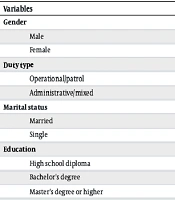
This study included a specialized sample of police personnel and examined associations among frustration, psychological capital, and suicidal ideation. Participants’ demographic and occupational characteristics are presented in Table 1. Descriptive statistics for the primary study variables are presented in Table 2. All variables demonstrated acceptable normality, with skewness and kurtosis values within ± 2.
Table 1.
Demographic and Occupational Characteristics of the Participants (N = 130) a
| Variables | Values |
|---|---|
| Gender | |
| Male | 118 (90.8) |
| Female | 12 (9.2) |
| Duty type | |
| Operational/patrol | 85 (65.4) |
| Administrative/mixed | 45 (34.6) |
| Marital status | |
| Married | 94 (72.3) |
| Single | 36 (27.7) |
| Education | |
| High school diploma | 48 (36.9) |
| Bachelor's degree | 67 (51.5) |
| Master's degree or higher | 15 (11.5) |
| Age, y | 35.4 ± 6.2 |
| Work experience, y | 12.8 ± 5.4 |
a Values are expressed as Np. (%) or mean ± SD.
Table 2.
Descriptive Statistics, Skewness, and Kurtosis for the Primary Study Variables
| Variables | Mean ± SD | Skewness | Kurtosis |
|---|---|---|---|
| Suicidal ideation | 19.30 ± 4.13 | 0.57 | -1.23 |
| Internal frustration | 22.07 ± 4.90 | 0.29 | 1.56 |
| External frustration | 39.64 ± 7.33 | 0.30 | 1.42 |
| PsyCap | 73.47 ± 16.14 | 0.47 | 1.59 |
4.2. Correlations Between Frustration and Suicidal Ideation
Table 3 presents the Pearson correlation coefficients between the dimensions of frustration and suicidal ideation. Internal frustration was significantly and positively associated with suicidal ideation (r = 0.45, P < 0.001). External frustration was also significantly and positively associated with suicidal ideation (r = 0.52, P < 0.001).
Table 3.
Bivariate Correlations Between Frustration Dimensions and Suicidal Ideation
| Variables | Suicidal ideation | P-Value |
|---|---|---|
| Internal frustration | r = 0.45 | 0.001 |
| External frustration | r = 0.52 | 0.001 |
4.3. Hierarchical Multiple Regression Analysis
A hierarchical multiple regression analysis was conducted to examine whether internal and external frustration predicted suicidal ideation. In step 1, internal frustration accounted for 28% of the variance (R2 = 0.28, F = 50.12, P < 0.001). In step 2, the addition of external frustration significantly increased the explained variance to 34% (R2 = 0.34, ΔR2 = 0.06, F change = 11.82, P = 0.001). In the final model, internal frustration (B = 0.25, SE = 0.09, β = 0.30, t = 2.85, P = 0.005) and external frustration (B = 0.18, SE = 0.06, β = 0.37, t = 3.11, P = 0.001) remained significant predictors (Table 4).
Table 4.
Hierarchical Multiple Regression Analysis Predicting Suicidal Ideation from Internal and External Frustration
| Model | Predictor variables | R | R2 | B | β | t | P-Value |
|---|---|---|---|---|---|---|---|
| 1 | Internal frustration | 0.53 | 0.28 | 0.31 | 0.53 | 4.25 | 0.001 |
| 2 | Internal and external frustration | 0.58 | 0.34 | 0.25 / 0.18 | 0.30 / 0.37 | 2.85 / 3.11 | 0.005 / 0.001 |
4.4. Moderated Multiple Regression Analysis
A moderated multiple regression analysis was performed to examine whether PsyCap moderated the association between frustration, calculated as a combined score, and suicidal ideation. Variables were mean-centered before the creation of the interaction term. The overall model was significant (R2 = 0.36). The interaction term (frustration × PsyCap) approached, but did not reach, conventional statistical significance (B = -0.004, SE = 0.002, β = -0.15, t = -1.90, P = 0.059, 95% CI [-0.008, 0.000]) and accounted for an additional 2% of the variance (ΔR2 = 0.02, F change with 1 and 126 df = 3.61, P = 0.059).
Assumptions of multicollinearity (VIF < 2), linearity, homoscedasticity, and residual normality were examined and adequately met (Table 5).
Table 5.
Moderated Multiple Regression Analysis of the Interaction Between Frustration and PsyCap in Predicting Suicidal Ideation
| Variables | B | SE | β | t | P | 95% CI |
|---|---|---|---|---|---|---|
| Frustration (total) | 0.42 | 0.08 | 0.48 | 5.25 | 0.001 | [0.26, 0.58] |
| PsyCap | -0.05 | 0.03 | -0.18 | -1.67 | 0.098 | [-0.11, 0.01] |
| Frustration × PsyCap | -0.004 | 0.002 | -0.15 | -1.90 | 0.059 | [-0.008, 0.000] |
5. Discussion
The present study demonstrated a strong positive association between internal frustration and suicidal ideation among police personnel. When officers internalize perceived professional shortcomings or personal inadequacies, they may experience reduced self-worth. In the high-stakes environment of policing, where emotional stoicism is culturally expected, internalizing failure may contribute to perceived burdensomeness and psychological entrapment. These findings are consistent with previous research showing that self-directed frustration and internalized shame are associated with an increased risk of suicidal ideation among first responders (23).
External frustration was also significantly and positively associated with suicidal ideation. In law enforcement, external frustration typically arises from systemic barriers, including insufficient organizational support, excessive bureaucratic demands, rigid hierarchies, and intense public scrutiny. These results are consistent with occupational strain frameworks suggesting that chronic exposure to uncontrollable external stressors is associated with increased emotional exhaustion and suicidal ideation (2, 3).
The hierarchical regression analysis showed that internal and external frustration together were significantly associated with suicidal ideation and explained 34% of the variance in the final model. According to the "cry of pain" psychological model, suicidal ideation may be perceived as an escape when individuals feel trapped between internal distress and external barriers (18). This interpretation is supported by recent studies emphasizing the role of cumulative occupational strain in high-reliability organizations (24).
The interaction between frustration and PsyCap approached, but did not reach, conventional statistical significance. Thus, PsyCap did not significantly moderate the association between frustration and suicidal ideation in this sample. Although high PsyCap is theoretically expected to buffer occupational stressors, these findings suggest that its protective effect may be limited under conditions of severe, chronic frustration among police personnel. Individual psychological resources alone may therefore be insufficient to mitigate the strong association between frustration and suicidal ideation in this population. Consequently, both individual- and organizational-level approaches warrant further investigation (25).
5.1. Study Limitations
This study has several limitations. Its cross-sectional design precludes conclusions regarding causality or temporal relationships among psychological capital, frustration, and suicidal ideation. In addition, convenience sampling limits the generalizability of the findings to other police forces in Ahvaz and elsewhere. Reliance on self-reported data may have introduced social desirability bias, particularly for the sensitive outcome of suicidal ideation. The study also did not measure potential confounders such as post-traumatic stress disorder, depression, substance use, organizational support, or exposure to critical incidents. Future studies should assess these factors. Finally, the exclusive focus on police personnel limits the generalizability of the findings to other occupational groups.
5.2. Conclusions
This cross-sectional study found strong positive associations between internal and external frustration and suicidal ideation among police personnel. Although the interaction involving PsyCap approached statistical significance, PsyCap did not significantly moderate the association between frustration and suicidal ideation in this sample. Preventive efforts in law enforcement should consider reducing occupational stressors that contribute to frustration while strengthening officers' psychological resources. Longitudinal and intervention studies are needed to clarify causal pathways and to evaluate individual- and organizational-level strategies for reducing suicide risk in this high-risk population.